
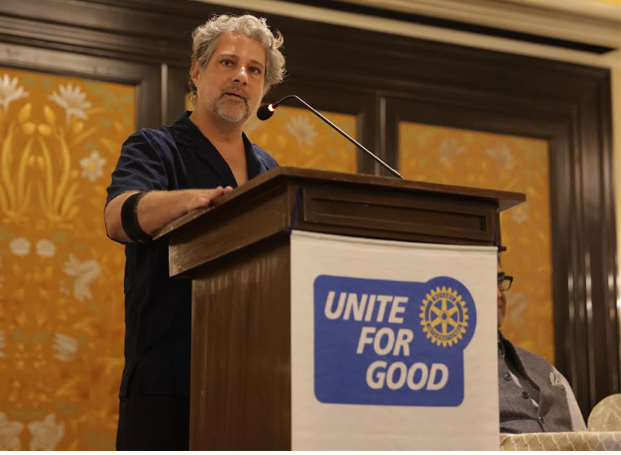
Ashish Hemrajani, Founder and CEO, BookMyShow, on building a sustainable business
Ashish Hemrajani, Founder and CEO, BookMyShow, on building a sustainable business
Thank you for having me. I’m honoured and truly happy to be here. A lot of people ask me, how did BookMyShow happen? It happened because of smoking and drinking. I don’t smoke. I like a cigar once in a while, but Hindustan Thompson Associates back in ’97 was a smoking office, carpet, flooring, window, air conditioners. Everybody around me smoked. It was the culture in advertising – smoking and having tea. And the secondary smoke actually got to me, so I wanted to take a holiday. I used to make a really big salary of ₹6000 a month at that time, so I saved up some money over 2 years and decided I’m going to go and take a little break.
Al was Big Al not just in size, but even his position. So Al was the client servicing director, 10 years my senior in MBA. And I went there as a flunky. We were all, ‘ohh, we made it in life’. And we got a paycheck of 6000 bucks, which at that time meant the world. So I collected 60,000 bucks over 2 years and took a trip to South Africa, Zimbabwe and Botswana. I said I’m going to go for a two-week holiday. It turned out to be 6 weeks. I texted my boss at that time, a dear friend of ours, and I said I’m not coming back.
And the reason was that I was backpacking from Joburg to Cape Town, and under a big tree which is at Storms River Valley, I heard a radio commercial trying to sell rugby tickets online. And in India – and a lot of you seem to be my vintage and older than me – you’ll remember the days of Sterling cinema, Regal, Eros, black marketeers, the paan ka dukan outside would be selling tickets, there was asymmetry and information. There was no democratisation of information. There was a structural hole. You went there, you’d see pigeon holes. And you would have advance counters and current counters and within that there was a segregation of dress circle, balcony and stall. And everybody thought it was normal and you’d have this paan chewing guy at the back in a dark room, with this pigeon hole, and you’d get, you’d be given out a pink slip or a green slip or a yellow slip. And there was some weird ticket serial number. And there were three counterfoils. There was an audit counterfoil, a patron counterfoil and a doorkeeper counterfoil and you’ve got 2. And he tore one and he kept it with himself. By the way, the law hasn’t been changed till today which, is the gauge of the paper, the gauge of the staple pin, the serial number, still stays. And the audit counterfoil still needs to be kept at the cinema in their strong room for 6 months and burnt because there were no shredders in 1956 in the purview of an entertainment tax collector.
There’s a gentleman, a client of mine, Mr. Dhanji Sidhwa who used to own Regal Cinema in at that time, in the 1990s, he used to be in his late 70’s. The guy was so ****** *** because the border wall of his cinema was next to a petrol station and you cannot light a fire within 500 metres and the law in the cinema regulation tag told you to burn it in the purview of an officer. for the last 50 years, he had counterfoils which he couldn’t burn, which he was keeping in his basement. I remember when Mr. Dhanji started going to the Mantralaya and dumping it outside, and tha’ts when they changed the law. there are some archaic laws in
India, and sometimes you have to treat these laws – I’m not telling you that you should do that in your business, but sometimes there is no reasoning all of this, and so I keep telling entrepreneurs that treat some of these laws, within reasonable limits, like how you would treat your marriage: “Always ask for forgiveness. Don’t ask for permission. Keep going ahead and things will follow up.” the 1956 act had’t been changed, the gauge of the paper, you could not do automated and digital tickets. You could not have a roll because the entertainment tax collector had to stamp each of those counterfoils. And when I was in South Africa, I heard this radio commercial telling me that you can buy tickets online. You don’t need to stand in a queue. You come to the stadium and you can bypass the line because you had a QR code and if you use the coupon, you get a 10% off on food and beverage and merchandise. I’m we’e living in a jungle, this was a zoo. Getting lathi-charged by the cops, standing outside Wankhede Stadium overnight, where they would put up bamboo scaffolding on the side and then in the morning, when you reached the box office, you were told there were no tickets. it’s almost like going to Starbucks and saying, listen, I want to pay for my coffee and the guy hits you on your knuckles and says I don’t want the money. That is how it was when we were growing up. And we were OK with it. it was an eye-opener for me.
I continued on my holiday and I reached Cape Town a few weeks later. And then, like I told you, it happened because of smoking and drinking. In Cape Town, they have a region called the Stellenbosch, which is the wine growing region of South Africa. It’s like the Nasik of India or the Napa Valley of the US for those who are familiar. And in any wine growing region you go there and they give you free tasting of wine. Now my surname is a big giveaway, I’m a Sindhi. I love free stuff, Anything given free in life is valued. And I’m going there and everybody is looking at this wine and putting it through their teeth talking about the viscosity, the oil, the notes. I only know musical notes, I don’t know about people here, and then they were spitting it all out. I’m like this is free stuff, so I had 25 glasses of free tasting wine between 11:00 in the morning and 3:00 in the afternoon. I woke up the next day at a youth hostel on a bunk that that wasn’t mine and I had sent the most expensive text message of my life. The actual text message at that time was ₹130. It was also metaphorically the most expensive or the most stupid. I told my boss in my drunken state I’m taking another four weeks. She said, don’t come back. And that’s how bookmyshow happened.
I came back and it took me a week to make a business plan. Two other Sindhis in my life, Chase Capital partner JP Morgan, Anil Ahuja and Bharat Kewalramani, who I still sail with, I sent them a fax because, if you recall, sending an e-mail at that time needed a TCP IP dial up and sometimes in the monsoons, TCP dial up failed. I was trying for about two hours to send an e-mail and it was easier to send a fax, so I just send them a fax with a one-pager business plan. A week later I had half a million dollars in my savings bank account. I didn’t have a current bank account. I could have taken the money and run. 26 years later, I’m still building the businesses like we started yesterday. So that’s the genesis and that’s why the name of
the company, even today, 26 years on, is called Big Tree Entertainment because we got an idea under a big tree at Storms River Valley.
People say it must have been like Buddha getting enlightenment. I say building a business in India is the stupidest thing you can do. Either the bravest thing or the most stupid thing you can do. coming back to that, the early days of 1999 were very different to what we see today. We started with the simple idea of looking at the asymmetry of information and democratisation of information. When you went to a cricket match or concert hall, or even a movie theatre, the guy at the box office would tell you that there are no tickets available. He would never tell you how many tickets are available and in what category. If you recall, you had to choose whether you wanted a current ticket or you wanted to go to an advance counter, and within that you stood in the line for dress, circle, stall or balcony. And if the ticket ran out, you had to come back out on the line and stand again and there were timings for the box office. That’s why college kids would be sitting on the steps waiting for the box office to open.
We said, let’s first address the asymmetry of information. And make the information democratic. Everybody should see how many tickets are available. What is the show? Time. What is the price and remove the asymmetry and then get into commerce. in ’99, as you would recall, there was no internet connection, forget mobile phones and data connections. And our entire business was built on the pretext of you could make a phone call and book a ticket. The challenge at that time was that nobody trusted us. We were these, 24-year-old guys coming and saying, listen, we’e gonna sell your tickets, which was a very, very cherished commodity. what a lot of the guys said, was: OK, you know what? I’ll give you 2 rows of my theatre or I’ll give you 4 rows of my theatre and you go sell it. But pre-buy the tickets right now.
The problem with that was as you build an internet or technology-enabled business, which a lot of you probably run technology-first businesses or you run old-world businesses – and I don’t mean old world in the sense… let me call it offline or analog businesses – and you need to move to technology. Both at the extreme ends of the spectrums are not sustainable. either if you say my business is going to be completely analog, I’m never going to invest in technology or scale that up, is a problem. Pr only tech-based businesses without having a backbone are also not sustainable. So you will see both the worlds collide. Some guys who build technology businesses today have actual vendors partners, cars, warehouses, logistics and they’re moving into all of that. And folks that had logistics technology, brick and mortar businesses are making them technology-enabled, whether you’re a conglomerate like the Tatas or whether you’re Reliance, it doesnt really matter. You cannot escape the advent of tech.
And so both these worlds are colliding; at that time they didn’t because we did not have any base to actually build off. And so the environment wasn’t there. We went over there, we would buy these tickets. The problem was we had seven call centres – we had launched in seven cities and so we had seven call centres where you could call, and we did not have a unified number policy. So the last four digits were common, say 5050, but the first 3 digits
were based on your city, Hyderabad, that had a separate number. Mumbai had a separate number. Pune had a separate number and therefore our call centre agents would pick up the phone and take your order and every four hours we could deliver 15 transactions to your home and then we would collect cash.
But we had pre-bought the tickets. Now the problem with that was every time our revenue curve went up, our cost curve went up as well. And the beauty about enabling your businesses for technology is you can flatten your cost curve as your revenue curve keeps rising and this variance is where the value creation actually happens. That’s why every time you’ll open The Economic Times, you’ll see Unicorn Unicorn Unicorn, and then you keep seeing these billions of dollars and you’re like this guy started yesterday, how could he be worth so much?
The problem is, with that, and some of it is right and some of it is wrong, so I want to give a reality check is that this variance of flattening your cost curve and increasing your revenue curve. And as this keeps growing is where you create real value and that is your future potential and that’s why you’re getting these valuations. But in our case, it was exactly the opposite. Because on weekdays, when we had spare inventory, we couldn’t sell it and we had an actual loss. On the weekends, when we had an opportunity to sell more tickets, they were not giving us more tickets. So we had an opportunity loss. But when people called us at the call centre and we had 100 people sitting or 200 people sitting and answering phone calls, the problem was that even on the weekend we had to pick up the phone and say tickets not available and why we would have hundreds of people answering the phone call is because we didn’t want to break trust with the consumer to say nobody’s answering my phone calls. the business model was not sustainable. And we had tons of issues over a period of time, but we said the market will evolve. But how soon it would evolve, nobody had an idea.
when we launched in 1999, by 2001 the dotcom bust – if some of you knew – happened in the US, and it came to India by early 2001. And we went from 150 people down to six. We were wiped out, like we were completely wiped out. We had an office at Prabhadevi. We moved to an office in Bandra to 136 square foot studio apartment with, a washroom. That’s it. That was where we scaled down to. And from 2001 to 2007, what we did was, we went back into completely pivoting the business model and being nimble and pivoting the business model to say what do our customers really want, not our end consumer, but can we become a B2B business?
for the next four years or five years, all we did was from 2002 to 2007, is instal technology and technology-enabled solutions at every single cinema. A lot of you, probably don’t know this, but 90% of all venues in the country, whether it’s NCPA or whether it’s Prithvi Theatre, whether it’s any of the movie theaters, the technology that powers the movie theatre or the venues where you buy your ticket or buy your concessions is actually provided by us. So that’s what we did. We pivoted the entire business model and we ran a B2B2C model, where all we did was put technology in and build the highway on which the cars can drive.
the challenge today with a lot of businesses is that everybody is so impatient and they’re hey, how can I get to this highway pretty quickly? people keep saying the difference between India and China and in China, the highway already exists and you can drive your car 120 kilometers. But the more you get successful, it’s probably a highway to nowhere. But in India, you’ve got to be more patient. You go through the bylanes, there’s a pothole, there’s a tuktuk, there is a biker, there is a guy crossing the street. There’s a cow sometimes. And you have to navigate all of that to get to the highway. But once you do, and you’re patient, then the law of the country stands for all. And you can, it’s unlike China in a lot of ways and before we launched in India, we also looked at markets like China, Middle-East and some of the other markets which I’ll tell you about.
Having said that, what happened from 2002 to 2007, was that we ran a B2B and B2B2C business. If you called up NCPA or any of the movie theatres, the guys that were powering the entire backbone, technology delivery of tickets, customer support was all us and you know a lot of businesses today and I see a lot of senior people in the room, the easiest thing is to… and I have nothing against them because I love McKinsey and some of the consultants. But to go to a consultant and tell you things about your business which you already knew. It’s OK to get some of these guys to come and endorse it for your board, but sometimes the answers lie within and you exactly know what you want to do. But sometimes you need validation from an external source, and sometimes the easier thing is to do is, hey, you know what, I’ll go talk to the salesforce guys or, let me get an SAP implementation done. These are prohibitively expensive tools to manage and run and sometimes, you need to go through the hard path to actually decide what you really want to implement.
I’ll tell you a few anecdotes. So when we were building our CRM right, a lot of people are hey, how do I make my business technology-enabled and we really learned along the way. Our CRM was built completely in-house. The scale of our operation today is completely built on the backbone of CRM and tools that we built over a period of time through common sense.
Another anecdote I want to use is the blacklisting and whitelisting of customers. true story, but I’m changing the names. It may sound funny, but it’s true. We had a guy called Mr. Khanna. And every time, Khanna ordered 4 tickets, and delivered them to his home, because that time we would deliver tickets, it was for a family movie. Every time he would order 2 tickets. And at that time for some of you young folks don’t know this. There were a lot of movie theatres in India which were playing very, very suspicious and really B grade and C grade movies because there was no internet at that time, and they would play really sleazy movies. We had some of them in Bombay. Some of your older folks may remember and there were certainly a lot in Delhi. Every time this Johnny would order 4 tickets for family movies. It would be to his home, and every time he ordered two tickets, he was ordering them to his office. We knew it, he knew it, Khanna was having an affair. But if he had mixed the two tickets, he was screwed for life. And so that confidentiality was so critical for us to build in to our CRM that you cannot get it wrong. You just cannot get your data wrong. You cannot get your backbone wrong and therefore for us it was very important.
Another story out of Delhi since we’re all Rotarians and Bombaywaalas, we can take do a little Delhi-bashing. There was a guy called Pappu Pehelwan. Now this is true. His name is true. And every time he would order tickets to Pahargunj, which was his area, the 3rd or 4th transaction, he would snatch the tickets and bang the door and never pay us. And he was from one of the local akharas, which was those local places. And so we started analysing how do you do blacklists whitelists? Who do you trust as customers, and who you don’t? These were things that we built over a time.
Last story on that. I’m 51, and we all grew up in a generation of no TVs, then black and white TVs, hand phones waiting for an OYT telephone you… if you remember, own your own telephone, Bajaj bikes or cars, Premier Padmini 11-year waiting, 10-year waiting and it was all normal for us. Ration cards. Our maids asking for our ration cards so that they could go and buy stuff, and this was all normal and we’ve gone through the generation of today being on AI robotics and a mobile device that has created the greatest democratisation in this country, which even elections couldn’t. And we’ve grown up in that generation, but a lot of the young folks haven’t.
My son, who’s 13, if there’s no Internet, it’s like he has no air, he’s going nuts. what the hell has happened? And they can probably go without air, but not without an internet connection. Today, when you have delivery from Amazon and Flipkart and Swiggy, you buy something, you can track it and it’s almost become our favourite national pastime. You’re looking at your Uber. Oh my God, everybody’s looking at their phone. I’ve ordered Swiggy. You keep looking at it and it’s created a great distraction because there’s so much time in this country, everybody is looking at their order. Once you’ve ordered it, it will come in 10 minutes, or 15 minutes or 20 minutes. Why do you need to look at it? Now this didn’t exist. Today, you could come home – the guy comes home, you can track you get an OTP. You don’t even need to do a digital signature. When we used to deliver tickets, there was no internet connection. There were no devices. There was no way to prove that we came to your home.
And two stories which were very anecdotal and you can probably use them in your business, that the more you observe, you start building these tools and for your own sort-of business. And these are tricks that you can use over a period of time on how the tech can enable this. Don’t be too focussed on tech. Everybody is reading about AI and saying, I want an AI business. Or blockchain or any of this, Or crypto? I mean, while some of it is true, you need to be a little patient till the technology stabilizes, what is the cost, what is your ROI and how are you going to implement it in your environment? And that a lot of people miss out on because it’s the next new shiny thing to.
What we did over a period of time is that World Cup was another big change for us. When we did the International ICC World Cup in in in India, we realised that people would turn on their friends. We would deliver tickets to people’s homes and the guy would say if it,s not
there, we would ring the doorbell of the guy next to him, the neighbour, and say we’d deliver the tickets. But because it was blind, there was no way to prove that our guy came there, delivered it. The original recipient of the ticket would call and say hey, I never got my tickets. We would say your envelope and your actual tickets are delivered to your neighbour. The neighbor would say I never got the tickets, I never received them, because the guy would just turn on him and go for the match instead. It happened a few times and then it was up to us. The onus was up to us to how to prove that we were there. And what we started doing was writing down the DDR and this is something that we created – the door delivery receipt, the door description receipt. So we would take the description of the door. So if the guy called up the customer and said, hey, you never showed up, we’d say, do you have a blue door with a great grill and a horseshoe on it? And he’s yeah, we’re like how would we know this And so that was our proof that our guy came there and we were there while you were not. And earlier we would even stick slips. Those slips would be torn away. And so over a period of time, we used all of these nuances and common sense and things where we went ground-up to build our business and implemented them in tools and things that you see today.
On the seamless technology that you are used to when you buy anything, probably on BookMyShow, and some of you may not be happy customers… but that’s how we built the business. Then this went on till 2007. 2007 was Web 2.0 when the internet really sort-of took pace and the mobile network started much later. For a long time, India did not grow. We were at about 150 million subscribers and then the prices dipped. And then over a period of time today we have close to 800 million subscribers of mobile devices.
Over a period of time, UPI came and Aadhaar came in and it&’s just completely transformed. We’re lucky to be standing on the shoulders of many other folks who’ve built these highways and super highways for us to actually build our businesses on. And today is the most exciting time in our periods that some of you who have the wealth of knowledge over the last 20-30-40 years of building your businesses, maybe second-generation guys in your homes and family offices, are building these businesses. You have the wealth of all of this knowledge and you have this advent of technology where the superhighways are actually already built out and are still constantly being built. And how do we take advantage of that? So what happened again – and I’ll come closer to the present – is that in 2016-17, so we went through dotcom bust. When the global financial crisis happened again, we had a big hit, but it wasn’t as bad. By 2017-18, we had started scaling up the business. And, BookMyShow was doing well where we were one of the only profitable Internet companies. Every time I get asked a question, are you a Unicorn? And I’m what is this ********, like Unicorn? I’ve never even heard of that animal. I’ve never seen a Unicorn. I’ve seen a horse.
I’ve not seen a horse with a horn. it’s the ugliest animal. It doesn’t exist. And then people ask me if I was an animal, would I be a unicorn, and I’m I’m like a cockroach. We’re survivors. We’ve been there for 26 years. We’ll survive a nuclear holocaust, and therefore we use this cockroach analogy, which is, I keep telling folks in the office, if you manage your downturns better than your upswings. Your business will flourish and you have to be patient. You have to look at cycles in 5- or 10-year cycles.
In sailing, as Al said, and I keep telling my son the same thing, sailing teaches you a lot of lessons. Unlike any sport, 1) sailing has no boundaries. Formula One has boundaries, tennis has boundaries, TT has boundaries, sailing has no boundaries. Right here we sail in the harbour. 3 marks are put in, you can go to Timbuktu and round the mark. It doesn’t matter. You are given 3 marks. It’s up to how you say.
Second, we can keep moaning and complaining internally about external factors. It’s about looking inward. In sailing, you can’t complain about the wind, you cannot complain about the lack of the wind, you cannot complain about the heat, a typhoon, a storm, the tide. You cannot complain about anything. All you need to do is adjust your sailes. You have to be inward-looking, not external-looking. Who are you going to complain to? Third, the boat is your island. Respect it. If you don’t respect equipment, you don’t respect your boat, you will capsize and it’s up to you to survive.
My son capsized when he started his sailing career three or four years ago. He would capsize 20 times in every race. Today he is the national champ for three years in a row, he is number 10 in the world, and he is continuing to love the sport, respect the sport. The other thing that it teaches you is that dinghy sailors make real sailors, but the big boats get all the glory. I have a yacht now, we get all the glory. But it’s the dinghy sailors that actually make the real sailing. So go as micro as you can in your business.
And finally, the last lesson that is so critical and important in sailing is that when you have high winds, it optimises and it equalises everybody. when you’re doing high-wind sailing, there’s no difference between sailors, it’s the low-wind sailing that differentiates good sailors from great sailors. And those are some of the lessons that we applied in our business that when it’s low-wind is how do you manage your down cycles. And we’ve had many and I’ll tell you about the latest one.
Our entire business was dependent on going out. You’re going to movies, you go to concerts, you go to events you do all of that. In 2018, we embarked on a journey of getting to start our own live events and production and promotion side of the business which you would have heard now. We’re pretty infamous for the Coldplay fiasco. We were called out in the papers, just skipped jail, bail, all of that Every single authority in the country was after us for something that we didn’t do. having said that, 2018, we realised that we were funding all the promoters in the country. And it was our money, we were not on the deal sheet. They were undercutting the consumer. They were cheating the talent by not declaring ticket sales. They were not paying taxes to the government, and they had a shoddy health and safety standard.
And therefore, in India, you would get one good show every three years and some, rock guy whose one leg is in the grave. And all of us would be happy that we have this graveyard of rockers that is coming to India. India was known as the graveyard for rockers. And you would get one guy whose one team members dead. One guy nearly died on stage. But, we’d all be there and we’d all be happy paying money for it. And the industry wasn’t scaling.
E-tax at that time was as high as 40% in some states, cinema e-tax was as high as 52%. When the GST rationalisation happened, everybody said this will never get rationalised. It was 28% during the pandemic and let me come to the pandemic. The pandemic was extremely hard for us because in 2018 we had just sort-of started this business. Instead of working with promoters, we started doing it ourselves. We were on the deal sheet. We focussed on health and safety standards, on production values etc.
And by 2019, we ended on a high by having Joshua Tree, which is U2 ending Joshua Tree after 40 years globally in India. It was hugely successful. It was born out of a personal relationship and we said we want to do this in 2019. By 2020, the pandemic happened. The government wasn’t sure whether to keep it open and closed. And the challenge for us was that we had… this was survival mode. Al was there – we lived through it together, and one of the things that we actually decided is that we just couldn’t sustain the way the company was being run. Pre-pandemic, we were close to 1700 people. When the pandemic was over, we were down to 500, so we had let go of 1200 people because we just couldn’t. But today the business is 2 1/2 times the size of what it was pre-pandemic. It’s 3X more profitable, but what we did in the pandemic was outstanding and I give all the credit to the team. Today, we are just 570 people. Our technology team used to be 550 people, down to 175. Our customer service used to be 250 people, down to 30. And so everything that we did in the pandemic, we focussed on only four things.
And the pandemic was pretty hard from a personal as well as an organisational point of view. People talk about challenges and all, we really had it hard. I lost my mother on 28th August, 2 days from now, 2020, to the pandemic. We lost 1200 people because we just couldn’t afford it. But we said we focus on four things: our people, the business, community and shareholder value. And I’ll tell you what we did.
On the customer side, we couldn’t engage any customer because we had no events, no movies, no plays, nothing in in the market. we created a platform within 30 days of engaging customers on live events in which artists could play from their bedroom. And you could watch it and we didn’t charge you anything for it. we kept the engagement on with consumers without actually taking it off BookMyShow. you’d have a lot of digital shows. The other thing we had to look for is our shareholder value and therefore we had to cut costs. what we did was – Al mentioned Indonesia – we had about 46 people shut shop. Shut Malaysia, shut Dubai, shut everything except for Singapore, we shrunk it down to four people and in India we went from 1700 people down to 500.
We did it over a period of time, but we had to protect shareholder value. The third thing that we did was to take care of our people. So even though we were letting those people go, we had insurance. BookMyShow covers everybody for insurance, we are one of the only few companies and it’s the cheapest thing that you can do. We cover insurance for you, your spouse, your kids, and your parents. And even though we had let go of people in 2020, we continued insurance for even the people that were outboarded. We continued insurance till 31st December 2021.
We also created an in-placement cell where our entire HR team, instead of recruiting, was now helping people get jobs in in other companies and the brand had a very strong recall value. Everybody found great positions eventually.
For the community, we run this charity, called Book A Smile. We’ve changed the name to Book A Change and we collect 1-1-1-1 rupee. I’;ll tell you a little bit about this. giving back to society, we truly believe that great businesses are built by drawing from society, creating value for yourself and keeping some of the value and giving back to society. And I don’t mean just CSR and charity, but this is also how you give back to society in product goods and services. And so our charity works. Not for roti, kapda, makaan, but we do things across music, arts, soccer. Anything to do with the arts.
And, when we speak about Vedanta, I’m not a religious person. I’m actually extremely irreligious. But the Gita is Krishna’s discourse to Arjun on the battlefield of Mahabharat. That’s the book. And if you read it as a philosophy book, what it talks about is that if your intention is good and your end goal is clear, the means can be completely wrong. Everybody calls Krishna God. And if he can say the means are wrong, who the hell am I? And I deployed every wrong means in the book to be able to reach the end goal of doing good for society. when you as customers today, buy a ticket on BookMyShow, you will notice there’s a ₹1.00 that we collect from. That ₹1.00 is Times New Roman. The size of the font is 6, and it’s grey. 90% of my customers miss the ₹1.00 per ticket because its pre-checked in and we collect close to about 12 crores a year which goes straight back to society without an overhead cost. the eight people that run Book A Change are completely funded by us and this is outside of the CSR 2%, which we make on profits.
This Is you, as society, us as a conduit giving back. The result of this, I’ll give you 1 anecdote. We have a charity based out of Jharkhand. There’s a guy called Franz who sails with me once in a while, he runs a soccer charity called Yuwa. He’s an American guy and he started with six girls who are 70 kilometers outside of Ranchi. There was child marriage, they were being told that you can’t do anything. You have to go and clean vessels. You’re gonna get married. That’s your place. They wanted to play soccer. He started playing soccer. He got beat up, the girls were getting beat up. Finally, it became a movement. Today there are 300 girls that play soccer and on the back of them playing soccer in the day, they go to a night school and now the whole village actually supports them.
One of these girls two years ago made it to Harvard on a full scholarship. And now two of her cousins in that village now also want to do the same, fully supported by Book A Change and Book A Change, which is you guys who missed the ₹1.00. And it goes there. Finally, the true purpose of the business is to draw from society, create some value and give back. And it doesn’t really mean CSR or charity. It means giving back goods and services. Today we are building some of the largest shows in the country. We have our teams on the ground. And we’ve come through that adversity to be able to come back a stronger day. So light-wind sailors make better sailors than strong wind sellers, thank you very much.
ROTARIANS ASK
A lot of new concierge services for ticketing have come up in the recent times and I saw a lot of them during the Coldplay concert. I was lucky to get the tickets on the Book My Show website, but a lot of them were selling it in black as concert services selling tickets now. I know that’s not the core business and the tech side of it was the core business, but how do you deal with that for your consumer?
The first concert that we went live with in Bombay, there was a judgment error on our part. We’re the first to say we were wrong. What we did was a linear queue and what that allowed you to do was in a linear queue, a lot of bots that came in, all of the concierge businesses that you’re talking about, which we can name are actually illegal in India. So they’re all based out of, Eastern European country. With your money being taken in rupees, which gets converted dollar, it’s busting all FEMA rules and everything. Our first show that we did, we had a linear queue, bots came in and therefore we had millions and millions of bots. We had 10 million actual customers in the queue, but there were 80 million bots in the queue. We had to reset the system, which took 7 hours 7 minutes and the people that were ahead in the queue got dropped out and they got…That was the whole challenge and issue. If you saw the second show, the third show and the Ahmedabad show, we did a randomised waiting room and then we solved the problem. So it was the first show that these bots came and collected these tickets. And these are the guys who then started selling them on the reseller sites, which is illegal in India. We don’t think that should be done because when you have secondary ticket sales and you mark up the price, and the intended recipient of that value should always be the talent. It is the talent who is supposed to get the money. Not me, not you. The talent has to get the money. He doesn’t get the money and somebody else takes it so we don’t stand by that. It’s completely illegal. We fixed that problem. Hopefully you don’t see any of that, but genuine customers can still do that because platforms in India exist and the implementation is with the police and the authorities of the land, which is the IT department. And I don’t think they’e doing enough to be able to kill them.
My question is more futuristic. When is BookMyShow going to be offering fully immersive booking experience with an augmented reality, so that you know the viewer could get a seat perspective in real time?
We have those tools. us implementing it on the mobile is where the challenges. If you go to the website, it’s very easy for us to do that. The thing is that 78% of our customers today are buying tickets on the mobile and we have to make sure that on that little screen, how much of that can we give you. Having said that, our next builds, for the next level of ticketing will be completely based on AI tools. So what you see with, ChatGPT and it’s going to be mostly chat-based because the newer consumers, my son who’s 13 years old, actually doesn’t use Google but uses ChatGPT. And Perpexity.
So you need a chat-based tool to be able to get your tickets where you can actually just communicate in real time. And the system books it for you. So thats where we’re moving towards. Thanks.