
HANGING BY A THREAT
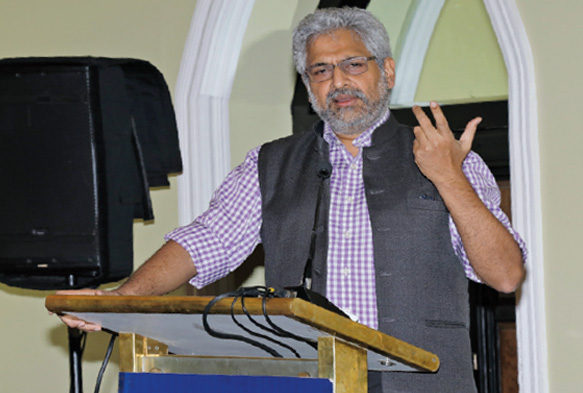
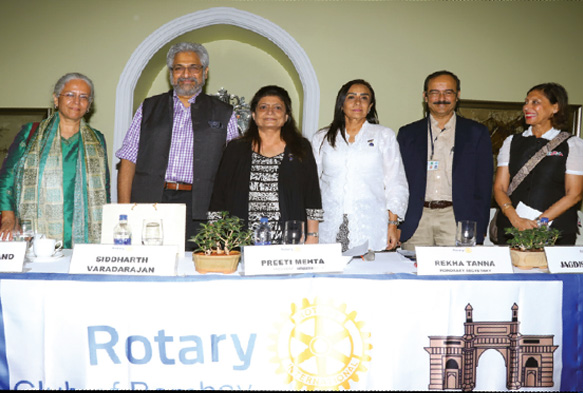
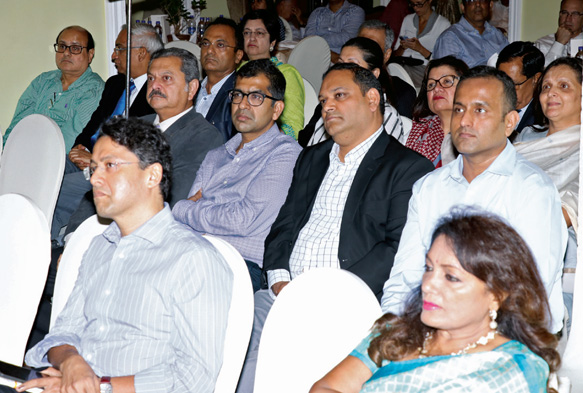
A day after casting their votes last Tuesday, Rotarians were in the mood to discuss the issues of the elections of 2019 with Siddharth Varadarajan, founding Editor of The Wire. He said, “Contrary to what you may have read, I still believe that the elections are wide open.”
“When I talk of issues revolving around elections 2019, I set aside the issues that political parties highlight, in particular the idea that national security or the future of India is at stake. Many bogus issues are thrown up in order to polarise or confuse voters. However, there are fundamental issues that need to be addressed and I am not sure that any of the contenders, including the opposition, are addressing them,” he said.
He focussed on three threats, 1) to the institution 2) to social harmony and 3) to economic well-being. He reminded people concerned about communalism, corruption and the future of our institutions that they had to acknowledge
that these problems had not emerged in the last five years but had a point of origin that went further into the past. This needed to be kept in mind while thinking about possible solutions.
“In India, democracy is not simply an act of voting in an election. The Parliament and the MPs are an essential part of the Executive branch but, in their wisdom, the founding fathers and mothers of the Constitution envisaged a range of processes that would ensure a transparent, fair, equitable and just functioning of democracy.
With these, it could be immunised from abusive power which, no matter how you design your system, the Executive is always prone to,” he said.
“THIS ELECTION IS ABOUT NOTHING LESS THAN THE FUTURE OF ALL INSTITUTIONS OF THE COUNTRY WHOSE FUNCTIONING IS MEANT TO GUARANTEE THE ROBUSTNESS OF OUR DEMOCRACY!”
“For example, we have an independent Judiciary and an Attorney General to give objective legal advice, the Comptroller and Auditor General (CAG), the Election Commission (EC), the University Grants Commission (UGC) and the media. The last of these is not formally a part of the Indian Government system but Freedom of the Press, as interpreted in Article 19 by the Supreme Court, is an essential part of democracy. A range of such institutions, many of which are staffed by decisions taken by the Executive, are meant to operate objectively and not be coloured by politics.”
For example, the EC is an institution which plays a vital role in the General Elections and has the right to take a decision on the violation, or an allegation of violation, of the Model Code of Conduct. Siddharth brought to notice how such an institution was unable to take a decision on any complaint filed against Prime Minister Narendra Modi. A case in point being how did the PM invoke the dead in Latur on April 9th? “The PM is reported to have said: ‘I appeal to first-time voters that when you vote, remember the soldiers who committed the act of bravery in Balakot and those who sacrificed their lives in Pulwama.’ By doing this, he went against the rules of the EC which say that candidates and parties cannot politicise what the armed forces do, in their campaign. Yet, a decision has not taken place on this complaint till date.”
Not just this but Siddharth reminded Rotarians that the Representation of the People Act prohibited campaign advertising on TV by any political parties 48 hours before the closing of polls. “It is a punishable offence. Yet, for the last four phases, something called NaMo TV has been allowed to broadcast which, the Election Commission acknowledges, is advertising. There is no sign of the EC filing a case against it.”
Having quite a long list of offences committed by the PM which have been neglected by our able institutions, the speaker brought to light another offence. “In Wardha, the PM’s third offence was when he said, ‘Rahul Gandhi has chosen a spot in India to fight elections where the majority is in the minority and then, he said, that I appeal to you (audience) to punish the Congress party to use the term Hindu Terror.’ This, again, is a violation of Representation of the People Act which prohibits appeals made in the name of religion.”
The EC has pulled up Mayawati and Yogi Adityanath, rightly so, but for the complaint filed against the PM, they are unable to take a call. This is a clear example of the failure of an essential institution of Indian democracy at a crucial time. “The EC is treating the PM as someone beyond the law which collapses the entire structure envisaged by Babasaheb Ambedkar and the others who wrote the Constitution,” said Siddharth.
Institution after institution is at threat. He further added, “One of the reasons why The Wire has come up in such a short time, with virtually no finances, is because people are dissatisfied with what they get from big newspapers and
big TV channels.”
“QUESTIONS ABOUT DEMOCRACY ARE NOT ASKED. QUESTIONS THAT I PUT TO YOU, SUCH AS ‘WHY IS THE EC SILENT?’ ARE NOT DEBATED EVERY EVENING AS THEY OUGHT TO BE.”
To supplement his point he shared, with Rotarians, a story covered by the Business Standard which no other big newspaper wanted to cover. An Indian Air Force helicopter came down in Budgam on April 1, in which six people died. It has now emerged that the helicopter was shot down by an Indian missile. This happens, said Siddharth, and the best army can make such errors. A month later and the Air Force is yet to give family members of the six personnel an explanation of what happened because, they (the IAF, said Siddharth) had been told that the release of the decision would affect the ruling party’s chances. They had been asked to do it after the elections, he said.
“INSTITUTIONS ARE UNDER THREAT. THE CABINET, EVEN THE ELECTION CAMPAIGN, IS BUILT AROUND THE CULT OF ONE INDIVIDUAL. EXCESSIVE POWER IS CONCENTRATED UPON ONE PERSON WITHOUT THE CHECKS AND BALANCES THAT THE EXECUTIVE BRANCH HAS, IN THE FORM OF THE CABINET.”
So you have irrational decisions like demonetisation, which has yielded nothing but pain, suffering and a two per cent fall in the growth rate and there is zero accountability to date. This tendency of the Executive, which also appened during the earlier PM’s tenure, has been taken to another level where institutions have also been undermined. And this in a situation where the Government had absolute majority in the Parliament.”
Talking about the second issue, of social harmony, Siddharth said he believed that being a part of the Hindu majority meant that there was a certain sense of assuredness that one’s nationalism was never suspected and identity never assailed. He said, “The 2014 election was not won on the basis of communal appeals, it was fought on the basis of promises of an economic kind. Today, it is very clear that the election is fought on the basis of religion and its proxies. So, when you have a high decibel propaganda against Pakistan and antinationals, often, street level politicians bridge that gap because by Pakistan they mean Indian Muslims.”
Siddharth recalls his first encounter with Modi in 2001 when he noticed his use of the words ‘Islamic Terrorism’. He wondered if it was ok for Modi to say Islamic terrorism, what was so offensive about anyone else using the words
Hindu terrorism?
Siddharth said, “I am not offended if someone says ‘Hindu Terrorism’; it doesn’t undermine my identity as a Hindu. While the allegations against Modi never led to charges being framed in a
court, in the case of Pragya Thakur, the court has taken cognizance under serious charges. Despite this, she is fielded as a candidate! Why!? When she was arrested, it became an attack on Hindus. It is important to remember that the first time Sadhvi Pragya was arrested, it was by the Shivraj Singh Chouhan BJP Government of Madhya Pradesh and the charges were of shooting an RSS leader. How times have changed! Someone has moved on from shooting an RSS person to RSS now mooting her candidature from Bhopal! She is being presented as someone respectable and as someone with whom every Hindu must associate.”
“THIS SOCIAL TENDENCY OF TELLING PEOPLE WHAT TO DO OR NOT DO AND TARGETING THEM FOR THEIR RELIGION IS, TO MY MIND, AN ISSUE.”
“It is a matter of dismay that the Opposition is unable to have an honest discussion about this. They also feel that if such an issue is raised, Hindus might feel alienated. So, somewhere down the line, it is fair to say that the social fabric of the country is being torn.”
The third issue, economic well-being, is a key issue which the Modi Government has recognised but not done enough about. The Congress party also recognised that not enough has been done historically by anyone, including itself, added Siddharth. So, many proposals have been made by the Congress and BJP. “Some of them are quite imaginative. Modi’s measure of introducing Rs. 2000 per quarter for farmers now, just at the time of elections, and the NYAY scheme by Congress – which they never did when they were in power for 10 years. But I am glad they have flagged these issues.”
Siddharth concluded, “No matter who wins, policy that focusses on basic support for the common person has to be prioritised and the institutions of democracy have to be safeguarded. Whatever encroachment has taken place has to be reversed. Social harmony has to be maintained at all costs because if we lose that, we lose everything. The common man, his family and their concerns have to be placed at the centre of policy making. If these issues are taken care of, it will help us to stand in strength even after election results.”