A Heart To Heart With Sunny
Padma Shri and Padma Bhushan, cricketor Sunil Gavaskar shared laughs and lessons he learned along life’s way at the Tuesday meeting
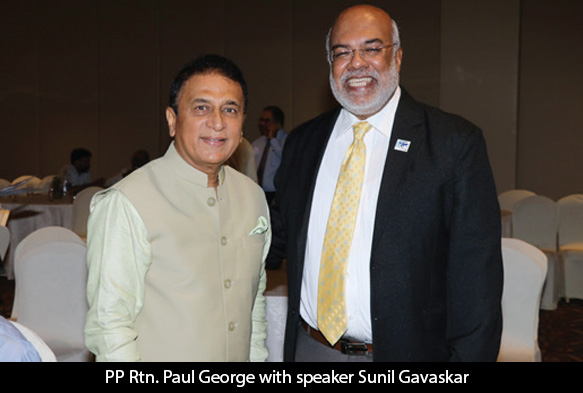
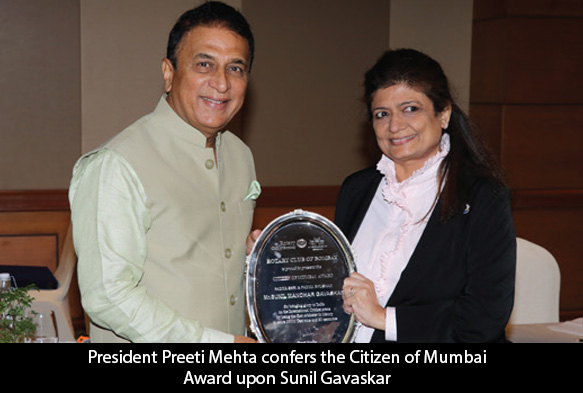
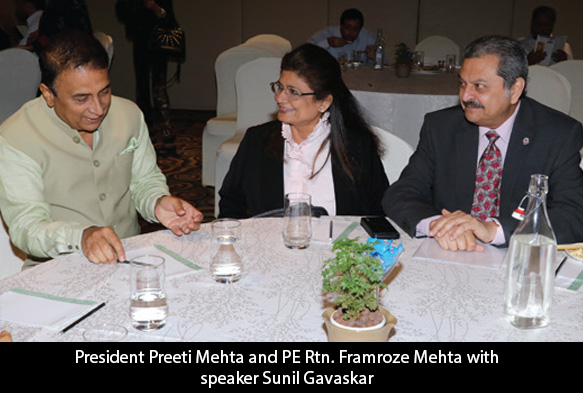
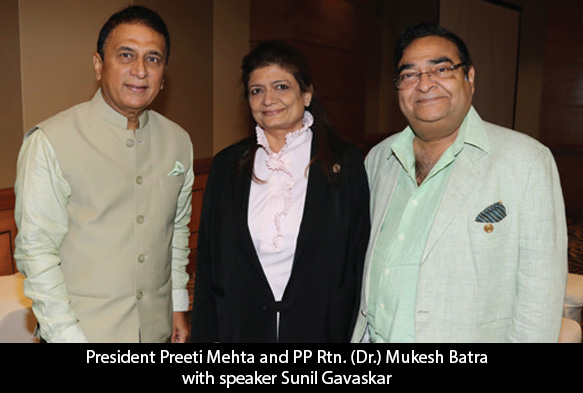
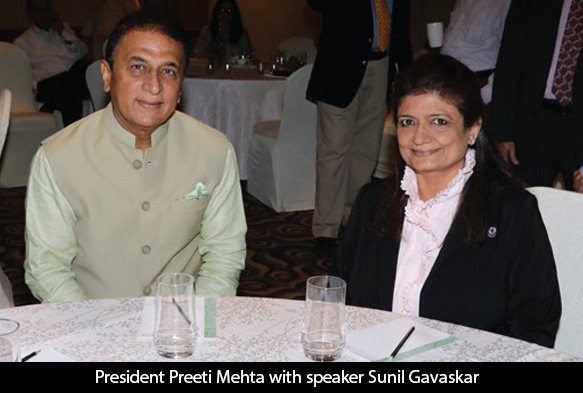
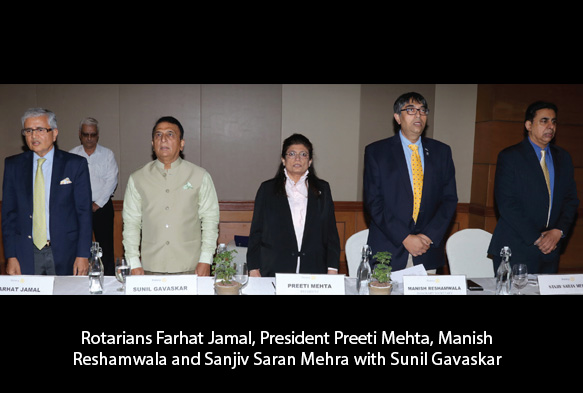
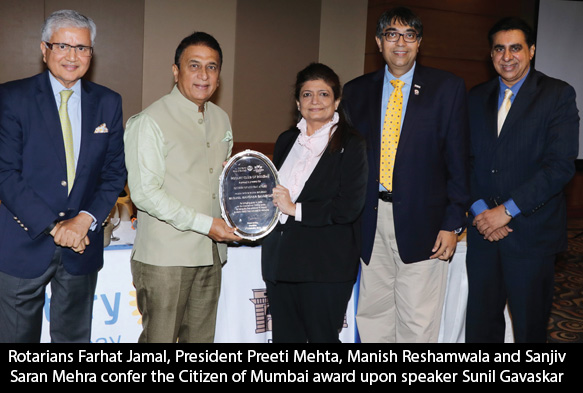
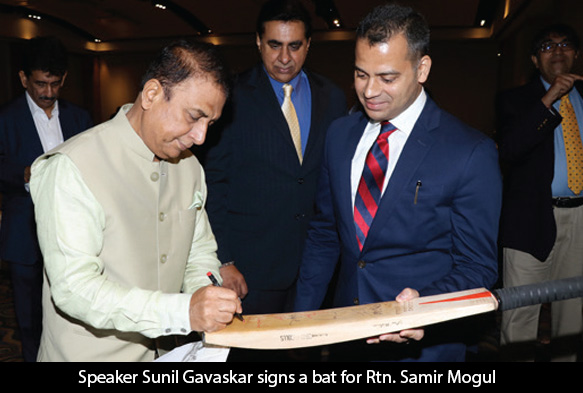
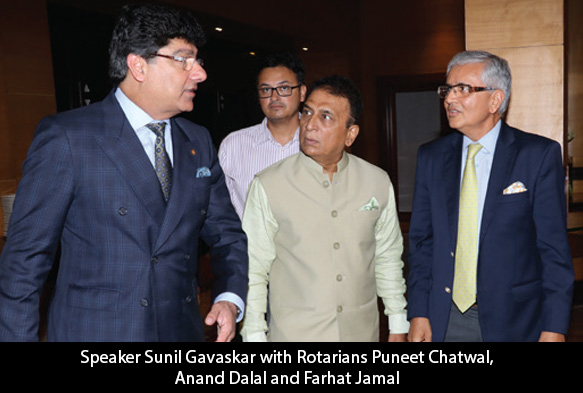
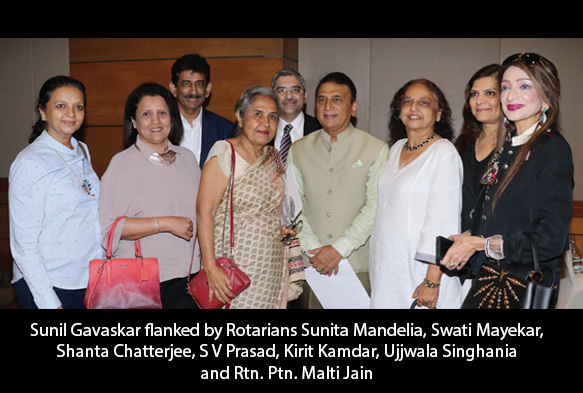
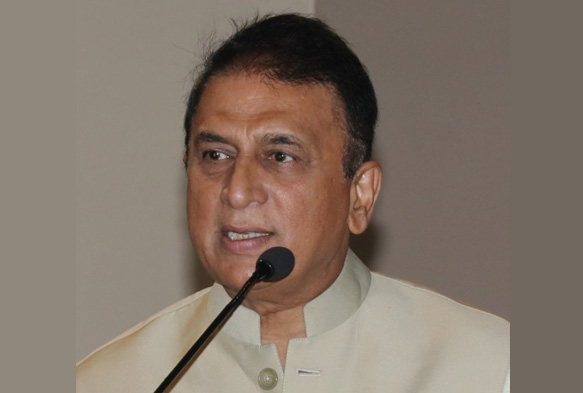
THE Rotary Club of Bombay was delighted to welcome Padma Shri and Padma Bhushan, Sunil Gavaskar, as a speaker for their weekly meeting on November 5th, 2019 at the Taj President Hotel. Rotarians were pleased to welcome the legend and confer, upon him, the Citizen of Mumbai Award at the hands of President Preeti Mehta. Sunil’s citation read:
“The Rotary Club of Bombay is pleased to honour Mr. Sunil Manohar Gavaskar with the Citizen of Mumbai Award for 2019-20 on being the greatest opening batsman of all time and bringing glory to India in International Cricket arena, on captaining Indian cricket team for 47 Tests, on an astonishing career spanning 16 years and 125 test matches, on being the first cricketer to score 10,000 runs and 30 centuries, on being the recipient of the Padma Shri and Padma Bhushan, on being nominated as Chairman of ICC cricket committee, on being inducted into International Cricket council’s Hall of Fame, 2009, on being the most respected cricket commentator, columnist, author and his contribution to social work. Congratulations!”
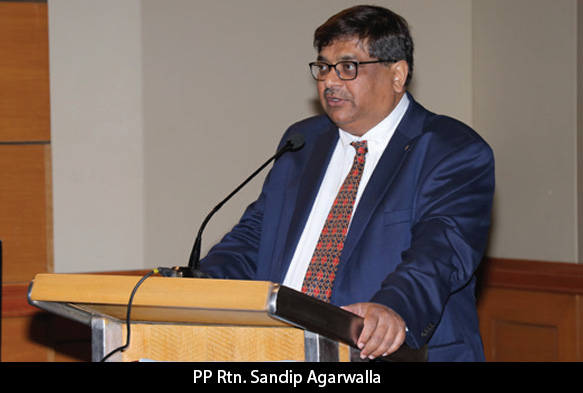
Rtn. Farhat Jamal introduced Sunil to the members while Rtn. Sanjiv Saran Mehra gave the vote of thanks at the close. Sunil grabbed everyone’s attention straight off the bat:
“Thank you, Farhat, for the introduction. Generally, masters of ceremonies get away by saying, ‘Sunil Gavaskar needs no introduction’ which is an easy way out but when you have been retired from the game for 30-35 years, it is nice to hear nice things said about you and some old records mentioned.”
“Speaking of introductions, I must share an incident. My maternal uncle Madhav Mantri played four test matches for India in the 1950s. He was a wicketkeeper captain. So, when I was the captain of the Indian cricket team, he was called as the Chief Guest for a sports day function at a school. The principal of the school asked him how he should introduce him. My uncle said, ‘These children would not know me at all, so why don’t you ask them who is your favourite cricketer and, say, that I am his uncle. That way it is easy.’ The principal agreed. So the principal, before introducing my uncle, asked the children, ‘who is your favourite cricketer?’ In one voice, all of them said, ‘Kapil Dev’. So that introduction went for a toss.”
“I am fortunate to be playing my third innings now; the first was as a cricketer, the second being part business-part media person and the third is as Chairman of the Heart to Heart foundation which is along with the Sai Sanjeevani Hospital in Haryana, Chattisgarh, and now in Mumbai, offering free services to children, mainly from the poorer sections of society, born with heart defects. I believe and hope that this is going to be the best innings of my life, to try and save the lives of as many people as possible.”
“As a child, one of my first lessons was from my mother. I must have been three or four years old. We were in the small balcony of our flat, she was lobbing a tennis ball at me and I was swinging the bat. I connected with the ball and it went and hit her on the nose. She started bleeding. I ran to her crying and hugged her. But she wiped her nose with the pallu of her sari and said, ‘No, go bat! If you want to play cricket, you must be prepared to bear the pain, this is nothing at all!’ That was my first lesson: you are going to play with a hard ball and there is going to be more than one painful event.”
“Another lesson followed quickly. She would take me to her brother Madhav Mantri’s place and, in one of his drawers, there were some jumpers and caps. I would ask for them but he would say, ‘No, these are things I have earned. So if you want to wear these caps, earn them.’ That, again, was a lesson that nothing comes easily, you have to work hard. You have to earn every single cap, blazer or jumper you get for representing a particular team, state or country.”
“When it came to representing the country, I had the most unbelievable stats anyone could imagine. My first runs in tests were actually leg-byes. The ball hit the pad as I tried to flip it away and I took two runs. Through the corner of my eye, I saw that the Umpire had not signaled a leg-bye. I said to myself, ‘First innings in Test and not out for a duck’. But then when I was batting at 12, Gary Sobers dropped an absolute dolly catch which allowed me to get to 50 and keep my place in the next Test. When I was batting at 6 in the next Test, I slashed hard into the ball. The ball went like a rocket, again to Gary Sobers, and it hit him in the chest and bounced up. By the time he recovered, it had fallen on the ground. That is how I got my first hundred and kept y place on the team for a while. During that hundred, also, when I was batting on 94 I went ahead for an off-spinner, got a glove and the ball just looped up. Gary Sobers who was standing there when the ball was bowled, had seen me move forward and hence moved a little left to catch it and the ball went exactly to his original position. If he hadn’t moved, it would have been a simple catch.”
“In those days, there was a lot of interaction between the teams. The general trend was for the batting team to go to the other team’s changing room at the end of the day with a crate of beer or soft drinks. So we sat, had our soft drinks, talked about the day’s play, enjoyed a little bit of banter and that’s when Gary Sobers said to me, ‘Hey, man, I am going to touch you for luck’. Because at the time, he was struggling a little bit, and the last two matches he had failed. So, as luck would have it, during the second innings he came to our changing room and asked, ‘Where is that little fella?’ He touched me on the back and when he went to bat, he was given not-out when he thought he’d be given LBW. I think the umpire wanted to see Gary play more so he did not give him an out; he went on to score a 100. It was fine. Next game, he came to our changing room again to ask about the game of the previous evening and everything. And he spotted me and touched me for luck. He scored 178.”
“Then we came to the last Test, India was only 1-0 up. In those days, if the series was not decided, you played a six-day Test match. So this was the final Test. So again he came in when we were batting and touched me, and scored 138. Now, the day before the final day, he had fallen while taking Ajit Wadekar’s catch. The ball hit him in the ribs so he was a little bit hurt. But the changing rooms in Queen’s Park Oval in Trinidad were such that you could hear the other team through the ventilators. The West Indians were playing music over their radio and once the music stopped, we heard Gary say, ‘Okay, I am going to say hello to Ajit and the boys’. This was just before the game was about to start. Ajit, my captain, heard this and said, ‘arrey toh Gary yetoy’. I was batting 180 overnight and he went and locked me in the bathroom. I kept arguing with him, saying things like, ‘Look I am batting, I need to pad up, I need to mentally prepare myself, what are you saying, are you serious about Gary Sobers touching me and scoring a 100? I mean he can touch me on the ground also na, if he wants.’ Anyway, he locked me in there and then Gary came and obviously didn’t notice me. At the end of the day we had a situation where West Indies had to score 180 in 90 minutes of batting to win the series and level the game. So, because of the urgency and because he could play those big shots, Gary promoted himself from 6 to 5 and he was clean bowled for a zero. As soon as we came back to the changing room, Ajit Wadekar says to me, ‘mee sangitlela na tula.’ So that was my first series, really memorable. We went to England after that, and we beat them as well.”
“I had the good fortune of being part of the Rest Of The World Team, because South Africa’s tour of Australia was called off. So in my first year, I had the good fortune of going to the three PP Rtn. Paul George with major countries of cricket: West Indies, Australia and England to get experience of various cricketing conditions. One thing that struck me was that while there was so much talk on Indian umpiring, umpiring in these countries was pretty biased. I always found it strange that their media would come down to criticise our umpiring skills because umpiring, at that time, was an amateur job except if you were in England. Everybody who umpired did it for the love of the game and obviously if you had not played the game you were bound to make the odd mistake.”
“I was also fortunate to be asked to captain the Indian team in circumstances where we had lost to Pakistan on the first-ever trip we made to Pakistan in 1978. Our manager was the late Maharaja of Baroda, Fateh Singh Gaekwad. He was, without question, the most popular person from the Indian team. He had the Pakistanis eating out of his hand. At any meeting or function, and he would start by saying Asalam Walekum and the whole congregation would say Walekum Salam. He had a rectangular watch then, which had all the countries and their time. He would sit with us in the evenings, after the game, to talk. Once, I said, ‘it is a very good watch’. That was all I said. He gave it to me.”
“First Test, I was clean bowled at 89, 11 runs short. Second Test I am batting on 97, Chetan Chauhan and I had a partnership of about 150 and we had gone out to bat, Wasim Raja walked in to our changing room and said, ‘You guys are gone, there was just a meeting of Captain and Vice-Captain, senior players and umpires. So you guys are gone.’ That is exactly what happened. Chetan Chauhan was batting at 95, and he was given out. I was playing forward and out at 97. Come to the last Test and I got 100 in the 1st innings and in the 2nd I was batting on 7 or 8 and Imran balls a real snorter, it hits my glove and then the bat and the catch is taken. Low and behold the umpire says ‘not out’!”
“But I managed 100, and you sort of raise your bat to the changing room and I saw Fateh Singh ji waving the watch. It hadn’t even struck me, because at that stage you focus on the batting. I still have that watch. It’s like a prize, a memento. We had some amazing times but none better than the 1983 World Cup. Nobody gave us the chance but we were quietly confident. For the simple reason that we had just beaten the West Indies on their home turf, and the first match of that campaign, we beat them again. So twice, it wasn’t a fluke, we were very confident and that is what happened. We had an incredible innings by Kapil Dev, 175, unfortunately BBC was on strike, should have been recorded
but it wasn’t. But it was the best One Day Innings I have seen because after that also I saw so many: Sachin’s, Virat Kohli’s, Rohit Sharma’s 100s. But none beat Kapil, because of the situation the team was in and those conditions. Then, of course, the catch he took to get rid of Viv Richards in the final was unbelievable.”
“Then it came to commentary and I was happy that I was at the right place at the right time. The skies opened up and instead of the BCCI paying Doordarshan to cover the match the Supreme Court ruled that the air waves were BCCI property to sell. So we had the International Management Group with a production house cover the matches. It was just a couple of hours after I finished playing cricket.”
“Coming to my third innings at the Heart to Heart Foundation. We help with free surgeries. There are no billing counters at these hospitals – only dil, no bill. Every surgery, because we brought down the cost, we call it a gift of life and it resonates with me. Because I know that but for the two lives Sir Garfield Sobers gave me, I would not have had the cricketing career of 17 years and which I was simply fortunate for because of these same opportunities.”
“Not to forget, the very first day of that series, there was a batsman from Hyderabad, Kenya Jayanthilal, he was senior to me, brought up on matting pitches in the south. He was a very good player on bouncers and short balls. So that first Test, he got in position to play the short ball but unfortunately it skipped his mind that he was now playing a West Indian fast bowler on a West Indian pitch. So he swayed out of the way but kept his bat hanging up and it went wide to Gary Sobers who picked an absolutely beautiful catch. For the rest of the tour, he got runs but he never played a Test match again for India. That’s what I mean, when you save a life you might save the life of somebody who might go on to do good things for the country. The satisfaction and feeling of relief and joy on the parents’ faces when they come to know that the baby is going to lead a healthy life is much more than a double hundred.”
ROTARIANS ASK
Do you think commentary these days has become more of a chat? It loses the focus upon the game.
Yes, when there are three commentators, one may feel left out while two are talking. It can be difficult but that has somehow been the trend. To me, commentary is like two people watching the game from the stand, with the only difference being that they have a mic in front of them to reach the rest of the world. There is a lot of chatter but we have producers who quickly point it out and help us bring focus back to the game. It is a team effort. The real hard work is done by the technicians.
What are your views on the substitution rule that they are introducing in IPL?
I don’t know if it is happening or not because it has to be discussed. But you are changing the game in the sense that with the substitute, if you are going to have a situation where he can come in during the last over when you need 15 runs. And he is somebody who has not been in the field for the whole day but you know that in three deliveries can hit three sixes and go to 18, I think it takes away from the game. This is my view. I think the game has been good so far, we have had our entertainment.
What are your views on concussion substitution?
Again, this idea I do not agree with because I could have a broken hand in the game and I still don’t get a substitute. Nine times out of 10, somebody who is hit on the head while batting is because of incompetence. So you are actually allowing a substitution for incompetence. So I don’t agree with it at all.
Why is Mahendra Singh Dhoni’s life so mysterious?
He has always kept a low profile. Even when he won trophies, he has taken the trophies and given them to younger players and moved to the corner. So he has let everyone hog the limelight. That is exactly how he is going to go. He’s going to go quietly in to the sunset. I don’t think he requires any sound and fury around his retirement.
You were an important pillar in the Indian cricket team of your time with the other being GR Viswanath; how come the two of you did not have too many partnerships? And how do you compare your batting and his?
He was a better batsman without a doubt because he had the ability to hit the good balls for runs. I could do that occasionally. We had a hundred plus partnership the first time we played together, my second Test. After that, I think we again had just one 100-run partnership. I guess we were destined to have another partnership in the family when he married my sister. So when many young cricketers ask me about some tips on the game, I always say, ‘Do not invite one of your teammates home if you have a sister.’