
Poet Extraordinaire
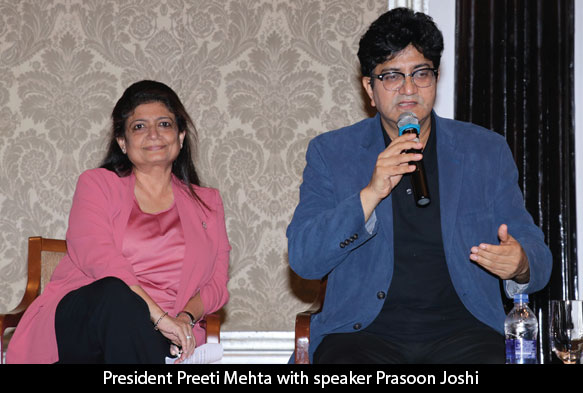
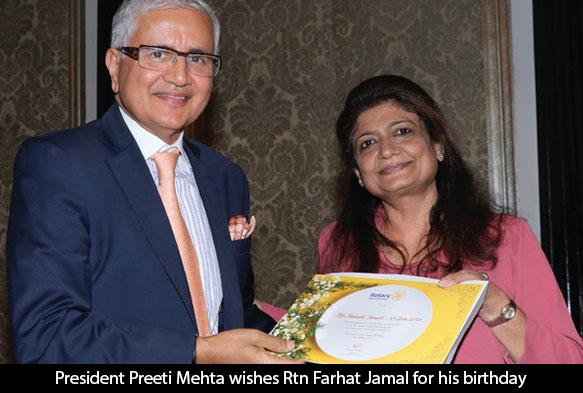
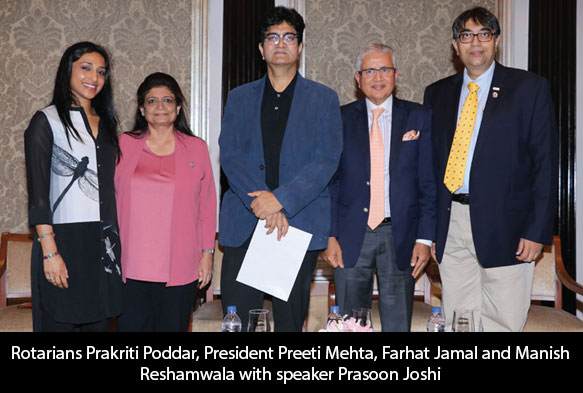
Prasoon Joshi shares his inspirations, his influences and his belief in people in an interview with Rtn. Farhat Jamal at last Tuesday’s meeting
Your parents are trained classical vocalists; what influence did it have on your life as a creative person?
I lived in the mountains in Uttarakhand. Those were not the great days of television and I am thankful to that. I explored a lot of books and nature. And they always come to rescue me. People who are familiar with my poetry would have pointed out, for example, I use the word dhoop quite a lot: tu dhoop hai, Chamm se bikhar; dhoop ke makaan; umeedon wali dhoop. I never looked at it like that but there was a time when dhoop, hawa, nadi, jhoke have come aur unhone mujhe ungli pakadke raasta dikhaya hai. Jab ye metaphors ki talash karte hain aap, ki kis tarah se express karein, woh metaphors khud ba khud aajate hai. Those images are ingrained in you. The mountains are a game of sun and shade. I remember how my grandmother’s khatiya used to move with the dhoop, woh sarak jati thi. These are the things that you subliminally observed and they come and reflect your attitude towards your life.
Nature teaches you struggle but nature’s struggle is honest struggle. If you see a river and try to cross it, it will not cheat you by suddenly becoming a mountain. It will remain a river from beginning to end. It does not cheat you by suddenly becoming a mountain. But if you are born in the cities, it teaches you a very different reality. My reality is that I am tough in a transparent way. Secondly, to have trust in people. I remember my childhood in my grandmother’s house: she never locked her house. There was a trust in other human beings. What you see and absorb gets manifested in your life further on. I owe a lot to my childhood. With both my parents being classical musicians and vocalists, while people wake to the sound of an alarm clock, I would get up to the strains of the tanpura. I instinctively started playing instruments which I never learnt formally. My father was obsessed that I should study science. So, although I was imbibing music, I was studying science but I was searching for poetry in science too. I found Schrodinger’s wave poetic, and Heisenberg’s principle poetic and philosophical. That is why formative years are important and I am thankful for it.
But, having done an MSc in Physics and MBA and then getting into the corporate world, was it a choice or did it happen by default? Or, is it that your creative side pulled you towards advertising?
I think it is important to be confused. People hate that indecisive phase of their life but that is the phase which is the most fertile. This is the time you are meandering and weighing things out. This is a human tendency and it is a very uncomfortable state and everyone wants to move out of that state. I don’t think I have mastered it; if you can master the art of comfort with discomfort – that is the most difficult thing to achieve. When I was confused, I found advertising where they were paying me to think of crazy ideas. I felt there was something for me here. I always treated advertising as a format through which I tell short stories. I stumbled upon it and I am thankful I did because it kept me and my pen alive.
Which are the ad campaigns that have been challenging or for which you feel proud today and which have a social connect?
If we see the current model of economy, every piece of work has a social connect. I think you are advocating a product. We believe in creating a meaningful role in people’s life. I fundamentally believe that people are good. So no one is doing anything to harm anyone. So I am greater friends with the owners of the companies than executives because I always feel people who envisage have a different level of commitment and I love that passion. Sometimes you meet people who have dreamt of the company and I want to understand the heart of that. I am not saying altruistic or idealistic. But there is something I feel, that every woman should have a right to live and this is why we work on sanitary.
I remember working with Johnson and Johnson, empowering women in those five days is important. That is something I would try to reflect so that is the reason I wrote: ‘Ab waqt hai badalne ka’. We have a tricky job. It is a small line but it talks about change in women and change in the product. In Japan they call it haiku, we have that. Coca cola works Thanda matlab Coca Cola, bringing pride, being Indian. Indians are exceptional people and there is a sense of pride reflected in the ads. I am doing Dettol right now. Not only are we telling people to wash their hands but we are also changing the behaviour of people. We have joined it with Swachh Bharat. Corporate and government partnership
can make it work because the brands are somewhat linked.
Somewhere, products empower people and that empowerment – if I tap into it – gives brands longevity rather than short term sales growth which, of course, is important. But great brands are those that resonate in the minds and hearts
of people and become a part and parcel of their lives. That is how I try to create advertising. Even humor, I have done a lot of work, for example, Happydent where you see the whole palace lit by teeth and bulbs.
One important campaign was needed for Afghanistan’s Immunity Charm. In Afghanistan, kids wear a beads bracelet/ wristband as a part of religious discourse. You would find it in the poorest of areas. So we did this for health workers; the beads have colours and every bead tells you which vaccine you have been given. If a health worker wants to know the child’s medical history, she just has to look at the bracelet. Marrying culture with existing practice and helping people do a significant thing. We are trying to work with many companies in India to take it to the grassroots here.
Another example is the ‘Share My Dabba’ system we created. Often, people who order dabbas end up eating out. At such times, that food goes waste. So we worked to create a ‘Share My Dabba’ sticker which the person would stick on their dabba. We work with the dabbawala union. So when the tiffins are collected back, the ones with the stickers are kept aside and distributed to NGOs. It does not cost anything and is a design idea which is redirecting food. Ideas like these make me proud of my profession.
How did you get into Bollywood?
I came to Bollywood to earn a living. Again, I stumbled upon it. I was working with some filmstars; my poetry was always there and I had a feeling that reading poetry was declining. Nobody seeks a poetry book out to read it. I realised that people were consuming poetry but they wanted it as fresh air and water, they did not want to pay for it. They used it in SMSes and messages. In fact, I am such a great believer of poetry that I think they should use it in management institutes. Any good corporate leader always quote from poetry. Parliamentarians, when they don’t have words, end up quoting poetry. The question is that if poetry is so important, then why are we not teaching it? Management institutes should teach poetry.
Bollywood provides a platform where people still consume poetry through the medium of songs and that is the reason I started writing songs. I met Rajkumar Santoshi – Amitabhji had told him about me. I had received a letter from Mr Bachchan praising my work. So I ended up writing my first song which was sung by Lata Mangeshkarji and composed by Ilaiyaraaja for a film called Lajja. People noticed my work, then came Hum Tum and Rang De Basanti and Taare Zameen
Par.
Now you are the Chairman of CBFC, there has been a huge improvement in the processes, people are finding it far more pleasurable to work with you because you see reason, and you also see the other side and you look at it from the public’s point of view, not just censor’s.
Artists are not creating to hurt people; they are creating to express themselves. I never thought I would be sitting and judging someone’s work. But it was a great learning for me. I accepted it. When you look at the river, if you ask someone who is in the river and trying to fight the waves of the river, river kya hai? He might tell you in an aggressive way. But someone standing on the banks of the river would say the river is calm; same river but two different perspectives. This happens to creative work also: the point of view matters. So I started seeing the point of view of other people and I tried to explain it.
Sometimes public interest groups approach CBFC and sometimes film makers. It is important to decode in the same way otherwise you have failed in your communication. All I’m trying to do is put reason there and see different points of view. It is important to see the holistic picture. You can’t always make people happy but certain points have to be dealt. For example, if there is a police woman in the movie, but the camera is only interested in her anatomy, and all the time focusing upon it, caressing that, then the intent is the problem. I think film makers will have to change their attitude. Such changes are required and there should be a step closer from both sides. People have to learn to become less sensitive about other things and give more licence to one another and trust.
People who are creating it must also take cognizance of society; there are certain things that we want to eradicate, we will need to try to work in that direction. You can talk of any sensitive issue as far as your intent is positive.
You have been a poet of choice for the PM’s new India. What is great is that you are not a fence-sitter, you are a person who is going to make a difference in your own field of influence. You inspire a lot of people.
I always try to see the positive side, there are people whose job is, in Hindi, we say nindak niyare rakhi. It is important to have critics but somebody’s job is to be critical. And in my skill set, how I can contribute? My skill set is not to say what is wrong, it is to see that if there is something like Swachh Bharat, then how can I write an anthem for it, how can people become aware of it, align myself with positive change and contribution. I
had written, in Satyameva Jayate:
Mujhe khud ko bhi hai tatolna
Kahin hai kami to hai bolna
Kahin daag hain toh chupaye kyon
Hum sach se nazrein hatayein kyon
I also wrote,
Desh se hai pyaar toh har pal ye kehna chahiye,
Main rahoon ya na rahoon Bharat yr rehna chahiye.
So I try to contribute: what is necessary –
keep, what is not – throw it out.