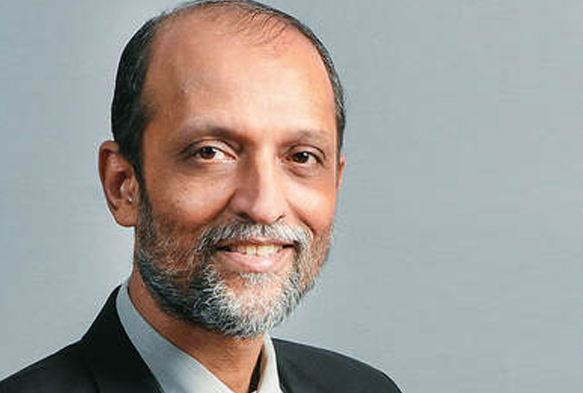
Rooting For Inclusive Growth
Ajit Ranade, Group Executive President and Chief Economist, Aditya Birla Group casts an eye on the way ahead for the Indian economy
Our objective has always been to have inclusive growth.
But before inclusive growth you need to have economic growth, the expansion of opportunity, the expansion of income, revenues and profits. So, I am especially happy that so many of you are doing so well in business because if that does not happen then other things do not happen – such as inclusive growth.
In my column for The Mint, I wrote a column on the concepts of economic inequality and economic growth. One of your missions as Rotarians is to do well and do good. Our societies, whether here or internationally, are being increasingly exposed to the phenomenon of widening disparity and widening inequality whether in income, wealth, opportunity or access to public services, access to quality education and health. Whichever dimension you mention, these inequalities are widening and some of them are inevitable consequences of the way economic growth happens. And unless we do something to reverse it, the ratio will get more skewed.
In my article, I have argued that the widening inequalities will ultimately hurt economic growth. If you want the Indian economy to grow at eight to nine per cent to reach a US$ 5 trillion economy, you need to take care of the basic problem of inequality. Back to the pandemic and what we have is a triple combination: a demand shock, a supply shock and a financial shock.
Demand shock means, for example, that if the green vegetables selling in Mumbai are affected by e-coli or there is arsenic poison in some of the mangoes coming from the Konkan region, the demand for them will immediately go down because of the scare, panic or caution. A demand shock is when demand collapses. Presently, the demand for airlines,
hospitality, and tourism are down.
Next is supply shock. Suppose there is an earthquake and a chemical factory is destroyed. The production of chemicals
stops until the factory is rebuilt – that is a supply shock. We have had the supply shock as well when the government announced a strict lockdown. Our factories could not function. Our group, for example, has several cement, metal and textile factories that trucks could not reach to because of the shutdown and we could not get raw materials. So we had demand shock when the demand collapsed and a supply shock when the supply collapsed.
Then we had a financial shock when the stock market went down in March but thankfully, since the last week of March, that has gone up by 30 percent. So we are now in a situation where we are trying to come out of this triple whammy.
The economy was a little wobbly even before the pandemic. Last year, just before March, many sectors of the economy were slowing down. This time, the slowdown is because of a virus and there will be no cure until a vaccine is developed. Plus, the infection spreads fast. This means that there is a lot of pressure on the healthcare system. There are not enough beds and quarantine facilities in Mumbai or any of the other cities. The strategy is that we are trying to flatten the curve that is increasing so that the growth rate of infection is manageable. As the fatality is small, many people will not even need to be hospitalized – just quarantined. But those who do require hospitalization will remain there for seven to eight days. Say we have 10,000 hospitals in Mumbai. This means that at any point of the pandemic, we should not have more than 8000 or 9000 people in the hospitals. That is the complete strategy – that is what you are trying to do.
In doing so, the section that is worst affected is the small and medium entrepreneurs and the daily wage earners. If you have a reasonable company, you can afford to not have a sales revenue for maybe a month or two. You do costcutting, cash conservation and maybe you defer paying salaries. But people who depend on their daily income have nothing to fall back on. Up to 40 per cent of the workforce in Mumbai are such people. And they have little to no savings to fall back on.
Now, there is also a lot of pressure from businesses and small and medium entrepreneurs to reopen the economy. It is a very strange situation that on March 23rd, when the lockdown was announced, all of India had 190 or 191 cases and
the fatality rate was two per cent. Two months later, the country has two lakh cases and the fatality rate is up to
3 and a half per cent. The daily count of fresh new cases of Covid is up to 8000 a day. And this is the time we are going to open up. You may argue that we closed the economy prematurely. This is an imported disease which is supposed to have originated outside India. So it came to India only through international travellers. Initially, in March, you could have focused on a detailed scrutiny of international travellers and kept the rest of the country open.
Imagine if you are in Mizoram or Arunachal Pradesh or Uttarakhand or Chhattisgarh or Kerala – why should your economy be shut down? Of course this is all in hindsight – we cannot go back but the issue is that the economy is about to reopen.
Going ahead, no one has been spared. Globally, there are six million cases and nearly onethird of these are in just one country: America, the richest, biggest and most powerful country is now the epicenter of this endemic. The death
toll has crossed one lakh. These are more deaths than in the entire Vietnam war. But until a vaccine is formulated, it is going to be difficult. The only way out is to keep the infection manageable, to adhere to social distancing, to observe hygiene and sanitation protocols, to do temperature monitoring and to do extensive testing that’s the only way.
Countries have poured a lot of fiscal support. In America, every adult citizen, except the very rich, except a tiny fraction of one per cent, every American has gotten a US$ 1200-1500 cheque every month. Many of the small businesses have got support. Other countries like Germany and the UK have reimbursed small companies for salary payment so that they don’t retrench workers. Different countries have adopted different things – and this is called a fiscal stimulus which comes from the government’s tax kitty.
In India, what Prime Minister Modi announced, much of it is in the form of loans. He announced Rs 20 lakh crore but except for Rs 2 lakh crore, everything is in the form of fresh loans from banks and RBI. But we need cash injection as well because we need people to run for the next one or two months especially the families who have lost livelihoods. In the next four to six months, each family should be given Rs 8,000 to 10,000 income monthly for their monthly expenditure.
In this pandemic, we have discovered that India spends not even 1.5 per cent of its GDP on public health which is way below the world average, not even half or one third of what China spends. We will also see a lot of growth in the digital sectors. Thanks to telecom and wi-fi, telecom companies are going to do well. The sectors which will unfortunately not do well for some time are: airline travel, public places like malls, hospitality, 5 star hotels and IPL. The one bright spot is the rabi crop which had a good season last year and if we have a normal monsoon, we will see a very good growth in agriculture. Agriculture constitutes 16 per cent of India’s GDP which means that 84 per cent comes from outside it. But it is a silver lining nevertheless.
India used to have the unfortunate distinction of having nine out of the 10 most polluted cities in the world but the sky is now very blue, the air quality index in Delhi which used to be at 440, came all the way to 45. I am told that at places like Haridwar and Rishikesh, the water of the Ganga is not only clean but it is also potable now. I don’t know how much of this is related to the pandemic but it is a silver lining.
Unfortunately, because of the impact of April, May and June, the economy is going to suffer. Our GDP may only be zero but negative. But our national income is Rs 200 lakh crore. So next year the income, even if we grow at zero per cent, will be Rs 200 lakh crore but it will probably grow at -5 per cent so it will be Rs 190 lakh crore which is the big number by the way. We will be still producing three million cars, maybe 300 billion tonnes of cement, we still will be producing 100 million tonnes of steel. So we need not dismay, what we should look at is the next year the GDP will go up by 5%.
In the meantime, we need the strong support of the government and a dose of fiscal stimulus which will help small and medium entrepreneurs. What happens whenever there is a downturn is that the customer starts delaying payments, the government itself delays payment, so what do the SMEs do? That is why the government should intervene; our country has 63 million SMEs which employ 10-12 crore employees. And, as I told you, we need universal injection of say about Rs 10,000 each across households, urban poor, that will be somewhat 80 crore or 70 crore people. So, if our national income is Rs 200 lakh crore, Rs 2 lakh crores that is one per cent of the GDP. If we don’t do a strong fiscal push at times like these, then when will we do it? If that happens, next year, I think we should come back seeing economic growth.
ROTARIANS ASK
If you had a freehand what measures would you take to help the economy get on track?
I would clear all dues to the SMEs. The government owes Rs five lakh crore to them, so I’d focus on paying off the pending payments.
Second, I would give all the income tax refunds right away, I would not wait till September and if the income tax wants to save some cash, they can give it in the form of refund certificates. An income tax refund certificate can be used to pay your advance taxes or your other dues.
A lot of people have input tax credits in GST, I would say that should be given instantly.
I would also allow minimum alternate tax, so if you are a company and because you are doing a lot of reinvestment and a lot of depreciation, if you have zero profit even then you are able to pay tax to the Government of India it is called MAT. Over the years, the accumulated MAT has become Rs 75 thousand crore. So, let us allow the companies to encash their MAT credit.
Lastly, the central government should immediately release all that is due to state governments. GST compensation is due to state governments. All the Covid-19 action at the state and municipality level means the state governments are struggling for money. Central government is the sovereign authority which has the right to print notes, the state government doesn’t have that luxury. So, the last measure would be that the state government get all the pending GST compensation.
Taking forward your MSMEs point, do you think it is too late because today’s Economic Times says that one third of MSMEs are shutting and, secondly, their decision to suspend the insolvency and bankruptcy code for one year – do you think it is rather harmful to the economy?
Unfortunately, my answer to both of your questions is yes. But I am a very optimistic person. So, if you ask me whether it’s too late, yes, it is. The USA, a Republican government, announced a fiscal stimulus of US$ 2.2 trillion which is practically the size of Indian economy. Whereas, we took a long time, a two-month gap, after which PM Modi announced Rs 20 lakh crore which turned out to be only bank funds. It is not a special fiscal stimulus; nothing is coming out of the treasury of the Government of India. He is saying that banks will give you loans, but banks are so reluctant nowadays.
If an MSME is dying and does not have anything to eat, an MSME which is close to bankruptcy, will it go to the bank for a fresh loan?
Unfortunately, we have delayed it too much but I am hopeful because no case is too late according to me. And some MSMEs were going to die anyway. This pandemic is going to change some consumer behaviour. Some firms have to accept their fate and move on.
Suspending the insolvency code is not a good idea. You can put it on hold. The whole insolvency code was a fantastic reform because it was putting discipline. The insolvency code success is not how many cases come to their court – the NCLT – the success is how many cases don’t even come there. The success is hidden. A lot of large companies are very careful to make sure that they pay the pending bills. We have a big crisis of pending payments so they should have not completely let them off the hook. I am going to be in touch with the insolvency authorities because I am sure they would not have thought it a good idea to suspend the law for a year.
Nirmala Sitaraman in one candid interview, did not rule out the possibility of monetization. Maybe the government wants to do it in the next stage?
Yes, that’s why I said that we need to be optimistic because the finance minister herself said that I am not done with it. She did a series of five press briefings and then gave interviews to also newspapers saying that she is not done, more is expected so you are right maybe they will do some fiscal stimulus from the treasury. I am hopeful about that.