

Such A Long Journey
Even as India and the world celebrate the quick lockdown effected upon 1.3 bn people in the world’s largest democracy, P SAINATH throws light upon a total miscarriage of justicebillion
On May 17th, the Ministry of Home Affairs issued an extremely strict curfew order which said: ‘Movement of individuals is strictly prohibited between 7 pm and 7 am.’ Who does this affect? You are telling lakhs and millions of migrants on the roads who have to walk between 7 am and 7 pm in 40 degree heat and humidity instead of between 7 pm and 7 am.
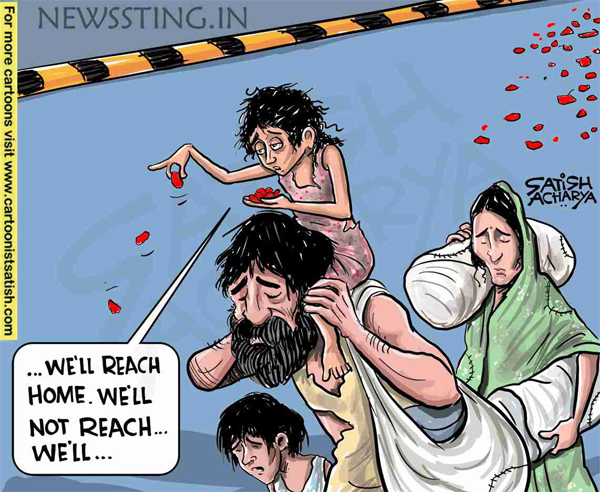
The notification goes into great detail as to which essential services are exempted but it does not mention one word about these thousands of migrants. Three days ago, in a village in Chhattisgarh, a 12-year-old Adivasi girl called Jamlo who was working in a chilli fields of Telangana 200 kms away.
Jamlo was desperate to get home as everything closed down upon her and joined a group of people walking to their homes in 43-44-degree heat. That little girl walked 140 km in three days and then fell dead from exhaustion and muscle fatigue. The MHA order commits many others to be little Jamlos. They are saying that you cannot work between 7 pm and 7 am when it is cooler. Then, what sort of thinking have we done in the actions we have taken and the decisions we have made?
 The first announcement on March 24th night gave 1.3 justicebillion people four hours to shut down. As Mr. Deva Sahai has put, “If a small infantry brigade is asked to go into a major action, it is given more than four hours-notice”, but we have told 1.3 billion people to shut down without planning. People panic, migrants start leaving the cities, no idea of what to do about it when there was plenty that could have been done about it. Then, they are all on streets on March 31st and the Solicitor General of India informs Supreme Court that there are no more migrants on the road. This is on March 31st after which the number of migrants on the road doubles and triples according to the affidavit of the Home Ministry in Supreme Court. By March 31st, they admit in the April 2nd petition, there were lakhs of people on the road and by April 12, in six days’ time that has doubled and they have 1.4 million people in relief camps of which they are boasting to Supreme Court. Please note that 69 per cent of those relief camps were in the single state of Kerala.
Then, the migrants decide to move out and I may disagree with them, but I fully understand why they did it. We stop them at the borders, spray them with disinfectants like insects or plants. There are clashes far more than you read about at the borders between them and the police at either their home state or host state. They are turned away and told that they will be taken care of, they will be put up in camps and they will be sent to their homes. Then, Rajdhani AC class trains are organised and they are charged full fare. The Chief Minister of Karnataka speaks to builders in the city and stops trains for the next 48 hours because they are afraid that the labour will leave. At every stage, how have we thought about those people for whom our hearts are overflowing with compassion? Where have we looked at anything from their point of view?
The Centre for Monitoring Indian economy, a very respected institution in the industry and corporate-owned media, is talked about when it tells us of the growing economy and reforms. But how much discussion is there when it tells us that our country has lost 122 million jobs in the single month of April at an unemployment rate of 27.1 per cent. Now the papers start telling you that the unemployment rate has fallen in May, from 27.1 per cent to 24 per cent which is still higher than the United States and four times the number of jobs that have been lost there. Where are we thinking about this? Where is the discussion? And I am not even talking about rural India at this point. We are talking about just the non-farm sector jobs – 91.3 million are your small kirana dukan, street vendors, hawkers, tiny eating places, carts, 30-40 per cent of them are never coming back. Even at our class level, a third of the restaurants that we all fancy are not going to open. Think about the implications for jobs. But ask yourself why isn’t it an eight-column or six-column headline when 122 million people have lost their jobs? There is no precedent to that in a single country. Why are we not discussing that? Why are we not discussing how fragile India’s prosperity and advances were? In 48 hours, people were pushed one week closer to hunger and starvation. That is why what you, Rotary is doing is so valuable!
Intervening on the food front is an extremely valuable thing to be doing. The levels of hunger and near-starvation are incredibly higher than what you have been told by the media.
What should it lead us to think about? A piece of information for you: many of us are genuinely shocked that we have 77 million ton of food grains and yet people are hungry and starving. That is an anomaly. You have had the situation since the year 2000 as I track food grain stocks in the country, in the year 2000 itself there was 63 million ton of food grain and then Pakistan declared four million ton surplus, Bangladesh declared one million surplus and Sri Lanka too. This was then celebrated across the world without ever asking, how is it that those three nations – India, Pakistan and Bangladesh – which had 70 million ton plus of food grains were also home to more than 60 per cent of the world’s hungry? More than half the world’s hungry?
That same question has been doing rounds in Covid-19, making us confounded. Let me tell you what they do with the 77 million ton. Do you think they are distributing them to the starving poor? That isn’t actually happening, they are giving the five kilo ration, that is also pretty hilarious in its own way but 20 days ago, the government gave its approval in a written GO for the conversion of large quantities of food grains into ethanol. For what? To manufacture large quantities of hand sanitizer. You are going to destroy 20-30 million tons of food grain to make ethanol, and by the way that is going to affect the south of India where I come from very badly. The ethanol is going to be made supposedly from the surplus stock of rice. Millions of tons of rice are going to be converted. The other purpose of ethanol, which they are less explicit about, though they mention it in a clause, is blending it with petrol.
You have a situation where you guys are collecting millions of packets of food for the hungry and the government is telling you that it is going to convert the food grain that it has into ethanol. What is the question that you need to ask yourself? What kind of a situation are we going to see in the kharif season?
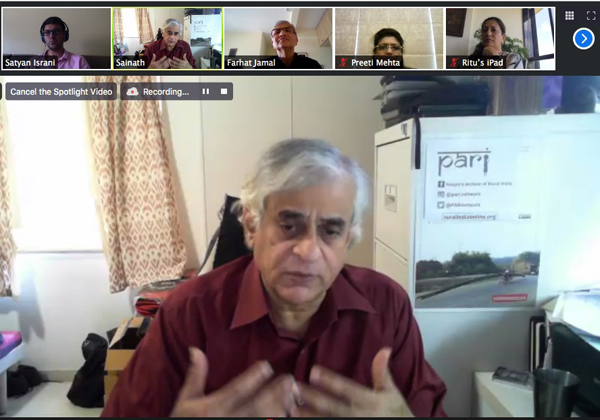
I have been a rural reporter for 40 years. I have lived with migrants, moved with migrants and the People’s Archive of Rural India, a website I started after I quit The Hindu as rural affairs editor for a decade, we cover
migrants 365 days a year. We didn’t discover them on March 26th, we understand who these people are. Even today, in all your discussions, can you pick up an ad, or a newspaper or channel or a discussion, which tells you how many migrants there are according to the census? How many interstate migrants there, how many circular migrants there are, how many long-range migrants there are, how many permanent migrants there are, how many footloose migrants there are? These are the different categories. We have no idea how many millions of them are there on the front. And here you are, extremely hungry people, many little Jamlos and you are going to convert food into ethanol.
What about the kharif crop? I believe you should not take any chances. From March 25th, when they announced this lockdown, I have been begging the farmers’ unions of the country, which represent a large number of farmers, to grow only food crops in the kharif season. Or there is a very fair chance that you will see a disaster on the scale that you have never heard of or imagined. Look at the Rabi crop, all the farmers who had grown cash crops are lying rotten or unsold. There are 70 lakh quintals of cotton lying and again we are going to grow cotton in Vidarbha, the epicenter of farmers suicide? Are we again going to grow sugarcane in Marathwada? Who will buy?
If these same people go for cash crops with the idea of exporting sugarcane, firstly, sugar prices are very fabricated, world prices are much lower than local sugar prices because here they have had powerful lobbies – the big sugarcane wala… there are millions of extremely poor sugarcane farmers as well. However, everyone in this meeting knows that worldwide there is a gigantic income crash, gigantic consumption crash. Are you going to buy a lot of sugarcane and cotton? I don’t think so. Poor people who make up the majority of our population are going to struggle to buy the essentials, the food.
Also, 77 per cent Indian farmers are net purchasers of food grain in the market. You can find that in Vidarbha and in Marathwada, cotton and sugar, guys who own two acres of sugarcane, three acres of cotton, they cannot grow anything else. Every square inch is to growing the cash crop because of the pressure of buying essentials for the family, paying off debts and loans. I understand these pressures but already cash crops are rotting in the fields. Imagine if these farmers do not have food for their own family. That is why, think about raising consciousness about it, asking the government. We need to concentrate on food crop growing cultivation in the kharif season or we are in big trouble. If we grow cash crops on a large scale, you are going to see another wave of farmer suicides, there will be no income, this time the governments may pick up but next time the government will say the we have no money. So that is one question that we need to ask what to grow in the kharif season?
One of the commonly repeated questions is: why did they leave? Will they come back? Of course, given our irresistible charm, why won’t they? But the destruction is going to be spread over a very long period. Still, many of them will come back because we spent the last quarter of the century destroying the livelihoods of the countryside. The question that you should be asking is why did they leave the countryside? Why did they leave their villages in the first place? That is the question that you must be asking not why did they leave us? They left us because we didn’t give a damn about them until we lost our services. We don’t understand that the migrants not only bring social capital to the city but also actual capital. Many migrants in the city bring Rs 10,000 or Rs 15,000 with them which they might borrow from family or wherever but these people have come to the cities giving us social capital, labour capital and financial capital. That is how much they have brought into this city. Seven cities that account to the majority GDP of the country are also the seven cities that account for the maximum number of migrants. So, it is important for us to know why they left the countryside in the first place?
We are focused on labour migrants because it affects us. Please note that millions of other livelihoods are completely devastated. How many of us know that handlooms and handicraft are the second biggest employers of the country after agriculture? Handlooms and handicrafts employ 10 times more people than the IT company sector. Now, weavers are starving, all the orders have been cancelled since mid-February. Many of us have tried to help these weavers (pre-Covid) by setting up market linkages like a BKC exhibition, Dilli Haat etc. Weavers and craftsman made the maximum amount of money in the year from those exhibitions which were held regularly from February to May. They were all cancelled this year leaving millions of craftsmen with inventory piling up to the roof and new cancellations everyday.
 The weavers of Chirala sarees, from Chirala in Tamil Nadu, are starving. But look at the discussions on television: can salons open? There is a caste group in the country, millions of people, called barbers. They are a helpless group because they exist in every village but they are the minority in every village. They are finished, they are daily wagers. All these jobs are gone. We keep talking about frontline soldiers against Covid-19 and talk about the doctors who are indeed the frontline soldiers, but we forget the sanitation workers. There are more than five million sanitation workers in the country and for the first time, in our better-off societies, we are seeing them with gloves. If you go to Chembur and in the Deonar area, you will see them doing the same work without gloves, without masks, without any safety.
Many of these sanitation workers were local government employees in the 80s. With the new reforms that we brought in, we sacked all of them, and outsourced them to contractors who re-hired the very same people, 99 percent Dalits, at lower wages and zero benefits. We are banging pots and pans to celebrate their achievement. They needed to be absorbed as regular government employees in class 4. The ASHA worker, she gets 4000 rupees a month, what justice is there in it? Are we going to address the questions of inequality in the country? The virus can threaten anyone in the world including the President of the United States but the impact is not equal neither is the threat. Because the lives of the vast majority of people in this country are so fragile. What kind of a health system do we have for them? You have one of the most privatized health systems in the world. If you look at the National Sample Survey, health rounds, the 42nd, 50th, 61st and 71st rounds concentrate on health. Each of the NSS surveys show us that the number of people not seeking medical attention purely for financial reasons is doubling and tripling.
Do you know that this country began before Independence, with the Bhore Committee of 1946 advising the construction of a National Health System on the lines of the UK or Canada? We never paid the slightest importance to it. We have accepted the idea of healthcare as something to be bought and sold and traded on the stock exchange not as a fundamental human need or right. It is embedded in your Constitution in the directive principles of state policy, that it is the duty of the nation to take care of the health.
We need to ask questions about how the lockdown was implemented, who it effected, were there different ways of doing what happened there? And you really need to ask yourself, have your media served you in all this? As a professional journalist who is in his 41st year, I never wanted to be anything else, I only wanted to be a reporter because I love connecting with Indian people because I love connecting with the Indian countryside. Yes, there are racism and sectarian, religious division everywhere in the world, but in no other country I have found a media’s performance as shameful as it is, as it has been particularly in the last two weeks where channels seem to exist just to demonize, create conspiracy stories. Another set of channels exist only to demonize the minority communities of the country.
My favourite WhatsApp message is a retired judge telling an individual that he saw a direct proof of this being a Muslim conspiracy to infect the nation. It has appeared in about 15 languages, complete falsehoods. I see a leading editor on the TV programme saying, never waste a good crisis. This is the time to ramp through labour reforms. 93 per cent of your labour have no rights because they are in the informal sector. And I am impressed that Azim Premji and Rahul Bajaj have said so, but they are a tiny minority. Both of them have said that it’s insane – as UP and MP have done – to suspend the basic rights of human beings, in this case factory workers and labourers. UP has withdrawn its ordinance but maintains the suspension of 38 labour laws.
I admire the compassion and we move forward on that compassion but please understand one thing, what the people on the highways require, what the people in the villages require, what the fishermen in Vizag require. You know what happens? There is a fishing ban between April 15 and June 14, which is the spawn season, which the fishermen accept. But it means that the two weeks before the breeding ban, are the heaviest weeks of fishing which came under the lock down, so now they starve. In each of these cases, it is not your compassion they need. Please understand that these 122 million jobs that were lost many of them were never marked as below the poverty line, they were not BPL people and many of them don’t have ration cards.
In her five-installment programme Mrs. Nirmala Sitaraman who, like me, is an alumnus of JNU, added up for you some 35 programmes that already exist. It doesn’t come to even 1 per cent of the GDP let alone 10 per cent. And one of the great announcements is that three crore people who don’t have ration cards will get ration. Do you know something? The same government cancelled three crore ration cards earlier. So, what is the new thing that you are doing? What these people need is not your compassion. I admire your compassion, but what they need is justice. What they need is enforceable human rights. What they need is basic recognition of their humanity. I think it is wonderful that in such a crisis you and I are getting together to help but it is a healthy not long-term relationship. But to try tackling this and remain in relief mode is like trying to mop the floor dry with the taps open and running.
There are a lot of fundamental issues and the greatest is how we approach the growing inequality which has devastated so many people.