
We Are Ready
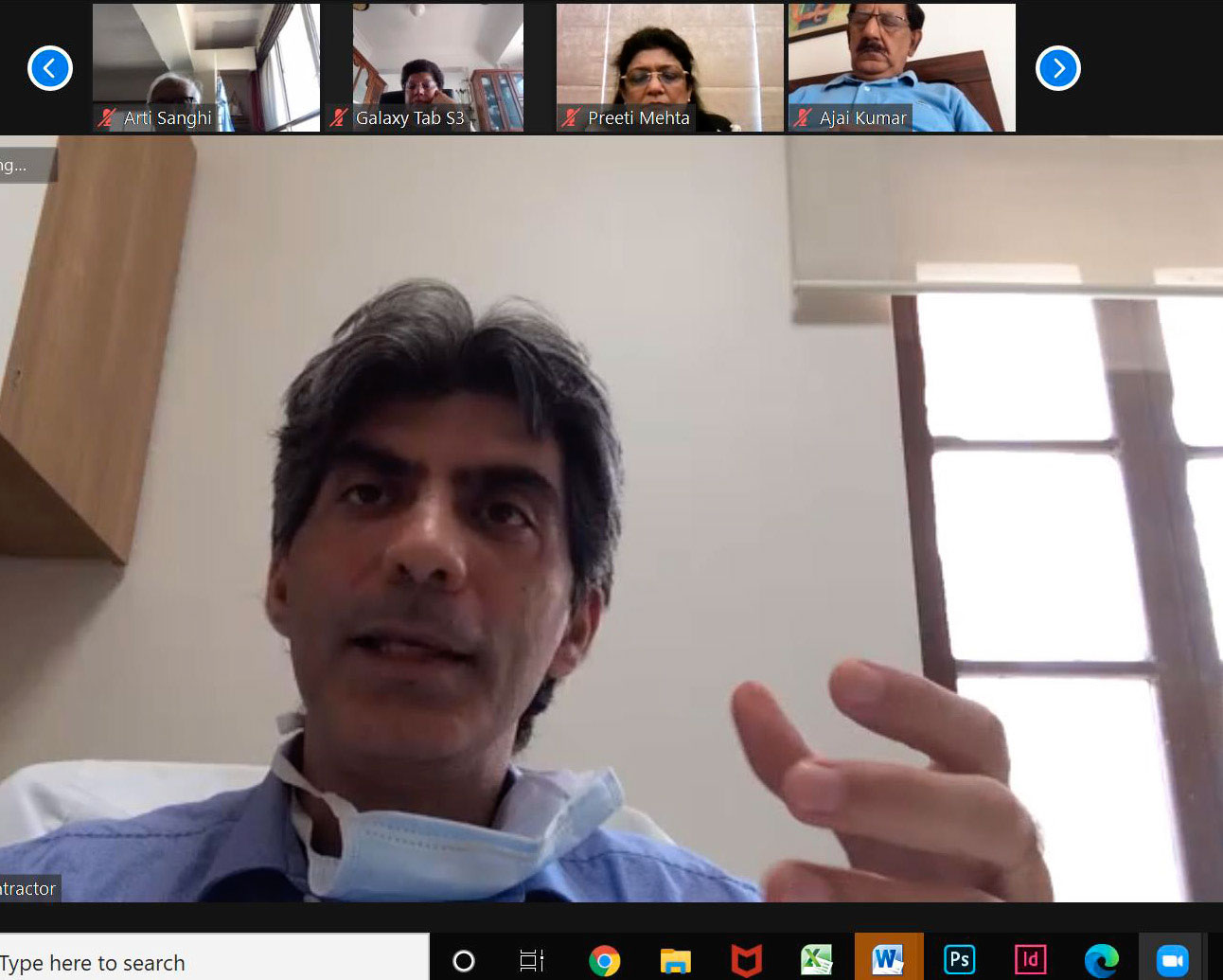
Rtn. (Dr.) Aashish Contractor provides an overview of where we are today with COVID19
ACCORDING to the official data from the Ministry of Health, we have 21000 active cases and we have 934 deaths as of April 28th, 2020, 8 am. The curve shows a slight upsurge in case of India, but considering how populous we are,… we are in a very good situation from a worldwide perspective. In terms of cases, the US is leading the tally with 295 per hundred while India is at two. The other important point is how the lockdown has been the strictest so far, it is like a curfew situation on road and that has been quite effective till now.
In terms of symptoms, one needs to watch for flu-like symptoms. One cardinal difference between the normal flu and this, is shortness of breath. It is necessary to keep in mind that not all show the standard symptoms of Covid, so if you have fever, cold or shortness of breath, please check with your doctor.
Another point is that of testing, I have members of family, friends and Rotarians asking me if they should get tested. It is not a good idea to get tested if you are asymptomatic. If you are, please consult a doctor. The ICMR has released the list of laboratories which are allowed to do the testing. Metropolis in South Bombay come to your doorstep to do test. If you are symptomatic, do the test. Earlier the Municipality had a rule that even if you are asymptomatic and you were positive, then they would quarantine you in a government facility – you could not be quarantined at home. From what I understand, today, facilities are becoming full and so you are allowed to quarantine at home. The fear that I am positive and I have symptoms, I am going to be locked up somewhere – that fear should be less.
In any case you should not get tested if you are asymptomatic unless you have been in close contact with someone who has then proved positive.
From day 0 when the person is not infected, to 30-35 days is the standard time when the nasal swab test, the RNA test comes positive. So people are now talking about antibody testing, which means that when your body fights any infections, you get antibodies, IGG or IGM. IGM typically becomes detectable six-seven days after you start symptoms and remains for 21 days. These kits test for your IGM and IGG. IGG is the type that starts once you start to recover and remains in your body for a longer time. If you do rapid testing and your IGM is positive, it probably means that the infection is in your body and then you can do a full-fledged swab and test. And if IGM is not there and IGG is there then that probably means that at some point without you even knowing you had the infection and now it is cured and now you have got protective antibodies which will last for the future. That’s the rapid testing.
Unfortunately there have been controversies about rapid testing. ICMR said that these aren’t necessarily accurate. There have been tests globally. But in terms of mass testing I think these would soon be available and they are going to be more convenient because they are literally a finger prick test, and the results are much like pregnancy kit tests. For large-scale openings like factories and mass office openings, this might be the tool that people use for testing.
Today, there are several groups all over the world looking for a vaccine to fight the virus. The good news is that a group in Oxford called the Jenner Institute, under Prof Adrian Hill, is way ahead in that race. Even better news for us is that the Serum Institute of Poonawala group in Pune has tied up with this Oxford group to manufacture the vaccine once it is tested and once is out in the market.
In terms of treatment from a scientific perspective, honestly, there hasn’t been a proven remedy yet. We are treating the patients but in science you go through a process called randomised controlled trials before you say any drug is okay. This means you take two groups of people and give the medicine to one group but not the other. At the end of the stipulated period of time, you check both of them and if you see that the medicine group is better than the other, then we say that the medicine is effective. There always has to be a randomised group because most people recover from the virus in any case. So, how will we know that the people who have been given the medicine recovered just by chance? That is why we need to have a trial.
Purely from randomised control trials perspective, there is no proven therapy or remedy as of now. Many parts of the world have been using hydroxychloroquine to treat the medicine along with azithromycin which is an antibiotic. One of the problems when using it is that you have something in your ECG, you have an interval called QT interval which is the start of Q wave and end of T wave. So if that QT interval gets prolonged, it can lead to arrhythmias or abnormal heart rhythms and giving this combination increases the risk. So that is the balance you need to keep when you give the medicine. Therefore a baseline ECG and ECG on a frequent basis is necessary while giving medication. So for the heart patients we (doctors) need to be a little careful which doesn’t mean we can’t give them the combination.
In terms of direct experience, some facts I’ll like to share. As you know the Reliance Foundation Hospital is looking after the section of Seven Hills Facility and right now there are 60 beds we are trying to look after and we are trying to expand this facility. We had over a hundred patients who have been discharged. So, general findings:
- We have seen more males than females and this is what we have seen also all over the world. The ratio is somewhere between 60:40
- The people with other comorbidities – diabetes or hypertension – tend to be more at risk
- In terms of age, we have actually found all ages. However younger people tend to fair better which is also one of the hypothesis of why India is doing better because we have younger population
- The people who do not have good outcome is the older age group from 60-70 and 70-80
- Those who come very late for treatment tend to have the worst outcome. So if you get typical symptoms, please don’t avoid them.
It is necessary to make sure that you are healthy, get adequate sleep because sleep is the most effective way to keep your immunity intact.
Be active! Being at home limits activity but you can do yoga and core exercise, it also helps to build your immunity. Of course don’t push hard on yourself as the immunity then paradoxically goes down. So the right amount of exercise is necessary.
Eat correctly. Tobacco and cigarettes should never be in your life but certainly not this time.
I would like to end on a positive note, I saw the data of the deaths in March 2020 and they were significantly lower than March 2019, 2018, 2017. So fewer people died in March 2020. Also, at hospitals, there are less people coming for acute heart attacks and strokes, and this is not just here, but all over the world. So somewhere the higher being is protecting us or people are taking better care of themselves. That is good news. I think India did a wise move of instituting the lockdown early, I think we had one trump card to play and we put it down pretty early and it has worked for us. Lockdown would not kill the virus but it will surely slow it down and slow the spread. The idea is that it will help us to buy time for research and medication and set up facilities and ensure that we don’t overburden health facilities.
QUICK FACT:
THE WORD QUARANTINE HAS A PERSIAN CONNECTION, A PERSIAN MEDICAL SCHOLAR IBN SINA FOUND THAT WHEN AN INFECTION IS SPREAD FROM PERSON TO PERSON, IF YOU KEPT THAT PERSON SEPARATE FOR 40 DAYS, THE INFECTION WOULD NOT SPREAD. YOU HAVE ITALIAN TRAVELLERS COMING TO PERSIA WHO WENT BACK TO VENICE WHERE THEY STARTED THIS CONCEPT OF QUARANTINE: ‘QUARANTINA’ IS 40 IN ITALIAN FROM WHERE THE WORD ORIGINATES.
I believe that the number of cases will increase next month but if we are ahead of the curve, we will come out of this much better than any other country.
When do you estimate normal healthcare issues like cardiac care etc are addressed?
It is an unfortunate aspect of this pandemic that normal healthcare suffers. That is the nature of the beast. We need to have stringent processes in place as to how we intake the patients. Like our hospital, most hospitals will not say no to any emergency. So a simple advice is if it is not an emergency, it’s best to consult with the family doctor over a call or Zoom call but in case of emergency, we are ready.
What are the precautions taken to protect medical staff?
As far as PPE is concerned, we are thankful to have adequate equipment. It is very well defined as to who needs Grade 1 PPE and who needs Grade 2 PPE. Everybody is scanned whether they be a nurse, doctor, CEO. We try our best to keep staff and patients safe.
Is there any reason why Mumbai has a higher number of cases?
Firstly, the number of cases is very ambiguous, it just depends on how much testing is being done. The more the tests, the more positive the number of cases you get. A better indicator is the death rate. I am not surprised that Mumbai has a higher numbers of cases because Mumbai is very populated, and it is the most densely populated city in the world with 40 per cent being in slums where social distancing is difficult. It should be more of a physical distance while being socially connected.