
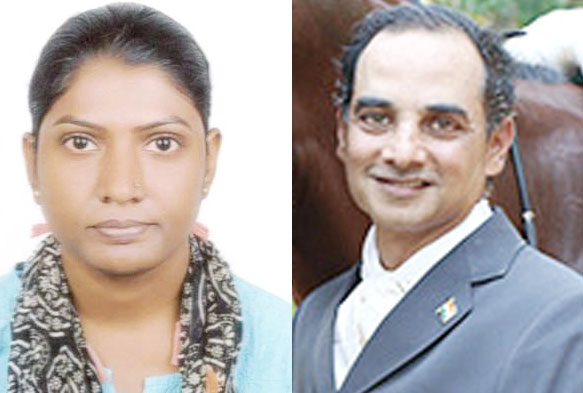
Social Activist Durga Gudilu, Recipient Of The Uma Jain Young Achiever Award, And Imtiaz Anees, Equestrian And Educator
DURGA MALLU GUDILU
I am missing my mother a lot today because she was always with me when I received any award, but she is not here today. I dedicate my 81st award to her. We were distributing ration kits last year, when she passed away in one of the Covid waves.
I am determined to make a school or hospital for my community because my parents were not literate, but they ensured that both their daughters got a good education. My sister was the first to graduate from my community. It is because of my parents that we see it as our responsibility to educate society.
Everyone lives for themselves but few live for others. I think God has sent me so that I can make a lot of Durgas in my community. I don’t think of changing the whole of India but I am making sure to change the society I am in, the community I am in, with my contribution.
The Vaidu community is one of the 42 nomadic tribes that you see on the signal begging or living on the road. I have been done that too. I still remember when I quit begging – I had a school friend on whom I had a little crush; once, while begging, I incidentally knocked on his door and he opened it. I felt so bad about begging at his house that I stopped begging altogether and have not begged since then. I understood that I have to do something different and so I started working in the community while studying.
There were a lot of issues in our society, the women were treated inferior, the caste panchayat (Khap Panchayat) wouldn’t even sit with women. If the panchayat is formed of women members, they (men) would take a bath before sitting in the panchayat. I thought that I had to change this. At the same time, my unborn sister’s marriage was fixed. She grew up to become the first software engineer from our community and decided to not marry. As a result, we became outcasts.
I understood that education is the key to fight against such injustices and empower ourselves. As a result, I want to get more education for our people. I am not greedy for money, but I know that when I pass on, my community will remember me. Today, not even 5% of Vaidu kids are educated, the violence and abuse is still prevalent, and it will take time to change, but that change will happen only if we try.
After my mother passed away, I was under a cloud of depression. Two angels helped me to get out of it and they introduced me to the Rotary Club of Bombay. The satisfaction I get after doing this work has helped me get on my feet again. Shernaz ma’am has always connected with us; I feel we will go a long way. My mom taught us that if we give something to someone, it multiplies. Neither of my parents were educated but they were very progressive.
When we enter the community, the sound of kids shouting, ‘Durga didi – Durga didi’ is what I define as happiness. We run a project called ‘Mera Sapna’ for children. We also work on adult literacy and education for women, that is, teaching them accounts, how to sign, how to open a bank account, this is what we are doing with the Rotary Club of Bombay. This journey with RCB will hopefully go a long way. I again thank all of you for recognising my efforts, this makes me determined to work harder.
IMTIAZ ANEES
My story is nothing compared to Durga’s, I look forward to people like you and we need such people and that is what this whole world is about. That is the reason I wrote my book as well because it is about making a difference. There is no point of getting up in the morning and doing the same thing that everyone else does.
When I was six years old, I had just one dream: to represent India. I didn’t even know which sport because I was that young. For me, it was a pride to wear the Indian blazer and see the Indian Flag. I used to write victory speeches wherever I went. Even at that young age, I still remember that if anyone was nice to me, I would make a note of their name. My parents would ask me the reason, and I’d say no, when I do represent India, I must remember all these names. This will be my victory speech; that is how I used to think. So, most people sang songs in their bathrooms, I wrote speeches and kept on talking. I did talk a lot and that is how I used to think.
As time passed by, the dream stayed on. It is a long story, and you have to read the book for it. But I was fortunate that I found my passion at the age of 11, and my coach, who was an ex-pat coach to India. It is all about having good relationships, good mentors and people to guide you and help you achieve goals.
I am going to jump from age 11 to 30. For 20 years, I trained with the same coach, and she took me to the Olympic Games without an exchange of money. She saw the passion in me, and it was also how and what my family did, how our country treated her. She was so grateful to India that she thought that this was her gift to us. So, it is about having people come into your life at different stages to achieve your goal.
In today’s age, one of the biggest things is having mentors. When you are in school and college, we have good teachers and professors, as you grow older you need people all the time and a realisation like this is perfect. That is what this organisation is all about: helping people; it is not about financial gain or fame; it is about what you want to achieve. When you are in a pathway and you don’t know whether to go right or left, you just need that help. You need advice and I had amazing mentors throughout my career. They just came into my life. I don’t know who they were and where they were. Whenever I came to a wall that I could not climb, somebody came and helped me, literally picked me up and put me over the wall and then I was on again. As soon as the next wall came, there were other people that came to my life. That is the beauty about the whole life that we live.
It is about value-adding, it is about giving back to society. I tell the kids at my riding school: how you carry your life is how people get attracted to it. So, it is easy to say I didn’t have enough time, money or resources. You will never have enough, you have got to make the most of it, you have to take charge, set your goals and go for it.
I was lucky that I was selected to represent India at the Asian Games at the age of 24. I was the first civilian ever to represent and I was so excited; they had trials in different parts of India. And it was all Army, and I was the only civilian, they made it more difficult, they put a trial in Bihar. To reach there, get my horse there, do the trials, but it didn’t deter me. If there is a will there is a way. There are people who helped me out, I took trucks, trains, my parents didn’t even know what I was going through, but I did it.
You realise that hard work must be there. It is not about making all the money in the world, it is about achieving something; have you value-added to society, have you value-added to the people next to you? It is not about doing big things; it is about the little things that make a difference.
A night before the Asian Games in 1994, I was wearing my blue blazer and I was so excited to represent India and the morning when the team was announced in The Times of India, my name was not in it. They had removed my name, I was shattered. I was only 21 years old and my whole world came to an end in one shot. Politics, bureaucracy whatever you would like to say, it was earth-shattering, I couldn’t get out of bed. My parents came to my room and asked me what I wanted. I said I wanted to represent India. They said just one thing: get back on the saddle. So, this is the kind of support that we need.
This is life, you can sit and cry or you can get up and get it done. I am firm believer of this. I was fortunate enough that in 1998 I got into the Asian Games again and I won a medal for India, but it didn’t end for me there. That was not enough, I wanted to go to the Olympics. My parents looked at me and asked whether I was serious. There was no question, they said, with me being a civilian. Plus, where would I do it? There were no qualifying events in India. I said the Olympics Game is in three years in Australia, and that is where I am going to base myself. They supported me. So, I moved base with help from friends and family. I found a stable where I could train and work at, I stayed in the stable, I worked every day, just to learn. It was not easy at all; it would break me every day and every time my parents would call and ask how it was going, and I would say fantastic, I love it. They had no idea what I was going through.
I was struggling; an Australian family saw how hard I was working, how dedicated I was in my work, and they said, ‘this is not a programme for you, you come and live with us’. I lived with that family for three years. I didn’t know who they were, and they didn’t know who I was, but they opened their home to me. Their kids became family to me, I trained with them at their place for the 2000 Olympics. So, when your heart is in the right place, when you are sincere, there are no barriers. That is the most important thing that I tell kids these days: if you are sincere, if you have the best intentions, people will come together and help you. And you will achieve what you have achieved and I was fortunate enough in 2000 that I represented India at the Olympics; after that I went to the World Equestrian Championships and made a career out of this. So, that is my story.
This is the reason I wrote my book, so that I could tell people about getting out of their comfort zone. Don’t do what everyone does. Don’t do something just because it is convenient. We are supposed to live the lives we want, there is going to be discomfort and the one thing I can assure you of is that there is going to be failure. But it is about overcoming these failures and learning through those experiences. Achieving something that is just a little bit more than the norm is important for life.
Rotarians Ask
What are you doing today? What exactly have you started?
I was in Australia, training the young riders of the Australian team and came back to India due to Covid. Since then, I realised this is the time to give back. I have achieved what I want to achieve, so, I started an Equestrian Programme to train young riders to go overseas and train and represent India. That is one part of it: we teach kids how to ride, how to deal with animals – it is so different from other sports.
It is the only sport in the Olympics with an animal, you must look after the horse. So, we teach how to take care of them, feed them, look out for them. My goal is residential schools; the kids can come from any walk of life, it is not about money; if you have the desire to do something, please come. It is a school where we teach all the aspects and place them overseas to pursue their career in this field.
Have you tied up with the Olympics or something?
Unfortunately, we can’t, because we don’t have qualifying events in India. The level is so high that India doesn’t even feature in it. So, it was a little crazy for me, too, to choose a sport in Olympics that doesn’t exist in India. But you will find people to help, it is about your attitude, discipline and determination that other people see and that is how they help. That is what this school is about, it is not just about riding, it is off the horse – management, discipline. It’s all structured.
Where is the school?
It is a small fishing village three hours from Mumbai, called Nargol. It is where the Parsis first landed in India. Parents like it more than the kids because there is no wi-fi. So, there aren’t many electronics. We mainly advertise through social media.
Like in the F1, as they say, a lot of the success depends on the cars; is there anything like that in the breed of horses in India? How do you compete with the breed of Indian horses and those abroad?
That’s half right, half wrong. You do need quality horses, that quality is available in India as well; we have to train them and that is what is important. Without education, there is nothing; until people go overseas and educate themselves, their level of knowledge won’t increase. We have the horses, but we don’t have education or infrastructure – the grounds, the training, the facilities. That is where we have to improvise. It is easier for the riders to go overseas than set up the infrastructure here.
Is there any exchange of energy between you and your horses?
Absolutely. My connection with each of my horses is different and most important. We have that bond, that connection to achieve something.
You said there are people who came in your life, is that also an exchange of energy?
It is a hard one to say but I think it is the vibes and the attitude you put forward. I didn’t have the money to train with top riders and top horses, but the one thing I did have was time and dedication. I still do; I ride a lot, teach the entire day. So, I would go to the competitions and watch the warm-ups, do as what they do, drop a jump, if they dropped the fence, I would pick it up and be on the side. I don’t know how many shows I did this for, when one day, a rider came to me and asked, ‘boy, you ride?’ I said yes. He said, ‘come and ride one of my horses, I am short of riders, come in the morning.’ So, I went there, on time, right clothes, right shoes. First thing in life is show up and be on time. That is the most important thing. Be ready in the ring. So, I used to take care of his horses, do everything and that is how I trained myself, and once he gave his horses to me for free because he saw my dedication; people see that.