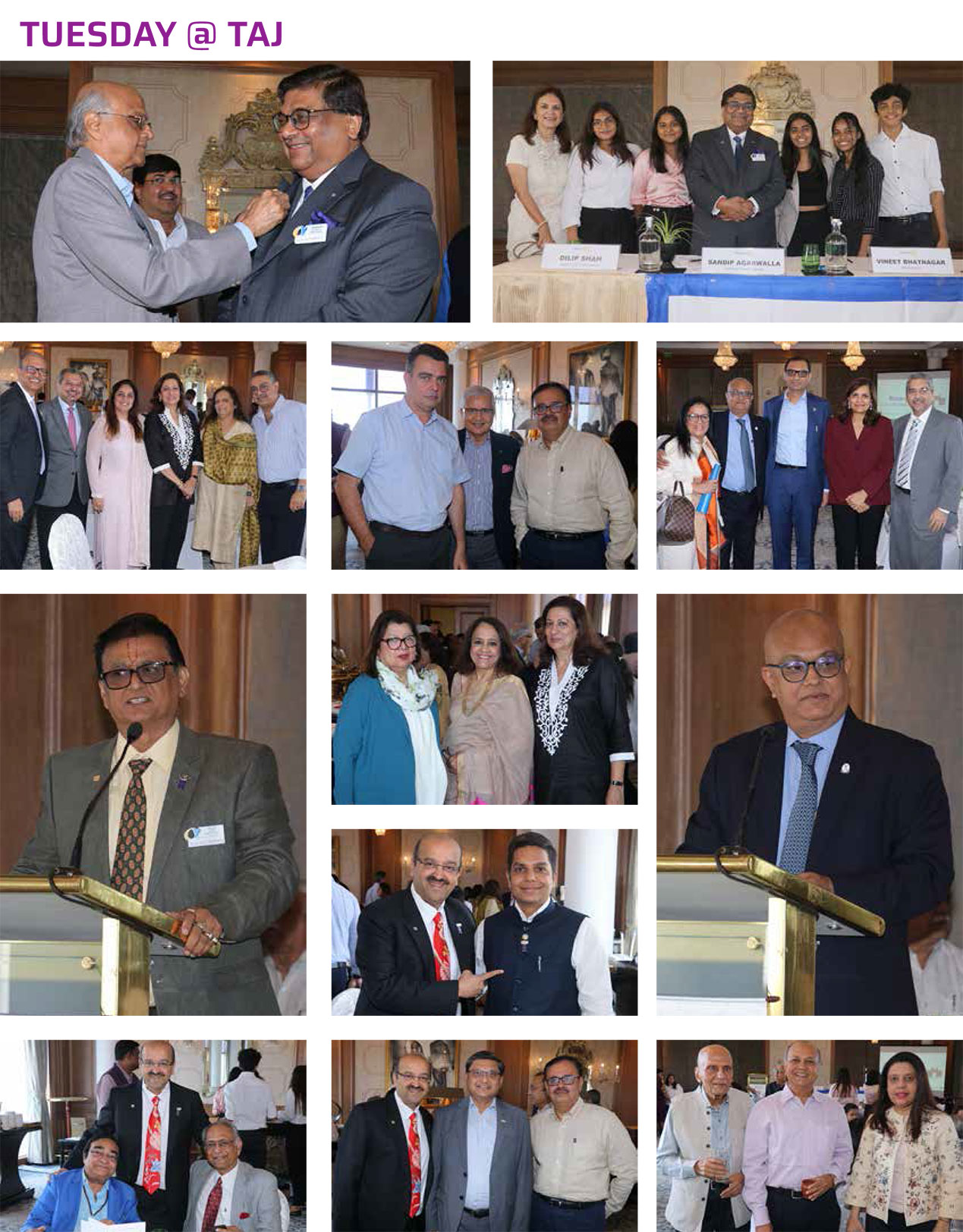
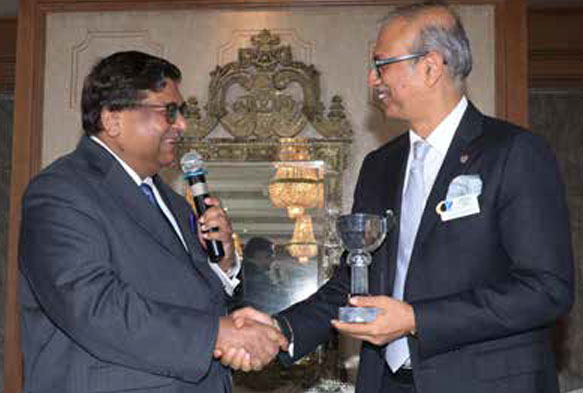
Official Club Visit Of DG Sandip Agarwalla
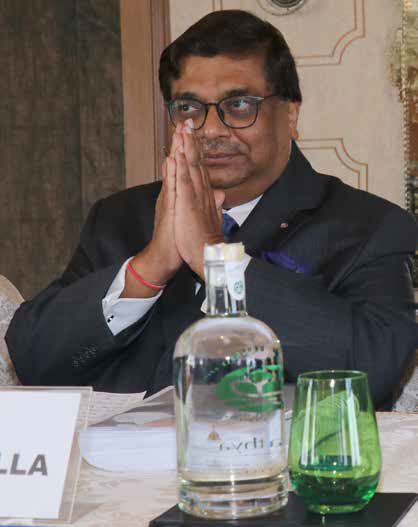
DG Sandip Agarwalla, a member of the Rotary Club of Bombay for 32 years, spoke about his passion for RCB as he stepped up to the podium on his Official Club Visit last week. While congratulating all the hard work of the year past and the success of RCB President Vineet Bhatnagar, he also reflected on the challenges that lie ahead.
“We are today standing at a membership of 351 members, which includes our satellite members which are 26,” DG Sandip said. “So really our Club is 325 plus 26 satellite members. President Vineet has added 25 new members this year. It’s a humongous task; it’s not easy to whet the quality of membership and yet induct them in such a short span of 12 months and it’s only 10 months since he’s done it. But we’ve also had a record loss of 14 members this year. And that means we’ve added a net of 11 members so far.”
Despite this setback, DG Sandip remained optimistic about the projects that had been completed over the past year and the growth in TRF collections. He said, “The kind of projects we are doing, the kind of responsibilities and
long-term commitments which we’ve taken, we need to keep growing, and we need to keep growing at a far more aggressive pace than we have been. It doesn’t matter what our absolute numbers look like; what is important is what is the number of working members we have on hand.”
DG Sandip challenged PE Manoj Patodia to continue the Club’s growth in the next Rotary year and to focus on increasing the number of working members. He also stressed the importance of doing large, impactful projects.
Speaking about The Rotary Foundation, he reiterated its goals of promoting peace and international understanding through various programmes and grants, such as the Global Grants programme, polio eradication, and peace scholarships.
Sandip emphasised the importance of doing good in the world but also stressed the need for sustainable projects that will make a lasting impact. He stated that the foundation should reserve 20% of its spending for immediate aid and 80% for long-term, sustainable projects.
“The whole idea of doing these programmes is with one aim, to bring peace in the world through international understanding and promoting goodwill. And that is what The Rotary Foundation hopes to achieve,” he said.
DG Sandip acknowledged that while immediate aid is necessary, it is not sustainable in the long run. He suggested waiting for the dust to settle after a disaster, sending a team to assess the situation, and then determining what is needed for longterm sustainability.
Sandip expressed concern whether the Foundation has lost sight of its original mission, and that it has become
disconnected from the realities of many communities. He expressed disappointment over the Foundation’s recent decision to turn down a project for solar lighting, saying that they did not understand the needs of the village.
“The principle of 80:20 is something which the Foundation is kind of losing now,” he said. “How do they know what a village in India is suffering for want of electricity? They don’t. They’re living in an ivory tower, completely
disconnected from the realities many times. And that is why I have written many times for them to reserve 20% of the spending on doing good in the world and 80% on long-term sustainable projects. But let’s look at the brighter side. 80% of the work they’re doing is something fantastic, which is transforming our communities, our organisations and individuals permanently. And that is what we should be doing even at the club level.”
“So, even if we use a Grant method or whether we use the Foundation funds, or whether we use our own funds, we
should only be looking at the long-term and sustainable projects to the extent of 80% with the view to transform that community organisation forever, so you don’t have to work on it in a big bang approach.”
DG Sandip went on to talk about RCB’s initiatives under the Panchatatva project aimed at improving the livelihoods of communities in Gale Village. The village had been improved incrementally and permanently, he pointed out, with the construction of a livelihood centre equipped with oil seed pressing machines for producing oil, bamboo weaving, cutting slitting machines, and other projects such as groundnut processing and rice hulling. Sandip emphasized that the projects were aimed at improving the village’s livelihood and not just providing water and lights.
The speech highlighted other initiatives that had been implemented in the community. Anganwadis in the schools had been renovated, girls were provided with cycles to travel to secondary schools, and toilets in the village had been reconstructed with wall-to-wall tiling, making them more pleasant to use. Furthermore, the village had been given safe drinking water, and a pipeline had been installed to provide an adequate water supply with lift irrigation. Solar streetlights had been provided to light up the village.
Sandip went on to highlight the efforts to improve adult literacy in Palghar District, the second-largest tribal district of India. The goal was to educate 25,000 women in Marathi, with the help of a module provided by Tata
Consultancy Services. He said, “We want to educate all the illiterate women in Palghar and make them functionally literate.” By the end of the year, he added, they would have educated about 9-10,000 women, thanks to the support of CSR donors who had pledged to provide matching funding for the project.
The speech emphasised the impact of educating illiterate women, with a focus on functional literacy. DG Sandip stated that the ability to read bus numbers, fill in bank forms, maintain arithmetical accounts, and teach their children was women’s empowerment.
Finally, the DG highlighted the dharamshala project, where 100 flats had been furnished into inhabitable flats with modern amenities, for patients coming from outside Mumbai to Tata Memorial Hospital. Talking about the beneficiaries, he said, “Who is it serving? All those patients… living on the footpath and pavements and under the flyover near the hospital, in absolute filth and with such dreaded diseases. They can’t go back home because they need to go back to the hospital every 10 or 15 days for their radiation or chemotherapy cycles. We expect 300 to 400 persons to take advantage of this every day.” He emphasised that the commitment to maintaining the place’s hygiene, cleanliness, and sanitation would be for 30 years, with funding tied up for 10 years for maintenance.
The DG then spoke of the importance of impactful projects in transforming communities. By investing incrementally in communities and focusing on long-term solutions, communities can be transformed permanently. He spoke of how simple interventions like providing safe drinking water, reconstructing toilets, educating women, and providing
housing can make a significant impact on people’s lives.
Lauding the diversity of projects undertaken by the Rotary Club of Bombay, he included the biodiversity park on the Kalina University campus, which will be run for 10 years, and the paediatric heart surgery project that serves
hundreds of children yearly, the medical centres, and projects focused on art, culture, medical literacy, economic and community development, water, and sanitation, all of which shone a torchlight on the indomitable spirit of RCB members. In addition, Sandip also encouraged them to contribute generously to the Rotary Foundation to maintain vigilance and eliminate polio globally.
In the field of environmental science studies, RCB has instituted an environmental science curriculum, developed in conjunction with Oxford India Center for Sustainable Development, a division of Somerville College of Oxford University. Experts and environmental scientists were brought on board to construct the content and worked with professional illustrators and artists to craft accompanying visuals. The material was peer-reviewed by the Bombay
Natural History Society, then edited and translated into Marathi and Hindi, with the potential for additional languages. Additionally, RCB developed an E-module kit which was submitted to NCERT to be aired across 12 free Doordarshan channels, which have a total viewership of one hundred million children. Even before the National Education Policy made the study of the environment mandatory, we had this content ready, DG Sandip said. Currently, it is being implemented in Palghar and 3000 students are already taking advantage of it. In addition, any Rotary Club in India or abroad can access the material for free.
Rotary’s projects have also focussed on economic and community development, water, and sanitation. The club provided hand wash stations to 700 schools, and 150 schools received safe drinking water for a student population of 80 or more. These projects started before the pandemic and have continued with advocacy and teaching students the benefits of hand washing.
efforts towards diversity and inclusion, including the establishment of the first-ever Rotary Club for the LGBTQ community called the Rotary Club of Mumbai Equivalents which came into existence only three weeks back. He said that inclusion should not only be based on gender, age, profession, vocation, or religion but also sexual orientation and preference.
Rotary is set to play a pivotal role in the corporate social responsibility (CSR) landscape in India. According to DG Sandip, there is no country in the world where the government has mandated that profitable corporates have to
compulsorily donate a portion of their profits to charitable activities. This is where the Rotary Club of Bombay
comes in, as it is well-positioned to take advantage of this opportunity. The club has two separate structures: the Rotary Club of Bombay and the Rotary Club of Bombay Charities Trust. Members pay subscriptions to be part of the former, which takes care of all administrative activities, leaving the trust with zero admin costs. This is crucial when it comes to CSR prospects, as every rupee donated goes towards the intended cause, unlike other NGOs where admin costs eat up a significant portion of the donation.
THE CLUB’S IMPRESSIVE FINANCES ALSO MAKE IT AN ATTRACTIVE PARTNER FOR CSR DONORS. AS OF JUNE 2022, THE CLUB HAD A CORPUS OF RS 24 CRORE. By March 2023, the Rotary Club of Bombay Trust’s corpus had increased to Rs 34 crores, translating to over ten lakhs per capita with 325 members in the club. The Club’s commitment to projects is equally impressive. In the current year, the total commitments received for future expenditure amount to 26 crore rupees. With two months left to go, the club expects a minimum of Rs 15 crore, bringing the total to Rs 60 crore. The Club’s leadership emphasised the importance of getting involved in the administration of projects and ensuring
the best quality at the best price. DG Sandip also commended the Club’s membership growth, TRF giving, and project execution, making it a significant contributor to Zone 4, one of the most powerful zones in South Asia. IN CONCLUSION, DG SANDIP CONVEYED THAT THE ROTARY CLUB OF BOMBAY IS POISED TO MAKE A REAL DIFFERENCE IN THE CSR LANDSCAPE IN INDIA, THANKS TO ITS IMPECCABLE STRUCTURE, IMPRESSIVE FINANCES, AND COMMITMENT TO QUALITY PROJECT EXECUTION.