
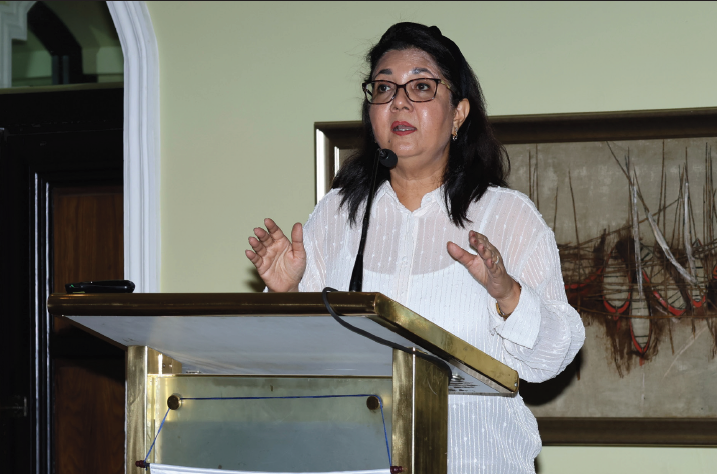
Sifra Lentin, Bombay History Fellow, on ‘Internationalising Indian higher education: Work visas for foreign students’
I’d like to thank the Programme Committee of the Rotary Club of Bombay for inviting me to speak on my latest paper: student work visas for foreigners pursuing a college degree in India. I make a case in this paper why the Government of India should amend its current “S” student visa category to enable foreign students not just to work in paid internships or work during college breaks but also to work for a limited period in India post-study. This is a global norm in most advanced countries, but it is not allowed in our country. You may wonder why I am proposing this right now.
The urgency is because we’ve had a new educational policy . “I’m very clear that what I’m talking about is not mainstreaming these students to a work permit or residency in India but allowing them to work here for limited time and this has a number of virtuous fallouts. Fundamentally, reciprocity is a foundation of good and sound foreign relations for our country.”
– Education Policy 2020 – which completely overhauls the higher education ecosystem in our country. It talks about benchmarking our
education to global standards in terms of curriculum, teaching methods, a student-centric approach or even attracting better or producing more research papers. These are all global benchmarks based on which colleges get their inter or global rankings. We don’t have that here, but pinning this entire overhaul is a concept of interisation.
It talks about attracting more foreign students to India – we do not have too many of them, and attracting foreign faculties to come and teach in our universities and colleges, and attracting foreign researchers so that Indian researchers or post-doctoral researchers can build global networks.
In academia, when I went abroad for a year, the thing for all the top professors is you either publish or you perish; that is it. Here, my findings suggest that it is a politically sensitive subject because the Government of India says that our educated students don’t have jobs, so what are you talking about giving jobs to foreigners in our country?
But my findings and suggested policies say it sort of veers away from this idea and we – the Gateway House – has recently come out with a paper compiling all the data points and my recommendations.
The thrust of this paper is that if India has to interise and we are opening our higher education system, one way of interisation that has been overlooked is the parallel approach, that is, student visas that permit inter students to work in India for a limited period of time.
Before I begin, I’d like to briefly talk about our organisation to give you an idea of why we have done this paper. Gateway House is amongst the very few foreign policy thinktanks that are based in Mumbai. Most of them are based in Delhi and the Delhiwalas are very aware of the thinktank world. So, we are very different. We are not a consultancy like McKinsey or Ernst & Young. Our job, the reason we chose to be present in Mumbai is because Mumbai is the financial capital of India. We feel it plays an unsurpassable role in influencing foreign policy, particularly monetary and fiscal policy, trade, supply chains, connectivity and companies.
I’m a Fellow of Bombay History and soft diplomacy. Bombay history and its inter connections form part of soft diplomacy. So, Indian diaspora relations are also a part of my study vertical.
This is where the education part comes in because education is part of soft diplomacy. Not only do we send students overseas, but we also attract students who come to our country and become our cultural ambassadors there.
So, the basic proposition, what got us really thinking about this paper, was the Afghan student problem that happened two years ago.
When Afghanistan was taken over by the Taliban government, most of the Afghan students, and there were 14,000 of them here in India, were stuck. They had no funding, they could get no funding, and they had to go back, but their lives were at risk. So, the Indian government, especially the ICCR (Indian Council for Cultural Relations), extended their scholarship periods and provided them with extra time to stay on. That’s when the idea came up within Gateway House.
If our students can enjoy the privilege of work experience during and after studies abroad, why can’t foreign students enjoy the same privilege in India?
This may sound politically very naive, given that India has 378 million youth in the 15 to 29 age group, or about 27% of our population, and 12.7% of them are unemployed.
So, how do you logically explain that you’re going to give foreigners a job here in India? But after closely looking at the Government of India statistics which my paper has, and interviews with educationists involved with foreign students in universities like Manipal, Symbiosis, and IIT Mumbai, I realised that it wasn’t really that difficult to implement
reciprocity, and, it is very doable if you have a system of checks and balances.
I’m very clear that what I’m talking about is not mainstreaming these students to a work permit or residency in India but allowing them to work here for limited time and this has a number of virtuous fallouts. Fundamentally, reciprocity too is a foundation of good and sound foreign relations for our country.
So, it’s good for India and India’s external relations. You may ask why now? I’ve been a student at Elphinstone College, and we had Iranian students and Iraqi students in the late ’90s and in the early ’90s. We’ve always had foreign students coming to India. Today we have, of course, Bangladeshi, Nepalese and Afghani students from the neighbourhood. The Government of India statistics say that we have students from 163 nations who study or pursue degrees in India. The reason this moment is important is because of India’s NEP 2020.
Sections 12.7 and 12.8 of the NEP are full of legalese, so I’ve just extracted the important parts. Basically, make interisation of Indian institutions, higher education institutions, fundamental or the key pin to all the changes that have been recommended in this policy in our college system. I’ve got a son who studies at Jindal Global Law School, and the private universities have implemented most of the recommendations of the NEP. At the time when he was applying for admission, and I asked him, ‘Why do you want to go to Sonipat of all places? You’re here in Mumbai, we’ve got good colleges here, why don’t you study here?’ He said, ‘Mommy, you don’t understand. The issue is that I’m getting an international education.’ So, he enjoys it, he likes the education there, he enjoys it a lot more than he did his undergraduate studies in Mumbai.
So, these are the changes that are happening, and as parents and as adults here, we don’t realise the rapid evolution taking place in our education system.
Now, what has been the outcome of this NEP? You may be reading in the newspapers that Indian universities are setting up campuses overseas, for example, IIT Madras has just opened their courses on the island of Zanzibar off the East African coast. IIT Delhi is opening a campus in Abu Dhabi, and, of course, I must mention here that Manipal University has had a campus in Dubai since 2000. So, they have been a little ahead of the curve. We also have a lot of foreign universities coming into India, particularly the Australian universities and, at Gateway House, I had the opportunity of meeting all these delegations. Their education person said they find it very easy to adapt their systems in Australia to the Indian system. It’s sort of the students here understand it, we understand them. So, we have two universities coming up at GIFT City and one university has already announced the setting up of a college or university campus in Bengaluru.
Given all these changes and, of course, the last thing is what the Indian universities are doing, regulations have already been passed by UGC regarding twinning initiatives between an Indian university or college and a foreign university and college and here, they’ve put one restriction. When they brought out the policy, they talked about the hundred top colleges or universities. Now they have expanded the pool to the 500 top colleges and universities. So, we have what are called joint degrees, dual degrees, and semester abroad schemes in most of our new private universities. This makes interisation or at least adopting a parallel approach to interisation to attract more foreign students, that is why the visa route is all the more important.
So, you can see that although the NEP 2020 has been out now for three years, there hasn’t been much of an uptake in foreign students coming into India. We do have that prior to the NEP 2020, there is a platform called the Study in India platform which was uploaded or has been functioning since 2018. But this has made absolutely no difference to the student uptake. This year there was a slight uptake in students applying – not too many sat for the Pragati Entrance Test – but it’s not reached the target of two lakh foreign students set by the Indian government.
To give you an idea of foreign students’ top countries of origins, students from Nepal, Afghanistan, Bangladesh, the US, surprisingly, the UAE, and Sudan, are the top sending countries for India and they make up almost 67% of the cohort that comes to India. So, although we talk about 163 nations or students coming from 163 nations, it is just a handful of 10 countries, five to 10 countries that’s the majority of the students. As I said earlier, the missing link in this policy is being talked about in government circles because I spoke to people in Delhi. Most of them spoke, they didn’t want to be quoted. Most of them said this is being discussed, but it’s still not happening. Student work visas are the missing link, and it is the only way to attract more inter students into our colleges. The top reason being that foreign students would like work experience in Indian companies. So, whatever it is, India being the fifth largest economy in the world, likely to be the third largest economy in the world, they would like to know the markets. They would like to learn how to navigate the regulations. And they would like to be acclimatised to the Indian work culture, which makes their degree that much more valuable.
So, where do our students go? India sent 750,000 students last year abroad. And we have an outgo in foreign exchange in billions of dollars. I read some newspaper articles. I don’t want to quote the number, but they said almost 60 billion in outgo for the 750,000 students, not just fees, but just in living costs and other things. So, the most popular countries by origin are Australia, Canada, France and Germany are becoming popular. We have the UK and USA. Now, what is common between all these countries is that they allow paid internships and post-study work. In some countries that have a shortage of skilled labour, they allow a mainstreaming into work permits and eventual residency, which makes them very attractive to Indian students, in addition to the fact that they are all English speaking countries with the exception of France and Germany.
The countries that do not allow post-study work is Russia, where a lot of our medical and engineering students go, and all the Central Asian republics also. China has just introduced, in a small way, work experience after study in their SEZ zones in Shanghai, in two of the SEZ zones. So, they’re slowly testing the waters and maybe will open up work for students.
How does India benefit from a student work visa? I’ve already touched upon reciprocity, but the most important thing is that we have a talent pool that can be trained in India by globalising Indian companies and then posted in branch offices and projects in their home countries. What happens is when the companies go for on-campus recruitments, they can recruit these students, train them, and well, they need not necessarily take a job in the same company, but it could work out that way.
So, you have people already acclimatised to the Indian way of working, working in these companies overseas. Foreign alumni from Indian colleges have always proved to be a natural cultural bridge between their country and India.
I know for a fact that when I had called up the Ministry of External Affairs, they said that they were undergoing this exercise of compiling the names of all their students, ICCR and Ministry of External Affairs scholarship students, who have studied in India since the 1950s. Now, we know the two most popular names are Aung San Suu Kyi, who’s from St. Stephen’s College in Delhi, and former Afghan President Hamid Karzai, who studied in a university in Himachal Pradesh.
The government doesn’t say this, but education now has become a services sector and is one of 12 champion sectors for the Indian government to promote abroad, and for the commerce ministry in particular, to promote abroad. So, they see the potential of how much of a money spinner or foreign exchange earner education can be.
Now, I just want to give you an example which I came across when talking to the Dean of Inter Relations at Manipal University. He told me a very interesting fact. He says, you do not realise it, but since the 1950s – Manipal University was founded in ’53 – we run an MBBS programme with Malaysia. That means they have had two campuses. They had a medical school at Manipal, and they had a medical school in Melaka in Malaysia. Malaysian students would come to this dedicated medical school on their campus in India for two years and complete their residency in Melaka in their home country but earn an Indian degree. So, what happened today? One in four Malaysian doctors have Indian degrees.
So, you can just imagine the kind of goodwill one university like Manipal has generated and this programme was discontinued two years ago because suddenly the Indian Medical Council woke up and said that you cannot award a degree when the residency is being done overseas, and residency must be done in India. But they also haven’t opened the door to foreign students doing a residency in India. You can do it for a postgraduate medical course, but you cannot do it for the MBBS course. So, this is the kind of potential.
Even a company like Mahindra and Mahindra had a programme where they would bring down foreign students from the top Ivy League universities in the US and acclimatise; they were undergrad students who had just completed their graduation, and kept them here on a two-year programme, which has been discontinued now. But they found that most of the children who chose, but this was many years ago, were the more adventurous kind, were the ones who wanted to experience India, and it worked very well. There were hiccups, but it worked very well. So, this is the kind of soft power that Indian education can exert overseas.
Now, the biggest bug bear for this policy is of course India’s unemployment rate. I touched upon this, I said 12.7%, we have an unemployment rate in the 15 to 29 year age group, but this unemployment rate is actually declining. The fact is that I came across only, I could find only one report, which has been also the stakeholder is UGC, and the Ministry of Education, and that report, 2023 report states, that it’s not unemployed, it’s not that jobs are not available for the students, the fact is that the quality of education is very uneven across the higher education ecosystem. Often, Indian graduates or post-graduates require further skills to make them employable.
Given this, the way I look at it is, can we not introduce a certain element of competition?
Because, if you have foreign students or your university or college has foreign students, it means they have to raise their standards. It means the standards will be raised across the board, even for Indian students, or otherwise they will not be able to survive.
This is the way I look at it. It is a slight risk. Most people would slam me at this, but I think it’s worth it. If there are certain checks and balances on the way that India implements this process.
The last part of my paper covers a staged implementation for a student work visa. What I’ve said very clearly is, yes, pay them, but allow them to work for a limited period. So, what we do is that in stage one, there are a number of ministries who are involved. One, the most important being the Home Ministry, which looks after security, internal security, the police; all these students have to be registered with the Foreigner’s Registration Office. So, the first thing is the Home Ministry.
Then we have, as regards visa, the External Affairs Ministry. The Education Ministry, which is the main point of contact between the university and the Centre, and also the companies who are coming to this loop when recruitment takes place. So, I have suggested a staged implementation from two points of view. One is to ensure that the coordination structures and communication structures between all these stakeholders works well. And secondly is giving them time to tweak the policy. It may not be exactly what I have suggested here. This is just a framework which I worked out with a former director general of ICCR. And we talked about this, we discussed this, and decided that maybe this was the best way to do it.
In stage one, you have post-degree work for one year only. And that one year only is for stage one and stage two. Only degree students from institutes of eminence and institutes of importance in the field of STEM and management studies. Now these are children who have really, or individuals who have a high level of skill and capacity. And lastly, all PhD students should be eligible across the board, across all colleges, universities, or fields of study.
At stage two, we stick with the one year, but we increase the pool of STEM students and make the benchmarking more inclusive, where you take the private universities, the state and regional colleges. So, a lot of ICCR students, MEA scholarship students come into this pool. Now this is all up for discussion. I mean, the policy is not firm, it’s just a suggested policy. So, I’d like to hear from some of you in the audience who are educationists about this and also students in social sciences who have completed both their undergraduate and postgraduate studies, who have at least done five years of education in India.
The reason for this is that means for five years they’ve had a spotless police record. And they mix well, they settle down well, they don’t have an issue. Then, the third thing is students from Indian institutes of mining and agriculture. The reason I’ve mentioned this is that most of these students come from Africa and from developing countries and underdeveloped countries. So, for them to get the work experience here in India before they go back home makes a lot of sense. And all PhDs are eligible for a two-year work permit post-study under the student visa. Stage three is that one year post-study work for those who have completed their graduation, two years for those who have completed their post-graduation and three years for PhD students and postdoctoral students.
ROTARIANS ASK
What you say makes sense, but it’s not happening obviously. They should even have foreign campuses in India. Many years ago, my friend who’s on the board of Duke University wanted to put a campus in Gujarat when Narendra Modi was the CM. But it didn’t go through because they wanted autonomy and it fell flat. Even now, why only student work experience, they should even have, how should I put it, foreign colleges in India. The small state of UAE, there are so many foreign colleges there, Carnegie Mellon and others, but they’re not in India because the policy is not conducive. Have you been given a chance to give your input for the NEP, which in my view is terrible. I have studied it, we have a school, it is terrible.
There, I’d just like to add one thing: a lot of the universities are opening, the two Australian universities are opening in GIFT City. But it’s a financial economic zone. So, the point is that not only is their autonomy guaranteed but also the financial transactions are seamless so whatever income they earn they can take it abroad and invest it without any issues. Now they’re working out the NSE.
All these kinds of ideas take time to fructify. It takes at least a good 20 years for all those elements to come in.
In fact, Gateway House is taking a policy trip next month to the GIFT City. I’ll get a chance to see it for myself. And I do believe it’s quite bare bones, but there’s a lot of activity happening.
I’m on the Service Export Promotion Council, which is part of the Ministry of Commerce. I’m on the governing board there. And the NEP, now they are opening it up to bring foreign universities here. In fact, during our interaction with Piyush Goyal, he kept saying ‘Bring them into India’. But I agree with him, the ecosystem and the whole, they have this vision, but on the ground, the reality is very different. What is happening? And we did raise this with Piyush Goyal on exactly this, why not bring work visas? It is a political issue. And he is pushing that under the carpet, saying that it’s not in my hands, it’s Home Ministry, External Ministry. So they just don’t want to take the bulls by the horns right now because maybe it’s elections or whatever.
Election time, exactly.
So, they understand it. People have made a big plea on this or universities because this is a deterrent to actually attract people. But it’s not going to happen that easily.
It’s not going to happen according to me in the next few months till the elections are over, because it’s something that’s going to raise a lot of hackles. But I personally feel that maybe once the idea is seeded, with this paper, people have been talking about it. They’ve been talking about it in your committee itself. They’ve been talking about it in CII. They’ve been talking about it in the ministries off the record, comments which were given to me. But I just felt it was good to have this paper out there. At least the conversation can start.
We’re not so aware, like you rightly said, about thinktanks. I wanted to understand how it works, and how do people take advantage of these studies?
OK. My director here, Manjeet (Kripalani), is a member of the Rotary Club of Bombay, and she suggested this subject to the Programme Committee. You see that people don’t realise. I mean, we have business chambers, And when we have an issue with our company, we have a consultancy firm come in. But those are very big companies that, you know, can afford to consult. The issue is that research, the way we do it, helps you to map trends. So, for example, energy. Very often we have a lot of the foreign companies coming down, the energy companies. And they talk about, you know, India’s been talking a lot during the G20 of the mini nuclear reactors. And one of the companies who works in the field of the mini nuclear reactors actually said that it’s not going to be a reality for at least 15 years. So, we do the research, we interact with people globally, we know what’s happening across the world. Now, as far as education is concerned, even the other day I met someone who interacts very deeply, is based in Japan, and we had a round table conference on one of our subjects. And she told me, and I told her, I’d done this paper, and she says, you know, the Japanese use the student work visa really smartly because when they get students to study in their country, they sort of teach them the Japanese way of functioning and management. So, it works, it’s a give and take both ways.
So, if our country is going to be a global power, I feel it’s time that we started thinking, the government is already thinking along these paths, but it’s just politically an unpopular decision to make.
So, I mean, what we do as a thinktank is put the research out there, we have meetings for our members, they are updated on our research; if they are interested in any particular aspect of research, and we have the scholarship for it, we’d be just happy to do it. So, they get to meet the people who come from overseas to meet us, and at least 15 of the Consul Generals in Mumbai are our members. So, a lot of people who come to meet them are brought to Gateway House, it’s informal, it benefits the scholars, it benefits the companies too and our members, individual members also.