
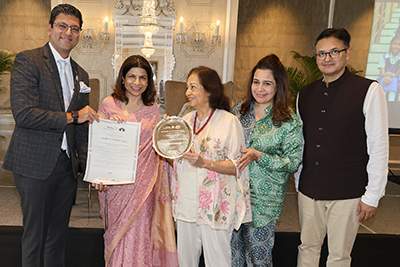
The Rotary Club of Bombay’s Anita Parekh Award for Women Empowerment to Project Nanhi Kali for being a perfect catalyst that metamorphosises and empowers the lives of young girls.
The Rotary Club of Bombay’s Anita Parekh Award for Women Empowerment to Project Nanhi Kali for being a perfect catalyst that metamorphosises and empowers the lives of young girls.
SHEETAL MEHTA: Thank you for honouring our project Nanhi Kali with this extremely prestigious Anita Parikh Award for Women’s Empowerment. We are humbled to receive this award, and continue to remain motivated because of it.
The Nanhi Kali was started by the Chairman of the Mahindra Group, Mr. Anand Mahindra, way back in 1996. He is also the Chairman of the KC Mahindra Education Trust. And the objective was to support girls from underserved communities with quality education till they complete their schooling. Nanhi Kali means a little bud and, of course, the hope was that once the girls go through schooling and complete it, they will be in a position to contribute to society. They will blossom into young, independent women.
Today, this project is jointly managed by the Naandi Foundation and KC Mahindra Education Trust.
A lot of people ask us: why girls? In a patriarchal society like India, unfortunately, girls still are children of a lesser god. If you just look at the child sex ratio – which is a measure of the number of girls compared to 1,000 boys in the age group of zero to six – it should be around 1,000. It should be 50-50%. It’s around 940-odd, as per the last census. And this, by the way, is the best it’s been for many, many decades now. Clearly, there are missing girls. Female embryos are aborted. Our government has taken cognisance of this and has abolished sex determination clinics.
But take a look at that one statistic, which is 21 million unwanted girls, and that came out in the annual Economic Survey in 2017-18.
So, who are these unwanted girls? Families, in their quest to continue to have sons, will continue to have children until they have the desired number of sons. So what happens? A family has limited resources. It has to be spread over a larger family. And boys get the priority – whether it is nutrition, health or education – girls are neglected. And hence, they are unwanted.
And we can see this in many statistics – I’ve just put a couple here. Female literacy – we lag behind that of males. This is the national average. Going to urban and rural India, and the gap just widens. Dropout rates – girls drop out of school by the time they come into the secondary schools, into high schools.
<<<VIDEO>>>
So, this film was a little dated, but it was not only this situation which made Anand Mahindra start Nanhi Kali. At the time when he was starting this project, the World Bank had come out with a report which showed that the best return on any investment you can get is by investing in girls’ education. And the benefits are manifold.
So, there is a reduction in infant and maternal mortality, a reduction in fertility rates – and that really caught Anand’s eye, because at that time our population growth rate was galloping. And then, of course, more than that, if you look at what educated women do – the benefits are increased agricultural productivity, as well as they contribute to economic growth. They contribute to our GDP.
Apart from this, what Anand felt is that a lot of the social evils that existed, such as the dowry system, superstitions – those would just naturally go away when women are educated.
So, he began the project in 1996, and the first decade was spent in bringing girls into government schools so that they could at least come in and complete their primary education.
From 2005, we entered into a partnership with the Naandi Foundation, and currently – this year – we will be celebrating a two-decade partnership with them.
Together, we decided to have an after-school intervention, where we taught the girls Maths, language, and English. And in 2016, we introduced digital literacy to the girls. We gave girls in secondary school a yellow tablet. Each girl had access to this, and it had the curriculum from Standard 6 right up to Standard 10.
In 2021, just before the onset of COVID, we partnered with another ed-tech company to expand and scale up our programme, and we were going to introduce this to girls right from Class 1 to Class 10.
Here, we actually brought in a smart learning software called Mindspark, which assessed the learning levels of the girls and taught from that level. So, if you see from 2021 to 2024, every single girl at Nanhi Kali had access to this yellow tablet. Each tablet had a unique ID, and the software understood what level the girl was at.
So, her learning level may have been of Class 3, though she may be in Class 6, but it would teach her from the Class 3 level. So, she learned with understanding, and she could learn at her own pace.
Apart from that, we give material support – a school bag, stationery, raincoat, pullover – and most importantly, feminine hygiene material for the older girls so they can attend school with dignity. This, of course, freed the parents of any financial burden they would need to bear.
But my favourite part is that for these girls who never ever get to see anything new, this was the only product that they got – it’s this new school bag, it’s new stationery – and it’s a hugely emotional stage for them.
We also introduced sports because we realised these girls didn’t understand the meaning of leisure. We would see boys always playing out in the schoolyards, and when we would ask the girls, “What do you do for your leisure?” they would turn around and say, “Reading.” “What do you read?” – “School books.” They had nothing more. So, we said we must introduce sports. And we did that, and we found that it had an amazing transformational effect on the girls – their self-esteem and self-confidence grew immensely, even though it was just a once-a-week programme.
In 2020, you all would be aware that the new National Education Policy was announced, and while this policy did talk about the importance of foundational numeracy and literacy, it also spoke about the lack of vocational education, the lack of critical thinking, problem solving – 21st-century skills – which did not exist in the schools. It spoke about integrating sports into the curriculum.
And so, we felt that this was a stage where we needed to align with the National Education Policy. Government schools had already started themselves tying up with ed-tech companies and bringing in digital infrastructure. We saw this across many of the states, and we were working more in the rural and tribal areas. So, we said, we’ll stop our ed-tech initiative because it may clash with this, and let’s move in to providing girls with 21st-century skills.
So, this is digital literacy, financial literacy, and softer skills – a lot of importance on gender equality – and this was rolled out in secondary schools, that’s from Standard 6 to 10, and in government schools where very often there will be many boys as well. And we felt that this is a great opportunity for boys to also understand what it means to have gender equality – that gender is equal. This is a time where we could sensitise them, and at this stage of their lives – adolescents – they are ready to mould their behaviour.
Since sports had such a transformational effect on our girls, we introduced this as an integral part of our after-school programme. This was only for girls.
And not only did we bring in a physical education module, but we also brought in team sports because this built leadership skills, taught them resilience, and taught them the advantages of teamwork. We modified our kit to be more sports-oriented because none of the girls had a pair of sports shoes. During their weekly classes, they would come and participate barefoot, and this was something that we really wanted to address.
So, let’s see – what did they learn from football? And every girl in this film is a Nanhi Kali.
<<<VIDEO>>>
So, you know, it was amazing to see the change in the girls. Parents who were very reluctant initially to send their girls for the Sports Club now were the champions. A brother would come along with the equipment. Somebody else – the father – would come to watch and cheer his daughter. This was something… I’m really talking about real, rural, tribal areas of the country. So you really see that transformation.
And for me, again, it’s just the joy on their faces which is the biggest win.
So, when Anand began this programme, he always said that as an individual, as a trust, as a company, there’s always a finite amount I can give – or any company can give. And the only way, if we really need to scale and reach and make some sort of social impact, is if we collaborate. So, the programme has always been designed as a participatory one, where any individual or corporate can participate by sponsoring a girl’s education.
What you see are logos of various companies who have been part of our journey and who I will always be grateful to. They’re very much behind Nanhi Kali. Some may have been there for a few years, some have been there right through our journey and still are with us. But to each and every corporate and individual who has participated, we are extremely grateful.
They have helped us reach this scale over the years. And today, we are supporting over 870,000 girls. And, these 870,000 girls – remember, it’s to the power of 10 for a lot – as the girls who have been with us from Class 1 to Class 10, and some of them would have been with us for a lower number of years.
We have also empowered tutors. Because we are working in such difficult-to-reach areas – aspirational districts – to find a teacher in that area becomes difficult. So, we’ve taken only women, young girls there, and have trained them. And they have become what we call community associates. They become the mentor, the role model for our Nanhi Kalis.
We work in 7,000 schools. We’ve worked in 15 states. We’ve also started a teachers’ training programme, where we are training teachers in non-Nanhi Kali schools – or government schools – with 21st-century skills training so that they can impart and support even more girls whom they teach. And therefore, we will reach our target, which is just a million per year.
So, how can anyone participate? It’s very easy. Our website is nanhikali.org, and just for ₹6,000, you can sponsor a girl’s education. Companies can give CSR funds, can do employee volunteering, payroll giving – and every donor will get an email with their Nanhi Kali’s ID, a photograph of who that girl is, who her parents are, and then that’s followed with a progress report.
I once again take this opportunity to thank the Rotary Club of Bombay and Anita Parikh for this really prestigious award.