
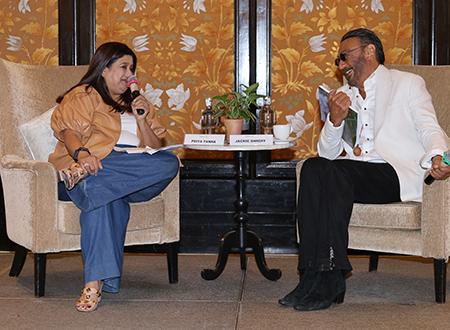
Mr. Jackie Shroff, Indian actor and former model, in conversation with Rtn. Priya Tanna on success, style and soul
Rtn. Priya Tanna: Forty years of acting, 250 movies, 13 languages. Multiple accolades including many Filmfare Awards and that’s just a part of it. Rarely does this level of achievement come with that level of personality as a person. That’s really what he is, to not just me, but to a whole lot of us. It’s how he shows up, not just at his work, but for the people in his life. For the things that matter.
Probably the only guy who can walk into a room with a plant and a tie — or a necktie — and make it look really, really cool. He really brings the swag in the swagat, if I can say that. He filled up our lives with his meaningful roles, he also filled up our world with his meaningful work. That’s one of the reasons I’m so excited to talk to him today — causes ranging from thalassaemia, to adopting villages, to adopting 15 cows, to organic produce, to him walking around with this plant. And we need to know a lot more about where that’s coming from.
I couldn’t imagine that a man whose name was Jai Kishan Kakubhai Shroff, who then became Bhidu and Dada… between these two names, there’s a really long journey. What most of you all don’t know — and Jackie doesn’t remember — is that I started my career with him; he was my first-ever film interview. I was all of 21, a little reporter at the Afternoon Dispatch and Courier, and always wanted to meet a film star. And my then boss Behram Contractor said, “Do you want to interview Jackie Shroff?” And I’m like, “Oh my God. But I don’t know what to ask him.” He said, “Just go meet him. He’s a really nice guy.” And I’m like, “No film star’s a nice guy.”
The interview was being held at NCPA Apartments. I walk in and Jackie is standing there like this cool guy with a cigarette in his hand.
He said, “Hi sweetheart, are you going to interview me?”
I said, “Yes.”
He said, “Let’s do the interview outside. It’s a beautiful day.”
Little did I know that when he said ‘outside’, it meant the parapet of the balcony. Both of us were sitting on the parapet with our legs dangling and me with the full fear of vertigo and thinking, “This could be my first and last interview as I fall to my death”. And him sitting there like he’s been doing this his whole life. And the two of us in a conversation that just went from everything to everything. Me, walking away, realising that this could be and probably may be the nicest film star I will ever know. And that hasn’t changed.
So, please extend a really hearty Rotary welcome to Jackie Shroff. I’m so glad we’re on a stage today and none of us are hanging off anywhere.
Jackie, I have a whole line of questions but there are a couple of lovely ladies here who want to know: why are you walking around with a plant?
JACKIE SHROFF: Thank you so much. You see, I’m a guy from Mumbai; I used to stay here at Teen Batti. To come out here to the beautiful Taj Hotel, I mean, we used to be scared to get in. Ramma Bans had her health club here, and we used to be scared of her. Now, suddenly, I’m out here on the stage at Taj and thank you to all the seniors for so much love and respect. I’m so happy to be up here. 96 years! Bahut bhaari bhidu, aise hi chitak ke rehna, ek dusre ko haath dena, jhaad ko paani dena, badhana (Very impressive, my friends! Keep going strong like this, help each other out, water the plants, and keep progressing.) Absence of malice — that’s all we need. We’re sitting out here amongst the best of the best of Mumbai. I’m so honoured. It’s a pleasure being out here.
Rtn. Priya: Jackie, let’s talk a little bit about Hero. What do you think led to its success? Did you think it would become the film it did? What do you think worked in favour of Hero? What made it iconic?
JACKIE: I swear to God I have no idea how. I knew he would handle it, he’s got to handle it. I told him, I have no idea of acting; I have no idea of the language — I am from Mumbai, Teen Batti, meri jabaan bekaar hai (my language is useless) — but he said, “This is what I want. And love changes you,” he says. I liked that thought. I said, “Love changes the guy, I will work so hard.” So I got into it, and I said, “Sir, you’ll have to take care of me. I won’t be able to remember anything.” He said, “Don’t worry, just flow.” He took care of me and everybody’s taken care of me. Down the line, everyone’s taken care of me. I don’t know how they do it, but they do it. It’s like Maa’s blessing, out in open, jo aaya, aaya, jo gaya, gaya (Whatever came, came; whatever went, went)!
Rtn. Priya: You’ve played a ghost, a gangster, a love-struck hero. Is there a role you really want to play that you have not played?
JACKIE: I never desired anything. Never thought of anything. What comes my way, I take it. Its ups and downs are there. I see it in front of my eyes. Everybody sees it. I flow with the tide — I mean, you know it yourself — enjoy yourself. Majja levenni jaao (Have fun as you go). Look at the tide. I was watching it. Just enjoy it and leave, man. Just leave, but leave behind something good for kids to come. It’s simple. It’s not a science. Everybody’s got children, grandchildren at home. It’s our job. We can’t leave filth for them. It should not be coffee table talk. You see plastic and then you say, “Ye kitna plastic hai (There is so much plastic).” Who’s responsible?
Rtn. Priya: OK, I’m going to ask you another question pertaining to films, and then I want to jump away from films because you are the sum total of so many things. You’re not just a film star. Which was probably the most challenging role you’ve played to date?
JACKIE: Can’t answer that. Because it was a challenge for the technician — they were very worried. “How the hell do I make this lakdi work?” I was like water, just flow. Whatever colour he wants. I’m just like a blank paper. Who paints? It’s alright. It’s just a bloody canvas.
Rtn. Priya: It’s a miracle you’ve not written a book. But is there a favourite role?
JACKIE: It was Dev Anand saab who took me in Swami Dada as second lead. He saw one of my ads, and he said, “Jackie, Jackie, Jackie. Subah subah tumhari tasveer dekhi, shaam ko tum mere samne khade ho. Tumhe ek role zaroor dunga (I saw a picture of you in the morning, and by evening you’re here, standing in front of me. I will definitely give you a role).” And I said, “Ji, giving me a role?” His son, who I used to know, was with me, and I got the second lead. I told my mum and 15 days later, Dev saab calls me and says, “Jackie, woh role Mithun da ko diya hai (Jackie, I have given that role to Mithun da).” And I was made a henchman to the villain and I was not even the right-hand; I was his left-hand. I had been demoted in 15 days. Mom asked, “What happened?” Well, I’m still in the film. I’m a fan of Dev saab’s. I just want to hang around. Even if I get beaten up by guys, I don’t mind. I mean, I do it on my streets also. It’s not a big deal. And I became a hero. And then Subhash ji saw… I don’t know what happened, but Subhash ji wanted a new guy. And I was there. One of the guys who used to know me — he said, “Hai ek ladka, Jackie, ek villain ke chamche ka role kiya hai. But modelling karta hai, Teen Batti ka ladka hai.” Toh mereko bulaya (“There’s this guy, Jackie, who played the role of a villain’s sidekick. But he does modelling, he’s a boy from Teen Batti.” So they called me).
So, Subhash ji saw that ad, and said, “Mereko aisa hi ladka chahiye, mawwali type ka teri tarah” (“I need a guy just like you, a street-smart/rough type”).
Sorry guys, lekin aaj woh mawwali baitha hai, aap log bahot pyaar de raila hai, sunn raila hai. Mereko ghar pe bhi bulana khane ke liye kabhi kabhi. (But today that street-smart guy is sitting here, you all are giving so much love, listening to me. Please call me home for meals sometimes, too.) Even if you do a pot-luck, I am in.”
Rtn. Priya: Jackie, if you had to start all over again today, in this day and age, you’ve observed generations of film stars coming and going, you’ve seen films, you’ve seen evolution, you’ve seen cinema change — why, how much has stayed the same? Would you do anything differently? What advice would you give yourself?
JACKIE: The first film — back to Dev saab — there was a shot I had to do in which his double was holding me, and I’m supposed to go down backwards with my neck like this. I said, “I can’t do it. I can’t do it.” So the fight guy — master, got angry, and said some words. So Dev saab, from there, said, “Take it easy, take it easy. Naya ladka hai seekh jaayega. Sikhao usko yaar (He’s new, he will learn. You teach him)!”
I said, “Me, a junior artist and a senior technician?” My confidence was boosted. So that’s what I feel when I see a little child who comes in — any new boy or girl who comes in — I feel that it’s just not my son Tiger that I love. Everybody’s my Tiger there. I mean, because I was taken care of.
Rtn. Priya: That’s so lovely. You felt the love. So you’re giving in.
JACKIE: Yeah. I thought — I said bang on. I mean, you looked after me. It’s not demeaning. You fall. You rise up. How does it make a difference, right? Just a bloody coffee table talk again.
Rtn. Priya: Right. So you get called bhidu and tapori and dada, and yet you make it to the best-dressed lists in your Armani suits and Gucci ties and Hermes belts. This is such a dichotomy. There is this street side of you, and then there is this really sharp side of you that shows up. Who’s the real Jackie?
JACKIE: Thank you so much for all those beautiful names you just gave me. It’s just me. Hawa ki tarha hu main (I am like the wind)! I am Teen Batti ka ladka (I am a boy from Teen Batti). The driver’s son is my friend and the diamond merchant’s son is also my friend. I would know everyone, from the minister’s bodyguard to the minister’s driver — everyone — we would play cricket together. So, I am just me. Then I could see everything. I could go down to Somerset House, Breach Candy. Go to Breach Candy pool. Man! It was difficult, but then I could go with my girlfriend then, Ayesha, now my wife of 48 years now. Yeah! Chitak ke rehneka, koshish karneka, todne ka nahi (Be together, try harder, don’t break).
Itna acha nahi banneka ki bhagwan, itna bura nahi banneka ki shaitaan. Beech ka banke chalneka agar ban sakta hai toh (Don’t become so good that you become God, don’t become so bad that you become the devil. If you can manage to stay in the middle, then just do that.”). That’s it, just enjoy each other’s company, be friends, be buddies, but don’t crack.
Rtn. Priya: Actually, what he’s saying — and it’s being said with so much humour — but it’s such an important tenet for life, right? That you have to be equanimous. Whether it is that you’re talking to a driver or you’re talking to a corporate. And I think one of the things everybody can pay testament to, where Jackie is concerned, is the way he makes you feel. I saw it — I think when Rina and Akhil and I were down — we saw him hugging the guy at the entrance, posing for pictures, you know, with everyone. And I think that’s not just for the paparazzi. That’s not just for the sake of it. That’s so much of the person. It really is!
Jackie, you are amongst the first film stars who went corporate — who went into the whole entrepreneurial mode. You are the one who started off this journey by investing in Sony. What led you to it? Was there a moment where you felt that, “Films are great, but I want to expand. I want to look into new horizons.” Was there always an entrepreneur in you? Or did it just come your way like everything else comes your way? Was this just a passing thing and you took it up? Or was this something you thought about and said, “I need to think about what next. I need to think about, I want to move with my life.”?
JACKIE: I’ve just been lucky that I was around when Sony was happening and in my heart, I felt, that being in the film industry for so long, it was the right time to get in. And that’s it. I looked around — there was Zee, there was Star, down there at 0.2 rating or something. Doordarshan was obviously ruling, will always rule. So I said, “Right time to get in?” And I felt — and then with a name like that, I would be an idiot not to get in. Yeah. So I gave all that I had in my… and then we ran. And hung around till 19 years. And then I thought maybe it’s high time that, you know, we pulled out.
Rtn. Priya: And how involved were you in it? Was that something that became a part passion for you — was business, enterprise, all of that?
JACKIE: I keep open. I keep definitely open. There are many things to do. You just have one life. So when you’re getting something, then your heart and mind and your soul should be in it. Media is something that’s in my heart. My environment, that’s in my heart and I’m going to definitely stick to that. Whatever years you have behind you. You know what I mean?
Rtn. Priya: Jackie, let’s move a little bit and talk about your philanthropy — things that really matter to you — because that’s at the heart of what Rotary does.
JACKIE: Sattar programme chal raha hai aap log ka, 360 log hai (You all have 70 programmes running, 360 people). That’s Fantastic.
Rtn. Priya: There’s a lot of people that take time off from their very, very, very busy lives. Every week, they all are parts of committees and they’re doing incredible work. A lot of it is driven by philanthropy.
Jackie Shroff: Rocking, rocking bossy, rocking south Mumbai boys and girls. Whoa, Bappa Morya!
Rtn. Priya: What’s fascinating is that you come from such different worlds and you got into things that people didn’t, at that point of time. What led you to the causes? Right from organic produce to adopting villages to the cows — I really want to know about the cows. And this chase, I understand you’ve always had that thing. Now the trees — tell me about how all of this became such a big part of your life.
JACKIE: Mummy. You learn everything from her. You don’t get to see Dad; Papa was working. Like, mother — I kept looking at her. Papa was an astrologer Kakubhai Trikambhai Hembhai Shroff, Rajkot, astrologer. And I’ve been lucky namak maine pehle Kokilaben ke haath ka khaya tha (I have eaten from Kokilaben’s hands). Papa was an astrologer for them. And BK Karanjia sir, Blitz Tabloid. Papa used to write for that as well.
So my mom, she would manage everything at home; she had a very helpful nature. Our house had the view of the sea, Governor’s Road used to go from our house. So, right from childhood, I have seen everything from peacocks, snakes, mangoose, rains, mangoes, chikoos, birds, So with all of this around me and my mother trying to help everyone around, I said if I am at a stage where people will listen to me, I thought why not! So, jhaad laganeko bola, thodi upkaar kar raha hai. Jhaad lagao (I only asked them to plant trees; it’s not like I was asking for a favour).
Rtn. Priya: But tell me about causes like thalassaemia, right? You’ve been supporting it hugely. And was there any emotional moment, or was there anything that led you to it?
JACKIE: Yeah, I had gone to the Delhi municipality hospital, and I saw kids lying on beds with syringes going in, and they have to do it monthly… Poor guys! Create awareness of this amongst all your kitchen staff, drivers, everybody in your offices — everyone should know about it — all you need is a basic blood test before trying to conceive. Why should the kids suffer?
Ladies and gentlemen and respected seniors, I think it’s everybody’s job to just take care of everybody else who can’t — who don’t know about it. Everyone needs to be aware of thalassemia. Start from home, because that’s blood transfusion we are talking about.
Rtn. Priya: OK. Talk to us a little bit about your farm. I’m very, very, very curious to know about it, and then talk to me about those 15 cows.
JACKIE: And a bull. Bull really needs 30 cows, by the way.
Rtn. Priya: That’s quite philosophical.
JACKIE: It’s a fact. Ignorable. I’m getting Swarna Gir, golden pink — and tongue is also pink and gold. Little gold. And they’re beautiful, Swarna Gir. You should drink its milk.
Rtn. Priya: So, where is your farm?
JACKIE: It’s somewhere… one is in Karjat where I keep all the cows that I find. Now, I’ve started going deeper into it. There is a farm, a river.
Rtn. Priya: And how do you find the time for the environment? Like the way you have now — you’ve got thalassaemia. I’m just impressed, Jackie. I’m not even asking you because I’m wondering. I’m just pure impressed that one person can be a public figure, a parent, a father or a husband — and then have the kind of time you do for all that you do. I think all of us here, somewhere, strive for that sort of a balance. To be able to, you know, keep up with all our professional commitments, personal commitments, and yet give back. And you’ve done it so beautifully. What do you think has been the trick, and is there any advice you would give to young people? I think there are a lot of young members in this Rotary who also want to start their journey. I know one thing you will say is “just give”. But it’s not just that, right? I think you’ve seen it through.
JACKIE: Breathe! Just breathe, don’t exhale, you will give out carbon dioxide. I tell my wife you give me carbon, this little plant is the only champ who gives me oxygen. And youth, balance technology with proper restraint. Let’s get real. Health above all.
Keep health to keep health, and then it’s automatic balance; take a deep breath every hour; one minute, every hour. It’s like a high; you don’t need to get smoked and stoned. Oxygen is everything.
Rtn. Priya: I never realised this conversation was going to go the way it has. I’m so excited. This is why I do the job I do.
JACKIE: Laugh and laugh and laugh from the tummy. Breathe! Sing!
Rtn. Priya: Jackie, what do you advise Tiger? What’s your advice for Tiger? And I know I’ve read this somewhere, that he’s had his career ups and downs, like you haven’t. I think you’ve always told him to just sort it out. Is there anything you tell him from your own experience that you wish you had applied for yourself?
JACKIE: There’s nothing to be told to him. He’s self-made. In fact, he teaches me to breathe properly and sit properly. So, at home, if you have your person who really loves you, he says, if you’re not healthy, it’s bad for everybody, Daddy. You’re the elder of the house. There was a time when I was small of the house at the end. But suddenly I’m the older of the house. Elders should be healthy; health is priority. 8 hours work, 8 hours sleep, 8 hours to yourself. Balance the 24 hours, health first. Till 90, your merudanda should be 90.
Rtn. Priya: I can say this with all assurance that never again will I have a conversation like this. Never have I had a conversation like this, and for me personally, Jackie is just a national treasure.
ROTARIANS ASK
You have real screen presence. My question is: PETA voted you as most beautiful celebrity. Anything you want to comment on that and on your association with them?
The thing is about the wildlife, I mean, I try to balance them by going easy on skin. Hemp. I want to get into vegan. I want to start getting things that people carry also in vegan. Woh toh karna hi hai Bhidu (I must do that, my friend). We are surrounded by living beings. Think of all living beings. I try to see gold. I try to do things which will be beneficial for further down the line — so thanks, PETA. I appreciate — you also should take care.
You’re lovely. You people are beautiful to be doing such good work in society. I’m trying my best. I’m a chawl boy from across the road. I’ve come here and I am sitting with you and trying to say what my heart feels.
Hello Jackie. Suppose — you know, your brilliant insights — but if you were given an opportunity to sit across with Donald Trump and give him advice, what would that be at this particular point in time?
To Trump, the President? I have no idea what I’m going to ask him. So… how do you try and cut the carbon footprint that every human leaves behind? What will I advise him?
But carbon footprint is what we should take care of, I should be accountable to what I am leaving behind. 164 trees per person. I have no idea, but there is a certain amount of things. Apna jhaad chhod ke jana (Leave some plants behind). How many things are being used per person. How much of detergent, how much of water to be wasted.
Talk to us about the school project.
Ohh, it’s a municipal school of Maharashtra. I’m going to be planting out there. I’m going to be keeping plants in the classroom. So that if we all are sitting there — oxygen, plant takes away the dust, the humidity, and the oxygen. Three things with so many people breathing. So I’m starting with municipal schools in Maharashtra, taking that model all across India.
Oh yeah, I’m giving first-aid to everybody. First-aid at heart. We are teaching 8th, 9th and 10th standards. The kids should learn first-aid.
It’s amazing. So, every house will have a little nurse. The kids should know how to deal if someone chokes, someone has a heart attack, or someone faints. Parents say my kids know how to operate a phone. Wow. But does he know what to do if he chokes while eating? So, I’m teaching them first-aid — 8th, 9th, 10th — first-aid for all of them. I will apply to the Maharashtra Government. Health will also be wealth. MFN is my wife and my daughter’s brand. I’m thinking of teaching kids self-defence, taking it across India, starting with Maharashtra again. And health is wealth, so said Mr. Kakubhai Trikambhai Hembhai Shroff.