
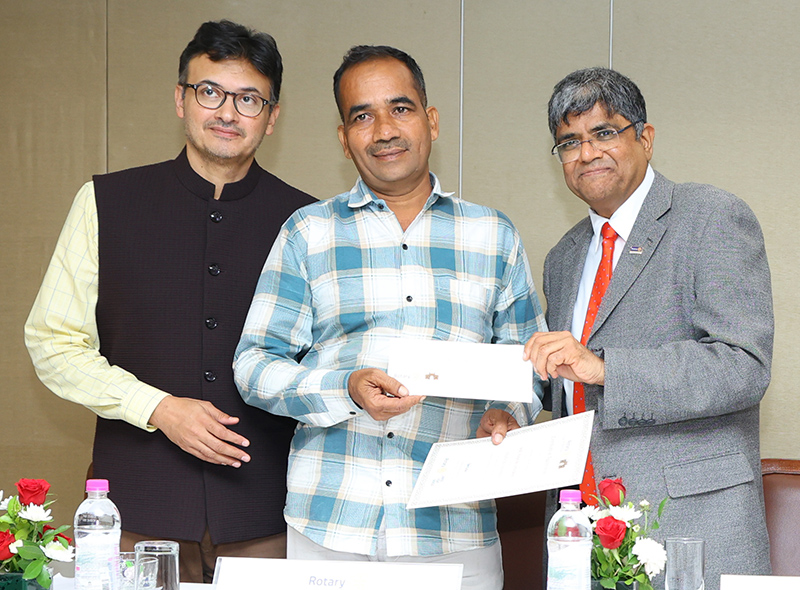
Nazim Shaikh, lifeguard, Mumbai Waterfront, Gateway of India, felicitated with the RCB Bravery Award
Nazim is an extraordinary human being. He was born and brought up in Mumbai and lives here with his family and four children. Today, he has also brought his brother Mohsin, who is amongst us.
As a day job, he does very ordinary work, selling pav and bread from home to home, especially in Khusro Bagh. But what he does voluntarily and selflessly is extraordinary – his ability to save lives. That is why we chose him for this award.
He quietly operates at the Gateway of India and saves the lives of people who have fallen into the sea. He is the point of first contact there. Even the police call him before they call any other officials. He has become that well-known. The guards at the Taj Mahal Hotel also know him very well.
It is not only in calm waters – he jumps into dangerous wells too, probably even today, and I am surprised that he has not received a call and is here with us. His motto is very simple: he says God has given him the ability to save lives, and he does not want anything else in return. It is the will of God.
He says he was also present when the bomb blast took place in the taxi at the Gateway of India. At that time, too, he was a first responder, even before other authorities arrived to help.
He recalls saving the lives of people, sometimes even three in a single day. He is present at Apollo Bunder and never hesitates to jump into the waters to rescue those in need. He thanks God for the strength and bravery he has been blessed with to save people.
ROTARIANS ASK
Question: How did you think about starting this?
Nazim Shaikh: I used to always feel for people who would slip into the waters or lose their lives. I always thought I should be able to help them in some way or the other. So I started swimming, and by God’s grace, today I am a very good swimmer. So I used to be at Apollo Bunder and if something happened, I would jump to save them.
Question: How did you learn swimming?
Nazim Shaikh: I used to tie thermocol to my waist and dive in, slowly I exceled at the skill. It is the determination and the courage that helps the person move ahead and achieve something. I am blessed that I am a good swimmer, it is He who saves life.
Question: What is the support you have got from the government?
Nazim Shaikh: There is no support as such from the Government. I also want my kids to be educated, to go to good schools and have a better life. It is people like you who keep me motivated in doing what I do.
Question: Congratulations, Elizabeth. The best thing I took back is that we shouldn’t be teachers; we should be learners. We shouldn’t be talkers; we should be listeners. I help out in the Rotary in elder care in Awas, Alibaug. I also teach there — sorry, I also learn from the children in the Awas and Mandwa schools. If I can help Muktangan in any way, I would love to work with you if there is any chance. Thank you.
Elizabeth Mehta: Thank you very much.
Question: Hi Elizabeth. I really liked your lecture. You do some amazing work. I wanted to ask you — you spoke about the World Bank as one of the organisations funding education. What is your overall view? Because people are divided on whether international organisations funding education projects are really effective. Could you share your experience of it?
Elizabeth Mehta: My own personal view is that it does help. Ideas come in, people are stimulated, but the real work needs to happen at the grassroots. This is what I have learnt from our teachers—they are amazing people with aspirations to bring about change.
I remember attending the first-ever seminar in Delhi at NEPA, the National Institute of Education Planning, on educating the urban slum child. People were saying that the children are not interested in learning, their families are not interested either. But I think we need to look at bottom-up approaches.
I don’t want to comment much on international organisations. They are well-meaning. Sometimes people say they do it for the wrong reasons—economic reasons—but I am not going into politics. What I believe is that there are tremendous human resources in India to bring about change. If we can ignite them, the change will happen. I see it every day.
Our teachers are sleeping barely four hours a night, balancing domestic chores, cooking for their families, and looking after the elderly. Yet they work tirelessly. Since joining Muktangan, 95% of them have gained additional qualifications through distance learning. Many of them are now postgraduates. The aspirations are there, and I think a bottom-up approach is required.
You can talk about enormous five-year plans, but what I have discovered is that you need to reflect upon what you are doing on a day-to-day basis. Growth needs to be organic; it cannot be imposed. Reflection is key. I hope that answers your question.
Question: Yes, it kind of does. I know you don’t want to get into the politics of it, but just one follow-up. You said they are well-meaning, but every country has to deploy those funds properly. Do they? Because you have worked in Africa, Pakistan, and India. Is it more a question of whether countries actually deploy those funds effectively?
Elizabeth Mehta: That I would not know. I think a lot of good work has been done by these projects, and much of it has increased awareness of the need. For example, the District Primary Education Programme, which the government took on, has done a lot of good work. I think these projects light a torch that needs to be carried forward, and that is where we must focus—on how to take it ahead.