
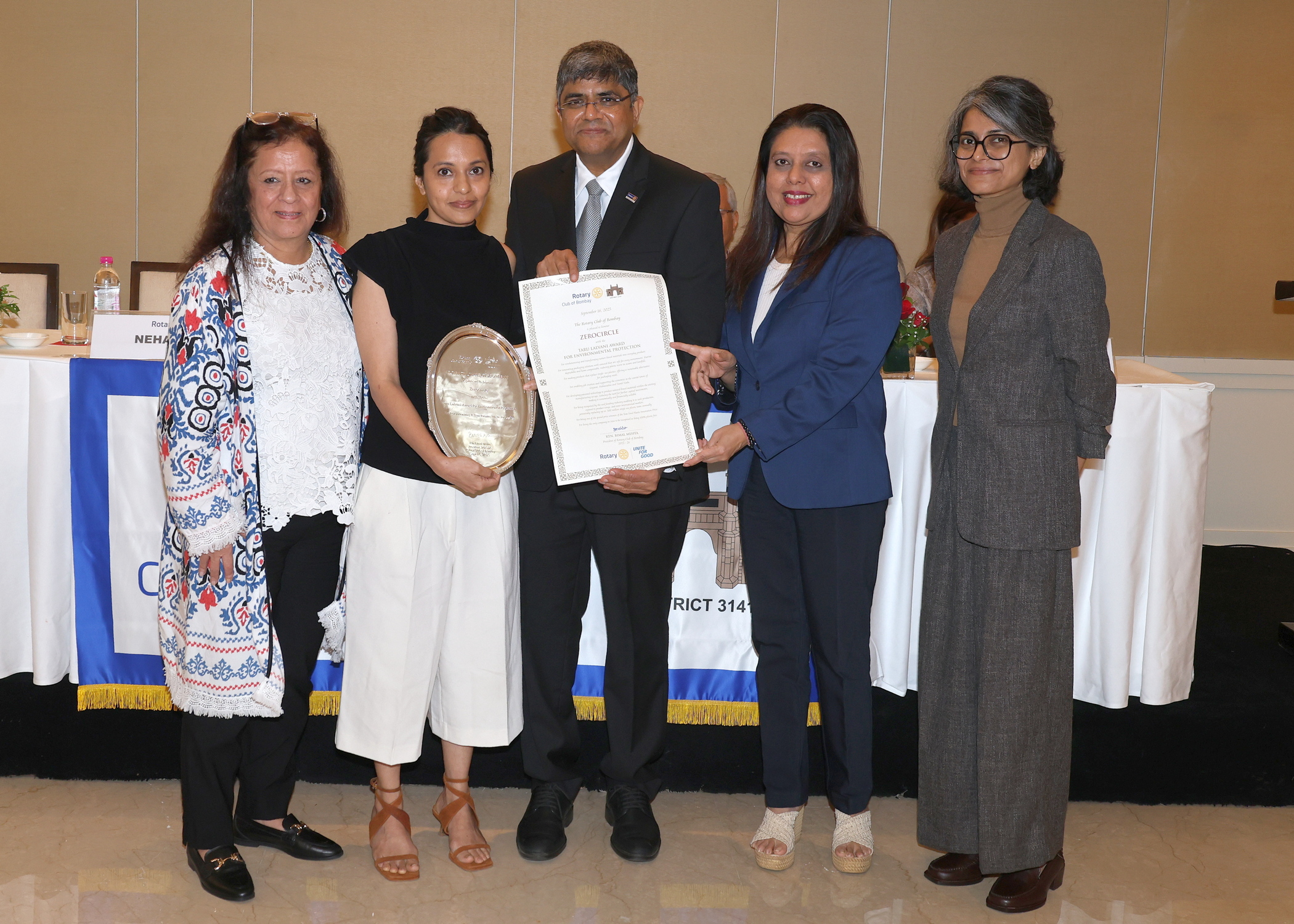
Neha Jain, Zero Circle, recipient of the Taru Lalwani Environmental Protection Award
It’s truly an honour to be here and receive this recognition from the Rotary Club of Bombay under the Taru Lalwani Environmental Protection Award. Thank you for giving Zero Circle this platform.
There’s something special about Bombay. It quietly teaches you a life without fear — you become fearless, travelling to any corner at any hour, and slowly, that fearlessness becomes your second nature.
Thirteen years ago, I started a service that delivered to any part of Mumbai, even in the dead of night, through the rains, past the smell of the Arabian Sea, and around the cats. Cats everywhere, scattered through the streets. But the other litter — the kind that does not vanish and tragically appears in the dump yards of Deonar — that was the Bombay I could not love.
I knew I wanted to fix our air, so I started fixating on solutions: permaculture, direct carbon capture, the list went on. One day, I found seaweed. It grows faster than anything on land. It was perfect. I couldn’t bring a forest to Mumbai, but we had our own sea.
I desperately scouted for the right spot. I went to fishing villages. I convinced a few punters to join my expedition. But I knew I needed an experienced eye. That’s when I met Dr. Reddy, a marine scientist and a biologist. I asked him, half naïve, half hopeful, questions like, “Can we set up a seaweed farm in Juhu?”
Once the knowledge bar was set low, I couldn’t stop asking questions. Endless questions about what seaweed could do. Those journeys across Maharashtra’s coastlines turned into a scientific inquiry. That inquiry became a shared anger towards the endless dumping at Deonar. And that anger became fuel.
Dr. Reddy introduced me to chemists and PhDs — people who took my dream of this beautiful, flowy seaweed and began shaping it into soft, flexible material that mimics plastics. Nestlé accelerated the idea in 2020, and then COVID hit. While the world was baking banana bread, we were cooking seaweed.
In just a few months, something clicked. “Yes, it’s working, Neha,” our accelerator lead said. “It’s so clear, I can read through the page.” In my mind, we had crossed the main milestone. Milestone one: done.
And then a month later, my team of two scientists had to walk away. Family pressures during COVID pulled them out. So I built again. Stronger, better. But this time the mountain grew bigger — performance, cost, scale, funding.
A solo founder.
A solo woman founder.
A solo woman founder building a science company.
There were good days, and then there were endless rough months. Someone once told me, “You’re not just making a material replacement; you’re building hope.” And I believe we are at an inflection point. If microplastics have managed to enter our lives so quietly, then solutions can also spread just as quickly if we choose them.
So, as I close, I want to leave you with this. The future is going to be shaped by the materials we choose every single day. And the question I ask myself, and I invite you to ask yourself, is a simple one: if the materials I’m using today are going to end up inside my body or a child’s body, would I still choose them? That, to me, is where the real change begins.
Thank you once again for this honour and for walking with us on this journey. And this note would be incomplete without thanking our generous host, Rina Deora. Thank you so much, Rina, for believing in me and my entire team at Zero Circle with this honour.
ROTARIANS ASK
Q1: I am Dev Parna, I head Communications and Marketing at Zero Circle. I’ll just start the ball rolling because I know this is, apart from an awareness and award ceremony, also about knowing more about the work that we do.
So, my first question to you, even though I know these things, would be this: I think most people are very interested to know the thought process that went behind designing the main properties of this material. Because we are talking about a very cheap, durable, voluminous product like plastic, right? Can you take us through the thought process? What was behind designing the main properties, and what were the deciding factors? How did you decide that those should be the properties of the material?
Neha Jain: Thanks. So, we’ve designed this backwards. When something does not degrade, it takes up space on this planet forever. So, it should be made of materials that know how to go back to nature. Plastics, with time, break down into microplastics, and we all know that. It enters our food stream. The fish mistake it for food. And in the cycle of life, it becomes our food. Vegetarians are not spared either, because when microplastics enter soil, plants absorb them, and then they reach our plates.
So what we were very, very sure about was that when plastics enter our body, they need to break down. We’ve designed this material to be biocompatible. Even if it ends up through plants, through fish or by air, it breaks down in our body and passes like any organic matter.
Another property of this plastic is its interaction with the marine environment, rivers and oceans. When it enters rivers or oceans without any proper waste management, it enters our drinking water streams. And when it enters our drinking water stream, it will eventually enter our body. So it was very important that we designed this chemistry to signal the materials in such a way that, when it enters the water stream, with time it breaks down and becomes water, leaving no fragments behind.
Another property we have designed is not just for human health and biodiversity, but also for climate change. A lot of people think that plastics, because they come from oil, are heating up the planet. But it’s actually their end of life that heats up the planet in a much bigger way than just their source. Because when plastics break down in water, they settle on the upper surface of the sea and block the ocean’s ability to breathe. And the ocean is responsible for 50% of the oxygen we breathe. Every other breath you take is actually coming from the ocean. When you restrict that ability, the oceans die. And when oceans die, the oxygen disappears.
So we’re not just talking about reducing carbon dioxide, we’re also making sure our oxygen remains. That’s the thinking process behind the material and its properties.
Q2: Neha, I’m still not sure — what exactly does Zero Circle do? You spoke about seaweed, you spoke about your visit to Juhu, and the Deonar waste dump. I’m still not clear — how does it work?
Neha Jain: At Zero Circle, we make the ingredient material, which is essentially a lookalike of plastic pellets. These go into plastic machines and turn into a bottle, a coating, or a flexible film. We’re actually changing the core material that makes the plastic.
Today we’re able to make flexible films. We’re able to make the invisible coating that sits on the surface of bakery products or anything you order from Swiggy or Zomato. When the box arrives, it’s coated with plastics. We’re also replacing that invisible layer of plastic.
We’re also working on developing the engineering behind making hard plastics — for example, the caps of PET bottles. PET bottles are highly recyclable, but the HDPE caps are not easily recyclable and usually find their way into the ocean. So we’re designing materials that can go into a flexible system, into a rigid plastic system, or into a coating system. All these materials are made from seaweed, the hero material is seaweed.
Q3: That’s great work, Neha. Tell me, where is it being used currently, and what is the cost of this?
Neha Jain: Sure. I started in 2020. We made our first prototype in six months. In about four years, we scaled it enough to start hitting the industry and industrial-scale production. We launched our products in Europe this year, for the first time in the world, in March. We’re working with distributors, wholesalers and manufacturers in Europe. Europe was chosen because compliances are stronger and policies are clearer.
However, we knew we wanted to launch in India as well. This summer we launched in India with Zomato and Swiggy, in Mumbai, Bangalore and NCR. We’re also launching with names I can’t reveal today, but which will probably be going live soon — fast food chains and coffee shops. In fact, we’ve launched with about 100 coffee shops already.
Coming to your last question, which is about cost. I was telling someone else: about five years ago, we were 10 times the cost of plastics. Two years ago, we were at least five times the cost of plastics. Today, when we produce, we are anywhere between 25–30% higher than traditional plastics — not compostable plastics, but polyethylene, which is one of the most subsidised products in the market.
Q4: I heard you talking about it as if it was plastic. You said plastic for your product. Actually, it’s a substitute for plastic, right? So have you made anything for a water bottle? And are you able to substitute the water bottle? Because that’s where we use a lot of plastic. Have you been able to cut into that market?
Neha Jain: So, water bottles have not launched at this point. This is something that we’re developing in the lab right now. In fact, if you were to look at the recyclability of bottles versus other materials, we’re going for something which is highly single-use — which is used for a few minutes and then thrown away. That’s why we’ve targeted deliveries.
Even if you get a packet of chips, it sits on the shelf for about six months. But the packaging that you get from Zomato and Swiggy is literally 30 minutes, or in five hours, you’ll throw it away. So we’re targeting those applications first. However, bottles are in our plan to launch in a couple of years, but they’re not ready yet.
Q5: And in terms of scalability, the way you’re mentioning, I think your next few years’ production must be tied up. I mean, I’m not asking you for your numbers. But have you taken a patent on your product? Are you looking at expanding? And what about funding? I mean, these are some of the thoughts. Wearing a strategy hat, I thought I’d just ask you.
Neha Jain: For sure. In terms of patents, we already have a few to our name in India, in Europe, and in the US. We have, I think, six patents in the pipeline. So we are very research-focused and patent-focused. Because we’re launching in international markets, it’s very important to be compliant as well. We invest a lot of money in certification to actually stand out.
In terms of funding and scale, we have been supported by several climate funds. We closed a round last year, and we’re going to be making some announcements in a couple of months as well. We’re getting support from the industry, and it’s coming from places we didn’t expect. We have VC funds, mainstream funds, environmentalists who have supported us in the funding journey, and even supporters who are helping us with market access.
In terms of pure scale, we don’t necessarily just work with retail. We work backwards in terms of the value chain. So when you say you’re taking on big oil, I think long-term the strategies will change their way, because there are going to be compliances where they will also have to diversify. That will be an interesting chapter five years later, or maybe even in a couple of years.
But because we’re working with manufacturers in the value chain, we’re not disrupting anybody’s work. In fact, we’re saying: this is the same pellet that you would use in the same line, so keep your manufacturing as it is. There’s no capex change, or only very slight change. And what they’re able to do with that does not really disrupt the industry in any way.
So we’re able to build that scale because for us, the only goal is to actually build the core material. Everything else in the value chain flows in the same way. And that’s why it’s taken us this long to retrofit it into existing lines.
Q6: Your product is basically right now a raw material for others. Are you planning to get into end use also, where we can just go and buy something off the shelf?
Neha Jain: So it’s not necessarily consumer-focused, but it could be retail B2B. In the B2B pipeline, you’ll have a manufacturer, then converters who will change the form factor of plastics, then distributors where it changes hands, and finally it reaches the retailer.
In our world, the retailer is the absolute consumer of our product, because consumers generally don’t — like you and I on the street — we’re not going to buy packaging. If you were to go to a Blue Tokai, Blue Tokai would buy the packaging. So for us, that’s the consumer.
We’ve had an interesting journey. We were very focused on building the raw material and the tech. We realised that if I go to Blue Tokai — just using that as an example, not saying that we are or aren’t working with them — but if we were to take coatings to Blue Tokai, which basically take plastics away from the boxes they send, they wouldn’t really know what to do with the material.
If we go to the paper manufacturers, they will have questions like: how do I apply that on my line? Your throughput is too slow. Or many other questions. So in this process, we’ve not just created the core material, we’ve actually built the technology to apply the coating on the paper, and then convert that working with packaging companies who change the form factor, and then launch in the market with Swiggy and Zomato.
Now we continue to build the credibility of the coating and its performance to the end consumer, such as a café. So this is more about building credibility of the product, not our long-term strategy. It’s application development — as any company that makes raw materials would do.
Q7: One point is when you said that would be only the cities, but only small tetra packs — the milks, the mazaas, the food items — they have plastic coating in the paper. So the tetra pack, can this be used in the wood cardboard tetra pack? It’s a coating, right?
Neha Jain: Absolutely, absolutely.
Q8: And last point, as you said something, it’s more than 25% of a plastic’s cost. Now, when the seller is selling the whole thing at 10 or 15 rupees, would that not be a hindrance? Because the consumer cannot raise that 10, 15, 20 by a few paisas; they can only stick to those two. So how will they absorb this extra cost?
Neha Jain: No, it’s a fair point. So I think there are multiple ways we actually pick our product-market fit. I’ll come to the tetra pack, but for example, if you were to buy a burger which is roughly 300 rupees, the price of the packaging — not the price of the burger — might be 3½ rupees, and you’re probably paying 4 rupees. It’s not going to hurt you as much, right? It’s the packaging price that changes slightly, and here you won’t feel the pinch.
Typically, in CPG products is where you feel the pinch because they are created at scale. Large companies — soft drink companies for example, without naming anybody — when they’re selling something, they’re not charging you for the product, they’re actually charging you for the packaging because that’s the main cost. So any change there hurts their margins and profitability.
As you just heard, GST subsidies are a big win. Anywhere from 18%, if you were to drop it to 2% when using a material that does not cause environmental harm, there is also no requirement of EPR — Extended Producers’ Responsibility. That basically means if Coca-Cola produces something, they have to pay an X amount. In different countries it works differently, but there will be taxation or some form of penalty they have to pay. In this case, they don’t.
So one, GST flows lower so the consumer doesn’t feel the pinch. Another is how the company that’s actually using the final packaging recovers that cost. So I think it works in multiple ways. That’s why we need brilliant minds — people who have contacts with policymakers, are policymakers, or are working in government — making these recommendations, sitting and actually pushing the buck. We can only take the tech so close to the consumer by scaling it and reducing the cost. But the absolute will of large companies to transition only comes through compliances — and very sharp compliances.
Q9: As you can see, this house is quite impressed by this — if you call it an invention. Plastic recycling is the biggest headache for the entire universe. Do you think this is the first of its kind, or is a similar thing happening in other parts of the world? And how scalable is it — are we going to replace plastic altogether? That’s the type of thing we’d like to know. Thank you.
Neha Jain: I’ll start with this: there’s no silver bullet. Not one thing can replace everything, because that’s the starting point of a disaster. It’s important to understand what solutions bring and what they can solve for. Solar can’t solve all problems of power, which is why we have multiple forms of renewable energy. Similarly, every solution will have its place.
In terms of whether it’s the first of its kind — yes, we have been globally recognised. For example, in Asia, we’re the only company that makes 100% plastic-free, certified material. Are other people using natural materials? The answer is yes, a strong yes. There are innovators across the world working not just with seaweed, but with water hyacinth and many waste resources — naturally growing resources not coming at the expense of agriculture. Because you don’t want to use single-use plastics with your food; you want waste that goes into it. Multiple materials can be mixed together.
I think I forgot to answer the tetra pack question. When you make tetra packs, you don’t just change the coating — there’s also the paper. Now there are new laws in the EU regarding deforestation. Earlier, just a simple FSC (Forest Stewardship Council) allowed you to buy paper. Now there is a very strong deforestation law coming in. So today, if I change the coating, that doesn’t just solve the problem of plastics. You also have to consider the cost of the entire packaging. If paper costs go up, the entire cost of packaging goes up.
Today there’s a lot of dumping from South Asia and other parts of Asia, where paper is becoming cheaper. So if you look at the entirety, it’s important to know that we’ll require multiple innovations — even from cellulosic-based sources — to solve packaging problems.
Speaking of cellulose, just a little extra from Zero Circle. There is seaweed that grows naturally in different parts of the world, but there is also problematic seaweed growing between Florida and North Africa. That belt is called the sargassum belt. There are 14 million tonnes of sargassum growing there. That’s one kind of seaweed also found in India. Forty million tonnes — and 50% of that is pure cellulose.
Just imagine: if the paper industry globally uses 220 tonnes of pulp, there are 20 tonnes of waste pulp just growing naturally. That’s global pulp consumption. So there are natural resources available — there are solutions out there.