
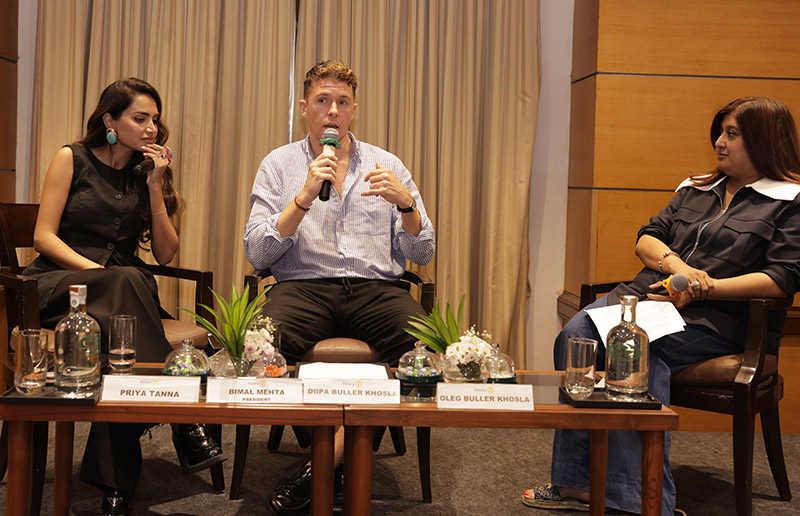
Diipa Büller-Khosla & Oleg Buller Khosla in conversation with Rtn. Priya Tanna
Rtn. Priya Tanna:
Diipa Büller-Khosla was born in Delhi, moved to Chennai, was a pre-med student who dreamed of becoming a human rights lawyer, but instead went on to become the first South Asian face ever on social media. Then she met a very good-looking Dutch boy — you may be able to find him easily today in this room — who happened to have a smashing career as a diplomat and then became an entrepreneur. The two of them launched an NGO.
They also organised a workshop on Iraqi influencers and the United Nations Population Fund, educating people about the transformative powers of social media. They moved to India, launched a brand that became a global success, sold in Sephora, UK and US. Through all of this, they had a beautiful daughter. Both of them look picture perfect, like they eat no carbs at all. And all of this sounds like many, many Karan Johar movies rolled into one.
I love a good success story, but I have to say I love a story even more when it’s woven in with love. So please extend a warm Rotary welcome to Diipa and Oleg Büller-Khosla.
What was the “aha” moment that led to the birth of Indē Wild? Diipa, I want to know that first from you.
Diipa:
Hello, everyone. I’m so delighted to be here. My dad was part of the Rotary Club in Ooty, so, being here and speaking to you all feels like a full circle moment.
For me, Indē Wild was not so much an “if” it was going to happen, but a “when”. Looking back at life, one sees that the dots always connect. My mother was an Ayurvedic doctor and a dermatologist, and I grew up with her making kashayams (a traditional form of Ayurvedic medicine) in the kitchen. When we had acne, it would be the solutions of mum’s dermatology background plus Ayurveda that took care of them. I suffered from acne for about two decades, and finally solved it with a combination of Ayurveda and chemistry. I suppose that these were seeds that were being planted throughout my life.
After that, I became an influencer, and I tried and tested every beauty brand in the world at that point. So there was a moment when I knew this was going to happen. I knew I was going to be a businesswoman, but I didn’t know when. And that’s where I think my husband comes in, because I had a lot of ideas and ways of making it happen. But he was like: “I’m giving you a deadline. It’s in December. What year was it? 2020.”
Oleg:
It was just before COVID. When I gave the deadline, it was just before COVID. Because this woman is an idea machine. She’ll come to me three or four times a week with, “We should do this.” And I’m like, “That’s a really good idea, but we’re not going to do it because we already have that idea we’re working on.” This is a recurring theme. I think my biggest contribution in Indē Wild is telling Diipa “no” about certain things, and once in a while, “yes, let’s do that.”
Rtn. Priya:
I’m coming back to you: as a person who understands strategy, you’ve also had a career as a diplomat. What made you commit to the idea of Indē Wild? What made you feel that India was ready? The reason I’m asking you this is because I do feel that the beauty market has exploded in India, right? You must have done all your SWOT analysis and everything. India is bursting with home-grown, indigenous labels. What made you feel there was still a gap that Indē Wild could fill?
Diipa:
I can take it first. I think, firstly, for me, building an audience of 2.5 million people who were exactly in the perfect demographic of what I like to call the “new India” is the inspiration behind the brand. It’s me, it’s my followers, and we all lacked a brand that really stood for us — the proud new Indian woman who has this very clear friction point.
On one hand, we’re very proud of being Indian. We love our food, our culture, our weddings, our ingredients. At the same time, we want to be global. We want to be modern. We want what is there in the West. We love science. We believe in facts.
So there is this coming together and this internal struggle between, “What Dadi said, what Nani said must be true — the turmeric with yoghurt must work.” Then again, there are brands talking about vitamin C and niacinamide. “Does that work too?”
There was no brand that brought them together, that said: let’s science-back Ayurveda. Let’s truly talk about these potent herbs and adaptogens from India, science-back it ourselves — not wait for the West to do it for us — and then take it to the West as a celebration of what our country has. That was something no brand was doing, and that was the white space. Immediately, when we did that, combining it with storytelling, it just instantly connected.
Rtn. Priya Tanna:
Oleg, at your end, from a business point of view, how did this make sense?
Oleg:
I think a combination of factors. Diipa and I met about 10-12 years ago, and it was through her that I started learning more and more about India. Indeed, as you said, I was a diplomat in a previous life, so I was a student of geopolitics. Looking at the facts, it was just a matter of time for India to become who we are — what we’re seeing today happening to India.
But it was also through Diipa’s passion for her Indianness. She was deeply proud of who she was as an Indian woman, what India taught her, the elements she just described about Ayurveda. She felt it was something the world should know, not just India.
The critical point was what she described: the marrying of the two. They’re not mutually exclusive. You can look at Ayurveda and find things the world doesn’t know. We’re only starting to see now that in America they’re selling ashwagandha and turmeric as — what was the word — “sex dust.” No joke, if you go to a supermarket.
Diipa:
It’s a brand called Moon Juice. They put Ashwagandha, Shilajit and Shatavari together and call it “sex dust”. And it’s the number one selling supplement in America.
Rtn. Priya Tanna:
So many amazing business ideas just coming out here at the end of this. That’s another conversation. Moon Juice!
Oleg:
Sex dust. I’m sorry. I didn’t come up with it.
But back to India. For me, it was just a matter of time until India would unlock itself. I think it’s happening in front of us faster than we ever imagined. Even if I look at our first deck that we presented to investors in 2021, the estimates by McKinsey or BCG were that the beauty industry would be 24 billion in 2025. We’ve already surpassed that in India.
What I realised is that Diipa’s passion, combined with her understanding of marketing and branding, as well as the rise of India — in India itself, but also globally — made sense. India is being recognised by the world, and India has so much to offer.
So far, a lot of what’s been brought to the world from India — like yoga and meditation — has been done by goras and goris. That’s what I’ve heard Diipa often say with annoyance: “Let’s reclaim that. Let’s own that.”
Diipa has a very clear vision, as strong as it can be. Some people live on instinct. Some are good marketers because they studied marketing. Then once in a while, you bump into someone who is a marketer through and through. They live ahead of the curve, see things before they happen when it comes to knowing where the world’s going. And Diipa is that when it comes to marketing and branding. So all I had to do is just once in a while tell her no about all the ideas that she has and say, let’s stick to these, and these. And here we are today.
Rtn. Priya:
Thank God for the “nos.”
Oleg:
They’re necessary.
Diipa:
I say this jokingly but it’s true, in every good business partnership, you need one delusional one and you need one with feet on the ground. I think you can tell which one is which here.
Rtn. Priya:
Diipa, my next question is, when you launched Indē Wild, there was a bit of a murmur – and I’m talking purely from the optics, from the market side of it – there is an influencer, and she’s launched this incredible oil, this champi oil, and this hair serum. Let’s try it out.
That murmur became quite the movement. It’s become the product that you really want to have. It’s not easy to launch a beauty line with a few products. It’s easier to almost launch with a massive range. That’s what people normally do. But you chose to zero in.
What was the thought behind that? And where did the confidence come from — to know that you would start with this and then grow? Talk to us a little bit about your product trajectory.
Diipa:
Traditionally, in the beauty industry, a brand focuses on price or value and offers 200 SKUs in the market. It’s all very much about “put it out there, something will stick, and then we’ll try to make it a hero product.”
With Indē Wild it was always very different, in the sense that we were very cognisant and very thoughtful with every decision we made. Our NPD — new product development — can take up to 24 months, and I wouldn’t have it any other way.
For me, I realised if you focus on the right things — the formula, the product, the ingredients, where they come from — everything else will do the job. Everything else is almost secondary. I am obsessed with ingredients and products, where we get them from. Even the bakuchiol that we use in our PM serum comes from this raw material manufacturer called Cintiol, which makes the purest bakuchiol in the world at 99%. I would only buy from them, because that makes a difference in skin. It’s not just about putting some ingredient and making it flashy.
So, being intentional was very important to me. And then secondly, with a limited amount of money, I’d rather have two amazing products that solve a problem and put all our money behind them, instead of having 200 that clog up money operationally and warehousing-wise.
I’ve always been very clear: we’d rather do two or three launches a year, but really solve a problem with incredible products and put everything behind them, instead of the other way around.
Oleg:
I would add to that. In this day and age, going for that strategy where you just “spray and pray,” dumping as many products in the market as you can, it doesn’t work anymore. It’s bad for the environment. It’s not good from a business point of view because, like Diipa said, you tie up a lot of capital in your inventory. Your NPD team is busy creating products that are never going to land. It’s just bad strategy, if you ask me.
And then one element where we did have a certain advantage is that we built a following and had more followers over the years. That’s something we leveraged as much as we could. You can talk to them: “What do you like? What do you care about? What are your main concerns? What ingredients are you excited about? What proposals do you have that we can solve for?” That allowed us to really listen.
Rtn. Priya:
Actually, that’s what I want to talk about. Diipa is not just any other influencer. For me, what stood out about her — and I’ve worked with an island full of influencers, so it’s almost impossible to recognise one from the other — was that, yes, all her images were gorgeous.
I remember her wedding that was covered beautifully on Instagram. I can never forget the time when Oleg touched his mother-in-law’s feet, and all of that was covered by Vogue. But equally, there were moments when she had a bad skin day, a bad hair day, a not-so-good day — and she wouldn’t fake it. She was authentic about skin. She was authentic about having dialogues.
Even the NGO that she launched was about getting women to come on and accept their authenticity. My question to you is: you had this following, and it was easier to convert them into buyers. How much of this was karmic, how much of this was thought through, how much was planned in terms of how you wanted to position yourself as an influencer? Because when you started out, there weren’t that many South Asian women doing it. You may have been the first to do it at a global level.
Diipa:
I think with everything in my life, like Oleg said, I have a bit of a — I don’t want to call it “sixth sense” — but a feeling. I feel like I can, a little ahead of the curve, see where something is going.
Perhaps it’s just me being like a social sponge. I take in information from different aspects — whether it’s the news, talking to the community, or trends. I’m an obsessive trend-forecast watcher. I try to connect dots from different landscapes and media to somehow compute: this is the way.
Over time, as my confidence grew, I learned to trust that inner voice more. Now, with Oleg, we back it up with data, with actual surveys and everything. So there’s this very strong feeling I had.
When I set out to become an influencer, I knew very clearly in my head — I computed it: “You’ve got to do it now. This is the time. This is the moment. This is going to explode. You’re in the perfect position, perfect timing. Go.” And then I gave it 100%.
Oleg:
Same with Indē Wild. It just computed in my head that this brand is going to be something the likes of which India hasn’t seen yet, and the world hasn’t seen yet. Now go. Give it 100% and move. Maybe for context, this was about 2012. “Influencer” was not a term. It didn’t exist yet. No one was really doing it. But she saw some people in the West.
What I love in this story — you’re going to love this one — is that she decided, “Okay, I need to do this.” Her sisters would have taken photos. So she said, why don’t we grab a camera and take photos? But she didn’t have a lot of clothes, because she was a young student. So she went to her mother and asked, “Can I borrow 100 bucks?”
Mum asked, “Why do you need 100 bucks?” She went to the local H&M, bought a bunch of clothes, left the tags on, went back to the site, changed those same clothes, and was able to extend that 100 bucks to about 50 different outfits. That allowed her to create a lot of content.
So without knowing it, Mama was the first investor in Diipa’s influencer career. Which she regretted later on when Diipa was blowing up on the internet. Then she had to say, “Mum, I’m not going to continue my law Masters because this thing is blowing up and I need to give attention to it.” And of course, she was not too happy about that: “Influencer kya hai? What are you doing? What is that going to be?”
Diipa:
Till today, that’s the only black mark in my mum’s view of me — that I didn’t finish my Master’s in law. But I say, “Mum, look at everything else it gave me.” For any Indian parent, that dropout is not good.
Rtn. Priya:
But you’ve had a big year this year. You got funded. You raised your first round of funding — congratulations on that. You’re now available in the US and UK, in Sephora. Did you see Indē Wild reaching this milestone so early in its journey?
Oleg, I think you can take this.
Oleg:
Yes, I did, I think. Sephora US — we’re launching in February. Sephora UK — we launched last year.
But that comes with the delusional wife that I have. From moment one, she said, “We’re going to be a unicorn.” And I’m like, “Okay, how do we plan on getting there? What are the first five steps?”
But with her by my side, I think what she said earlier — the combination we have between her very clear vision that she can communicate very strongly, and that she’s proven many times. Anybody can scream big visions, but if they haven’t proven it before, it’s hard to trust. She has proven over the last 12-14 years that she’s really good at understanding where it’s going, and then saying, “We have to go there.”
If I can keep up with her a little bit and make sure, from an operational standpoint: what are the first five steps to get there, what do we need to put in place to get this thing moving? — I’ve always felt that together we could achieve that.
Diipa:
And I think maybe Oleg is not talking enough about himself as well. One of his greatest skills in this partnership — Oleg is a very good team leader. People don’t give enough attention to how to build good teams. He and I could only do so much, but today we’re 40 people strong. To be able to lead a team — he’s led teams in war zones, so I guess a beauty brand is worse.
Oleg:
The beauty world is more intense.
Diipa:
But I think that made a big difference too, because I’m very much a solo leader. I’m like, “Keep up with me if you can, no time.” And he’s very much a collaborative leader. And I think that makes sense.
Oleg:
That’s one thing. When we first started dating and she had just begun her influencer career, she was doing everything by herself — reading every contract, handling every negotiation. And I said, “Baby, if you want to scale, if you want to get bigger, you’re going to need to trust some things to other people to make sure that you can do more in a day’s work.”
Even today, she would prefer to run this business with just her and maybe one or two others. Because you have those types of leaders — the ones who just go, run, run, run. If you can keep up, great. If not, they don’t have time for you. Whereas I am more the type who looks at the rest of the team and says, “Guys, come on together. Are you okay? Still motivated? Let’s make it.”
Diipa:
Recently, we had a very big sale and Oleg literally turned that day into an army day. Our team had all these roles — snipers and so on. I said, “Guys, this is a 90% female team. What are we doing?”
Oleg:
No, but that touch was there. We had a big sales day with 48 hours where the whole team needed to be involved. So indeed, we grouped teams into infantry, special forces — the CE team was special forces.
Diipa:
Beauty brand.
Oleg:
They’re on the front line. But then I said, of course, we’re a beauty brand, so it has to be an aesthetic army. So everybody was wearing pink army hats and things like that.
Rtn. Priya:
Okay, I have to stop this for a second just to think aloud. Anybody else in this room thinks that if you’re married, it’s hard enough to live with your spouse, let alone work with them? If I had to go and start a business with my husband, it would be murder in the first 15 minutes. And I’m looking at the two of you praising each other, saying beautiful things. I’ve spied on you guys, I even asked Isha, “Are they really this cute together all the time?” And she said, “You know, it’s sickening, but they are.”
No, what is going on here, guys, that we don’t know? Is there a pill that we’ve all missed, or at least I’ve definitely missed? How do you not kill each other being business partners?
Diipa:
There are definitely moments of ferocious debate. Absolutely. And actually, this ferocious debating makes the idea even sharper, so we encourage it. If there’s something he very much disagrees with, he will fight his case. And then I let him fight it so I can fight back, because it just makes everything clearer in the end. But yes, we do love working together. That is the reality. I think we have very complementary skill sets — that helps.
When we first started out, there was a bit of friction, more from my side. As a woman, I think you’re more insecure about your abilities as a leader. So when Oleg stepped in, I was insecure about his alpha energy and his leadership. We did have issues with that, but later I realised my strengths are my strengths. I don’t need a title. The team knows what they come to me for, they know my value. Understanding that made everything easier. So it’s not all perfect.
Rtn. Priya:
Thank God, you’re making us all doubt our marriages. No, really.
Oleg:
I think also the balance is a bit like Bollywood. We’re good at fighting. She’s a more dramatic fighter — more grand gestures, more screaming. Punjabi. I just say, “OK, sure.” I don’t take it too seriously.
Rtn. Priya:
And you have a vision, a common vision. I want to talk a little about how difficult retail is in this country. This is specifically for anyone young who is looking at a start-up, building a brand or selling. Were there moments where you questioned yourselves? Were there moments of internal failure, of missed milestones? What does it take to overcome them? And what is the advice you’d give to young entrepreneurs — or to anyone here who wants to start their own business in this hyper-competitive, hyper-exposed, social-media-driven time? I’m sure there were moments you questioned what you were doing. I’m sure there were wins, but also losses where you felt, “Is this worth doing?” And then what convinces you to come back on track?
Oleg:
For me personally, what I’ve learnt in this journey of four, four and a half years is that in the beginning, when problems hit — and they hit with high velocity all the time — I would internalise them, thinking, “Oh gosh, how do we deal with this?” and get worked up. At some point it clicked for me that the job is dealing with those problems. Once you accept that — “Oh, problem, let’s figure out how to solve this” — it becomes easier. You don’t take it emotionally or stressfully. The job is solving problems daily.
Also, with experience comes confidence that no matter how big the problem, we can solve it. I can now list problems that, at the start, seemed huge, but today I’d need reminding of. And quite often if you present me with a big problem on Monday, by Thursday or Friday I feel much better because we’ve found a solution, or at least a way to tackle it. That’s something every entrepreneur has to learn — some faster, some slower. But for me, that’s the essence.
Hard work compounds. If you put in the work every day, get the things done you’ve identified, then little by little you get closer.
Rtn. Priya Tanna:
But what is the hardest part of retail in India right now? What is your greatest challenge? Of running a brand like Indē Wild in India. What was your greatest hurdle?
Diipa:
From the consumer lens, our greatest challenge is making them step away from looking only at price as the deciding factor. What Indē Wild is trying to do is show that high-quality ingredients also matter. It’s not just about, “Oh, if it’s 200, I’ll buy it.” It’s about: if it’s 500, 700 or 900, this is an FDA-approved brand, going under the strictest EU regulations. Our brand is sold all over the world. We list every single percentage of our ingredients on the back because we use them at optimal percentages, not 0.001% just for marketing claims.
So the biggest challenge for Indē Wild today is making the Indian consumer understand the value of how good the product is. Because once they do, I think they will spend the money. Right now, it’s the well-travelled consumers — probably many in this room — who understand. The question is how do you reach the next 10%, and then the next?
Oleg:
To add to that, when I first came to India, everyone told me, “Indian consumers are low-trust.” I thought it was probably a stereotype. But after three and a half years in India, I fully agree. It is a low-trust market. I’ve even become a lower-trust consumer myself. I assume marketing claims are not true. If someone says 70, I assume it’s actually 30.
Because they do. In India, especially in the business I know very well, there are brands claiming things that, if you claimed them in the US or the UK, it would be the end of your business. You cannot claim something if you do not have those ingredients; you would literally be banned and fined to such a degree that it would probably kill your business.
I was talking to the founder of The Whole Truth. I said to him that sometimes it feels like we are fighting with one hand tied behind our backs in India, because all these other brands are claiming their Vitamin C serum, but if you look on the back, it says 0.5% Vitamin C. Any dermatologist can tell you that 0.5% Vitamin C will do exactly nothing for you — especially as it oxidises over time. A few months later there is virtually no Vitamin C left. But no one is stopping these brands from screaming and claiming what they do. That, I find a challenge sometimes. But the founder of The Whole Truth, he said something interesting: whenever he feels that disadvantage, because he is fighting against brands that claim nonsense, he turns it into content. He turns it into an angle and a hook to tell his story of why they are different.
But then you bump into what Diipa said earlier: the Indian consumer is very price-sensitive. They do not want to pay much, and they want everything. In the US or the UK, they will pay and then ask questions. In India, they want everything from you, but they do not want to pay for it.
Rtn. Priya Tanna:
What is next up on the anvil for Indē Wild? I actually have two questions, which I am going to end with before we open it up to everyone here. One is that I am always worried about Indian brands that sell globally. As you just spoke about the ashwagandha, I tend to feel that a lot of Indian brands work towards cultural appropriation. They try to sell India to the West, which we do not need to do.
We want to say we are great at what we do, we have the best products, and everybody globally should have access to this hero product. An Italian beauty brand does not sell Italy to us; they sell the product to us. So, do you sell differently to your Indian market compared with your global ones? And second, what is next up for Indē Wild — short term, long term — any vision you would like to share?
Diipa:
Do we sell differently? The thing is, because we have one main page, which is our Instagram, one website, one voice, we usually speak to our customers in the same way. Our customer, currently, whether she is a Desi girl living in New York, Birmingham, or Mumbai, is the same. At this point, our customer is that global Desi.
As we step into Sephora, I think that will be the first time we sit in stores next to the biggest of the biggest. That is when the story will fine-tune a bit. I do not think Indē Wild will ever use India in a purely cultural way, but it is a very good story. The same way Tatcha — one of the biggest beauty brands in the world, acquired by Unilever for about 700 million — does Japanese backed by science. They do not go very deep into Japan, but they use what people subliminally think of Japan: “The Japanese must know their skincare.” In the same way, “Indians must know their haircare.” There is subliminal messaging that the West already has.
We are basically saying, “Hey, we are really from India.” So that is the way we will nuance it for global audiences. For India, I think we will just continue doing what we are doing.
Rtn. Priya:
What is the vision for Indē Wild? Where do you see it five years from today?
Oleg:
We will be the brand that brings Indian beauty to the world, teaching the world about Indian beauty and showing that Indian women have the best hair. Can we agree on that? We will teach the world the beauty secrets of 5,000 years of Ayurveda and what India has to offer.
Rtn. Priya:
Great. I must say I have never seen anybody mix business and pleasure so beautifully as the two of you have. It has been such a pleasure. I have known Diipa since she came to India, and I have watched her grow with so much pride. More power to both of you, and I cannot wait to see where Indē Wild goes from here.
I have a couple of questions, but I am going to open it up to everyone here. Any questions for Diipa or Oleg?
ROTARIAN ASK
I was just wondering — where do you make the products, and how do you mix Ayurveda with the modern ingredients you need?
Diipa:
We make our products all over, really. The Champi Hair Oil specifically is made in India because it was my mother’s original recipe that we then got a formulator to create. Our lip balms are made in Korea because Korea had the technology to turn ghee vegan. Since we are a vegan brand, the ghee in our lip balm is vegan. Korea is far more advanced when it comes to beauty manufacturing.
We needed to extract the properties from ghee that we wanted, but we could not find that in India, so that is why it was made there. I basically go wherever in the world I can find the best lab. We then source ingredients from India — for example, bakuchiol. So really, never compromising on the ingredients.
We have been using Indē Wild for the longest time. We use Champi Oil and the lip plumpers at home. Congratulations. And I know most of my daughter’s friends use your products. What is that one skill you both find has brought your success together — one skill each, as a couple?
Oleg:
I think we are both very strategic in our own way. She is extremely strategic when it comes to branding, marketing, and beauty specifically. She is second to none in terms of seeing that. Whereas my contribution is slightly more macro-strategic — deciding which moves to make, which investors to engage, which markets to enter. That combination together is what lights the fire.
Diipa:
I would also say problem-solving. As an entrepreneur, you need to be very good at solving problems. We are both very good at doing that.
Do you ever worry about scaling up beyond a certain point? Will you always remain a boutique brand? Because as you get investors in, margin pressures rise, supply chains expand, and value engineering happens on the cost side. Do you ever worry about that?
Oleg:
At this point, our investor is Unilever Ventures, the venture arm of Unilever. They are extremely good at helping us improve our margins by doing business better — by running the operational side more efficiently.
As a business, we are still in the phase where scaling up gives us economies of scale. In the beginning, if you go to a manufacturer and ask, “Can we discuss the price?” the answer is no. “Can we discuss payment terms?” The answer is no. It is only in your second or third year, when you start showing bigger numbers and ordering larger product runs, that you can negotiate and bring down costs.
Over the last three years, we have been able to reduce our COGS simply by operating more efficiently and negotiating better. UniVentures is extremely good at finding those levers. I anticipate it will take a few more years before we are fully optimised.
Also, imagine the logistics — our products go from India to the US, Canada, and the UK. There is so much still to optimise in terms of shipping and supply chain that there is a lot of margin to squeeze out before anything else.
What is your best-selling product?
Diipa:
I would have to say the Champi Hair Oil, my mother’s oil. It is the number one selling product on Tira and on Nykaa. It is the number one premium hair oil in the country today. After that, it is our lip balms, the ones I mentioned earlier. Within skincare, our AM Serum, the Vitamin C serum, is the most loved.
Oleg:
I will give you an example — the Champi Hair Oil. It is actually a good example of the visionariness of this lady. When she came up with the idea, she said, “I am going to launch an oil, my mum’s recipe, because it solves problems. It makes your hair thicker and longer.” You should see her mother — she is 65 and has hair down to here, this thick and black.
She said, “I am going to launch a hair oil and I am going to make it fantastic. I am going to make sure it has the best of the best ingredients, and I am going to price it at 900 rupees.” No one gave her a cent for the idea. Anybody in the business, whether from Nykaa or Tira, said, “No, in the land of hair oils you are going to launch a hair oil? That is not going to work.”
One and a half years after launch, we were number one on Tira, number one on Nykaa, beating all the hair oils, including those priced at 200 or 300 rupees. That showed she understood the pain points of the modern-day consumer when it came to hair oiling, and she was able to solve them while delivering even better results than the cheaper hair oils.