
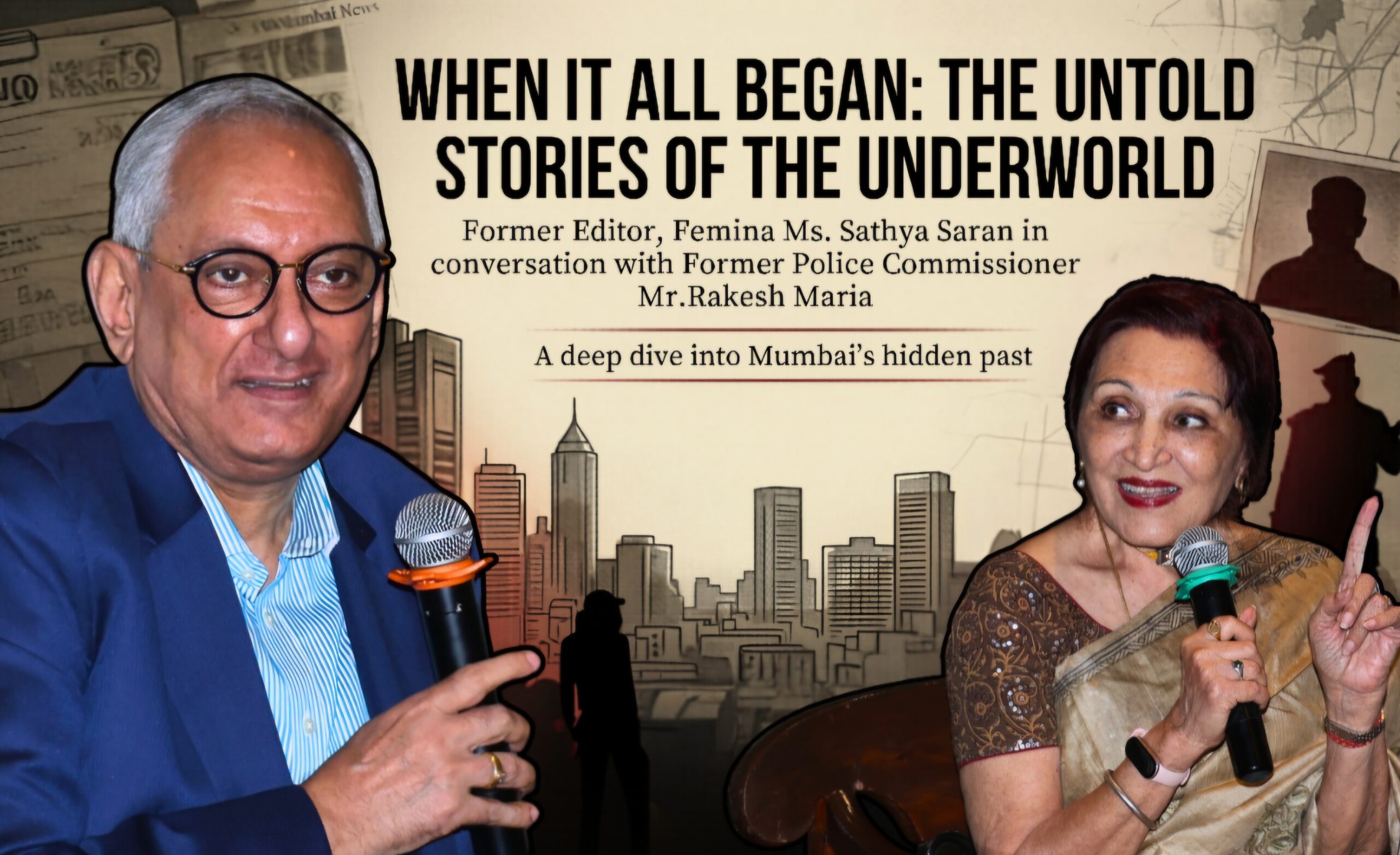
Former Police Commissioner Rakesh Maria in conversation with former editor of Femina Ms. Sathya Sara
Former Police Commissioner Rakesh Maria in conversation with former editor of Femina Ms. Sathya Saran on the Book ‘When It All Began: The Untold Stories of the Underworld’
Ms. Sathya Saran:
I have read this book not once, but twice, because every time you ask me to do a moderation, I read the book again. And it’s not difficult to read it twice. It’s fascinating, and I keep discovering new things.
But I always wonder how you managed to do the research for this book. We heard about your six cupboards, but tell us more about that, because you go back to 1930. I don’t think you’re that old. How did you get all that information?
Mr. Rakesh Maria:
Good afternoon, ladies and gentlemen. At the outset, I’m a little surprised and worried as to how such a distinguished gathering would be interested in crime and the underworld. So, I’ll try to do justice to whatever Rtn. Rashmi has spoken about me.
Crime and criminals have fascinated me right from childhood. Bombay, or Mumbai, is my Janmabhoomi, is my Karmabhoomi. Bombay was blessed with a police force famous for its detective work and plagued by a rising underworld determined to make its presence felt.
I had always dreamt of detecting exciting cases and sharing the accounts of these cases with readers by writing interesting books like the ones I had grown up reading. I was not to be disappointed. Thanks to the Almighty, the blessings of my seniors, parents, and elders, my plate of investigations was always full of sensational, complex, difficult, and hard-to-believe cases. It was an overdose of a dream job, but nothing could have been more stimulating.
The Mumbai serial blasts of 12th March 1993 catapulted me to another league altogether. The thrill of bringing a few criminals to book was nothing compared to what I was mandated to do now — that is, unravel a terrorist conspiracy with international ramifications.
So, gathering, sifting, and analysing information on the underworld became a core duty. Sensitive police stations like Dongri, Pydhonie, Nagpada, Agripada, Byculla, and V.P. Road became my regular haunts. I sought out officers and men, both retired and serving, who had handled the underworld to understand how the situation had developed right under our feet.
I spent hours poring over police station records — the history sheets, the gang registers, the gang dossiers — and I made very copious notes in the process. I also learned an important skill: cultivating khabris (informants) or informants of my own. Now, this khabri world is very fascinating. It became my mission to get as many khabris, or informants, as possible, and I feel I succeeded in that.
How? In 1993, Mumbai was hit by a spate of political killings. In April 1993, the Member of the Legislative Council, Maulana Ziauddin Bukhari, was shot dead while he was sitting in a shop-cum-office, God’s Gift, at Byculla. In May 1993, the firebrand Shiv Sena union leader, Ramesh More, was shot dead in Andheri. In June 1993, the very influential BJP Member of the Legislative Assembly, Prem Kumar Sharma, was shot dead in Pydhonie whilst he had brought his family out for dinner.
I was able, with my team, to detect all three sensational cases. Of course, it attracted the attention and appreciation of my superiors, but it also drew the attention and anger of Dawood Ibrahim. He simply could not afford to continue to make dents in his organisation by arresting his shooters, his money launderers, and his infrastructure.
So what did he do? In January 1994, he had an important informant of mine, Sayeed Hamid Haidar alias Haji Bidar, shot dead in Dongri. Again, in September 1994, he killed a very important informant of mine called Zubair Parveen as he finished afternoon prayers and came out of the Jumma Masjid in Pydhonie.
Before that, in January 1994, he had tried to kill a very resourceful informant of mine called Abdul Mannan Sheikh. Mannan survived two bullets in his chest and shoulder and lived to tell the tale.
Mannan was an inmate of Arthur Road Jail when criminals like Dawood, Hameed Aziz, and Samad Khan — these were the top gangsters after the old gangsters like Karim Lala and Haji Mastan had phased out — were incarcerated there. It was Mannan who could describe to me the vicious atmosphere inside the prison when these notorious criminals created a reign of terror and held sway over the inmates and the jail staff.
All dons like Karim Lala and Haji Mastan met me several times, and I had very lengthy discussions with them. Their stories were eye-openers and gave me totally different perspectives. I felt the urge to delve deeper into why and how the bhai(s) and dada(s) of Bombay evolved and adapted — their codes of conduct, their cultural upbringings, and the codes which drove or limited them.
I also got to understand the response of the police force and its predicament. Policemen are human beings, after all.
Another very important source for this book was the Pathan — Shehzada Jangrez Khan, brother of the Pathan ganglord Alamzeb and son of Jangrez Khan, one of Karim Lala’s oldest and closest associates. Shehzada was in the thick of the gang war, but with the passing of Alamzeb, he and his brothers had called it a day.
It was Shehzada who made me understand the milieu in which the Pathan boys grew up and got drawn to crime — what went on behind the scenes in the turbulent 1970s when they formed groups and began challenging and entering rival turfs, and the trail of revenge that continued into the 1980s.
Now, my story in this book starts in 1930. That is the time when it begins with Karim Lala. How did I get the information? Because Karim Lala was born in 1911 in a village called Samalam, in the picturesque Sehgal province of Kunar, which today is the easternmost province of Afghanistan.
So it was Shehzada, who was a Pathan himself, whose family lived a few kilometres away from Samalam, who got me in touch with the elders there. I did video conferencing with them, I spoke to them, and got stories. Of course, I have hours and hours of taped conversations with Karim Lala and Haji Mastan. So it’s first-hand information that came to me.
Then, of course, it is the officers and men who worked under me in the various branches and police stations. There was a perennial supply of information that kept coming to me. And I had a weakness for crime detection and interrogation.
There was a time in 1994 when I spoke to my seniors and told them, I am DCB Detection in the Crime Branch. I don’t want any more promotions. I want to remain DCB Detection for the rest of my life — no promotion — because I love doing this work.
So this — the officers, the khabris, meeting these senior gangsters — is the source of information for my book.
The primary objective of this book is to preserve a history that was in danger of being erased, not from paper, but from consciousness. So that is the main purpose of this book.
You will find stories in the book that have not been published anywhere. There is so much myth-making and storytelling about gangsters. I felt that it was time somebody put the myths to rest and brought out the truth. And that is what this book is about.
Ms. Sathya Saran:
Wonderful. It’s really an honour to be speaking to you because, in my long career, I have seldom met someone who is so particular about research and who has spent years and years investigating in detail not just cases, but the stories behind the cases. It is really an honour. Thank you, sir.
But what I want to say is this: this book, because of the gang wars that keep happening and the rivalry and the revenges, is peppered with murders. We only know about somebody pulling a gun and shooting someone, but we do not realise, until you tell us in the book, that there is a lot of planning. It is almost like planning a war, like a general planning a war behind every little murder that happens.
One case which I found particularly interesting was that of Yusuf Patel. Do you want to share that with the audience?
Mr. Rakesh Maria:
You see, Haji Mastan was the first gangster to come and settle in Mumbai in 1934, Karim Lala came in 1936, and Varadarajan Mudaliar came in 1944.
Now, the first-generation gangsters, the names that I have taken, respected each other’s turf. They felt that there was enough money for everybody. There was no need to kill each other. You respect each other’s boundaries, you do not transgress into other areas, and everything was fine.
It went on like that. The eastern suburbs were given to Varada. The south-west central went to Haji Mastan. You had Sukur Narayan Bakhia and Lalu Jogi, the two biggest smugglers ever in India from Gujarat. So they had their turf clearly marked out. Everything was fine, hunky-dory, no problem.
In 1963, Haji Mastan took on a partner called Yusuf Patel. Yusuf Patel was unlike them; he was educated, and he could speak English. So maybe that is why Haji Mastan took him on board: he wanted an educated person on his management team.
So, in 1963, Yusuf Patel came in as a partner of Haji Mastan. Everything was going on till sometime towards the end of 1967 or the beginning of 1968. Sukur Narayan Bakhia called Varada, saying that the silver ingots you sent me—those boxes — do not contain silver; they contain only glass.
Now, silver in India at that time was ₹3,000 a kg, whereas in the world market it was ₹10,000 a kg. So textiles, watches, gold, and electronics used to be smuggled into the country, whereas silver and pulses used to be smuggled out of the country.
So when Varada came to know this, he phoned Haji Mastan and told him that the consignment we had sent contained glass, not silver. Haji Mastan was shocked. He said, how can it be possible? Let me check.
Now, Haji Mastan did not have the guts to ask Varada, I sent it to you, your people loaded it in trucks — because transportation was Varada’s domain. By that time, Varada was the liquor king of Mumbai, so he had transportation networks all over the city and outside.
So Mastan asked his operations man — who was his operations man? It was Yusuf Patel. He told him there was glass, not silver. Yusuf Patel was also shocked. He said, how can it be glass? Anyway, let us find out. But Haji Mastan told him that the two of us will have to bear the loss.
A few weeks after this incident, Haji Mastan received a phone call from Yusuf Patel saying that Customs and Marine Preventive officers had entered his house. Haji Mastan was petrified because they had just smuggled in a big consignment of gold, and that gold was kept in Yusuf Patel’s home.
So Haji Mastan told Yusuf Patel, “Kuch bhi karo, niptao, jaldi se jaldi niptao, jitna kharcha hota hai, niptao” — take care of the issue as soon as possible.
After a couple of hours, Yusuf Patel called back saying that he had somehow managed; this was the cost incurred, but the consignment had been saved.
Now Haji Mastan was wondering who was after him and his business, with all these losses that he had to incur. Haji Mastan loved to play cards, and there was a Diamond Club at Musafirkhana, Crawford Market, which was owned by him. He would sit there the whole day and play cards.
One day, while he was playing cards there, some Customs officers came in. They exchanged pleasantries with Haji Mastan. Haji Mastan recognised them because these were the same names that Yusuf Patel told him had visited his house.
So Haji Mastan asked them, if you were coming earlier, you should have told me, I would have arranged a good welcome for you. What was the need to conduct a raid?
They looked shocked. They said, “What raid are you talking about? We have not come for any raid.” He said, “No, you went to Yusuf Patel’s house for a raid.” They said, “No, Yusuf Patel had called us for dinner and drinks, so we went to a party at his house.”
The penny dropped, and Haji Mastan realised where the trouble was. That consignment of glass, the so-called Customs raid — he understood that Yusuf Patel was the culprit.
Now, smugglers and gangsters worked on two principles. One was zaban — word. A person’s word. And the second was ittemad — faith, trust. So it was a gentleman’s word and trust, nothing in writing, no contracts signed.
Yusuf Patel had broken that trust. So Haji Mastan had a massive showdown with Yusuf Patel and threw him out of the business.
This created a seismic disorder in the Mumbai underworld. Haji Mastan broke away from Yusuf Patel, and Yusuf Patel went and joined the rivals — Gaffar Sopariwala, the Dholakia brothers from Lamington Road.
Besides this, Yusuf Patel knew that Haji Mastan would not let him off so easily. So what did he do? He got hold of a journalist, a very honest man with a vitriolic pen, called M. P. Iyer.
M. P. Iyer was a freelancer but used to write big columns in Rusi Karanjia’s Blitz newspaper. The “P” stood for Pandarinath. His parents had prayed at Pandharpur to Lord Vitthal, and he was born after those prayers, so they named him Pandarinath. He could speak fluent Marathi and was one with the Marathi ethos.
He started writing articles in Blitz against Haji Mastan because he was getting inside information on Mastan from Yusuf Patel. He wrote twenty-three articles against him.
Haji Mastan was repeatedly raided. When he returned from London and landed at Santa Cruz Airport, he was picked up and detained under the Defence of India Rules and sent to Arthur Road Jail.
While he was in Arthur Road Jail, he had time to contemplate. He decided that he had to do away with Yusuf Patel. He called his right-hand man, Aziz Honda, and told him to go and speak to Karim Lala, saying that he was giving a supari for Yusuf Patel.
For many of you, the word supari may be new — it means a contract to kill. So he gave this contract to Karim Lala.
Karim Lala agreed. This was the first supari given by the underworld. The price was ₹2 lakh in cash and two Fiat cars. This was the first supari given in Mumbai — then Bombay — by the Bombay underworld.
It was planned in October 1969. Yusuf Patel lived in a house called White House. This name, “White House”, is a great favourite with the underworld.
Ms. Sathya Saran:
And now we know why. And now we know why.
Mr. Rakesh Maria:
You see, I’m talking of the 1960s. Yusuf Patel lived in a building in Nakhuda Mohalla. I don’t know whether any of you here have had the opportunity to visit Nakhuda Mohalla. If you put a DJ at full volume there, you will have two or three buildings collapsing.
So you have this house called White House. From there, he would come out and, to go to his office, he would take a left turn at Masjid Bunder. The Pathans were ready. There was a car that came out of the lane and took a left turn. A truck that was parked there revved up at full speed, went, and banged into this car. Both the inmates of the car died on the spot, but Yusuf Patel survived. Why? Because that was not his car. They hit the wrong car.
Then Karim Lala said, now I cannot rely on this method, let me send my people and shoot him dead. So it was decided that on 22nd or 23rd November 1969, outside the Jumma Masjid, after the evening prayers, as soon as he came out, Yusuf Patel would be shot.
He sent two Pathans, Majid Deewana and Rashid Deewana. These Pathans were known by that name — Deewana means crazy. Aziz Honda’s job was to identify Yusuf Patel to them. So he identified Yusuf Patel, and these two Pathans opened fire on him. Yusuf Patel was hit, and so was his bodyguard. They were rushed to the hospital. Yusuf Patel survived; his bodyguard died.
Now again, there was turmoil in the underworld. All smuggling activity came to a stop because they were not allowing each other to function. The biggest receiver of stolen property in Mumbai was a man called Usman Ibrahim. His ostensible source of income was a ball-bearing shop at Chimna Butcher Street — what is Chimna Butcher Street? It is Chor Bazaar.
He ran a ball-bearing shop there. Now it started affecting receivers of stolen property, because there were no goods to sell. So he spoke to a man called Shehzada Kalkattewala, an ex-gangster who had left Mumbai and settled in Calcutta. He called him and said, we need to put sense into these two groups, otherwise all of us will be finished.
So Shehzada came down and convened a peace committee meeting — a peace committee meeting for the underworld. This meeting was held at a designated place. They all gathered, placed their hands on the Quran, and said, let bygones be bygones, no more fighting, we will not harm each other.
Everything was fine till Yusuf Patel said that M. P. Iyer had so much information on all of them that if he came to know they had settled, he would write even worse things.
So then Haji Mastan and the others decided that M. P. Iyer had to be killed. They told Yusuf Patel that it was now his responsibility to eliminate him. Yusuf Patel took it upon himself.
The meeting was ending, and Shehzada Kalkattewala gave the vote of thanks. In his vote of thanks, he said that while killing M. P. Iyer, he also wanted one more person to be killed. He said he had an ex-mistress called Kaneez Begum. When he shifted to Calcutta, he had wanted her to come with him, but she refused. He was very angry and wanted her killed as well.
They agreed, saying that since he had helped mend fences, they would do this for him.
So Yusuf Patel sent word to M. P. Iyer that someone was ready to give him very vital information on the underworld, but he had to come to Khandala. M. P. Iyer, like any good journalist looking for breaking news, agreed.
They also informed Kaneez Begum that her ex, Shehzada Kalkattewala, was in Khandala and wanted to meet her. So she agreed to go.
They travelled together; she sat behind, Yusuf Patel sat in front. The car started at full speed. At that time, the expressway was not there, so they had to take the ghats. While the car was speeding through the ghats, the driver jumped out. Along with him, M. P. Iyer was also forced out, while Kaneez Begum remained inside.
The car went off the ghat. M. P. Iyer was killed on the spot. Kaneez Begum survived but was paralysed for life. So this is the level of planning that the underworld undertook to settle scores with rivals.
Ms. Sathya Saran:
Wonderful, wonderful stories. I think we are running short of time. There is a story on match-fixing, there is a story where a dog plays the main role — you will have to read those in the book.
One more story — do you want to hear about the dog or match-fixing? All in favour of match-fixing? There, that is your story.
Mr. Rakesh Maria:
You see, match-fixing is not one story. The first match-fixing incident that came to my notice was in 1995. If you recollect, the Azharuddin match-fixing scandal broke out in 2000. You had Aniruddha Bahal of Tehelka doing a sting. One of the first people who was stung was me, without my knowledge. That was in 2000. I am talking of 1995.
There was a spate of shootouts in the city, and we were looking for gangsters belonging to the Sharad Shetty group. So I told my officers to round up people — what we call in Mumbai “section garam karna”, meaning to make things so hot that people start talking and the gang eventually says, tell us what you want. Then we tell them we want the shooters, we want this, we want that.
So I ordered them to make things hot. I was sitting in the Crime Branch office one night at about 10:30 when my officers brought in a young man, around 32-34 years old. He was reasonably well dressed — gold chain, gold bracelet, gold ring, watch.
He came and stood in front of me. I told him, you are definitely involved in something. You look so rich, you must be involved in some shady activity.
He said, “Sir, main bahot gareeb hoon—” and before he could complete, my officer standing behind him gave him a tight slap on the head and said, “Sir, he is lying. He has come in a Mercedes car.”
I told him, you are definitely involved in the underworld. He said, “No, sir, I don’t do anything like that. I do match-fixing.”
In 1995, the term match-fixing was something new. I asked him, “What is this match-fixing?” He said, “Sir, I speak to cricketers, and we fix the game.”
I said, I don’t believe you. He said, “Sir, today is 15th February 1995, 10:30 pm or 11 pm. There is an India-New Zealand match. You hear the whole thing, and it will prove what I am saying is right.”
Now, the New Zealand cricket centenary celebrations were being held. There was a quadrangular tournament — New Zealand, Australia, South Africa, and India. India was right on top. We had won the Champions Trophy — you remember Ravi Shastri driving the car around — and we were kings of the world at that time.
So I told him, there is a telephone here, use this telephone. I told my officer to put a tape recorder and record the conversation. He said, “Sir, I cannot make the call from here. There is a particular ISD PCO booth from which I have to make these calls.”
I asked, where is it? He told me the location. So I told my team to go with him there and tape the conversation. I phoned my wife, Preeti, and said, I am not coming home tonight. Today I am going to decide whether I continue to be a cricket fan or not.
I stayed back in the office. In New Zealand, the matches would start at around 3:00 or 3:30 in the morning. At about 2:30, my officer called me and said, “Sir, India has decided to lose.”
I asked, what do you mean? He named three or four cricketers. This man had spoken to them, and it was decided that each of them would be paid ₹25 lakh. I am talking of 1995, which was a substantial amount. These four cricketers were to be paid ₹25 lakh each.
My officer told me that they had instructed the bookie to place their ₹25 lakh on New Zealand with another bookie. All of this was being taped.
India batted first — 160 all out in 45.5 overs. New Zealand batted second — 162 for 6 in 32.2 overs. India lost the match. From our underworld sources, we came to know that the bookies made a profit of ₹43 crore from that one match.
This was the first time I heard of match-fixing.
Fast forward to 6th November 1996 — the Titan Cup final, India versus South Africa, at the Wankhede Stadium.
Now, I will go back a little. There was a murder on 7th May 1994 of an industrialist called Sunit Khatau. It happened at Mahalaxmi, just outside the railway station. He was sitting in a cream-coloured Mercedes, driven by his driver, Anand Ghorpade.
At the Mahalaxmi signal, a Maruti van came and stopped diagonally. Four or five motorcycles arrived. They believed the vehicle was bulletproof, so they took an axe, smashed the windscreen to pieces, opened fire, and shot him. The driver was also injured but had the presence of mind to drive to B.Y.L. Nair Hospital, where Sunit Khatau was declared dead on arrival. The driver was admitted.
The Khatau family was no ordinary family. In the 1700s and 1800s, among the distinguished marine and trading families of Mumbai — the Tatas, Wadias, Sassoons, Banajis, Morarjis, Khataus, the Dawars, the Petits — the Khataus were one of them. So there was a lot of pressure.
Being in the Crime Branch, we suspected this could be a rival gang issue. Khatau wanted to sell the Khatau Mills and was to receive thousands of crores. For that, he needed the workers’ signatures. Arun Gawli had promised to get those signatures and vacate the mill.
The rival, Amar Naik, felt that if Gawli got that money, he would gain more men and weapons, so he would not allow it. So we suspected the Amar Naik gang, but who within the gang, we did not know.
The murder took place on 7th May 1994. Around 10th May 1994, at about 12:30 in the afternoon, a visitor’s slip came into my chamber — name, purpose of visit, date. The name was Mehrunisa, purpose “official”, date 10th May 1994.
After finishing my work, I asked the orderly to send the visitor in. A woman walked in, completely clad in a burqa, even her face covered. She sat opposite me and asked, “Sir, can I trust you?”
I was taken aback. Nobody asks a police officer that. I said, what do you mean? She repeated the question. I told her, I am sure this name you have written is false. I have not seen your face, I do not know who you are, so what damage can I do to you?
She said the information she was about to give could get her killed. I told her she must have heard about me and decided to come. Then, in one swift motion, she lifted the veil.
She was an exceptionally beautiful woman, about 25 or 26 years old. Coming from a film-associated background, I had seen many actresses, but I felt she was on par with, if not better than, most of them.
She told me, “Sir, I can give you the shooter in the Sunit Khatau murder case.”
I asked how she would know. She said, “Sir, I am a bar dancer.” She explained that she earned about ₹10 lakh a month in 1994. Apart from tips, she entertained private clients after business hours, selecting those who could pay her fees, meeting them at a suite in a 5-star hotel.
She told me that a month earlier, a young man had come, spent lavishly, and taken her to the hotel repeatedly. After a few days, he started bringing a revolver, placing it on the table, and preventing others from approaching her, affecting her income.
Two days before meeting me, he had boasted that he was the shooter in the Sunit Khatau case. His name was Om Prakash Bhardwaj, also known as Omi Bhardwaj, the right-hand man of Amar Naik.
She gave me the motorcycle number — MH-06-A-3650, a blue Yamaha — used in the crime. Subsequently, Omi Bhardwaj was killed in an encounter.
Mehrunisa kept in touch with me and would even offer to relieve my stress. I told my wife, Preeti, that I had found a new “therapist”. My wife replied that it would be the first time in the history of the Mumbai Police that an IPS officer’s wife killed someone in an encounter.
Two days before the Titan Cup final, she called me again and said, “Sir, enough of this hard work. It is time you made some money.” I asked how. She said, “Sir, I am the girlfriend of Hansie Cronje, the South African captain. Wherever the team goes, I stay with them. India is going to win the final.”
At that time, South Africa had just lost the World Cup final, had won a triangular tournament in Sharjah, and was performing very well. India, on the other hand, was not doing well.
She insisted India would win.
Police officers usually receive two free tickets for such matches. I had my tickets but had stopped watching cricket after 1995. Our Director General of Police then was Mr. Amarjeet Singh Samra. I gave him my tickets. He asked why I was not attending. I told him I already knew the result — India would win.
He went to the match. India batted first — 220 all out in 50 overs. During the break, I received a message that the DGP wanted to speak to me. I called him. Eventually, South Africa was bowled out for 185, and India won.
Later, in 2013, we detected the IPL match-fixing case involving Chennai Super Kings, Gurunath Meiyappan, and Vindu Dara Singh.
Match-fixing is a huge subject. Anyway, thank you.