
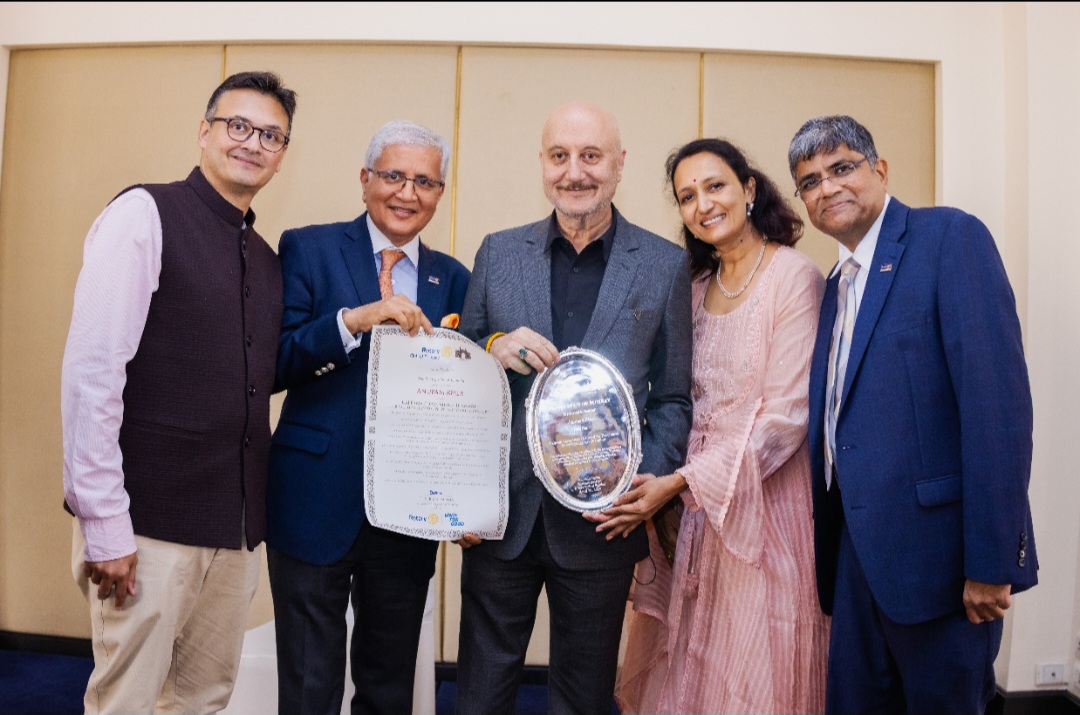
Kalpana Sham Munshi Award for Excellence in Performing Arts & Culture to Mr. Anupam Kher
Kalpana Sham Munshi Award for Excellence in Performing Arts & Culture to Mr. Anupam Khe.
Yes, good afternoon. Thank you so much. To look important on an occasion like this, where I think people are more qualified than I am, I dressed up differently. I rarely wear a suit. I do not usually wear a suit in the daytime, but I spoke to Mr. Jamal. I said, “Jamal, what am I supposed to wear?” He said, “Kuch bhi pehen lo.” And then he took a little pause and said, “Jacket jaroor pehen lena.” That is the hotelier in him. First, he makes the guest comfortable, and then he sort of says, “This is what we need.”
I think it is a wonderful feeling. Also, this is not the right time to make a speech, because you have just finished your lunch and some of you are already suppressing your yawns. I am not here to give you any gyan. I always believe that people on this side of the town are much more qualified than people on that side of the town.
I never got more than 38% marks in my life. Never, in my whole education. I was also very bad at sports. In fact, once my PT teacher saw me running, he said, “Stop it. Even if you run alone, you will come second.”
But I will justify why I am here. So let us just play a small game that I play with my guests and my audience. How many of you got more than 60% marks in school? It is a stupid question to ask. The lady over there said, “Is he an idiot? He is asking us this question.”
Okay, let us take it a little further. Remember that I got 38%. How many of you got more than 70% marks? Again, the same expression. What are you talking about? We live in South Bombay. How many of you got more than 75% marks?
Okay, you are still sitting in the audience, and I am standing here. So that justifies it. But I do not want to take away from the great achievements of your lives. I think I just lived life in a certain manner. I lived life on my own terms. God was kind, life was kind, that I could achieve whatever I have achieved, for the reason that I have been given this citation.
Earlier, there were only one or two very popular clubs. Rotary was one of them. I remember in Shimla, where I come from, the Rotary Club was very popular. I could never become a member of that. But now it is a great achievement that I am being honoured by Rotarians.
When you come from a small town, you dream a lot because the day does not end, it stretches. There was no transport there. In Shimla, there was no local transport, so you had to walk, especially in the late 50s and early 60s. You walk, you talk, you meet people, you actually see a sunrise, you see the shadow of the sun through the trees. You notice nature, you notice everything. If somebody stood alone and started looking at the sky, five or six people would gather and also start looking at the sky, just like that.
So you grew up as a person should grow up. You had the luxury of being bored. You had the luxury of having nothing to do. You had the luxury of teachers who were human beings, in the sense that they were like parents, like uncles.
In this whole system, I was growing up with dreams. When you are very poor, you dream a lot. I came from a very poor family. My father was a clerk in the Forest Department. There were fourteen of us, not in a big house. The house was maybe double this stage. We had one room, one kitchen, and one veranda. Fourteen of us were staying together.
Because we were so many people, and there was one bathroom and very little space, we used to bump into each other. I saw my childhood like that. My grandfather had made a very interesting rule. He said, “Whenever you bump into each other, hug the person.” So I grew up hugging people, my uncles, my aunts, my cousins.
We also noticed that we were very poor, but we were very happy, which was a little odd. Now we have various definitions of poverty: economically deprived, lower middle class, upper middle class, and so on. At that time, it was simply poor and rich.
So one day I asked my grandfather, “Dadaji, we are so poor, why are we so happy?” He gave a brilliant answer. He said, “When you are very poor, the cheapest luxury available is happiness.”
Now I will also do one thing. If I think I have said something very important, I will scratch my head. That means it is time for you to clap. So let us rehearse.
So I grew up with this feeling that it is okay to be poor, because my grandfather said that when you are very poor, the cheapest luxury available is happiness.
Then my father took away the fear of failure from my life. As I said, I was a very bad student. We had to get our report cards signed by our fathers. Because I had very low marks, I used to make sure my father was in a hurry. I would quickly give him the report card, he would sign it, and go away.
One day, when I was in the 9th standard, I gave it to him, and he realised he had forgotten his store key. So he came back and actually looked at my report card. He said, “Oh, you are 59th in your class.” I said, “Yes, Papa.” He said, “How many students are there?” I said, “60.”
I thought he would get upset. He never scolded us, but when a father does not scold you and just gets disappointed, that is the worst punishment.
He said, “There is one thing. A person who comes first always has the tension of staying first. Even if he comes second, he feels demoted. But a person who comes fifty-ninth can always come forty-eighth, thirty-sixth, twenty-fourth, or eighteenth. Do me a favour. Next time, come forty-eighth.”
Then he said a sentence which became the most important sentence in my life: “Remember one thing, my son. Failure is an event, never a person. The event fails.”
Thank you, Farhat. You are a real friend. Without scratching, you actually did it.
Also, this side of the city does not really believe in clapping, because clapping is for that side of the city. I can feel it, but why do you not, right now, think that I am on that side?
So, for a 13 or 14-year-old boy, two major fears were taken away. One by my grandfather, that it is okay to be poor, because the cheapest luxury is happiness. And one by my father, that failure is an event, never a person.
So no power on earth could now frighten me. These two statements, these two philosophies, came from my grandfather and my father. My father was not very highly educated. My grandfather was relatively more educated.
Because in a small town, there is a lot of time to think and a lot of time to dream, I wanted to be famous. Now, there was no way I would become famous because I was the most studious boy in the class. There was no way I was going to be famous because I was the most dynamic athlete in school or college. So what do I do?
I started copying my teachers, my grandparents, and my father. Every family, especially a joint family, and I am sure many of you here come from joint families, has very typical relatives. Frankly speaking, all of you talk about those relatives.
So I had… I was going to say the worst relatives. No, I had the most comical relatives in my life, especially my father.
My father had this habit… can you imagine earning Rs. 90 per month? One day, I think he got a 50-rupee lottery ticket. That morning, he had seen the face of a man who used to sell bread to us. After that, it became our duty, mine and my brothers’, to find that man and bring him home. My first visual early in the morning was my father doing this ritual.
So that became comical. I started performing it for my friends. I would say, “This is what my father does.”
Then my teachers also… I went to a Hindi-medium school. I have never spoken English for 15 minutes continuously as I have done right now. Never. My jaw is aching, and my tongue feels too big for my mouth. But I think on this side of the town, I have to speak in English. You are the culprit. If you were not sitting here… but I am happy that you are sitting here… I would have managed to speak in Hindi.
So my teacher… my typical teacher… “Murga banate the…” He used to ask the students to stand up, sit if they remembered what was taught. My entire year would go standing.
What I am trying to create is a world which was innocent, which was beautiful, and not touched by any kind of manipulation. Teachers were like that.
People say that actors are born. It is all rubbish. Actors are not born. They work hard, and then they become. Because if an actor were born, then my first experience of acting would not have been a disaster.
So let me share that with you.
I was in the fifth standard. Our class teacher, Mrs. Bajaj, chose a play. The name of the play was Prithviraj Chauhan. Prithviraj Chauhan was a very famous prince and warrior.
Because I was the fairest boy in the class, I got the main role. But I was very thin. I was so thin that I could see through a keyhole with both my eyes. Literally. If it was very windy, my mother used to put extra books in my bag because she thought I might fly away.
So, I became Prithviraj Chauhan. And there was a doodhwala’s son, Nand Kishore, whom we called Nandu. He was given the role of Jaichand.
Now, Nand Kishore was five times bigger than me. Typical casting was done even in those days.
I told my entire family, “I am doing the main role.” My father said, “And what happens in that?” I said, “I win.” I had to lift a sword and deliver a dialogue: “Chala ja, chala jaana…” and Nandu had to fall. I had to say it three times.
The next day, when the curtain opened, there was already a divide in the audience. On the right-hand side was Nand Kishore’s family, strong, robust, moustached, typical doodhwala family. On this side was the Kher family, teachers, clerks, thin, looking almost like refugees. There was already a rivalry.
My father was relaxed because, in the end, I was supposed to win.
You know how parents look when their child is performing? That slightly foolish expression. Now it is even more foolish because they are also recording a video. The child is performing only for the camera.
My father knew the result because I had told him ten times that I had rehearsed “Chala ja”.
So the final moment came. I said, “Chala ja, chala jaana, na bakwas kar, Nadu gir…” Nandu fell. I had to say it three times. The second time, also, I said it, and he fell.
When I said it the third time, suddenly Nand Kishore’s father got up from the audience and shouted, “Nandu, agar iss baar girta hai toh ghar mat aana!”
And suddenly, for the first time in my life, everyone started shouting, “Nandu, Nandu, Nandu!” The play lost its direction. The teacher was saying something else, the audience something else.
Jaichand picked up Prithviraj Chauhan and threw him into the audience. He said, “Bapu, main yahaan hoon!”
So I thought, since I had the main role, I would get the Best Actor award. But the Best Actor award went to someone else. Best Supporting Actor also went to someone else. The Consolation Prize went to Nand Kishore.
I did not get anything.
When you live in a joint family, and you go through failure, you do not look at anybody. You just sit in a corner. So I sat in a corner.
My father came with a bunch of wild yellow flowers, tied with a small red thread, seven or eight of them. He came and gave them to me. It is a very beautiful moment in my life.
He said, “Beta, this is not for losing the award, but for trying. Take it.”
I realised my father was my biggest fan, which he was. If he could give me an award for losing…
Many years later, when I read Acharya Rajneesh, Osho, who said, “If you try, you risk failure. If you do not try, you ensure it,” I felt my father had already told me that years ago.
So what I was trying to prove is that I was not a born actor.
Again, this desire to be famous… In Hindi-medium schools, there is a big complex about English-medium people. Even Hindi-medium boys feel that English-medium girls do not look at them, which is a fact.
All of you are English-medium girls. Have you ever looked at the boys from Dayanand Saraswati School? Never. Bishop Cotton, St. Edward’s, those kinds of schools… I understand that.
I was so thin, as I told you, and my school was surrounded by Tara Hall School, St. Bede’s School, and Auckland House. We were surrounded by English-medium schoolgirls, but they never paid any attention to us.
So this teacher, who used to say, “Aath dande, chaar dande…” had this burning desire to do an English play in the school. He had his own complexes.
One day, five or six students from English-medium schools failed there and joined our Devi Higher Secondary School. Mr. Hardarshan, that was the name of the teacher, saw his dream coming alive. He said, “I want to do an English play.”
Because I was a chamcha-type student, bringing samosas and chai, I got a small role in that English play: the Clerk of the Court.
The teacher chose The Merchant of Venice by William Shakespeare. I became the Clerk of the Court.
My dialogue was: the judge would say loudly, “Clerk of the Court, read out the charges.” I had to read them out: “Charges against you are as follows: Charge number one, charge number two, charge number three.”
In the dress rehearsal, I made twenty-seven mistakes in eight lines.
The principal came on stage and said, “He will kill our play tomorrow. The Deputy Commissioner will be there. He should not be in the play. Out.”
I almost fell at his feet. I said, “Sir, I have told my whole family, my grandfather, my parents, my father especially. If I am not in the play tomorrow, it will be very bad. It will finish me.”
In those days, teachers felt compassion. The teacher said to the principal, “It is okay, sir. Let us keep him in the play, but give his dialogue to the judge. The judge will read the charges.”
So I was in the play, but with no dialogue. Just nodding my head.
Again, I did not tell my father, because he was my biggest fan and I did not want to disturb him.
The next day, my father was sitting in the eighth row. My mother and relatives were in the front row. The Deputy Commissioner and the principal were there.
I was relaxed, just nodding my head in a Shakespearean costume.
Suddenly, I heard the judge say, “Clerk of the Court, read out the charges.”
I was shocked. The teacher had said something else the previous day.
I almost had tears in my eyes. I said, “Thou… read out the charges…”
The principal had said that yesterday: eight lines, twenty-seven mistakes.
I wanted to… I looked towards the stage wings. My heart was sinking. I said, “Pardon?”
The judge said, “What do you think of yourself? He is ready to give you a pound of money. You want a pound of flesh.”
I just started rambling anything.
And I noticed that the audience was laughing uncontrollably at my dialogue. Sabse zyada mere mata-pita hans rahe the, ki beta kya comedy kar raha hai. That day, in The Merchant of Venice, the person who got the maximum applause was the Clerk of the Court.
In fact, it felt as if my dialogues were telling William Shakespeare, “Hey, Hindi-medium boy, thou shalt now stop.”
But that is the magic.
Again, I did not get Best Actor, Best Supporting Actor, or even a Consolation Prize. Again, that same night, my father… and this is not made-up… my father brought a bunch of yellow wildflowers and said, “This is not for losing, this is for trying.”
So how can you stop anybody from becoming successful if your father is celebrating your failure? You cannot.
And my father was not an intellectual kind of person. He was simply dealing with life in the best way he knew.
Then I went to drama school, did my training, etcetera, etcetera, and I came to Mumbai on 3rd June 1981. I came here as a gold medallist from drama school. After my graduation, when I joined drama school, I suddenly discovered the world of Laurence Olivier, Marlon Brando, Charlie Chaplin, Arthur Miller, and Tennessee Williams.
I discovered that there are books on theatre, books on paintings, and I became so enamoured, so fascinated, that I spent almost all my time in those four years in the library.
But when I came to Bombay… this is a very dignified, bald, sexy look… but when you lose hair, some from here, some from here… some of you may know that. I am glad that you have a shaved look; that is the best look.
Everyone said, “Oh, you want to be an actor? Baal nahi hai. Baal jaroori hai,” I said, “Yes, I am a drama school gold medallist.”
They said, “No. You become a writer or an assistant director. Without hair, how will you become a hero?”
Strangely, I got a film where my baldness came in handy. My first film, Saaransh, and I was twenty-eight when I played a sixty-five-year-old man.
Again, I was taking a chance. I was living life in an unformatted, unusual manner, because that is what life is about. You make your own decisions. You are an original, sent by whoever has sent you. You are an original, and then we become copies. Life makes us feel mediocre.
And then how I got films, the ups and downs, etcetera… And when you said ten films less in your introduction, it is not 540, it is 550. Five hundred and fifty films in forty-one years.
That is only because I have no fear of failure. I am okay to lose. I am okay to fail. Because many years earlier, my father said, “Failure is an event, never a person.”
My father, unknowingly, gave me such amazing strength.
Aapki khaasiyatein, aapki qualifications, aapki zindagi jeene ka andaaz mujhse better hai. But main aapse kya share kar sakta hoon… ki jeevan ko apne tareeke se jeene mein apna hi ek anand hai, ek power hai, ek sense of power.
Before every event, I get a little nervous. People have a restless energy. What will they want to listen to? It is 2:00 in the afternoon. What will I say?
Also, I read the citation. You sent me the citation one month in advance. Very organised people you are, I must say. Highly organised. When I left Andheri, I knew it would take one hour and ten minutes. Still, every twenty minutes, I got a call.
In these forty-one years in films, as you must have discovered by now, how bad my English is, I felt I must try English-language films. Because what I know about acting is not fully used here. We make a certain kind of cinema, and I am very proud of it. We entertain 1.4 billion people, even with completely unconvincing things, but we entertain them.
So I said, let me try English-language cinema.
My first film was Bend It Like Beckham. It became a super hit because I had no fear of failure. I said, “Maximum kya ho sakta hai?”
Why do we live a life that is very balanced, or very… I should not say fake… but superficial? Let us play twenty questions. A life that is not yours.
People pretend because they do not like themselves. I love myself.
People pretend because they want to be somebody else. They want to be somebody else because they do not like themselves.
Whereas your power, my power, is who we are. And strangely, I see many people here who are themselves. That is rare.
Usually, people are not like that. But people who have come here are comfortable with who they are.
So what I am trying to say is, our power is who we are.
Imagine this: I do not carry the burden of Anupam Kher on my shoulders. I do not carry the burden of 550 films. I am proud of all these things, but they do not bog me down.
I have told all my media friends never to call me a legend, thespian, or veteran. That is their way of telling me, “Now you have done enough, now retire.”
Who are they to decide that I should retire?
I have just reached the interval of my life. After twenty years, then you can start thinking of giving me a lifetime achievement award.
Till then, my competition is not with my contemporaries. It is with the young people. Because I will decide the course of my life.
A lot of people say today… I have nothing against any generation. Every generation has its strengths and weaknesses. But there are three things I have never said in my life.
One, “I am bored.” I have not used that word for the last thirty-five years. It gives you a false sense of importance.
Second, “This is the way I am.” If you say that, it means you have stopped growing.
I do not take myself that seriously.
So I do not know what else to say, but this is my story. I am happy to be who I am.
My father used to say, “The easiest thing in the world is to make somebody happy.” Strangely, today I am talking so much about my father, but those are the lessons he gave me.
In fact, he gave me the best lesson in his last few days.
We were travelling to Mahabaleshwar one day. My nickname at home is Bittu.
He said, “Bittu, you are not doing many films these days.”
So I thought I would give him a smart answer. I said, “No, Dad, I am not in the rat race.”
He looked around, then looked back at me and said, “Oh, so you have left the race for the rats.”
I said, “Okay, Dad, you are happening, man.”
My father, unfortunately… he was a very active man, even at the age of eighty-four. Very active. He used to walk eight to ten kilometres. Then, unfortunately, he got a strange disease, because of which food became like sand for him and water became like acid. So he almost starved.
When the doctors told us to take him home and just let him be, I told my brother that I had to go for shoots and social engagements. I said, “Call me whenever he wants something.”
One day, I had just reached Goa. My brother called. There were many missed calls. He said, “He wants to say something to you.”
I rushed back to Mumbai, to my brother’s house. He was lying down, very thin, with no energy. There was a paper on his chest and a pen. He did not have the strength to speak, so he wanted to write something.
He started writing. There was a naughty glint in his eyes. He kept looking at me, writing, stopping, hiding the paper. It felt like two or three hours had passed. Finally, he dropped the paper on his chest and asked me to take it.
I picked it up. He was waiting for me to respond.
But the paper had only lines. He did not have the energy to form words or sentences. There were just strokes here and there.
I thought, what do I do now?
He was looking at me, waiting.
So I gave a casual answer, “Of course, Dad. Yes, you are right.”
He seemed a little disappointed.
Then he gestured for me to come closer. I put my ear near his mouth. For a man who was going to pass away in the next twenty minutes, his last two words to me were: “Live life.”
So you see, even while leaving, he gave me the best lesson.
That is what I do. I try to live life. And that is what everybody should do. That is the takeaway from this conversation. Live life. That is what is important.
ROTARIANS ASK
Your first experience with Saaransh, you almost did not get the role. Can you share that with us?
When I was twenty-eight, I played a sixty-five-year-old man in Saaransh. Strangely, this morning, I had a meeting with Mr. Mahesh Bhatt, because I told him, “Mr. Bhatt, I am seventy-one now, and I want to do Saaransh 2 with the spirit of a young man.”
We discussed the script today, where a seventy-one-year-old man is action-oriented and believes in doing things.
I had rehearsed for six months. We were supposed to shoot on 1st January 1984. One of my classmates came and said, “You have been rehearsing for six months, but I heard a rumour that you are not doing the role.”
I said, “What are you saying? This morning I was with Mr. Bhatt trying costumes.”
He said, “No, Sanjeev Kumar is doing the role.”
I called Mr. Bhatt from a ration shop, because I was in a bad situation and did not have a place to stay. I said, “Have you heard this rumour?”
He said, “Yes. The Rajshri people wanted an established actor. You do the other old man’s role. Okay, take care, bye.”
I was shocked.
I said, “This city does not deserve me.” I packed my luggage and decided to leave for Delhi, Shimla, anywhere.
But my grandfather used to say, “If you want to be equal to anyone, do not expect anything from them.”
So I said, now I expect nothing from Mr. Bhatt. Now I can tell him what I feel.
I took a taxi with my luggage and went to his house. He said, “Fantastic, you are taking it sportingly. Sanjeev Kumar is a big star, it will help you.”
I said, “Hold on.”
I took him to the window and showed him my luggage. I said, “I am leaving this city. I do not care what you think, but I want to tell you that you are the biggest fraud and cheat. You are making a film about truth, but you do not have truth in yourself.”
I said, “With all respect, Sanjeev Kumar cannot do this role as well as I can, because you need a hungry person, someone defeated, someone humiliated.” Now, usually you want to say these things in a climax, give your last line and leave. But I wasn’t getting my last time… something something, and I curse you…. but it was not happening.
I finished and was about to leave.
He called me back, called the Rajshri people, and said, “The scene Mr. Kher just performed, only he can do this role.”
And the rest is history.
If I had not gone to his house that day, I would not be standing here, and you would not be asking me this question.
I am also from a small town, Jabalpur. When I came to Mumbai, I had a lot of fear, everywhere. I am a doctor, a gynaecologist, and it took everything in me to start my nursing home. Even today, I feel I may be different from the rest of Mumbai.
What did you tell yourself when you came from a small town? How did you motivate yourself to be comfortable being different?
I used to see my life as a film. In the beginning, the hero faces problems. But in the end, he becomes a hero.
I am not making this up. Whatever does not work in your present becomes a story later.
I am an eternal optimist. The best definition of optimism is: nothing is entirely wrong. Even a stopped clock is correct twice a day.
Giving up is not a choice. When giving up is not a choice, you keep moving.
Earlier, I was walking nowhere. Now I am walking somewhere.
Why should I walk on a path without problems, without ditches, without speed breakers? A path should be difficult, so that when you reach the destination, you can turn back and say, “I walked a beautiful, difficult path.”
That gives you a sense of achievement.
If there is one great role from the past you would have loved to do, what would it be?
The Godfather. Marlon Brando’s role. Amazing. One of the finest.
You have worked on international platforms like New Amsterdam. How was that experience?
It was fantastic. When I work abroad, I feel I am representing my country.
During New Amsterdam, I played a neurosurgeon. My English is not great, and the terminology was difficult. So I would wake up at 4:00 am, rehearse my lines, almost like drama school again.
Before every scene, I would say, “Bharat Mata ki Jai,” because I felt I was representing India.
That gave me strength.
How do you deal with people who try to pull you down?
That is an autobiographical question. You have to be smart. You cannot fight every battle. My grandfather had a habit of making sounds like tch-tch-tch while eating. My mother tried stopping him, but he said, “You have a problem, beta, I’m just enjoying my food!” So, your strength is who you are. Time heals. The difference between ordinary and extraordinary is that little extra. You must give that extra.