
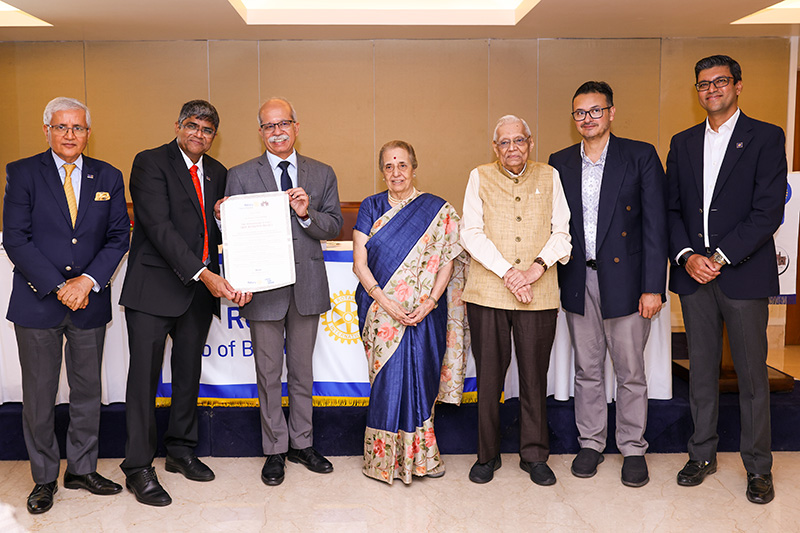
Rotary Club of Bombay Indira Suresh Kotak Award for Conflict Resolution through Mediation and Conciliation to Justice Akil Kureshi
Good afternoon, everybody.
We have this National Judicial Academy, which our friend mentioned a couple of times in his address, where we judges all get together, exchange thoughts and ideas, and education programmes go on. The post-lunch session is described as a graveyard session. It’s difficult to keep the audience awake with a sumptuous lunch and cool air-conditioning blowing. I’ll try to keep it simple, short and interesting.
Thank you for inviting me. Thank you for this honour. It’s a privilege to be present here before this lovely, distinguished audience.
As a judge, I was told that there are three stages in a judge’s career. The first five years or so, a judge is hesitant. He thinks he’s always wrong. The next five years, he thinks he’s always right. And the last five years, he doesn’t care whether he’s right or wrong. For us, there is a fourth stage after retirement, where nobody cares whether he’s right or wrong. So, at that stage, to invite me is a special honour for me.
I accept this award with all the humility at my command. Coming from this section of society, which is so aware about its social obligations and responsibilities, it means a lot to me and my family. In whatever I have been able to do in my 18 years as a judge, I’ve always given credit to my family and my friends. The family which makes no demands can only be a supportive family for a judge to succeed in his performance. And friends who protect you against all the pressures are what I needed and what I had.
In my farewell function, I had said that if I get another chance in life, if life rewinds and I’m offered judgeship, I’ll accept it, provided I get the same family and friends.
Mediation, when I look back, came because I was just at the right place at the right time. In the last four or five years, there has been a great impetus from the judiciary to go for mediation more and more. There is a spurt — more references, more awareness.
Internally, thinking about myself as a person who prefers harmony over friction, peace over disharmony, it came more naturally to me. Oftentimes, I’ve wondered whether I’ve enjoyed my career as a judge more than as a lawyer, because as a judge, you had far more flexibility and liberty to do justice, to bring people together. As a lawyer, that’s something you don’t have.
But also, it sometimes reminds me of that famous joke where there is a spate in a river full of water and a child is drowning. A whole crowd is there, and somebody jumps in without thinking, swims across, saves the child, comes to the shore, and everybody is congratulating him. “What a wonderful act you have done. What a brave act.” He says, “Woh sab theek hai, but who pushed me?”
So I wonder if somebody pushed me to land myself here. But so many things in life are pure happenstance, and this is one of them. And as I said, it was just the right place at the right time.
But apart from anything else, a large number of arbitrations have never given me the same satisfaction as the few mediations which I could resolve. A legal philosopher once said that all court orders are necessarily violent in nature. I don’t want to sell my land, but there is a decree which says you’ll execute this agreement to sell. I don’t want to annul my marriage, but the decree would say the marriage is, by dictate of the court, annulled. The court’s orders are necessarily violent in nature.
Mediation eliminates that violence. Mediation gives you the satisfaction of having arrived at a negotiated settlement which is acceptable to both sides, which never happens in litigation. One mediation which is resolved puts an end to, at least on an average, five to seven disputes which are already in process, and a few more which are in the pipeline. It also mends relations for life.
I’ll tell you about two or three cases which gave me immense satisfaction.
There was this family — husband and wife, both very bright professionals. The lady was a doctor, a specialist. The husband was a professional in IT, doing very well. But there were extremely bitter disputes between the two. It went to the extent of making the nastiest possible allegations against each other, against other family members, against the mother, against the sister of the husband, and so on and so forth.
One lovely child, very bright, but extremely confused, thoroughly demoralised.
And we sat together for months on end. Meetings after meetings we had. There were times when meetings were acrimonious, there were allegations, there was shouting. There were times when the woman would cry hysterically. But slowly, slowly, we could untangle the knots.
Eventually, when we settled the disputes, at least 11 pending cases got resolved, and five to seven which were already in the pipeline were terminated.
It was a matter of great satisfaction when both of them finally shook hands. Maybe they parted ways. They would probably never meet each other. But for one last time, they shook hands and went with a smile.
And more than anything else, the child would become happier, more mentally healthy, and a better citizen in future. And that was my reward. That was my satisfaction.
Another case that I remember immediately is one involving a public sector company, a government company, where there was a huge financial fraud in billing — online billings. There was a glitch in the programme. Some people realised it, tapped into it, defrauded it, took crores of rupees, and they came to us and sought mediation.
I had the assistance of an ex-bureaucrat, a retired IAS officer, who himself had been part of an oil company leadership during his tenure. I got excellent support and guidance from him.
We had meetings upon meetings. It was, in fact, a five-way mediation — four service providers and one consumer. Between them, we had to apportion liabilities and decide who would take how much haircut. And each service provider did not want that discussion to be known by the rest because there were confidential issues.
Meetings after meetings, eventually we could persuade each one of them to accept some portion of the haircut. The entire dispute was resolved. The consumer, the public sector company, accepted a reduction in the total loss. The rest of the companies accepted a certain portion of the remaining loss. And the entire dispute was resolved even before it escalated to the level of litigation.
But one of the most satisfying outcomes of mediation was when I was not a mediator, but a judge of the Gujarat High Court. A couple came before me in a Division Bench. I was sitting with my colleague. Husband, wife, three children — they had troubled times. The husband’s business was not doing very well. Added to the family pressures were some disputes.
The wife came to the High Court with a petition of habeas corpus. As you know, a habeas corpus petition is when a person comes and says somebody is illegally detained — set him or her free, give custody, or let the person go.
The woman said, “I’ve been thrown out of my matrimonial home, but my three children are kept by the husband. I cannot live without my children. If I’m not reunited with my children, my resistance will break down. I’ll be compelled to sign on the dotted line. Whatever he says, I’ll agree to it. Get back my children.”
As this happened, we called the husband, wife and children.
Now, there were three children. The girl was about 12 years old, very bright, very mature. The boys were twins, Ayaan and Amaan. I still remember the names. They came. Obviously, the husband must have said, “Don’t go,” this, that and the other. That is bound to happen. We called the children alone into the chamber. We requested the parents to sit outside.
Now, to break the ice with young children is not that simple. The first time they are coming to court, and court is a very imposing atmosphere. And in the chamber, there is a plush, large room where two seats are there on that side.
So, we made them comfortable, joked a little bit — who is naughtier of the two, who creates more trouble, and so on. After five or ten minutes of introductory remarks, we asked the daughter, “Where do you want to go?”
She said, “To my mother. She’s my best friend. I’ll go to my mother.”
The two sons said, “We’ll go to the father.”
And that was a bit of a surprise — eight-year-old twin sons saying that they wanted to go to the father.
So we probed a little more.
“Would you like to meet your mother?”
“No, we don’t want to meet our mother.”
So I said, “All right. Why do you not want to meet your mother?”
They wouldn’t say anything.
One of the two softened a little bit and said, “All right, I’m prepared to let the mother come in and meet.”
When the mother walked in, he just hugged her and cried.
The other boy was very stoic. He wouldn’t go to the mother.
After some time, we requested the mother to go out, and I said, “But Amaan, what’s your problem?”
He said, “I had promised my cousin in the joint family that if I leave, I will come back home, and I would not break my promise.”
So we said, “We will not let your promise break. You can go home. But at least meet your mother.”
And then he also melted.
And you know what he said? “Mama, ab ghar chalo. Main ghar jaa raha hu, aap bhi chalo.”
We said, “All right, we are working on it.”
And we put the matter after two weeks and requested the High Court Mediation Centre to look into it and give the best mediator that we had.
A week later, the entire family came to the High Court. They had settled the disputes. They went home together. And when we passed the order, this is what I thought: this is the power of mediation. This is what we stand for. This is what we are trying to do. And this is what mediation can achieve.
Friends, we are all products of liberalisation and globalisation in the post-1990 scenario. We are also aware, and we know about scarcity. When a son was turning 18 and the parents wanted to gift him a scooter, they had to book it when he was four years old. There would be a 14-year wait. Suddenly, cheese and butter would disappear from the market, and so on.
But with globalisation, with advanced industries, trade and other things, started the commercial disputes. And that is overwhelming the courts.
And not just commercial disputes — the overall trust and faith in the judiciary, greater awareness about your rights, and the belief that the judiciary is the one institution which will solve people’s problems is the reason why we have a docket explosion in the courts.
And unless we go for mediation, there is no end to this litigation.
It is my unpleasant and unfortunate duty to tell people who come for mediation that if you don’t settle now, 10 years later you will have to settle. Out of litigation fatigue, you will settle. So why not do it now?
Today, you are fighting for a pie. Ten years later, there will be half a pie. The other half will go to lawyers.
And actually, somebody told me — and I know about this case — there was litigation in which the litigant would come in a fancy car, while the lawyer came in a simple car. Ten years later, the ratio had reversed.
I said, “Don’t bring it to that stage. Why do you want to do that?”
It is unfortunate that this is my selling point.
But don’t be under the impression that abroad things are better. They have faster litigation and dispute resolution, but the costs are scary, frightening. And that’s what works for them. So there has to be some sting. There has to be some punishment for not resolving. And that’s what works.
Three or four prime reasons which I have experienced for mediation failing are: one, too much ego; two, too much bitterness.
We Indians are emotional people. Between family, husband and wife, even in business, we tend to get sentimental. And I’ve heard people say, “I’ll get hurt, but I’ll destroy him or her.” And we are unable to let that go.
Then, of course, too much faith in the court. When I say, “Just let go a little more,” he says, “No, if I don’t get this, I’ll go to the court and take it.” He doesn’t know that he will not get it. For the next 10 years, he will not get it.
And the last is downright dishonesty. If I borrowed money from you and you file a civil suit to recover it, I’ll see you in court after 10 years. What does it matter to me?
So these are three or four main reasons why mediation fails.
But I would present a thought in your minds. You are from trade and industry. We need trade and industry for poverty alleviation. Through this, we have brought millions of people from below the poverty line into the middle class.
But our legal system is not just for trade and industry.
The Constitution of India was framed, as you know, in 1950. The Preamble says, “We, the people of India…” What? Resolve to achieve social, political and economic justice for all.
And this is the theme of our Constitution. It is an experiment in social change through constitutional means. It is a revolution we are trying to bring about.
And with the adoption of the Constitution began the journey of a nation of half a billion people then, from the days of poverty, illiteracy, hunger and malnutrition towards a better future and equal opportunities for all.
And this is the larger picture. This is the purpose of law. This is the purpose in society of our Constitution, which we should always be aware of.
At a time when the world is gravitating towards masculine posturing, violence and use of force simply because you can, with scant regard for human rights violations, it is time to remember Gandhiji and his vision of world peace. Try to remember his message.
With that, I think I will leave it to the audience.
They also say — and I always believe this — that you should stop when the audience says, “Why did he stop?” rather than when they start asking each other, “Why is he not stopping?”
Kehte hai na, ‘bade gaur se sun raha tha zamana, hum hi so gaye dastaan sunate sunate!’
Thank you.
Q1. As a superb Justice — as somebody said — when a judge comes into the court, people rise, and the judge says they respect the position, the chair. But in your case, sir, we respect you even before the chair.
So my question is, sir, when coming to a judgment or formulating one, what do you rely on more — your heart or your mind? Because judgment is technical, but the heart goes beyond that.
So what qualities of heart or mind do you employ when coming to a judgment?
I’ve often said that in a judge’s career come some very difficult moments. And the difficult moments are not where the legal issue is very complex. The judge has the assistance of lawyers. He has to put in a little more hard work. If he goes wrong in legal assessment, there are layers to correct him. So that’s not really the difficult moment.
The difficult moment is when the judge finds that law and justice do not converge. On one end of the bank is law; on the other end is justice. His dilemma is: do I do justice by breaking the law, or do I uphold the law and do injustice?
And that is where the most difficult test of his character comes.
And that is where my theory is that we are all part of a collective system. And in a collective system, I cannot put my wisdom ahead of collective wisdom. Parliament is the voice of the people, and Parliament has framed the law, and I must enforce the law. In 999 out of 1,000 cases, if I work hard enough, if I think hard enough, I can make law and justice come to the same standpoint. But in the one case where it eludes me, I must uphold the law.
And my answer to you is that this question arises in one out of a million cases, but it is the mind which will prevail and not the heart.
Thank you.
Q2. Justice Kureshi, that was outstanding. Really, I was holding on to every word.
I’m a practising lawyer myself. My name is Haresh Jagtiani. In fact, my son, I think, appears before you from time to time — Sharan Jagtiani. Anyway, he’s a great fan of yours. Of course, you must be knowing that.
The question is slightly technical.
The skill sets of an arbitrator — at least in foreign jurisdictions where they’re under organisations like the LCIA, etc. — are kept completely separate. An arbitrator doesn’t double up as a mediator because they say the skill sets are totally different.
In fact, I was involved in one arbitration where I was appearing on behalf of an Indian party against an American party. It was an international arbitration, and they chose London as the seat of arbitration. The arbitration went on and became very acrimonious, but it also became hugely expensive. So they decided to take a hiatus and see if they could mediate.
They went into mediation, and that was an experience. In fact, I took Sharan along with me. The mediator, from 9.30 in the morning, worked continuously, and we finally concluded the mediation successfully at 12.30 at night — signed, sealed and delivered. And of course, the award was later passed by the arbitrator.
Now, when I asked the mediator whether he also doubled up as an arbitrator from time to time, he said, “No, we’re not allowed to.” He said it was because the skill sets are totally different. Now, I saw how dogged he was as a mediator. So what is your view? How do you double up, when I’m told you do it wonderfully? You talked about being an arbitrator as well as then converting that situation into a mediation, where of course you’ve told us what outstanding results you have had.
But I’d like your view on that.
Well, it’s a very, very interesting situation you have brought up. I entirely agree with you. As an arbitrator and as a mediator, two vastly different approaches and skill sets are needed.
An arbitrator just goes through the matter and decides. Hands down a decision. That’s what his role is. A mediator is always trying to find ways and resolutions.
In the same matter, I’ve struggled to change hats. People have asked me to keep the arbitration in abeyance and try to mediate. Sometimes people say, “You are the only one we have confidence in.” But then switching back becomes difficult because people have told me so many things in confidence, and I have to erase them from my mind when it goes back to arbitration.
So that’s something I don’t do. But to strictly say that the same person should not do both, in the Indian scenario, may be difficult. I’ve never had really refined thoughts on that. But I do personally believe that the lawyer-and-arbitrator combination is not working out for me. I can either argue or judge. I can’t shift roles.
Some judges are doing that, as you know. But I find it a very difficult situation because, as a lawyer, you are trained to think your client is right and to prove that he is right. As a judge, you are totally impartial, mulling over everything, looking at all angles, and then coming up with a decision about who is right and who is wrong.
Thank you.
Q3. I’m going to take you back to your earlier hat — not your mediator and arbitrator hat — and I’m going to ask you a ticklish question, which you can say no to, please.
Your famous judgment in our present Home Minister’s case, where you effectively sent him to CBI custody, I believe — and I can share with my Rotary colleagues that, from what I hear, your Supreme Court seat was truly denied to you, I’m sure partly, if not entirely, for that reason.
So I just want to ask you, if you feel comfortable, especially in these polarised times, and when some of us feel that the judiciary has let us down on many such matters, what was your experience like over that whole period? What do you feel about this? Would you care to open up on that?
See, I come from a family of semi-politicians who never say no to answering anything. Whether they eventually answer or not is a different matter.
But no, I have no hesitation, no inhibition in discussing a few aspects which are a matter of record and a matter of fact.
Whether it was denied because of this or not is always a matter of conjecture. So I would not say anything on that.
So far as the incident is concerned, it is known world over, and it keeps flashing every time you type anything on Google about Akil Kureshi. Everything that comes up is that case. So where is the question of hiding it? Where is the question of not saying anything about it?
Once I was reminded — I think it was Mr. Narayana Murthy who was given an award for being a law-abiding citizen — and he said, “Why should we get an award for being law-abiding? That is what everybody is supposed to do.”
So if you ask whether it required courage or independence, that is what judges are meant to do, right? If you don’t do it, you fail in your duty.
I’ve always told myself one thing. When I entered the judiciary, I said, “I don’t care if, at the end of my career, I am not remembered as a brilliant judge, as long as I’m remembered as a person who is as straight as they come.”
And this is part of being straight.
And I laid down my office after exactly 18 years of judgeship with one single satisfaction — that I have not decided a single case differently from my legal belief.
I may have been wrong. I may have made mistakes. I might have decided cases incorrectly in law. But not once did I think this is the legal position and then say something else in my order.
And this is just one part of many cases. It was simply deciding what you thought was correct.
Consequences never matter to a judge.
Thank you.
Q4. Sir, it was absolutely fascinating to hear you, but more importantly, there were a lot of learning points, and I have made a few notes for myself.
My question to you is: you are talking about cultural aspects, but do you as judges get any chance to interact with judges in other countries — for example, in the UK? And what are the cultural differences? Not just the UK, but any other judges that you meet. Would you like to say anything about that?
I have not had very great opportunities to meet judges from other countries.
I had been part of a delegation to Australia, where I met Australian judges. I could see many changes — some positive, and in some aspects we were better.
For example, when we were in Australia, the judge who was handling patents and trademarks specialisation was a PhD in biology. And to see her grasp and super-specialisation in medicinal patents was phenomenal.
We are asked to do everything. Judges here decide IPR work, civil work and criminal work. So that super-specialisation was very impressive.
But let me give you another example. Once, they invited us to observe court proceedings. They came at about 11 o’clock, and some of our team members were a little late, so we reached there around 12 o’clock. The court had already retired. They had finished the day’s court work.
Not that they were relaxing — they were reading, researching and writing orders. But the workload is so different. It’s impossible to compare.
But why only foreign judges? Even Indian judges have different cultures, backgrounds and mindsets. We meet at Bhopal, and that is where we come to know about people from Karnataka to Madras to Jammu and Kashmir to Assam. They are so vastly different.
Thank you.
Q5. Thanks, Justice. That was really an inspiring and beautiful talk. I didn’t know judges had so much compassion. That’s great. Thank you.
I’m Anushka. I’m not a lawyer, I’m a journalist. I want to ask you about your opinion on the judiciary and the independence of the judiciary, because after yesterday’s election results, we’ve seen that BJP hegemony is here to stay for a while.
And in such times, we need a very independent judiciary, a very robust and independent judiciary.
What is your take? Are you worried about the situation?
Is it revenge for the questions I asked Sharan? Did he brief you to ask questions like this? No? All right.
So, lighter side apart, the judicial system that has developed in our country, more so than in many other countries, is that the judiciary is there to arrest executive excesses.
The role of the constitutional courts is to keep the executive within its legal bounds and to keep even the legislature — that is, Parliament — within its constitutional bounds.
So judges can say that Parliament has made a law which is unconstitutional, or say that executive action is illegal.
PIL jurisdiction arose because the executive, which ought to have done certain things, did not do them. So environmental degradation, malnutrition, deaths due to poverty — judges nudged and expanded.
Therefore, it is sometimes said that you are taking over executive work. But that happens because the executive space has receded. So when the executive asserts itself back, PIL must recede.
But at the same time, vigilance in keeping executive excesses within bounds must increase.
Unfortunately, oftentimes, it is not happening. The Emergency was one such example.
Today, the judiciary is facing pushback from the executive. And this is a time when the judiciary has to stand up.
Whether it will or not, I’m not sure. I cannot guarantee that. But the very role of the judiciary under the Constitution is to stand up when the executive is more assertive. Otherwise, it is not necessary to interfere. It is only when the executive becomes overbearing, when it has the power to ride roughshod over people’s rights, that the judiciary comes into the picture. I am a little concerned about the judiciary’s response.
Time will tell whether we should worry or not.
Concerned? Yes, definitely I am.
Worried or not — perhaps time will tell.