
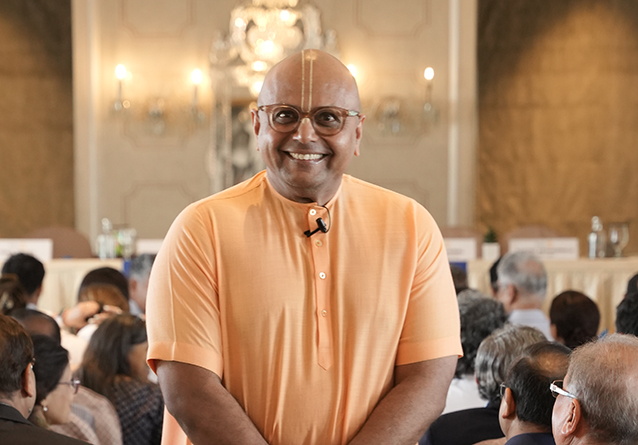
Prabhuji Gaur Gopal Das on building bridges across generations, values, and vision
Prabhuji Gaur Gopal Das on building bridges across generations, values, and vision
It is my great privilege, pleasure, and honour to be here this afternoon for your very first meeting of the year. I would like to express my gratitude to the President of the Rotary Club of Bombay, Mr. Manish Reshamwala, to everybody who has helped organise this event, and, of course, to each and every one of you who has taken the time to be here this afternoon.
I remember coming here a couple of years ago. I have no clue how many years ago that was, but I do remember speaking from this very place. Life has changed. I don’t know whether you changed it or I did, but regardless, life has definitely changed for the better.
If you allow me, may I come down? Brilliant. That’s what I love doing. Stages are the most boring places in the world. Trust me, you’re alone there. Here, there are so many people. Here, you can make a connection and feel the energy. Up there, you’re isolated.
I feel stages are like success. The higher you go, the lonelier you get, because you don’t know whom to trust. Everybody begins to see you as a resource rather than as a friend. Strange, but very true. Many people are only looking at you as someone to be used. There are no genuine human connections out there a lot of the time. There are only resourceful connections. That’s what that place can become.
For 30 years, I’ve been speaking, and not a single person has come to take a selfie with me. Today, everybody, especially the girls, says, “Guruji, please, one selfie.” That’s why I call myself #MonkSwag.
Sometimes I wonder, are they really taking a picture with me? Or are they taking a picture with my good times? Times change. Because in a transactional world, it’s all about good times. When times are good, everybody is around. When times are not good, nobody cares. That is why I say, Jinke na aate the jawab unke salaam aane lage, mera waqt kya badla mere neem ke ped par aam aane lage. Suddenly, everyone is crowding around asking for a selfie.
Which is why the higher you grow, the greater the need to come down. To come down to a space where there are relationships, where there is trust, where there is confidence that you’re not being used; to a space where there are heartfelt connections, not just business-card networking meant only for transactions.
In a dog-eat-dog world, these are the relationships that matter the most. They truly matter. Because how long can I stand there enjoying the fanfare? How long can I bask in the warmth of the glory that everybody is giving me without having somebody to truly connect with?
How many of you love eating? Sorry, that was the wrong question. Let me ask instead, how many of you don’t like eating?
This is a wonderful audience. I feel at home because, in some audiences, there are people who actually raise their hands. Then I have to tell them, “We’ll talk after my session because you need counselling. If you don’t like eating, you need counselling.”
A British friend of mine once came to Mumbai and said, “You know what? I really want to eat something very spicy.” How many of you have tried Maharashtrian misal pav? Oh my, it is so incredibly spicy that any blockage anywhere is instantly cleared.
So I took him to a misal pav joint. I knew the chef very well. I told him, “Aaj dil khol ke daalo masala. He’s asked for something spicy.” The chef prepared this fiery, red-hot, oily misal and brought it to our table. My friend looked at it and said, “This looks really exotic.”
I said, “Just wait a minute. It will feel very exotic too.”
He took a spoonful and put it into his mouth. Explosion. Absolute explosion. His face became redder than the misal itself.
How many of you would agree that men are often very ego-driven? Give me an honest show of hands. The ladies are raising their hands much more enthusiastically than the men. The men are saying, “Come on, give us a break.” The ladies are thinking, “This fellow doesn’t even realise how ego-driven he is.”
I actually think that being ego-driven is not always a bad trait. We often say ego is bad, but there are times when it helps. Sometimes your ego pushes you to complete something because it tells you, “I can’t leave this unfinished. I have to finish it.”
My friend somehow finished the entire misal. The problem with eating something that spicy is that it’s never that day. The real problem comes the next morning. He was staying here at the Taj, and I lived only a couple of miles away. I drove over the next morning to meet him.
I asked, “Good morning. How are you doing?”
He replied, “I’m doing very well.” We chatted for a while and, in the middle of the conversation, he said, “Can I use the toilet, please?”
He went in and came out a little later. Then he looked at me and said, “Now I know. Now I know why Indians use water in the toilet. If you used toilet paper after eating that, the paper would catch fire.”
My God! I think he was probably swearing never to taste Indian food again. How many of you love cooking? Any men here who cook?
And how many of you, with your hand on your heart, would say that the defining difference between Indian cuisine and many other cuisines is what we call a tadka?
How many of you know what a tadka is? A chhonk, a tempering.
Practically everybody.
If you’re making upma, for instance, you take some ghee or oil, add mustard seeds, increase the heat, and the mustard seeds begin to splutter. Have you heard that sound? That’s the mustard seeds crackling. Then you add some salt. Incredibly, salt adds one of the most critical elements to the preparation, yet it is never seen.
Some of you are having your meals, and some are probably still taking a bite. A critical element of what you’re eating is salt. Have you ever seen the salt in the preparation you’re relishing? No.
Any Gujaratis in the house? Make some noise! Lovely, lovely. The Gujarati boys. In their tadka, they’ll even add sugar. I once went to a Gujarati home for a meal. After lunch, the lady asked me, “Can I get you some dessert?” I said, “I don’t know what I was eating until now. I need a separate dessert after everything you’ve already fed me?”
Jokes apart, she added sugar to the tadka.
After that, you add some spices or green chillies to make the upma nice and spicy. Then you add a little turmeric, to give it that beautiful yellow colour. You’ve seen that kind of yellow upma.
My question to you is this. When you’re hungry, would you ever eat a handful of mustard seeds? No. Would you eat a handful of salt? Turmeric? Even sugar? No.
Isn’t it amazing? We would never eat any of these ingredients individually when we’re hungry. Yet each one of these diverse ingredients comes together with one purpose: to make the upma delicious.
Nobody is concerned with “I’m mustard,” “I’m salt,” “I’m sugar,” “I’m chilli,” or “I’m turmeric.” There is only one purpose: to make the upma tasty.
I’ll tell you what. Rotary Clubs, families, and workplaces are exactly like that tadka.
Some people are like mustard seeds. Raise the temperature a little, and they start crackling. Can you think of a face in your mind right now? If you can’t think of anyone, perhaps you are the mustard seed, cracking up the moment the pressure increases.
Some people are like salt. Salt adds the greatest value to the preparation, but you can never see it. There are people in every Rotary Club, every family and every workplace who add immense value to everything we do, yet they never seek credit. They quietly remain in the background, and sadly, nobody gives them the recognition they deserve.
The irony is that they never ask for credit, and nobody thinks of giving it either. In organisations, that’s exactly what often results in attrition. Valuable people leave because salt doesn’t shout, salt doesn’t scream, and salt doesn’t demand attention. Nobody notices it while it’s there. Only when the salt is gone do you realise what that gentleman or that lady was actually bringing to the table.
Then some people are like sugar. Meetha bolke topi pehnaega. Great negotiators, I’m telling you. And then some are like chilli peppers. They cannot begin a conversation without raising their voice. They have to shout.
How many ladies here feel your husband raises his voice for no reason sometimes? Any children here who feel that, for no reason at all, they’re constantly being told off by their parents? Thank you. That’s why today’s topic is building bridges.
Talk if you want to talk. Why are you yelling? Why are you judging? Why are you labelling? Relax. For some, Mummy is the mirchi. For others, Daddy is the mirchi.
And then there are people in the tadka who are like haldi. They do absolutely nothing, but at the very last moment they arrive and take all the credit, maine kiya.
I always get the biggest applause for that one.
The beauty is that when all these different ingredients build bridges despite their differences and diversity, something magical happens. The upma becomes delicious.
That’s exactly what Rotary represents.
People from different backgrounds, different socio-economic groups, different religions, and different cultures all come together with one purpose: Service Above Self.
That is why you can contribute so much.
I’m going to say something a little sensitive this afternoon, if you’ll allow me.
When we come to clubs like these, organisations like these, or gatherings like this, it’s relatively easy to harmonise because we’re in a social environment.
But what about our homes? What about our personal lives? What about the people we lead in our organisations? Do we display the same values, the same vision and the same character there? It’s called Hypocrisy. It’s a strong word, isn’t it?
I’m not saying that you are hypocrites. I’m simply inviting all of us to reflect.
When I’m here, I’m so courteous.
“How are you, Sir?”
“Doing well?”
“Wonderful to see you.”
“What a lovely smile.”
“Hope you’re enjoying yourself.”
Do I speak the same way to the people waiting for me at home?
Do I present the same version of myself there?
Dikhane ke daant alag, khaane ke daant alag.
The bridge we really need to build is between the face we show the world and the person we truly are in our private lives.
Character is what we do when nobody is watching.
When everyone is watching, it’s easy. Look at me. But when nobody is watching, what do I do? That’s what character is about.
Please take these as principles that apply everywhere: at home, at work, in Rotary, in your social circles, everywhere. Principles are universal. These are a few thoughts that have helped me immensely, and perhaps they’ll resonate with you as well.
How many ladies here think your husband is perfect? I have to see whose wife has raised her hand.
Ah, Sir… blessed are you! Blessed indeed that your wife believes you’re perfect. Now, how many of you gentlemen think your wife is perfect?
Wonderful! Some of the ladies are nudging their husbands, saying, “What are you doing? Raise your hand!” How many of you think your children are perfect? How many of you think your parents are perfect? These are difficult questions, aren’t they?
I’m asking them because I want all of us to reflect.
A lady once went to a pandit and said, “Panditji, I want to get married. What do you call a man who is dashing, handsome, romantic, educated, passionate, never flirts, never cheats and does everything for me?”
The pandit smiled and replied, “Beta, usse kehte hain mann ka vehem.” The imagination of the mind.
Perfection is a myth. Your spouse is not perfect. Your children are not perfect. Your parents are not perfect. It may sound harsh, but that is the foundation on which bridges are built. Bridges are not built on imagination. They are built on reality. If you try to build relationships based on imaginary perfection, you’ll never bridge the gap.
Parents deserve respect. That does not mean they are perfect. They have faced struggles. They have weaknesses. They have moments of vulnerability. Everybody does. Because every one of us has weaknesses, every one of us makes mistakes. How many of you have made mistakes in your life?
Sorry… perhaps that’s the wrong question.
How many of you are married? Oh my goodness!
Why did you react like that?
You know what an oxymoron is, don’t you?
For example, “She’s pretty ugly.” “Pretty” and “ugly” are opposites.
Or, “There was a very small crowd this afternoon.”
Or someone asking, “Can you give me an exact estimate of how many guests are coming?”
Or you say, “Can I have an original copy of that document?” Can something be both original and a copy? Or you say, “Celebrity monk.” Isn’t that an oxymoron? How can a celebrity be a monk, or a monk be a celebrity? Or you say, “Business ethics.” These days, that almost sounds like an oxymoron. But perhaps the funniest oxymoron of all is “happily married”. I’m joking, guys.
I’ll tell you something. What we say can be serious, but how we say it doesn’t have to be. What we say should make us reflect, but how we say it should keep things light. Laughing is fun, especially when we’re laughing at ourselves. It’s not about making condescending remarks; it’s simply about enjoying the moment. Galtiyaan hoti hai!
Can we do a quick exercise? Think of a number between one and ten. Done? Brilliant. Now multiply that number by nine. Done? Brilliant. If you now have a two-digit number, add the two digits together. If it’s already a single-digit number, leave it as it is. Now everyone has a single-digit number. Brilliant. Subtract five from that number. Done? Now convert that number into a letter of the alphabet, where A is 1, B is 2, C is 3, and so on until Z is 26. Have you got your letter? Brilliant. Now think of a country beginning with that letter. Whatever country you’ve thought of, take its second letter and think of an animal beginning with that letter. Brilliant. Were you thinking of an elephant in Denmark?
The logic is very simple. Nine ones are nine. Nine twos are eighteen, one plus eight is nine. Nine threes are twenty-seven, two plus seven is nine. Nine fours are thirty-six, three plus six is nine. Nine fives are forty-five, four plus five is nine. Nine sixes are fifty-four, five plus four is nine. Nine sevens are sixty-three, six plus three is nine. Nine eighths are seventy-two, seven plus two is nine. Every time you multiply by nine and add the digits together, you arrive at nine. Subtract five and you get four. Four stands for D. If I ask you to think of a country beginning with D, you’ll most likely think of Denmark. The second letter is E. Which animal comes to mind? Elephant. That’s why I ask whether you were thinking of an elephant in Denmark. Ooohhhh…
Kartik just corrected me. He said, “Nine sixes are fifty-four.” What did I say? I accidentally said fifty-eight. I got almost everything right, but the one thing everyone immediately noticed was the one mistake. That’s the problem with building bridges. We catch people doing something wrong. At home, at work, everywhere, we catch people on the wrong foot. In the entire table of nine, I got every answer right except one. Shouldn’t our attention also be on everything right?
To build bridges, our attention has to shift towards what is right, not merely what is wrong. I’m not saying there are no mistakes. Of course there are. We must address them. We must communicate what went wrong. We must discuss difficult issues. We must have uncomfortable conversations. But should our attention be consumed only by what’s wrong? The problem is that, instead of correcting mistakes, we become obsessed with them.
“My child came home at three in the morning. I wanted them home by ten.” “My child doesn’t listen.” “My Gen Z child spends all day watching Netflix and OTT platforms and doesn’t care about studies.” It’s always, “My child this, my child that.” And children, in turn, speak about their parents. “These old people don’t understand.” “Your generation used to do that. We can’t.” It isn’t only between Gen Z and parents. Many of you are older, and it’s the same between you and your grown-up children. “Papa, let go of control of the business.” “No, he’ll keep holding on to it.” Am I making sense? Make some noise if I’m making sense. Thank you. I love that.
Isn’t it important that we begin catching people doing the right things? By nature, we tend to do the opposite. Am I saying we shouldn’t correct people? No. Am I saying we shouldn’t communicate what went wrong? No. Am I saying we shouldn’t discuss difficult issues? Absolutely not. We must have those uncomfortable conversations. But do you know when those conversations become meaningful? Only when people know that we also notice what they do right. That’s when they’re willing to sit down and listen. If we’re constantly catching people doing wrong, do you really think they’ll listen to us? They may not say it aloud, but inside they’re already defensive. They’ve already decided, “I don’t want to hear this.”
Ladies and gentlemen, this afternoon, at your very first meeting of the year at the Rotary Club of Bombay, I make one humble appeal. Build bridges. And to build those bridges, begin by catching people doing the right things. Your children, your partner, your colleagues, your team members, your family, your spouse, your parents, everyone. There is so much goodness. There is so much that is right. Only when we focus on that goodness will we truly be able to bridge these gaps.
There’s a beautiful song, Khamoshiyan. One line from that song has always struck me deeply: “Bataun tumhe kya mere saath kya kya hua.” Think about the young gentleman sitting here, the young lady sitting here, every young person in this room. Do we really know what kind of pressure they’re under? They may appear relaxed. They may seem very chilled because they’re Gen Z. But do we realise that many times they are under enormous pressure simply to fit into their social circles, even when they don’t want to? When will we sit down and truly listen? When will we try to understand what they’re silently carrying? “Bataun tumhe kya mere saath kya kya hua.” Do you really know what I’m going through?
And to all the youngsters here, I always say this. I have always seen parents come from a place of love. They may not always express it in the right way. Sometimes it comes across as harsh or controlling. But the place they come from, and the intention behind it, is almost always love. This principle applies everywhere: at work, in Rotary, at home, in every relationship. We must first seek to understand one another.
Let me conclude by sharing one final story. There was a boy in Class 6 named Arnav. His teacher asked him, “Arnav, if I give you two mangoes and two mangoes, how many will you have?” Simple maths.
He said, “Five.”
The teacher said, “Arnav, two and two mangoes. How many will you have?” He said, “Five.” The teacher thought, let me change my strategy. She asked, “Arnav, if I give you two strawberries and two strawberries, how many will you have?”
He said, “Four.”
The teacher was visibly pleased with this change. She thought, let me check once again. “Arnav, if I give you two apples and two apples, how many will you have?”
He said, “Four.”
“Brilliant!”
Just to make sure he had understood his maths correctly, she went back to mangoes. “Arnav, if I give you two mangoes and two mangoes, how many would you say?”
He said, “Five.”
The teacher said, “What? Two apples and two apples are four. Two strawberries and two strawberries are four. But two mangoes and two mangoes are five?”
He said, “Yes, Ma’am, because I already have one mango in my bag. So that makes it five. Two and two is four, and the one in my bag makes it five.” I am asking you a simple question, ladies and gentlemen. Was Arnav wrong? Was the teacher wrong?
And that is the problem. You as parents are not wrong, and they as children are not wrong. You as a boss are not wrong, and they as employees are not wrong. You as a Rotarian are not wrong, and your fellow Rotarian is not wrong. There is no wrong. There is just a hidden mango.
The teacher was technically correct, and Arnav was practically correct. All conflicts come from being technically correct and practically correct.
Building bridges means bridging the gap between technical correctness and practical correctness.
Dosto, ek baat batao. Agar yahan 9 hoga, toh yahan se dekhunga toh kya dikhega? 9. Udhar se dekhunga toh kya dikhega? 6.
They are on that side, I am on this side. One person is seeing 9, the other is seeing 6. And the conflict begins because the person seeing 9 says, “I am right. It is a nine. This is the right way to do business. Do you understand?”
The other person says, “Hang on, Dad. Hang on. I am seeing a six.” The person who sees 6 is strongly convinced that it is a six. The person who sees 9 is strongly convinced that it is a nine.
Building bridges across generations with values and vision means having the ability to move to the other side and see what they see.
If you have a Gen Z child, are you willing to go to their side and see what they see? How do they see the world? Just because you saw it a certain way does not mean they see it that way.
Are children willing to go to the other side and see why their parents see it as a nine?
Ladies and gentlemen, there is only one problem in the world today: the lack of willingness to look at another person’s point of view.
If we are able to go to the other side and say, “Let me understand what you see,” I am not saying that all problems will be solved. I am saying relationships will become better, generations will understand each other better, and that is what we need in a rapidly changing world.
Have any of you ever done a religious fast?
Some of you have. Wow. Some youngsters are raising their hands as well. These girls are saying, “We have done religious fasts.”
It could be Navratri, Roza, Paryushan, whatever your tradition may be.
You know what? If you want to do a fast in 2026, do not fast from food and water. Fast from your phones. No WhatsApp, no ChatGPT, no Claude, no LinkedIn, no Instagram.
For one day, Bhagwan might come down and say, “Bas kar pagle, rulaayega kya?”
It is a fast-changing world, isn’t it?
In a world where everything moves so quickly, are we willing to sit down, talk, understand and communicate?
India has one problem. Our families are wonderful. Our people are wonderful. But the singular problem in this country is the lack of willingness to go to the other side and see how others see things.
The lack of willingness to sit down and have difficult, uncomfortable conversations. Or do we always want everything to remain pleasant and easy?
Sit down, talk, understand, clarify and communicate.
A million issues are solved when we are able to do precisely that. And that is how we build bridges across generations with values and vision.
Thank you all very much.
ROTARIANS ASK
It was brilliant. But the problem is, people listen here, they say, ‘Wow, it makes so much sense,’ and then they walk out of this room, and ninety-five per cent of people forget what you said.
Thank you, Sir, for bringing that up. In fact, while it is being spoken, they are thinking, “What does this have to do with me? I will think about it later. Oh, that is for them.”
Now, jokes apart, what do we do about that? And it is not just about this talk. We read books, we listen to people, and we consume content online. We like certain things. Some things move us. Certain things resonate with us. We reflect and feel, “This is probably where I lack something. This is something I need to work on.”
Now, if this is what we want to do, what is required to bring reflection into action?
There is reflection. There is agreement. But many times there is a lack of action.
Make-up and knowledge, ladies and gentlemen, are surprisingly very similar. Even men today know about make-up. Both change only when they are applied. When you apply make-up, your appearance changes. When you apply knowledge, your life changes.
The question is, how do we apply it?
Number one, Sir, this cannot be limited to just a Tuesday afternoon where we spend twenty minutes prioritising this kind of content. It is not just what we read or what we watch here. It is also about what we read, what we watch, who we spend time with and who we surround ourselves with.
We need to constantly expose ourselves to the right kind of value system because where attention goes, energy flows.
When something keeps influencing me constantly, at least I am reminded of what is right, even if I am not able to implement it immediately.
But if it is only twenty minutes one afternoon, and then one year later another twenty minutes, it is gone for the rest of the year.
Number two, how many of you go to the gym? A gentleman was asking me on the way up here, “Do you work out?” When you go to the gym and you are alone, there are so many excuses not to work out. How many of you have found yourself saying, “I will start on Monday”? There are so many excuses.
But when you have a gym buddy, somebody you are accountable to, that company also influences you. That person gives you the inspiration to go back to the gym. The same applies here. If you are constantly surrounded by people who only talk about numbers, deadlines and gossip, what are we getting back? There is no value addition to our lives.
There are friends we hang out with, friends we chill with. Those friends are important too. We need some relaxed time. We need laughter and conversations. But we also need people who add value to our lives.
We need that company which helps us grow. There were two people gossiping with each other in Gujarati about a third person. After one hour of gossip, one person said to the other, “Why? Let it go now. What do we have to do? Why did we spend one hour talking about that person?”
Why would you spend that one hour gossiping about that third person? So, Sir, indeed, we need those chill friends. Gossip is a part of life. I am not against it. I don’t do it, but that does not mean you shouldn’t, right? There is some juice in gossip. I don’t know what it is. What is that instant thing? And men think we don’t gossip. They do their own kind of gossip. It is different. The juice is different, but it is there.
I’ll tell you what, Sir, that company matters. Whom we spend time with will probably determine what we make a priority in life.
And last but not least, I would really like to share this third thought. There was a gentleman whose son was learning multiplication. The gentleman asked his son, “What is nine multiplied by eight?”
The boy said, “One hundred and fifty-two.” The father gave him a chocolate.
The boy’s mother came and said, “Darling, do you know what nine multiplied by eight is?” The father said, “Seventy-two.”
She said, “Our son is saying one hundred and fifty-two, and you are giving him a chocolate?” The father said, “Look, honey, yesterday he was saying one hundred and ninety-two. Today he has moved from 192 to 152. He is forty digits closer to the right answer, seventy-two. Should his coming closer be punished or rewarded? If he had gone from 192 to 222, then I would have corrected him. But he has moved from 192 to 152. We should reward him.”
I’ll tell you what, Sir. The problem is that in the journey of transformation, we punish ourselves too much for not reaching where we want to be. We have this ideal in mind, and here we are. But change does not happen from here to there overnight. Change happens from here to here. Every little step taken must be rewarded.
I was at 192 yesterday. Today I am at 152. I am closer.
Imagine this hall being filled on a Tuesday afternoon. That itself tells us that there are people interested in listening to how they can transform their lives and build bridges, isn’t it? That is moving from 192 to 152. That is a great beginning.
And you must give yourselves a loud round of applause. Come on, guys. What a beginning! If we continue like this, change will come. The willingness, the right company and the right kind of content constantly influencing us, slowly and steadily, will bring that change.
Thank you, Sir. Thank you very much.
- I have two questions, actually. The first thing is, what made you pivot? What made you move into this kind of thinking altogether? We are all conditioned to live a very transactional life. That is a fact. From when we are young, when we go to school, the education system itself is like that. Coming from that educational system, what exactly made you change and pivot your mindset?
And the second question. I have very young children, six, three and one-and-a-half years old. Gen Z is a different story. This is Beta and Alpha. I have a genuine question. My six-year-old daughter’s behaviour and everything is almost like a teenager. Like you are explaining, we should have discussions with them. They are extremely smart. They are born with a different chip. But they are not at the level where we can have certain explanations and conversations, yet they have an opinion on everything. How do you deal with something like that? A six-year-old teen, a three-year-old teen? How do I bridge that generational gap?
What made me move towards a mindset like this?
In the world that we live in today, if there is anything that truly, truly fulfils our souls, it is meaningful connections and relationships. Trust me, money cannot do that. It is very good to have money. It has utility value, and we should grow. Let us not limit growth. Numbers are critical for growth, and we must have them. But I don’t think anyone here would agree that numbers alone bring joy or fulfilment to the soul.
Having worked in the corporate world and having dealt with so many people over the last three decades, I saw a pattern. The pattern was that everybody is aspiring towards two things simultaneously: growth and fulfilment.
Is there somebody here who does not want to grow? Everybody wants to grow. Is there somebody here who does not want to be happy? Everybody wants to be happy. These are two parallel tracks that everybody is trying to pursue: growth and happiness. Sadly, society has also connected the two and created the belief that growth equals happiness.
My shift towards this mindset was about spreading awareness of things that people already know, simply reminding them, giving them a gentle reminder, to return to what truly matters and what truly brings fulfilment.
It is not the car we drive that brings fulfilment; it is the destination we drive towards. The car does not matter.
It is not the phone we talk on that brings fulfilment; it is the quality of conversations we have that brings fulfilment.
It is not the watch I wear that brings fulfilment; it is how I use the time on that watch that brings fulfilment.
It is not the fancy house that brings fulfilment; it is the home, the connections and the relationships within that building that bring fulfilment.
And when those relationships are missing, you see how it becomes like the Mahabharata’s Kurukshetra every day.
That was the shift: to discuss these things, to remind people, and to help improve the quality of life.
And regarding your six, three and one-and-a-half-year-olds, oh my God, that is a question I am not sure I can answer. I am also trying to figure it out. I have to be honest; even I am trying to understand how to deal with it.
But I can definitely share one principle. No matter what language these young people use, when I go to Gen Z crowds, especially school students from Classes 9 to 12, I use terms like hashtag monk rizz. I don’t say monk swag. I use words like rizz and other terms they understand.
But no matter what language we speak, there is one language that everybody understands: the language of love, the language of empathy and the language of respect.
Everybody understands that.
People may or may not understand our words, but if we love them unconditionally, and that is very difficult, Madam, to do, if we respect them for who they are and if we trust them, believe me, they are going to go off track sometimes.
Hundred per cent. We live in a world like that.
But even if they go off track, they will come back.
It is not that they will never go off. It is about them coming back on track.
And trust me, with love, empathy and respect, even if they move away, they themselves will find their way back.
- Hare Krishna, Prabhuji. We always say that anything good happening is because of good karmas in the past. Anything bad happening is because of bad karma in the past. Whatever we have to improve, we do now so that we don’t have to bear it in the next life. But we don’t remember what wrong we have done in our past life. So how do we actually put everything on karma all the time?
Okay, I am going to ask you a simple question, Madam. If a snake bites me and I cannot see the snake anymore, should I go around searching for the snake? Or should I deal with the poison and save myself? I am not going to be able to figure out where the snake is. When I came to our ashram in the year 1996, thirty years ago, I got malaria eight times that year. It was insane. Eight times that year I got malaria. Serious malaria. One was falciparum malaria.
When I got malaria, the treatment was chloroquine phosphate. You have to take these pills, you lose your taste, and all of that. Now, I had no clue which mosquito bit me. But I took the medicine. I took the medicine eight times, and I cured myself of malaria.
That is how life is.
We may or may not know the cause of what we are going through, but we do know how to heal ourselves, how to move forward and how to grow from where we are. So let our focus be on what we can do with it, rather than why it happened to us.