
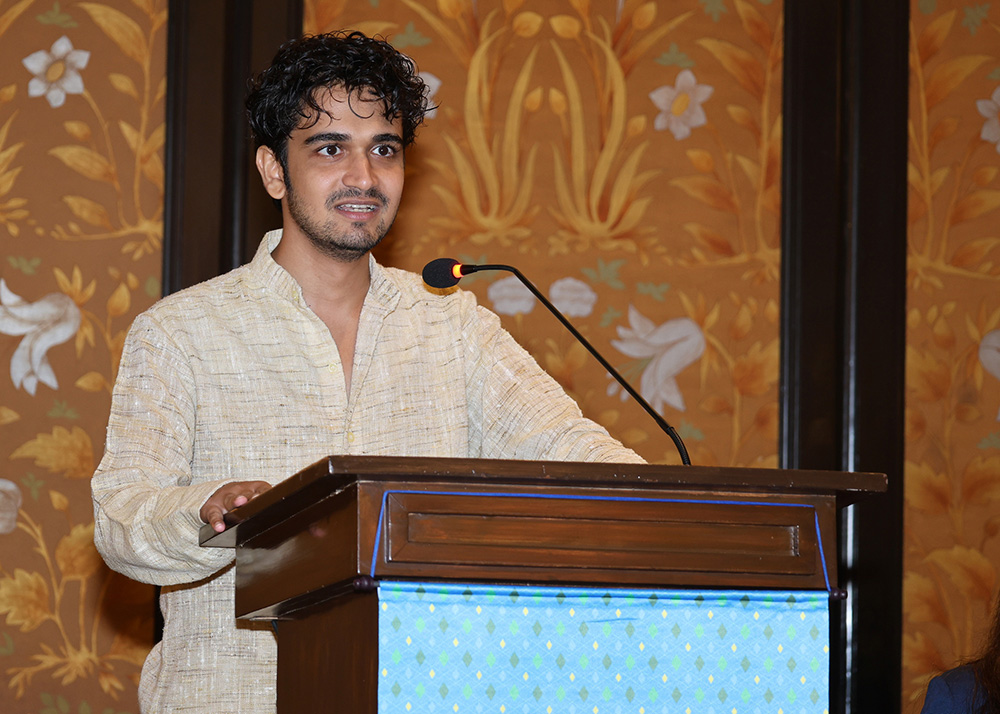
Anish Gawande, National Spokesperson for the Nationalist Congress Party and the Founder of Pink List India
I am humbled to speak from this podium today at a club with an almost century-old legacy that has been known to give back not only to our city but to our country. I want to start by saying that I follow in the footsteps of many great people who have spoken here before me and can only hope to live up to the great expectations you’ve had from me — and to the honour that it is to speak here.
Rina Aunty and I were discussing what I would speak about. The first thing she said was, “Don’t be too political.” And I said, “Of course! I go on 9 pm television debates and scream my brains out every evening — you think I want to do that at the Taj, in the middle of people I know very well? I absolutely don’t.”
So I thought the most interesting thing to share might be the story of how I got here — what made someone who went to Cathedral, who ended up at Columbia, who wandered and meandered his way to Oxford, come back and join the rough and tumble of Indian politics.
I’ll try to keep it brief, but if I do meander — as is very common with politicians — please just nudge me and tell me to stay on time.
The story begins, like most do, in school. This was 2013. I was at Cathedral, in the 11th standard, and we were one year away from the national elections. As someone studying the humanities, I closely followed the elections. Every evening, my father and I would watch the news. The biggest fight would be over the remote — he wanted to watch Arnab Goswami, and I was hell-bent on watching Barkha Dutt. Our political opinions were such poles apart that we ended up fighting like cats and dogs every evening.
Months went by, and the election started heating up. Many of you will remember that it was one of the most momentous elections we’d had in a long time, and an opportunity came my way. Milind Deora, who was the Mumbai South MP at the time, a Union Minister, and also a fellow Cathedralite, was running a programme called the Milind Deora Initiative, where young people could sign up to be door-to-door campaigners for the Congress Party.
What I only found out later was that they needed those campaigners in South Mumbai because our housing societies would never let a Congress karyakarta enter with their little gamchas. So, sweet, innocent-looking boys like me were ideal targets to enter buildings that otherwise would have been inaccessible.
This was the period between my prelims and board exams. I had already gotten into university. I’ve always known I wanted to do something that gives back to the country, whether by becoming a lawyer or an IFS officer. I was very inspired by Dr. Tharoor, who at the time had not yet entered politics full-time but had served as a career diplomat at the UN. I thought, what better way to experience this idea of giving back than to work in an election?
With all those lofty ideals — and, primarily, to spurn my father, who as a BJP supporter was aghast that I was off campaigning for the Congress — I took my first step into politics.
I have never had more doors slammed in my face or more abuses hurled at me by strangers than as someone campaigning for the Congress Party in 2014, after the India Against Corruption movement and all the allegations being levelled against them. But it was a humbling experience. It taught me the very brass tacks of politics. It stripped away the shine and sheen of the kind of politics I participate in now — the television-debate-and-podium-bearing kind — and reminded me what it meant to do politics the old-school way.
As you know, we lost that election, and we lost it quite badly. I was grateful, then, to be heading off to university. When I entered Columbia University, I thought I would major in Economics and Political Science like every good Indian boy and then come back and get a law degree, forging a career in those areas. But something happened during my time at Columbia that radically changed my perspective towards both coming back and politics.
I came out of the closet.
This was incredibly challenging. On one hand, I was very comfortable with my sexuality — I knew I had no problem with it, and I knew very early on that I wouldn’t be marrying a woman. But at a time when Section 377, the anti-sodomy law, was still in the statute books, it was literally illegal to be gay in this country.
The choice between being out and coming back to work for the country had never been starker. To me, I had made that choice: I wanted to come back home, so I’d have to stay in the closet.
But over the course of my time at Columbia, I realised that wasn’t really an option. It was sending me into a spiral of depression. It was having a damaging impact on my mental health. So I made the more difficult choice: to come out, to live my life more freely — and to give up any hope of coming back to India and entering politics.
So I studied Comparative Literature. I decided to become an academic. I studied Francophone West Africa and Senegalese linguistic politics in the 1960s. I imagined I’d end up in some small town in Iowa, as a professor, speaking from a very different podium, not one in front of thousands of people in Gadchiroli. And I made peace with that.
But as these things go, you can’t really run away from something you’ve believed in your whole life.
As chance would have it, one fine day I got a phone call from Milind, with whom I had stayed in touch. He was supposed to come to campus because Rahul Gandhi was giving a speech, and I was still involved in some campus activity. We had exchanged emails, and after all that, he called me and said, “Listen. Will you come run my campaign?”
And I said, “One second. I’m very out — and in New York City.” And he said, “So?” And that so really stayed with me.
As someone who had gone to Cathedral, who had gotten into Columbia — I’m sure many of you have been to these institutions, and many of your children, whom I also know, have been to these institutions — the one fear you have, and the one disadvantage of going to a prestigious institution, is the fear of failure. Because all around you, your colleagues, your classmates are doing exceptionally well. They’ve all gone into McKinsey or become investment bankers, and they’re going to be starting off careers that will serve them well for the rest of their lives. You don’t want to be the one person who’s taking a risk that may not pay off.
And that one “so,” which suggested that no matter what happened, there would be someone ensuring that I would not be wasting my time, made me take the most reckless decision I’ve ever taken — which was, four days after graduation, packing up all of my bags, moving back to India, sacrificing my OPT (Optional Practical Training), and saying: let’s do this.
Now, what I didn’t know, upon coming back to India, was that Milind had very different plans for me. He said, “Listen, the election in South Mumbai has not heated up so much. Why don’t you go work with Ashok Chavan with the Maharashtra Congress? They’re taking out this Jan Sangharsh Yatra.”
I said, “Listen, I’ve come back from New York City. Politics in Mumbai — in South Mumbai — was already a challenge. You want me to go into the rural hinterlands of Maharashtra with Ashok Chavan, who I don’t know, and the whole Maharashtra Congress?”
But it was a challenge I accepted gladly.
Now, the biggest problem I had was — this is all OK — but you want me to go to rural Maharashtra? I don’t have a wardrobe. What am I going to wear? What you wear in Brooklyn is not what you can wear in Bhandara.
So this is what came about — and the sort of khadi-wearing phase of my life began. I said, well, one needs to invent a new wardrobe for a new profession. But I wasn’t going to be dressed in those ugly black chappals that all the politicians seem to be wearing. One has to look slightly nicer than that, because one has some self-dignity and self-respect to maintain as well. And so the wardrobe emerged over the course of that campaign.
We travelled from Ichalkaranji to Pathadi, from Yavatmal to Gadchiroli. I saw every part of this state across that Jan Sangharsh Yatra. I travelled with the bodyguards because they were the only ones who could push me into the bus when I was a scrawny 20-odd-year-old, and ensure that the hundreds of other people scrambling to get on stage were kept away. For me, I was able to wiggle in.
And I shouldn’t say this here, but I drank very cheap whiskey out of plastic bottles in the middle of Hotel Krishna in the middle of nowhere — and really got the experience of a lifetime. I also got swine flu from a senior Congress leader, who I shall not name — that’s a story for another day. It was the whole package.
Six months after coming back from New York City, I said, “I have been cleansed. I have been purified. There is no New York left in me anymore. I am now as under the soil as you can get.”
And then, of course, I came back to South Mumbai, and ran Milind’s campaign, which is where Smriti, Rina aunty’s daughter, who was also my senior at Cathedral, became a dear friend. We had, of course, known each other in school, but we started working on Milind’s campaign together.
We were ideating, we were brainstorming, and over the course of that brainstorming, what came about — alongside his campaign, which ended rather disastrously in 2019 — was the realisation that the last six months I had spent on this campaign trail had the potential to transform into something far bigger than a story to tell on a podium.
I realised that over the last six months, I had spoken to countless politicians across the state about LGBTQ+ rights. Section 377 had just been read down a few months prior to the Lok Sabha elections in 2019. The Supreme Court had taken a momentous decision, which meant that being gay was no longer criminal.
I had had these conversations with farmers’ leaders, with trade union leaders, and what emerged was a very different picture than the one I had had in my mind when I was a student at Cathedral, or when I was at Columbia, that at our heart, we were a conservative country. Because across the board, there seemed to be more acceptance of LGBTQ+ rights — even amongst the most conservative politicians. I still remember journalists telling me about Raju Shetty, a farmers’ leader from Hatkanangale, who, when asked the question “Do you support LGBTQ+ rights?” replied nonchalantly, saying, “I support farmers’ rights. If I don’t support the rights of any other minority, that’s hypocritical. Human rights are human rights.”
And that suggested that, in many ways, our comparisons to the West — our understanding of ourselves as liberal or conservative, our ideas of what is acceptable or not acceptable — were shaped more by what we perceived to be true, rather than what was actually happening on the ground.
So I came to Smriti with the idea. I said, “I should discuss this with you because you’re the smartest mind I know at putting things into practice, at turning grand ideas into something that can actually make sense.”
And I said, “What if we create a list of politicians who support LGBTQ+ rights? Let’s forget the ones who oppose. Instead of giving brickbats, let’s give bouquets. Instead of the stick approach, let’s use the carrot.” And I said, “Let’s come up with a PDF.” She looked at me and laughed and said, “Nobody’s reading PDFs anymore. Let’s do this on Instagram.”
And so Pink List India was born — where, for the first time, we catalogued politicians running for office who supported LGBTQ+ rights. It went viral. And I did not understand what virality meant — because at that time, as now, I did not understand much about how social media works, which is a big problem in politics these days.
But as Pink List India went viral, another dramatic escapade came into being.
An interview appeared in The Times of India. On their opinion page, right next to Shobhaa De’s column (which is the only reason people read The Times of India anymore) — a big photo of me in my Columbia robes, titled: “You’re always told you can’t be queer in Indian politics. That needs to change.”
Now, overnight, what had been a very personal identity — something known to me, my friends, and my family at the time, who had all been very accepting and gracious — suddenly became not front-page, but middle-page news. It wasn’t a private thing anymore. And it was in that moment that I said, “You know what? Let’s embrace this.” By then, all the karyakartas knew. All the people I was travelling with to random rural parts of Maharashtra knew.
And I said, “At this point, if I try to deny it, then I’m going to have to lead a lie forever.” So I said, “I’m going to be out. I’m going to be proud.” And my happiest moment was when even the most homophobic politician on that bus secretly came up to me on the side and said, “Who’s your tailor?” And I said, “Chalo, we might not be able to see eye-to-eye on LGBTQ+ rights, but at least you want my tailor. So you’ll be nice to me.”
And so that journey culminated with the Lok Sabha elections in 2019, which, again — as you know — ended quite disastrously. And I was left high and dry once again, because here was someone who had left his degree at Columbia University — and that OPT, and any chance of making a life abroad — to come back to India to work on an election that everyone in his party had failed.
And so I was, in contemporary terms, sushikshit berozgar, educated, unemployed. And I said, I’ll do what people do best: apply to graduate school. So I filled out all of the application forms, and I was lucky enough to get the Rhodes Scholarship and went off to Oxford, right as the pandemic was beginning, to study for a Master’s in Intellectual History and then a Master’s in Public Policy. I said, now I must at least study something that’s not Francophone West Africa — something that’s going to help me solve the problems of our country in this day and age.
In 2022, after finishing up at Oxford, I decided to come back to India. I said, this is a moment to be back in the country, a moment to give back — especially at a time when I’d gotten some recognition with Pink List, when I’d been able to build some traction.
So I moved — wait for it — to New Delhi. I was prepared for Gadchiroli. I was prepared for Ichalkaranji. What I was certainly not prepared for was New Delhi. So in 2022, I moved back to India. I moved to New Delhi, got a house there, and said, I’m going to rough this out and start making the contacts I need to make in a political system that is, unfortunately, still primarily run out of the national capital.
I was gearing up again with Milind to help him in the 2024 elections and maybe join the political party — until the bombshell arrived in 2024, at the very beginning, when Milind, as many of you might know, switched sides and moved to the Shiv Sena (Eknath Shinde faction).
I said, “You can’t be serious. I can’t be going through this again. I can’t have one more rollercoaster ride arriving at this point in my career. I’ve just spent two years in Delhi — and for what?” And he said, “Do you want to join the party?” And I said, “No, I can’t, because I don’t agree with it ideologically. And I’m not selling my morals — at least not yet.” So I said, “I’m not coming this side right now.”
Of course, he remains a very dear friend. I think people make the choices they have to at the stages they do in their careers. But I was left high and dry.
Then I messaged Supriya Sule, who is my party leader. I had only met her very randomly at a conference before and happened to have her WhatsApp number. I said, “Hey Supriya, I’d love to meet you.”
Now, amidst all the people in politics — none of whom had ever asked for my degree or what I studied, or where I studied, or indeed whether I had studied at all — there was one leader who actually cared that I’d gone to university. She was very excited to meet me. She said, “Very lovely.” And I said, “Listen, do you have any work? Because now I have no work. We’re three months away from an election, and I want to work on it.”
She introduced me to Jayant Patil, who was the state president at the time, and his son. I started working with the party. I started working on their English media strategy because, for a party primarily based in Western Maharashtra, they didn’t have an English press office — journalists they were reaching out to.
And lo and behold, a party that had been split not too long ago, and which everyone had written off, won 8 out of the 10 Lok Sabha seats they contested. So this rollercoaster journey that had begun like a horror story ended up on a surprising note — where the gamble that had been taken just a few months ago paid off in equal measure, and then some more.
A few months after that, I was sitting in New Delhi — at 6, Janpath, the house where Mr. Pawar and Supriya tai live — and I said, “You know what? Over the last six months, we’ve done XYZ, and XYZ is still not fixed in the party. You need to work on this, this, and this.”
She just stared at me and said, “You fix it.” I said, “Excuse me? Then give me your position.” She said, “What position?”
And this is the cockiness of youth — that one can demand such things without any idea of what one is demanding. But I said, “National spokesperson.” And I just saw one eyebrow getting raised. She looked at me, as if to say, “Have you actually considered what you are saying?” But I was reasonable. I said, “I’m doing the work for you anyway. I’m coordinating with the media, so I might as well get a position if you want me to go on TV.” And in a split second, she said yes.
She made the phone call. It was exactly a year ago, on the 5th of August 2024, that she made the call to the office and said, “Get the letter signed. This man has to catch a flight to Mumbai at 1 pm. I want the letter here before then. Appoint him as National Spokesperson.”
And, just like that, ten years after that initial foray into politics in 2014, when I had fought with my father and convinced him it was a good idea to let me go campaign door to door for Milind Deora right before my board examinations, I was appointed for the first time to a position in a political party.
Appointed by a leader I truly admire and deeply respect, and to a role that I was frankly entirely unprepared for. Because for the last six months — or rather, the last year (I keep forgetting and losing track of time) — I have been thrown into the rough and tumble of Indian politics.
It has left me debating on national television — discussing Ranveer Allahbadia on one day and Aurangzeb’s grave on another, Operation Sindoor on one day and laadki bahin on another — and really having the time of my life. With little to no instruction from my party, I’ve been able to live out the dream I saw with my father, during all those debates with that TV remote — being on air with both Barkha and Arnab.
So I will leave it there. There’s a lot more to discuss. There’s a lot of work I do in the art world to keep the bills paid and the house in Delhi running. It’s a difficult task — and then some — to be in a profession where you don’t know what tomorrow looks like or what the future holds. But it’s a profession I’m grateful to be in every single day. It’s a risk I’m glad to have taken so many years ago. And it’s a risk I’m glad to take even today.
Thank you so, so much for being such a wonderful audience, and for having me.
ROTARIANS ASK
Full power to you, Anish. If you stand for elections, I’ll vote for you. So please give that suggestion to your party. My question is: when you see things around you — business becoming politics, managing politics like business — who’s really serving the country? Rotary Club of Bombay?
Can I just say — we discussed this a little earlier — that we should outsource the running of the government to the Rotary Club of Bombay, because I think you would do a far better job. But it is a crisis. And I’ll tell you, the rot starts at the very bottom. We have the BMC elections coming up in a few months. These were supposed to be held in 2022 and have been delayed repeatedly. How many of us have raised our voices about this?
When we don’t elect a good corporator who’s going to ensure that the basic level of governance is carried out adequately, there’s no point electing a good MLA or MP. I’ve always said time and again — I don’t want to become a Prime Minister, I don’t want to become a Chief Minister. I want to become a corporator. Because the first thing that needs to be fixed is our civic infrastructure. The three things that matter most — our roads, our schools, and our hospitals — are all controlled by your city body.
The reason politics doesn’t work is because we prioritise the wrong politicians. I often tell several others, a Milind Deora or Supriya Sule might be great — but they’re actually, frankly, irrelevant. Because at the end of the day, the person doing the work is the one elected by 10,000 people at the local level. They’re the ones who can prevent a harmful iconic buildings policy that might ruin Marine Drive’s skyline, or ensure we get a coastal forest on the coastal road instead of yet another parking lot.
These are the decisions that affect us as citizens, and we need empowered people in charge. Structures need to be put in place. I don’t believe even for a minute that people are in politics purely for money or business. I’ve seen them up close. You wouldn’t want to be in this profession otherwise. They work 18-hour days. There’s a lot of risk. And frankly, politicians are far smarter than they let on. They’d be far better businessmen if they didn’t have the political tag and the threat of the ED hanging over their heads like a ten-headed serpent.
Politicians want to do good. The unfortunate reality is they aren’t kept in check by the processes that should be holding them accountable. And we’ve not built infrastructures that help citizens hold politicians accountable — but also help politicians succeed.
How many of us have voluntarily supported a politician — someone we see promising? In the US, Zohran Mamdani just got the ticket to become the Democratic nominee for New York City, all on independent small donations from citizens and PACs. People said: we want different political parties and different politics in our city, and we’re going to put our money where our mouth is.
For too long, especially in Bombay, we’ve kept ourselves separate. We’ve not put good people in positions of power. That needs to change — not at the MP level, not at the MLA level, but at the corporator level.
I enjoyed your speech a lot. I wanted to ask you — you said you were taken on by Supriya immediately. I just need to know: who’s in charge? Sharad or Supriya?
There’s no doubt it’s Mr. Pawar who is in charge. And there’s also no doubt that nobody knows what he’s thinking. We all find out the party’s future direction when he tells us himself. Even Supriya tai doesn’t know that direction.
But a party works like a multi-headed hydra. You have to have many people responsible for different things. One person can’t run a party that’s effectively a corporation with lakhs of employees and career karyakartas working for you, often for free.
Pawar saheb is the ideological and inspirational fountainhead — the man who shows up at a rally and draws 20,000 people. But the brass tacks are managed by Supriya. And from observing her, I can tell you two things: first, she’s inherited one of her father’s best traits: you never know what she’s thinking. She’s ever-smiling to everyone — including me. I never know what my boss is thinking. She’s smiling at me — what does that mean for me tomorrow? She’s very cordial and lovely, but always keeps her cards close.
Second, she has an incredible ability to forge friendships across party lines. Even during Parliament sessions, no matter what’s said on the record, outside Parliament we maintain civility. That’s the legacy of our state, one we often mistake for political weakness. But we’ve always believed political opponents are not political enemies. I might disagree with you, but I can still share a meal with you. That’s a tradition her father held, and that she has maintained — even though it’s not very common now.
Other political parties — including those in Opposition — have taken on far more hardline stances. But that’s not what we want. The legacy of this country is one of debate and discussion, and has been for millennia. We can’t sacrifice that just because someone is behaving badly or being vindictive. Just because they do, doesn’t mean we should. That’s something Supriya’s picked up from Pawar saheb, and it’s held her in good stead — even during a very challenging time for the party.
Anish, it’s amazing to hear your story. But the only thing is — in politics, it’s all strange bedfellows. Today, one thing is said. The next minute, the topic changes, and nobody’s responsible or accountable to people. So what’s the point in trusting anybody? There’s no trust factor anymore. How do you get it back in this new era of next-gen people like you? Because people are very honest at that age. How can we deal with dishonesty?
Under Chatham House rules, I’ll tell you this very honestly. I told you the story about Milind’s shift to the Eknath Shinde side, and that put me into a moral quandary. I’m not nearly as prominent or accomplished as he is, but even among people I know, it felt deeply wrong to be switching political allegiances just at the sight of power. I said, I don’t know how I’ll be able to justify this to someone. At the end of the day, it’s a deeply personal choice.
Now, for someone like Milind, who’s at a much later stage in his career, it’s also a professional choice. You risk fading into political irrelevance if you’re not in power — either as an MP, or someone prominent in your party, or someone heading the party. So you have to make that difficult choice. When your profession is politics, there are constraints placed upon you because this is your job. If you have to switch jobs, you do what you must. Where you draw that Laxman Rekha is entirely up to you.
There are difficult times. I’ll give you a personal example. I’ve been someone who’s very vocal against the death penalty. It’s something I believe very deeply in, inspired by Gopal Gandhi, who’s been a dear friend and mentor. I was against the death penalty for Ajmal Kasab, and also for the Delhi gang rape convicts. It’s a very personal opinion. I feel very strongly that we do not have the right to take away any life.
When the Badlapur child sexual assault case happened, it was a very difficult moment for me. The party was demanding the death penalty, and I said, “This is something I will defend the party line on, but this is a stance I cannot take on television. If someone needs to take it and feels strongly about it, then another spokesperson can do it — but I can’t.” Could it have been something I left the party over? Possibly. Could it have been something I chose to go along with, despite my personal beliefs? Also possible. But those lines have to be drawn by yourself — and they have to be drawn every single day.
It’s not just about whether you’re switching parties; it’s also about what you’re supporting, what you’re not supporting. I was glad the party took a very sensible stance during the Pahalgam attacks. We said we’re not going to politicise this issue. During Operation Sindoor, we said we are not going to say that we don’t stand with the government or question the government — we’ll question them when the time comes, when Parliament session begins. And we did. But we said we’ll break away from the Opposition, and take a more sensible, mature approach. I was glad to also be taking my party’s line on that.
But in politics, when you belong to an organisation that’s far bigger than you are, with so many opinions, it becomes tricky to ensure that you’re 100% on board with every single stance the leadership takes. I’m very grateful to be given the freedom and liberty to take those stances myself. But it can get very tricky as the path moves ahead and more difficult considerations come into play.
We worked on Milind’s campaign together and you’ve come a long way. My question to you is about elections. As you said — Lok Sabha. Right? NCP, Sharad Pawar, did very well. I actually interviewed Supriya tai in Baramati at that point and I went around. The main issue there was the water crisis. There is still an agrarian crisis in that region. But in spite of that, Supriya tai did very well. Very happy about that, she beat her own sister-in-law, Sunetra Pawar.
Fast forward to the Maharashtra elections — what happened? How did all those gains get reversed? I mean, in the Lok Sabha, the Maha Vikas Aghadi did very well. And just a few months down the line, the mood changed. They didn’t do well.
You know, I still have a little bit of fear now looking at you, Anushka, because you were my boss when I went to the campaign in 2014 — and you’re still the journalist who asks the toughest questions! I expected some nice, easy questions and answers here, but I’ll take that in good spirit.
I’ll tell you quite honestly — we were surprised by the Lok Sabha election results. To be perfectly clear, I don’t think anyone in the country had anticipated that the Opposition would get so many seats. I remember on election result day, MPs across Opposition parties were confused and surprised that they had won. They were asking polling agents to double-check, like, “Are you sure?”
The public mood was created and sustained in such a way that it was very difficult for any of us to even gauge. That’s the crisis we have today — the public mood shifts so quickly and silently that it’s very difficult to have your finger on the public pulse.
That’s also what happened in the Vidhan Sabha elections. We were overconfident. There’s no denying it — we were complacent. We thought that since we did well in the Lok Sabha, we’d do well again. So why bother?
The second problem was the “cash for votes” scheme. You can’t call it anything else. In a closed room, ₹1,500 was being handed out. This is not the political culture of Maharashtra. We’ve had fiscal discipline. Jayant Patil kept making statements, saying, “I’ve been Finance Minister of this state — this is just untenable.” And now, 10% of the beneficiaries have been cut. The scheme was so badly executed that even 14,000 men received benefits under a women’s scheme.
How do you distribute ₹1,500 to every voter, even with all the money in the world? It’s not an equal playing field.
The third challenge — which we’ve been facing time and again — is that just as the election gets close, development is forgotten, progress is forgotten. The only thing that gets played up is the Hindu-Muslim issue. The only statement being made was from someone like Yogi Adityanath, who came to Maharashtra and said, “Batenge to Katenge,” and people clapped. That meant we just didn’t have an effective counter-narrative.
I blame us as much for this. I’ve said time and again that the Opposition needs to present an alternative political imagination. The old words — secularism, etc. — they’re old, boring, and done. We need to explain: why is it important to live in a pluralistic society? Why should we value diversity? Why is it important to have different religions, faiths, cultures, and beliefs in the same room?
We failed to convince people of that. We failed to create something powerful enough to convince voters not to vote based on religion, not to give in to fear. When elections turn on emotive issues, it becomes very difficult to make a rational counter-argument. I’m hoping that such emotive issues will slowly fade over time — but that’s a hope that only revives itself before every election, just enough to give you the strength to carry on.
Anish, I had a little bit of interaction with you during the last election, and it was very difficult because the candidates were not good enough. That’s the whole problem. So how do we ensure we get better quality candidates? That’s the main crux. It’s why people don’t come out and vote — because everyone feels it’s all a mess and nothing’s going to help.
I’ve seen candidate selection up close, the way in which people convince party leaders that they’re a good candidate is by showing either wealth or a large amount of public support. The challenge is that most of us don’t show up for the people we do think should become the candidate.
We have so many incredible ALMs (Advanced Locality Management groups) in south Bombay — why haven’t we seen a collection of ALMs come together and say, “This is the person we collectively endorse,” and ask a political party to give them a ticket before the party even starts distributing tickets?
What does someone with some hold in a constituency do? They hold a rally. A friend of mine did this — invited Supriya tai for a rally and said, “Look, there are 10,000 people supporting me, I brought them for a rally.” And demonstrated that strength. Unfortunately, we fail to do that when we come from slightly nicer backgrounds or don’t have the ability to put up a tent, some banners, rousing speeches and serve everyone biryani at the end to show we have public support.
But you’ll see that change. I’ll tell you why: today, I can fill a room with 10,000 people, feed them biryani, and they still won’t vote for me. The voter has become far smarter. He’ll go for everyone’s biryani event — and vote for whoever he chooses.
So, the way candidates convince parties is also changing. But this wheel, unfortunately, turns slowly. I hope that for the BMC, we all put our voices forward and say: this is the person. It could be someone who’s very resourceful in the neighbourhood — maybe someone who runs a small kirana store. Because, let’s face it, you and I aren’t very good at doing 24/7 politics. The rest of us have jobs. But there might be someone we know who’s resourceful, committed, and knows how to care.
At the end of the day, politics is about caring. If the person knows how to care, they will go far. They won’t betray you. If the person doesn’t know how to care, you’re going to have a problem. So, it’s about finding people who care and becoming their strongest backers. Speak Marathi, speak Marathi and Gujarati also. We need all languages in this city.
I was put in a very tricky position during this whole Marathi language debate. I’ve opposed the Shiv Sena my whole life. And as a Maharashtrian, I suddenly had to go and defend them. But that’s a story for another day.
But, we have to become cheerleaders for the people we think will make the difference at the smallest level. That would truly make a huge impact.
Anish, your candour has been refreshing. You’ve now been active at the national level in New Delhi. I wanted to ask you: if you can think of three things, what would make Opposition more effective?
Part of the problem is that we have a toothless Opposition, despite the numbers. But they can be effective in certain ways. What, according to you, should they do?
Honestly, I get asked this very often. The first thing Opposition needs to do is start reading again. It’s very important. The first time I went to Supriya’s house in Pune at Modi Baug, the first thing I noticed was a huge library. Every time I go to meet even Mr. Pawar, he’ll always hand me a book or ask, “What are you reading?”
That’s very important. We’ve forgotten how to read. And not just newspapers — read poetry, read literature. We need to learn how to start caring again. Because when you learn to care, you’ll stand up for what’s right, regardless of whether it benefits you.
The second thing is that we need people who are better on economic policy. We’ve dropped the ball on economics. We haven’t countered this government well enough on policy fronts, and we’ve failed to present a sustainable plan that XYZ has gone wrong and this is what needs to be countered.
Right now, we’re seeing FII outflows, and especially in the skilling space, the situation is terrible. So many young people are getting degrees today — I get so many of them coming to me for jobs. They have B.Tech degrees from some random university, and they’re basically replaceable by ChatGPT in a minute. They have no core skill.
One guy came to me the other day — he’d been trained in Microsoft Paint to retouch photos. I said, “You can just do that on your phone now through Google AI.” He’s completely irrelevant — and has no other skill.
Upskilling is very important. These people don’t want to become drivers, cooks, or cleaners anymore because they’ve got a degree. But if your government gave the institution the right to grant a degree, and that degree is worthless, then someone has to hold them accountable.
What are you going to do about all these young people who are unemployed and sitting at home? Their parents pay the bills now, but what happens when they pass away? How will they support themselves or their families? This narrative of useless degrees, unemployable youth, resonates across caste, class, religion, and region. It’s something we need to emphasise.
The third thing: we have to push for greater accountability in our processes. You’re a lawyer — you know the reality. Our courts have disappointed us time and again. Judges sometimes don’t have the spine to do what is right, and sometimes that’s understandable too.
But under the PMLA (Prevention of Money Laundering Act) today, the ED (Directorate of Enforcement) has powers that are completely incongruous with our Constitution. Now, a confession or a testimony is counted as evidence. That goes against the Indian Evidence Act — and against basic principles of justice around the world.
How can an agency be given such power to get testimonies, use them to shut down businesses, put people behind bars, and then those people have to go through years of Supreme Court processes? I don’t just hold the government accountable. If you have power, you will use it. Someone has to put a check on that power.
The reason we once had judges with strong moral character and integrity is that they stood up and said, “No matter what, we will stand against you.” We still remember the Kesavananda Bharati case as a blot because judges did not have the spine to stand up to Indira Gandhi. It’s high time we hold our judges to the same standard. Regardless of whether they support a political party or not — their job is to uphold the core institution. When we have those processes in place, we’ll really be able to ensure that any government — whether it’s the current one or us in the future — can be kept in check.
Because let’s face it: any government that comes after this one has an arsenal that’s unprecedented. I can do whatever I want, because I have impunity. The question is: how do we control that impunity?
That’s the only way an Opposition can be effective.