

Architect Tejas Sidnal, Founder, Carbon Craft Design Recepient of Rotary Club Of Bombay’s Taru Lalvani Award for Environmental Protection
I am an architect by profession, at an intersection of science, technology and business. I graduated in 2011 with an interest in bio-mimicry that is bios and mimesis, life and imitation, taking inspiration from nature to design. I did my Masters in Emerging Technologies from London with a Tata scholarship.
I thought India is not where I want to be; after my visa ended, I worked in China for a year. I thought I shouldn’t really stay away from my house for long, so I came back to India in 2015. There is no regret there; I underestimated India.
I felt I would not get the opportunity to do what I wanted in India. But the journey began. I wanted to practice as an architect. If we build more, we pollute more and that’s the type of construction we do. So how do we grow from here and what do we do has been the central argument of my life till now.
How do we build carbon negative homes?
We can’t, not without carbon negative products. It is difficult to spot a tree these days. We are building the size of New York and with this kind of need for raw materials, we convert carbon emissions into building materials. On record, seven million deaths occur due to air pollution. Should we develop or not develop or build consciously?
How do we capture air pollution and what do we do with it? We are tackling the second question right now. We take the carbon from
- factories, tyre recycling factories,
- partners working with farmer groups to get a carbon-rich by-product, and,
- Particulate matter which is captured from source.
The first two can be prevented from burning at the source; we will not wait for someone to burn the tyre and then go. We are going to the source as well. Anything black around you, could be the mic, black dress, is using by carbon black as a raw material. It is made by burning fossil fuel in a controlled environment. So, tyres, made of carbon black, go to the scrapyard, recycling unit, and generate 150 million tonnes of waste and are then burnt, creating massive air pollution. Each factory generates 10 tonnes per day. India recycles 100 million tyres and the EV car is not going to put an end to this.
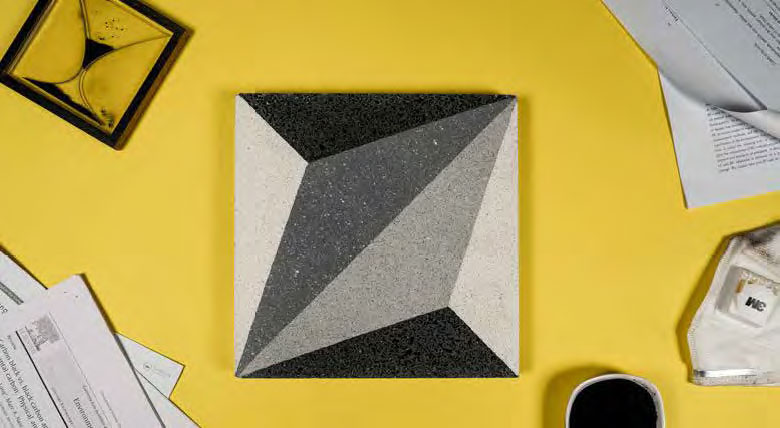
Our first flagship product is a tile that uses 1/5th of energy as opposed to conventional tiles; it prevents 15 minutes of diesel car pollution, 70 per cent upcycled material and is absolutely handcrafted, having a certain social impact. We have gone through various green certifications.
We have a three-stage process: collect – process – build: Collect at various factories, send it to a facility to process the carbon, then we send it to Morbi in Gujarat, and artisans use a 200-year-old craft to make customizable tiles. We have worked with Adidas, made patterns, we did 7 showrooms for them.
Everything is handcrafted at Rs 300 per sq. ft. and our goal is to make it half and then go ahead to make it half and so it can be produced everywhere in the world. We want to mechanise the process. We launched in 2020 before the pandemic and it is a blessing because people saw the need for it. We have received recognition and early grants and awards including the Climate Launch Pad.
We do this for environmental as well as social impact. We want to prevent three billion litres of air from being polluted in the coming years. We have five artisans at the moment, we want to add a hundred. Scaling is a challenge; that, plus the curing time. We take 28 days which we want to change to four hours. Carbon dioxide curing will reduce carbon footprint even further and would use zero litres of water.

We are working with Gitam University (Gandhi Institute of Technology and Management, Andra Pradesh). So, it’s the process of how limestone turns to calcium carbonate. We aim to accelerate this in a controlled environment for carbon. We have made a reactor in Hubli with a conducive environment to cook the tile. We are working with IIT Madras and others to build this technology. We are working on an Indo-Swedish arrangement and there is a grant coming up.
We want to build a carbon lab to build carbon negative materials, it will cost Rs 30 lakhs, and that’s our vision.
Did you develop the technology, or get it from Gitam University?
We built the technology; I have been with it since 2005. There are two parts to it: one uses solid carbon and other uses carbon dioxide. Now, we are working on the carbon dioxide problem with universities; the IP will stay with us. It is still too nascent to license, which will take about three-four years. We are waiting for 1 million sq. ft. space, with a grant, and that’s how we will showcase what we do.
Have you considered getting carbon credits?
Yes, but it is a very informal market in India. If you can’t measure it, you can’t manage it. There are very few companies who are able to do it. But we will still need funding, as per the calculations we have made, because the R&D is massive.
Once you start this product, the prices are really high. The target should be actually Rs 65-70 per sq. ft., not Rs 150.
Yes, cost is always a problem. But any technology will take time to be affordable. We are already so competitive, that it breaks my heart to say that we might produce here, but we might not sell it in India. Rs 150 is great for other countries. We are still going around those conversations.
Who are the champions of biomimicry? Have you thought of other products?
I am a big fan of Janine Benyus who coined Biomimicry. I met her in 2012 when I presented my thesis. She is my inspiration. Michael Pollen as an architect, he was the first guy I went to for a job. He has been my inspiration.
We look at other products as well, we are exploring ink.
Is anybody else in the world working on the technology?
Lots of companies in the West but with different techniques. No one in the Middle East. We are first to fuse environmental and social impact.

