
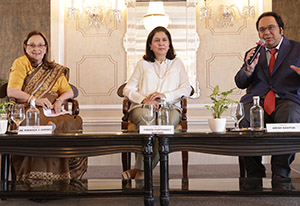
Dr. Pheroza J. Godrej and Mrs. Firoza Punthakey Mistree in conversation with Rtn. Arish Adi Dastur on The Circle of Time: Recreating the Past for the Future – The F. D. Alpaiwalla Museum.
Rtn. Arish Adi Dastur:
Dear Rotarians and friends, welcome to what promises to be an inspiring afternoon in conversation with Dr. Godrej and Mrs. Mistree. Dear Pheroza and Firoza, given how warmly you have welcomed so many of us Rotarians to the museum on various occasions, it is indeed our genuine pleasure to welcome you today to our meeting.
The title of the talk today, Recreating the Past for the Future, draws focus to how vital our collective heritage and culture are in giving us a sense of identity, orientation, and purpose, especially in an age that seems to be moving towards a somewhat uncertain and tenuous future. Could both of you, in turn, please tell us a little bit about what brought you to work in the field of heritage and cultural preservation?
Mrs. Firoza Punthakey Mistree:
If I have to speak for myself, as a person living in the city of Bombay, when you wander around the streets and see these magnificent buildings, both from the colonial as well as the pre-colonial periods, and you see the mix of all kinds of people who lived in Bombay over a period of time, you begin to associate yourself with these things.
You look at little images, little structures, special buildings, and you feel akin to them. Once you begin to relate to certain buildings and structures, this feeling of wanting to preserve things and look after them emerges. You feel that you have a stake in that future. And that is really how I got into heritage.
We took a very big step as a community when a couple of us formed an organisation that helped to put all the Parsi fire temples on Bombay’s notorious heritage list. That is how I came into it. And, of course, working with Pheroza for many years, since the 1990s, it was inevitable that some of her passion for heritage would rub off on me.
Dr. Pheroza J. Godrej:
Thank you for that question. It is a very good question, one that would require many Rotary meetings to answer, but I will try to be brief.
When I first came into this field and was asked to work with the community, my response was that I was really a picture researcher and did not know much about this area. I am a devout Zoroastrian, and I am a Parsi because I was born in this country and live here, but it was a subject that I knew I would need to give a great deal of thought to.
Like Firoza, I have always wondered why we neglected the architecture of this truly fantastic city — not only the built architecture, but also the natural architecture. I am referring to the harbour on one side and the Arabian Sea on the other.
To be brief, Arish, because we love our city so much, we wanted to see a positive change. I remember when we started listing all the heritage buildings, categorised into Grade I, Grade II-A, Grade II-B, and Grade III. I will not go into the ramifications, rules, and regulations, but that was when we discovered the immense wealth of built architecture we had here. And we had to ask ourselves: what were we doing about it?
The best thing was to get it listed, and I am really glad that we did. It was a battle. I will give you just one example of a battle we lost, but which allowed us to prevail elsewhere.
Everybody knows where the State Government Guest House, Sahyadri, is located — on BG Kher Marg, also known as Ridge Road, also known as Malabar Hill. It was torn down years ago. In allowing that one to fall, we saved more than 600 buildings, because the State Government was absolutely adamant that they needed a state-of-the-art guest house. They had visualised it as a very tall building, sticking up like a needle between Raj Bhavan, Doongerwadi, and Malabar Hill.
Thanks to the good offices and sensitivity of Mr. I. M. Kadri, it was decided to go ahead. As Firoza said to all of us, “Let Sahyadri go, otherwise the whole list will go.” So, sometimes, we do have to make sacrifices in order to bring about change. This had nothing to do with Zoroastrianism; it had everything to do with the city.
My involvement with Zoroastrianism was something that simply fell into my lap. I took it on without fully knowing what I was getting into, but I had the support of many scholars, starting with the late Professor Richard Fry of Harvard University, and Professor James Russell, who had almost given up hope about the Parsi community. There are anecdotes attached to all of this. But yes, a picture person walked into the field of Zoroastrianism.
Rtn. Arish Adi Dastur:
Through the years, both of you have collaborated on a wide range of fascinating initiatives. Whenever you collaborate, the results are tremendous, and sometimes even once-in-a-generation outcomes emerge. Could you speak a little about your earlier collaborations before we move into discussing the F. D. Alpaiwalla Museum?
Mrs. Firoza Punthakey Mistree:
I will start, and then you can take on Zoroastrian Tapestry. It is rather strange, but in the 1990s we were organising something called the Naoroji Godrej Memorial Lecture, the first of its kind after Naval Godrej passed away. I was asked to liaise with someone called Pheroza Godrej on the invitation.
I did not realise at the time that this invitation would take me decades down the path of working with her on many, many projects. What I noticed was that even for a simple invitation, she spent an enormous amount of time checking the fonts, the colour, the paper — adding a squiggle here, improving something there. I learned from her, and that is how our association truly began, although we had met before that.
Dr. Pheroza J. Godrej:
Yes, it did start with Zoroastrian Tapestry: Art, Religion, and Culture. It was a project envisaged by our publisher to focus on just that — art, religion, and culture — but they did not specify how many centuries we could work on.
In our typical style, trying to do justice to the subject, we realised we could not limit ourselves to just the last 600 years. We had to go back and ask: where did we come from, and who are we? Very often the community hears questions like, “You are from Kashmir, aren’t you?” or “You came from Afghanistan, didn’t you?” And we would say, no, we were originally from Iran. That story has a historical, cultural, architectural, and religious context.
We decided to take this opportunity and not divide the book into the usual ten or eleven chapters that everyone expects, including Parsi food. Yes, there is ‘Jamva Chaloji’ that you hear at weddings and now even at jobs, but there is also a whole Iranian section to our cuisine.
So it became an all-encompassing book, and I am pleased that we did it. Unfortunately, it is now out of print. Much of its content has been shared the world over. Sometimes I watch a film till the very end, just to see whether the book has been acknowledged, and then, in very small type, it appears.
One cannot take up battles endlessly. There are so many legal luminaries in this room, and we would only be fighting futile cases. We consciously decided to share whatever we had written, because that is the best way forward.
It was a project that we both enjoyed working on. It had some highs and many more lows. But when you speak to art historians and Zoroastrian scholars like the late Professor Mary Boyce — whose working life you, Arish, know far better than I do — she once told me, “Whatever you do, and whatever obstacle you face, do not be swayed. Do as your conscience tells you.”
I have always used that as a yardstick: to try to do the right thing and to be honest with my own conscience. That is what Zoroastrianism is about. That is what all religions tell us. Nothing new.
Rtn. Arish Adi Dastur:
Thank you. I wish we all had the courage to always stay true to our conscience. For those of you who have not seen Zoroastrian Tapestry, it is truly a once-in-a-lifetime — perhaps once-in-several-generations — publication. It weighs about seven and a half kilos and is so beautifully illustrated. Every article in it is simply stupendous, so do make it a point to see the book if you have not already done so.
Let us now move to the F. D. Alpaiwalla Museum. Could you speak about its genesis, its collection, and its restoration and reopening, in which both of you played such a great and instrumental role?
Dr. Pheroza J. Godrej:
I am going to let Firoza answer this, but I will set the context. It is an old museum, almost a hundred years old, tucked away in South Bombay, on Hughes Road. We pass it almost every day, travelling from Pedder Road towards Chowpatty or Opera House.
Both of us have been visiting this museum since at least the 1980s, largely because the curator there was a good friend of ours, the late Nivedita Mehta. She was a Parsi Zoroastrian who took up archaeology after completing her post-graduation and went on to study excavation and archaeology at Deccan College.
It was always sad to take people around the museum because it was extremely run-down. One often had to hang one’s head in shame, especially when showing it to national and international scholars. For a long time, we let it be and moved on to other projects. We borrowed extensively from the museum for exhibitions in India and abroad, and that is when the fire was rekindled. We realised we could not let this continue.
I will now let Firoza speak about the museum itself. We used to say the museum was in seven parts, but it is actually in nine parts. We always knew there were treasures there that needed to be restored and displayed properly. Rotary has been helping us in this effort, and Firoza can comment further. Arish can also comment, as the committee is present in full force. Even Natasha Treasurywala, who vetted the agreement.
I must say this openly: if it had not been for the very generous grant from the Ministry of Culture, Government of India, we could not have begun anything. Without funds, it is futile to start a project if you cannot finish it; leaving it half-complete is even worse.
The Panchayat, which owns the property, told us that they would give us the responsibility provided we raised the funds. We asked for ₹5.25 crores and were granted ₹4 crores, with the understanding that the work already completed — worth ₹1.25 crores — would be treated as the owner’s contribution. The rest was to be given in a certain number of tranches.
It was a huge learning experience, and I would do it again. Firoza says she would not. But it taught me that if you work within the parameters, follow the rules, and do not deviate even slightly, you can get work done with the government. There were times when we were asked to do certain things and I would simply go to the Ministry and say, “But how?” They showed us the way. They hand-held both of us and our small team throughout the project.
Ministers came and went, elections came and went, Secretaries for Culture changed, and everything happened in between. When the museum finally opened, we were both so happy. Seven officials wanted to come from Delhi, which is unheard of. The Government of India does not easily give permission to travel to Bombay. So we did the next best thing and connected them via video, with excellent connectivity and no technical glitches.
The museum opened, and I was extremely happy. My only prayer is that it should never return to the condition in which we found it. We have had support from so many friends, including the Prince of Wales Museum, INTACH, many individuals, and Rotary, of course. We are looking forward to the project ahead with enthusiasm. There will be challenges, but we will get there. It has taken time, but we are moving forward.
Mrs. Firoza Punthakey Mistree:
Yes, the journey was very hard because we were dealing with a ready-made museum that was antiquated and outdated. Pheroza and I had long discussions about what we truly wanted to emerge from it. It would have been easy to pack everything up and put it into storage.
But when nearly 800 to 900 cartons came back, the task of sorting through them and deciding what could be displayed, what could not, and what was possible was enormous. There was a great deal of back-and-forth discussion.
I was very keen that the museum should not be uni-focused and limited only to the Parsi community. Pheroza kept asking how that was possible in a Parsi museum. Eventually, what emerged was that every object we displayed was connected to another civilisation, another era, or another community, all linked to the Parsi story.
So if someone walked into the museum without knowing anything about the Parsis, they would still come away with an understanding of the community’s history, culture, and traditions. They would also find points of familiarity — something that resonated with them. When you connect with an object, empathy develops, ideas meet, and communities come closer.
We created eight or nine standalone stories, all connected by a fine thread. If you walked through the entire museum, you would see a knitting together of civilisations, eras, and objects. We wanted the objects to tell their own stories.
The first section dealt with the ancient world, which was pre-Zoroastrian, covering Mesopotamia, Babylon, and Assyria. We began there because we had a substantial collection of antiquities excavated from Susa in south-west Iran. These were excavated in the 1920s by a Zoroastrian archaeologist working with a French archaeological team. He brought back over 600 objects, of which we have displayed only about ten or twelve.
The same archaeologist also excavated a Tower of Silence in Yazd, where he found material objects such as combs, rings, ivory items, spindles, fragments of cloth, and even a beautifully handcrafted leather baby shoe. This was puzzling, because traditionally nothing accompanies a body placed in a Tower of Silence. From his notes and records, he concluded that there had been a pandemic, and anything touched by the infected was placed with the body, after which the Tower was sealed for 400 years until it was excavated in the 1920s.
He also brought back polychrome baked bricks with daisy and chevron designs, taken from the palace of Darius the Great, dating to around 530-540 BCE. We are proud to say that some objects in the museum date back to 4000 BCE — nearly 6,000 years ago, while others continue into modern times and are still in use within the community.
We included a map tracing the migration of the Parsis, showing where the community came from and how it eventually settled in Gujarat and Bombay. There is also a wall of images depicting sacred sites, offering a visual understanding of religious spaces.
Given the association of the Parsis with the Tower of Silence, I was insistent that we include a model. We found a dilapidated one in the custody of the Bombay Parsi Panchayat, who kindly gave it to us, and it was restored. This helps visitors understand the structure and the process involved.
We also wanted to highlight the Iranian aspect of our heritage, so we recreated an adobe home of a Zoroastrian family from Yazd. One of its special features is the door, which has two knockers — one producing a heavier sound used by men, and a lighter, tinkling sound used by women — allowing those inside to know who was at the door. This reflected the safety measures developed by the community in difficult times.
We then moved into the Parsi lifestyle, including the gara and how it is worn. Visitors often ask why Parsi women traditionally wore only one earring. The answer lies in thrift and practicality: the sari pallu covered one ear, leaving only one visible, so a second earring was unnecessary.
We displayed textiles, manuscripts, artefacts from the imperial period, and evidence of Chinese trade. While many people are familiar with blue-and-white Chinese porcelain and famille rose, we discovered something remarkable — a small figurine of an elderly, bearded man holding a knotted staff. Research revealed that this was a Chinese representation of Zarathushtra, known as Suluzhi. Further investigation showed that it was based on a portrait once held in Dresden Castle before the First World War, later recreated in China.
I will now leave it to Pheroza to cover the lifestyle room, which is her favourite, and where her artistic vision truly comes to the fore.
Dr. Pheroza J. Godrej:
That was quite a challenge because space is extremely tight and we have nine sections in the museum. Firoza has already covered the ancient world, imperial Iran, textiles, costumes, and the China trade. We also have a section on coins that were brought back, and we were extremely fortunate to collaborate with the British Museum through a friend who received a grant from the European Union.
She brought several scholars with her, including a specialist dealing with coinage and seals. He spent about three weeks with us, cleaning the coins and photographing them. We told him, “We will give you permission to do all this, but what will you do for us?” He said, “We will catalogue your entire collection and put it on our link so it will be available on the web, through CERN in Switzerland.” It was a wonderful idea. We had no funds to pay for it, so we offered hospitality instead, and we continue to do so.
As a result, the coins and seals were catalogued. Some of them are extremely small, but they are incredibly beautiful and convey an immense amount of history. It is astonishing what coins can tell you, because money has always been at the heart of civilisation, even in the ancient world.
The lifestyle section reflects trade, particularly the China trade, which the British encouraged. This community embraced it because they had no fear of crossing open seas and no religious or social taboos preventing them from doing so. They brought back not only goods, but also the exquisite art of embroidery for their wives. When they settled into large homes, they filled them with furniture influenced by Portuguese, British, and Dutch styles, along with crystal and other imported objects.
All of this had to fit into a very small room, which we call the Lifestyle Room. It has become a major attraction, and everyone wants to have their photograph taken there. More importantly, the museum offers something for every generation. Children are often fascinated by the diorama-like structure of the Yazd homes, including a model dressed in traditional Yazdi costume.
Whatever the Iranians have, Zoroastrian Parsis have a counterpart in India. The difference is that the community was no longer as severely persecuted, so they lived with relative frugality. They were largely agrarian, flourishing under some Persian and Iranian dynasties and struggling under others. All this documentation is part of the museum narrative.
Most museums worldwide display only about 30 per cent of their collections, including the Prince of Wales Museum, due to space constraints. We face the same issue, but we try to rotate displays. Over the last eight years, we have received many donations from Parsi families, and everyone naturally wants to see their donated item on display. At the centre of the museum, we have created a platform where restored objects and those undergoing restoration can be viewed.
We are particularly known for our textiles, though textiles require enormous care and deteriorate if neglected. One room, which I call the Bombay Room, reflects the fact that Bombay was not built by Parsis alone. Trade and commerce involved many communities, and this room highlights common links. It depicts business activity from our community, but also acknowledges Ismailis, various Muslim sects, and Hindu trading communities who together shaped the city.
The final section of the museum is the Fire Temple. It is a walk-in space where visitors can circumambulate on three sides, as one does in a fire temple. It serves as a learning tool, especially for scholars studying comparative religion. We have hosted scholars from many institutions, including twelve fellows from the Royal Asiatic Society, who were fascinated by what they could see.
This particular display has travelled extensively — to SOAS in the UK, to Delhi at the request of the National Museum — and has always returned. The donor had stipulated that its final resting place should be this museum in Bombay, and we are deeply grateful to Dr. Cyrus Poonawala for that support.
One section remains to be completed: the stamp collection. Although stamps are no longer commonly used, philately is a global interest, and we have a substantial collection that still needs to be catalogued and displayed. It is an excellent teaching tool, especially for children.
The museum is fundamentally a teaching space. We host many school groups, bringing children in batches of around twenty, guiding them through the museum, and engaging them with activities. Despite all this, we operate with just two staff members — a deputy curator and an administrator — supported by security.
Housekeeping and hygiene were among our biggest challenges with the landlord. We have addressed these, along with installing solar panels, improving accessibility for persons with disabilities, setting up a small shop, and developing a reference library. This is not a lending library, but its catalogue is available online, allowing scholars to view rare and old books remotely. We have also established a conservation laboratory.
Rtn. Arish Adi Dastur:
Thank you. You really must see this museum. Even with such detailed descriptions, it is something that needs to be experienced. The final initiative we would like to discuss is the Heritage Restoration Centre, a collaboration between the Rotary Club and the F. D. Alpaiwalla Museum. Could you share your vision for this centre?
Dr. Pheroza J. Godrej:
Rtn. Jamshed Banaji visited the museum, he must have taken it forward to discuss. This has been discussed extensively within the committee, many of whose members are present here and have visited the museum. Rotary has done outstanding work in heritage and environmental conservation, not only at the Prince of Wales Museum but across the city and beyond.
We had very limited space, and the Government of India grant required us to have a conservation lab. When the Panchayat gave us a little more space, we decided the best use would be to expand the conservation lab rather than any of the nine museum sections. Expanding displays would simply mean restoring more objects and putting them out, whereas conservation reflects respect for objects, regardless of their age.
Restoration does not mean making something look new. With current techniques — for glass, textiles, manuscripts, and paper — we can preserve integrity. This is what we intend to focus on in the library and conservation lab, working with a professional conservator and Rotarian Jamshed Banaji, who has generously volunteered his expertise.
Museology and restoration are very important subjects today, especially for young people. It is a wonderful career to pursue. Recently, the Prime Minister organised an exhibition in Delhi, and our Deputy Curator was invited to attend. The Museum of Christian Art in Goa participated, as did museums from Bihar, and they showcased a wide range of developments.
These included modern lighting systems, solar panelling, museum-quality paper, and the types of wood suitable for museum use. This is precisely the kind of knowledge we want people to access and benefit from.
Restoration is a very complex career to enter, because one needs a strong understanding of chemistry — more so than physics. Students graduating from the science stream or other STEM subjects often move into the arts field for conservation and restoration.
At the end of the day, what do we want? We want young people to be economically independent, to generate income wherever they may work. They may not necessarily work in a museum; for instance, they could work in a bank, restoring artefacts such as share certificates and other paper-based materials.
Rotarians Ask
Ladies, Western scholarship contends that the great composer Mozart was influenced by Zoroastrian philosophy and, in fact, used it in his opera The Magic Flute. Would either Firoza like to comment?
Dr. Pheroza J. Godrej: She has just come here after hearing rehearsals for the Eroica, so I am not going to touch that subject.
But I will say one thing, Jimmy. A great deal of our history has been taught to us through Western eyes — through Herodotus or other foreign scholars. Only now is it emerging that there was an enormous body of work and written material in Persian. We do not always need to rely solely on Herodotus and the Greeks to tell us our own story.
Similarly, we know of Nietzsche and Thus Spoke Zarathustra. Where did these concepts come from? The Magi are represented in churches, and it has always been said — correct me if I am wrong — that the Magi were the three wise men from Persia.
Mrs. Firoza Punthakey Mistree: To answer your question directly, Jimmy, the West, particularly during the Renaissance and even earlier, was deeply fascinated by Zarathushtra. The Greeks and Romans had long-standing, often hostile, relationships with Persia, but in the process they absorbed many Iranian concepts and ideas, including religious ideas. Mithraism, for instance, came from Zoroastrian Iran.
So I am not surprised at all that composers like Mozart absorbed these ideas. There were several other musicians as well who made Zoroaster the central theme of their musical compositions. If you go to the Vatican, you will see Raphael’s famous fresco of the philosophers, in which Zarathushtra is depicted holding a globe.
Zarathushtra has long been part of European imagination and intellectual history. This is largely due to the presence of the Magi, whom Christianity adopted and integrated into its own religious thought. From there, many of these ideas emerged and spread.
Some scholars even suggest that the American Constitution was influenced by Zoroastrian principles, when Benjamin Franklin was ambassador in Paris and came into contact with Anquetil-Duperron, who first brought Zoroastrian texts to Europe.
I hope that answers your question.