
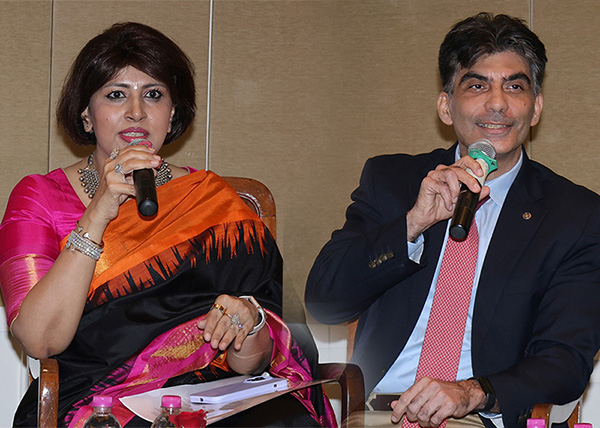
Dr. Tarang Gianchandani, Group CEO, Healthcare Initiatives and CEO, Sir H.N. Reliance Foundation Hospital, in conversation with Rtn. Dr. Aashish Contractor
Dr. Tarang Gianchandani, Group CEO, Healthcare Initiatives and CEO, Sir H.N. Reliance Foundation Hospital, in conversation with Rtn. Dr. Aashish Contractor on the transformational healthcare perspective of a healthcare leader and a doctor.
Rtn. Dr. Aashish Contractor:
It’s nice to be on the other side of your CEO, asking the questions today. So, let’s get started. Dr. Tarang, you qualified as an orthopaedic surgeon, and then as your career progressed, you moved into healthcare administration. My first question is: what brought about that transition? How did that happen?
Dr. Tarang Gianchandani:
I would like to thank the Rotary for having me as a speaker today, and to Mr. Dalal for such a warm introduction.
I don’t think it was a change, just a different style of taking care of patients. Even while I was practising orthopaedics, whether in India or Singapore, I was always curious to understand how things worked beyond the scope of just doctors. So, honestly, it was not a change, but a different way—or perhaps a way to scale up.
I’ve always been intrigued by how Singapore functioned. Around the year 2000, they were already using electronic medical records, and I was fascinated by how efficiently the system worked. I had gone from New Delhi, from a government setup, and landed in a similar setup in Singapore—but it felt like a different world. I was always inquisitive about that.
Then came opportunities and circumstances that pushed me to make a change—and I did. And I think it all worked out for the better.
Dr. Aashish:
Those awards clearly showed that it worked out for the better.
Dr. Tarang:
Yes, I would say I could at least move in the direction of what I wanted to achieve. I think we always need to set goals ahead of what we believe we’re capable of, so we can at least reach somewhere. As I’ve heard so many times from Reliance—dream big. So, I started dreaming very big.
Dr. Aashish:
Following up on that—the transition from studying in New Delhi, then going to Singapore—how was the transition coming back, both personally and from a healthcare angle?
Dr. Tarang:
It’s a very interesting aspect of human nature—how we adapt to the place we live in. When I was in India, I was used to that system. It took time to understand and adapt to the Singapore system. After 15 years there, it became a part of my DNA. I began to think that’s how the world functions.
Singapore is an ideal environment for people to live in. My husband was always worried that if our kids grew up in that environment, they wouldn’t be able to survive anywhere else. So before they became too used to it, he felt we should move back. I wasn’t too keen initially because I had made good progress in the Ministry of Health. I was acknowledged as a star performer, and they wanted me to stay on and grow.
But from my husband’s perspective, he wanted to return. Two things brought me back. One was that our parents were getting older, and we wanted to stay closer to them. The second—which absolutely failed—was that my brother had just moved from Hong Kong to Mumbai. We thought it would be nice to be together after so long. But within a year of my moving, he went back to Hong Kong!
Professionally, I was completely in the dark. I had never stayed a single day in Mumbai before we moved in 2012. So, Mumbai was completely new to me. And the healthcare system here is very different from New Delhi. When I joined Jaslok Hospital and Research Centre, it was a mixed package—a surprise and a shock.
I had given myself a lead time of 6 to 12 months. I said, “If things don’t work professionally, that’s okay,” because it was a huge change from Singapore to Mumbai. In Singapore, everything is systems-driven. In Mumbai, it felt like you didn’t even know what the systems were. So yes, it was a crude shock.
I’m really thankful to the trustees of Jaslok Hospital. They had faith in my capabilities. I joined as Chief of Quality and Patient Care, and within six months I moved into the role of Medical Director. Then within a year, I became CEO.
That year was a rollercoaster, especially because that was when the Shakti Mills case happened. The patient was brought to Jaslok in the middle of the night, and I had to manage the whole thing as Acting CEO because there was no full-time CEO at the time. I was just 36 then. I hadn’t planned on becoming CEO at that age.
I’m also very thankful to the senior stalwarts at the hospital—Dr. Noshir Wadia, Dr. Jamshed D Sunavala, Dr. Ashwin Mehta. I was younger than many of their children, yet they supported me wholeheartedly. I still remember Dr. Ashwin Mehta telling me, “Today, you are like a small child who needs our finger. One day, we will hold your finger and walk.”
So yes, it was an interesting journey. Initially quite shocking. A very different culture. I had to change some things, and some things changed me.
Dr. Aashish:
Thank you for sharing those personal insights. You spoke about your brother—well, Rotary seems to have brought you together again, because Ajay is sitting here in the second row. Coincidentally, he’s just landed from Singapore this morning and is staying at the Trident. Maybe circumstances played a role, since the meeting shifted from Taj to the Trident today.
Dr. Tarang:
Yes!
Dr. Aashish:
OK, so almost as soon as you joined Sir H. N. Reliance Foundation Hospital, COVID hit—and pretty much the whole world as we knew it changed. At that time, you were looking after several facilities—COVID, non-COVID, NSCI, Seven Hills. Can you talk us through those dark days, and how you managed?
Dr. Tarang:
COVID came as a brutal shock to everyone. It wasn’t just a city, state, or country issue—it was a global crisis. Your resilience is tested most during a crisis, and the world saw that those who managed the crisis best had the lowest mortalities.
It was also an interesting time because we had to deal with something unknown, with zero preparation. Nobody was ready. From my experience in Singapore, during SARS and H1N1, I could tell from the way the virus was behaving that this wouldn’t be over in two or six months—it would be here for at least a year, if not more.
At that time, at RFH was just putting together its plans to become a world-class transplant facility, an advanced cardiac and oncology centre. So where would COVID patients go? You simply couldn’t mix COVID and non-COVID—it would’ve been a disaster.
We proposed that we separate the facilities. It was a novel idea at the time. I’m very thankful to our principals—Mrs. Ambani and Mr. Ambani—who saw the logic and trusted me. They said, “Let’s make this a completely non-COVID facility.”
We got a large space in Seven Hills Hospital. Nobody else wanted to take it up. People wondered how we would even create a hospital there. But within ten days, we created the first fully COVID-dedicated facility with everything required—negative pressure isolation rooms, PPEs, EMR System. It was only possible because of Reliance. The entire company supported us—other businesses were shut, nothing was moving—and this became a rallying point.
That was the first step. And I thank the state leadership for accepting this idea. Maharashtra adopted the model of separating COVID and non-COVID patients. That led to the creation of jumbo facilities, and that’s why Maharashtra fared better than many other states.
We gained the public’s trust during those dark times. We tried to find calm amidst the chaos. We then managed the Trident BKC as a COVID facility for less severe cases—since hotels were also shut. We set up a 650-bed facility at NSCI in just a couple of months. We also ran the most successful immunisation campaign.
It just kept evolving. In all, we dealt with COVID for two and a half years. And yes, it was a trying time personally too—my daughter was in grade 11, and during that period, she had to go away. I couldn’t give her as much time as I would’ve liked. It was stressful.
Dr. Aashish:
I can imagine that, and I must give you credit. During the whole COVID time, one of the big initiatives you initiated was taking care of the mental health of the caregivers—because the nurses, the doctors—they were also dealing with this for the first time. So, we had an entire task force set up for psychological support for healthcare.
Speaking of the organisation, I know that the organisation you head overall is very woman-centric, which is not the most common in our country. Statistically, it’s a women-dominant organisation. What do you think are the unique strengths that come with that?
Dr. Tarang:
I think now we are proud of the fact that we are a women-dominant organisation—maybe not women-centric, because we are patient-centric. Around 65 to 68% of our entire team are women.
I still remember when I met Mrs. Ambani for the first time—not as the mother of my son, who was actually the first person to introduce us to the Reliance family when he joined the school in LKG. For the longest time, I was only known as that Rachit’s mother. But the first time she met me in a hospital context, she told me, “I run the school with the heart of a mother. What is your thought process in running the organisation?”
I told her that as women, we tend to run organisations like mothers—firm and strict, but also soft when it needs to be soft. At the end of the day, a hospital is only about people—patients, staff, doctors—it’s all people. That soft touch is something women naturally bring, and it’s important.
Our chairperson, amidst the million things she does, also has a strong inclination towards getting the best healthcare to India. I run it with that thought process. Likewise, our entire team—including our leading doctors—has strong women leaders in clinical leadership roles. That brings in a softer angle, which I think is very valuable.
Dr. Aashish:
Let me follow that up—is there any downside to the fact that it’s women-dominant?
Dr. Tarang:
I think like sugar—anything in excess is bad!
But truly, there is no downside. After 25 years in management, I believe we need more inclusivity and balance. God made us all to balance nature, and the same applies to management. We used to say, “Behind every successful man is a woman.” Now, there are many good men behind successful women too.
I actively work towards maintaining this balance in my day-to-day leadership. We don’t just evaluate performance—we also look at the gender mix of each department. Everyone brings unique capabilities and qualities to the table, so balance is crucial.
We are blessed to have fantastic male colleagues—one sitting right next to me—and many more in our management team. Functions like HR, Finance, and Marketing are led by men. That balance is what makes it perfect.
Dr. Aashish:
Speaking of healthcare systems—you’ve seen Singapore’s, and I know you travel widely and study systems in the UK, US, and India. I’ve got two questions: What are some of the strengths and weaknesses you’ve observed in these systems? And in India, where income disparity limits access to healthcare, what are your thoughts on how to address that?
Dr. Tarang:
Yes, I deliberately try to find time to travel to all the key healthcare systems—in the US, UK, Singapore, Europe (Germany, Switzerland). Each has unique features, and you have to spend time within the system to truly understand them.
Let’s take Singapore. I’ve been in that system for 15 years. It’s almost too good to be true. It functions on systems thinking, which is essential in healthcare. There’s commendable efficiency, but they can do that because they are a tiny country.
The UK, on the other hand, is built on the principle of equity in healthcare. No one is denied access. But like most national health systems, they struggle with efficiency. There are long delays—even to get a CT scan or MRI. In London, unless you go private, NHS appointments take months. Here in India, you call and get it done the same day.
The US system is fantastic in terms of innovation, technology, and research—they’re 15 years ahead of us there. But access to healthcare isn’t equitable. Costs are skyrocketing, and insurance dominates everything. They’re struggling to find ways to contain costs, but haven’t succeeded yet.
India is a very complex yet resilient system. At this stage, I don’t think we should try to copy any particular model. We are unique, so our system must also be unique.
We need to focus on a systems thinking approach like Singapore, improve access to healthcare, and invest in research and innovation. That’s how India can build the best healthcare system.
Now, regarding access for the less privileged—we do have fantastic government schemes now, but awareness is lacking. Through the Foundation, we’re running a project involving schools and even my own son. We’re working to enrol people in state and national insurance schemes that require no premium, just registration. Once enrolled, they have access to around 150 hospitals across the state—and more across the country.
There are also private insurance options. This year, thanks to an idea from my kids, we decided: instead of giving a Diwali bonus to staff, why not pay for their health insurance premiums? That way, their healthcare is taken care of for life. The premium is not more than one month’s salary.
If we enrol staff in government schemes too, we can really extend the impact. But again, the issue is awareness and grassroots implementation. Young people need to get involved and show how to do it the right way.
Why should we do it for our staff? Because if you do it for one person, that one person will tell ten more. If you involve a school child, that child will influence 100 more in their household. It’s a domino effect. Somewhere, we have to start.
Dr. Aashish:
Thank you. I think Rachit, you’re responsible for that—good. We should also get our Rotaract and Interact Clubs, which are the Rotarians in colleges and schools, involved. That’s something we can think about.
Super. So I’ve got one last question—which is about the future. A lot of people love the hospital, but there’s one very big complaint. The moment they enter—they don’t get rooms, they don’t get space. So, what’s the future for the hospital and the Reliance Foundation group? And where do you see the future of healthcare?
Dr. Tarang:
Let me speak about the future of healthcare first, because I think that’s important—and naturally, we’re aligned with that.
The future of healthcare is not just about building hospitals for acute care. It’s also about helping people live longer, healthier lives. Longevity is key—but in the right way.
Today, everyone feels entitled to speak about longevity the way they did about COVID, but it has to be done in the right way, with proper policies and proper protocols. Otherwise, we’ll create a big mess, and we won’t know what’s happened until 10 to 15 years later. That is something we need to look at seriously. We need to focus on our brain health, on rejuvenation—but at the same time, something I specifically learned during my recent visit outside India, especially to the US, is the importance of regenerative medicine.
I’ve already spoken to Mr. Anant Ambani, who heads healthcare initiatives at Reliance, and also to Mrs. Ambani. I said that only Reliance can bring regenerative medicine to India the right way. Everyone seems to be doing it, but not through the right protocols. Over the next few years, we will focus not only on personalised precision medicine but also on mental health and regenerative medicine—which are key to longevity. We need proper screenings, microbiome testing, and personalised packages for individuals. But most importantly, stem cell therapy, which involves using a part of your own body, is the future of regenerative medicine.
And trust me, the US is at least 15–20 years ahead. They are actually seeing results—they’ve managed to reverse the ageing process by 10 to 15 years for some people. That’s the way forward.
Coming to RFH (Reliance Foundation Hospital)—we will very soon be announcing several new hospitals in the next couple of months. These announcements will come directly from our principals. We’re growing not just horizontally, but vertically too. So we’ll have more space within our existing setup, and we are expanding significantly in Mumbai—and beyond Mumbai as well.
We are looking at healthcare holistically. We’re not just adding beds—we’re also thinking about how to keep people healthy in the first place. That helps reduce the burden on healthcare systems. And I think the only people who can do this with such a big heart are Mr. and Mrs. Ambani—and most importantly, Anant Ambani. He truly has a heart of gold and wants to do as much for people as possible.
We also run our hospital with systems thinking. We try to ensure there are minimal infections and that people can go home quickly. We’re now moving towards a more holistic model—a continuum of care—where we support the patient from the time they enter OPD, through any procedure they may need, and back home with continued care. We are also adding a well-being and longevity paradigm for every person who comes into contact with us.
Dr. Aashish:
OK, super. So the future is about both quantity and quality of life.
Before we open it up, I’m going to ask you one final question—which I know our senior Rotarians, like PP Arun Sanghi or PP Vijay Jatia, might ask.
Our Club had certain special privileges from the hospital post-pandemic. So, my final question is: could we please continue those privileges that the Rotary Club gets from the hospital?
Dr. Tarang:
Of course! I think we will surely continue that. Mr. Paras is here from our hospital—he’s your point of contact.
And not only will we continue those benefits, but we will also try to augment them further by giving priority to Rotarians.
And now that you’ve lit a fire under me, let me reverse the offer—don’t wait to invite me next time. Make me a member of the Rotary, and then these benefits will flow automatically!
But thank you so much. There’s nothing to worry about. We will definitely work things around, and we are here to support Rotary in every possible way we can.
ROTARIANS ASK
Mudit:
Thank you, ma’am. Mudit here, from your hospital. I have to say—I still get a discount. PP Needham initiated the 50% discount on OPD services.
Dr. Tarang:
Yes, but we will augment that with newer initiatives. Because I think it’s not just about outpatient visits—I really want all of you to think about how to stay fit, live longer, and live healthier.
Mudit:
My question, ma’am—you’re doubly qualified. So what do you grapple with more? The egos of doctors? (I’ve seen my grandfather deal with them at Bombay Hospital years ago.) Or running the system? Because managing a hospital is a combination of dealing with humans and machines—and machines are less temperamental!
Dr. Tarang:
Machines are definitely easier! But yes, being a doctor myself makes it a little easier—because people on the other side of the table know that I understand the science too.
And I guess women can do a better job at managing egos, don’t you think?
Zinia:
Yes! Reliance is a wonderful hospital. I go very often to Ashish for physio, and he’s helped me tremendously. I’m just wondering—do you use AI, EMRs, and systems like that in your hospital?
Dr. Tarang:
Thank you—and yes! We were the first hospital to have all systems completely on electronic medical records, going back 11 years. Today, all our machines have artificial intelligence built in. The beauty of AI is this: first, the machine must be enabled to capture data. Then comes data mining—where you use the data to build algorithms that can predict outcomes. One of my personal goals for the next 10 years is to enhance knowledge in AI and digital health. When I came from Singapore, I was ahead of the curve in India in terms of technology. Now, when my son is about to leave and us becoming empty nesters, the number one item on my to-do list is to do a proper handshake with AI.
And also to get my doctors to do that handshake—because AI will never replace doctors, but it will definitely augment them. At least in India, it will never replace the human behind the machine.
Audience Member:
Thank you, ma’am. Thank you for this informative talk. It’s not more of a question; it’s more of a request. With the glowing tributes to the Reliance Foundation, I run a small hospital in South Mumbai. There are many such hospitals that have their own stories. Can the Reliance Foundation Hospital have some sort of outreach to upgrade, guide or mentor?
Dr. Tarang:
Absolutely. I would personally look forward to doing that. That is something that is my way of giving back to society, and that is one thing which is my goal. I will definitely be happy to help in whichever possible manner I can—no problem. All the more better.
Next audience member:
I have a very frank question, and hopefully I’ll get a very frank answer. A lot of us sometimes feel that running a hospital is more of a business than just giving to society. Is this true or not? Number two, we hear horror stories in the US about pharmaceutical companies trying to not give a cure, but rather a prescription by which you’re hooked on to that medicine forever and ever. I’d like your views on that.
Dr. Tarang:
Thank you. So first of all, whether running a hospital is a business or not—when I came from Singapore, it was a big question mark: where should I join? I was interviewed at various hospitals, including a very popular one in South Mumbai where many of you go (before Reliance Foundation Group).
I won’t say you’re completely wrong—some hospitals do run it like a business. In Singapore, I worked with the Ministry of Health, where healthcare was not a business. It was made clear from the beginning by policymakers (I reported to the Director of Health Services and indirectly to the Minister of Health) that healthcare has to be sustainable but should not be profitable at the cost of patient safety and quality of care.
I came with those principles; they are in my DNA. I visited some chain hospitals here, but their thought process was different. I was being asked to do things I wouldn’t have done. I told my husband that was a shock—I had reached a level where I was being forced to give doctors targets for a certain number of knee replacements, angioplasties, bypasses. I said, “No, I can’t work like that.” Then I went to a very popular hospital in South Mumbai—again, same thing. Doctors could charge anything and everything. Not my cup of tea. Then I visited a popular hospital in Andheri—again, not aligned with my principles.
Finally, when I met the trustees of Jaslok Hospital, whatever the situation of the hospital at the time, at least the thought process was aligned. They wanted sustainability but were clear that wrong things wouldn’t be done. I felt somewhat aligned.
When I came to Reliance, I personally felt this is what I had been looking for. The hospital was running at 30% occupancy when I joined. Today, it’s at 100% occupancy. In fact, I would prefer it run at a slightly lower occupancy because at 100%, systems begin to shake.
But it’s grown purely because we follow our heart. I run it my way. The beauty of our leadership is that they say, “You are the owner; we support the owners.” That’s the kind of ownership I’ve been given by Mr. Anant Ambani and Mr. Ambani. I run it with my heart.
No doctor in our hospital is forced to treat healthcare like a business. We do assess performance, but it’s based on clinical outcomes, patient feedback, and other quality indicators—not revenue.
Of course, when you gain the trust of people, revenues and bottom lines follow. So yes, I run a sustainable hospital. But our highest-level technology funding comes from the foundation. For example, we recently got a biplane catheter lab for neuro-intervention—it’s not available anywhere else in Asia. Now we’re bringing a unique type of CT machine, also the first of its kind in Asia. Those costs can’t be sustained by hospital revenue alone; that’s where the foundation steps in.
As for the pharmaceutical industry and vaccine-related concerns—it’s a hot topic. In the US, yes, the insurance system runs the show. Manufacturers dictate to doctors, and that’s where ambiguity and mistrust enter.
In India, while we are not that tightly regulated, pharmaceutical companies don’t control doctors to the same extent. That’s the good side of our system. The downside is that lack of regulation can lead to inconsistency. But the current national government is not leaning towards profit-driven healthcare models, especially when it comes to drugs. So, I think we’re on the safer side.
Lastly, this uproar about vaccines not being necessary—I disagree. We would lose hundreds of thousands of lives without vaccines. Vaccines provide herd immunity. What ultimately brought COVID under control was the vaccine. If we were not vaccinated, the strain would have become stronger and more deadly. Instead, it became weaker. So yes, vaccination is vital.