
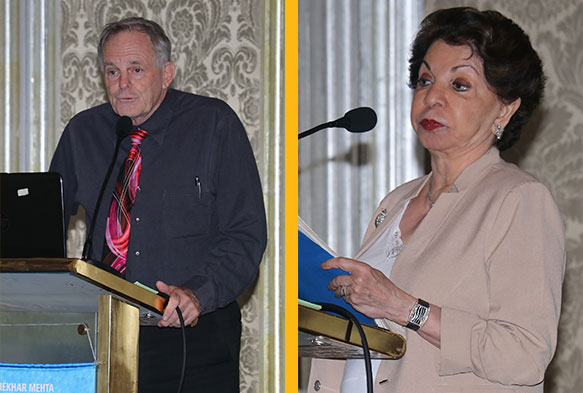
Dr. Thomas Virgets, Head, Corvuss American Academy & Rtn. Sabira Merchant

Dr. Thomas Virgets
Historically, in India, students are prepared to make decisions at an early age. They want to be athletic or pursue an academic career. There are few opportunities for individuals who are good at both. At Corvuss, we have a mission that is balanced on three columns. The first is to be an academic institution and our goal to be in the academic Top 10 throughout India. We have an athletic mission, and a balanced approached, we plan on being the best. We have another area that is equally important: leadership and character development. No matter how good a student or athlete you are, if you can’t manage from a stand-point of good leadership and have good character, it is not going to make a difference. This is especially true today where if a child from the Corvuss American Academy hasn’t developed confidence and leadership skills or hasn’t developed a character to know the difference between right and wrong, then we feel we have failed in our mission. We are trying to develop a whole person morally, mentally, and physically.
To do that we have to recognise what kind of a student we have. We have an individual who wants to be a great athlete but also a good student; if we can bring it together and give them the life skills to carry on throughout life, that is the foundation in time management and discipline. A disciplined and timed 15-hour day can balance athletics and academics; it is a rigorous programme.
Our goal is to integrate an educational and athletic career. Indian students find little opportunity to participate in academics while doing athletics. Why? Because they train at a club, do schooling at a regular school system. How do they keep up with their academics? If she is into regular school, she will have to drop out to continue the sport. At Corvuss, our culture and the teachers work together. They keep an upward academic graph the whole time. So, one of our students, while gone for 8-9 weeks training, has also been able to hold a 3.7 overall GPA. When you can do, it is a success.
Everything that we do is the combination and integration of these missions. We also add in strength training and nutrition to integrate and ensure that the athlete gets the finest training possible throughout. Our goal is to make sure that students not only graduate but can also go to any schools globally and continue to participate in sports if that is what they desire to do. We have all the support mechanism in place to prepare the students for finest of the colleges. As a boarding school we are able to take a student who is struggling with SAT and get them mandatory training to improve themselves. Because of the rigours of the day, the children learn responsibility. If you are able to manage things on your own, we give you the freedom to go home on the weekends. We are going to be with them side by side, every walk of the way. we can do this because every teacher lives on campus and we have the support mechanism in place and we are constantly teaching the young children to develop their own personal habits. Mainly time management and the discipline.
We have an American curriculum, and it offers a little more flexibility. Our students will be of same background as most students of IB programmes. But we are motivating them to be the very best they can be. Academically and athletically, it is the same motivation techniques. They should want it enough to overcome the barriers. If they are willing to do so then we are there for them with good teachers and knowledge as well as coaches. You have got to have talent. When a great athlete or student comes along, they know that it is going to happen, and that they can succeed with the opportunities we have. In this nation, we have seven times the potential of USA, but they need that opportunity to grow.
We focus on six sports – football, basketball, swimming, squash, tennis and track and field.
SABIRA MERCHANT
How to be a better speaker? I have students who are from six to 60 years old. Here are the words in front of you; the first is ‘clarity’. Clarity is clarity of thought and speech. I must think clearly before I speak clearly and be sure to speak very clearly. When you go to a function and if you need to speak there, you take your paper and card with you and try to keep it same colour as your outfit. For instance, if you are wearing a black one, try and keep a black card rather than a piece of white paper that flops around on the stairs. It won’t look professional; you must look professional. So, clarity of thought equals clarity of speech.
Second is speed. Do not be too fast while speaking. This is most people’s fault, especially young people. I have to constantly caution them on their speed so that everyone can understand. Who is going to be judging all that you do? It’s you and also all in the audience.
Next is volume. Do not speak too softly. You must imagine that there are people around you, conversations around, waiters around you and all kinds of people. So, raise your volume a little bit so that you are heard clearly.
Next word is enunciation. It is the bite, the completion. The end of each word should be bitten, stressed upon. Most people do not have enunciation because our Indian languages Hindi, Marathi, Guajarati also don’t have enunciation. They are soft languages; they don’t bite on their words whereas in English, you have to.
Then we have the word pronunciation which is so misused. I can’t tell you the words that are mis-pronounced. Just take a word like career – people say carrier. Academic – people say aka-demic. Development – people keep saying dev-lopment. India is dae-ve-loped country, no it is de-ve-loped country. Realty is another word that is mis-pronounced as reality.
Then, we come to emphasis. When you are speaking you have to emphasise on certain words, this is a WONDERFUL day, this is the most PERFECT day that I had. This is so you become more colourful in your speech, you become more acceptable, people come and tell you that you are a good speaker. So, that is again important.
Then we have ends of words and sentences. People unfortunately start with a lot of breath but they finish in a blur. Why does that happen? Because you do not take enough breaths in between. That means you have to speak, take a break and take another breath and the third breath to be able to complete your sentences. The ends of the words and sentences must be heard.
Then we come to grammar. It is something we try to use, like we use our mother tongue. We try to translate that into English and it just doesn’t work. You have to be careful about your grammar. People introduce themselves as ‘Myself Pushpa’. Then, it is my father and I not me and my father. And, using moved and shifted. People say I have shifted from Andheri to New Bombay. You don’t shift, furniture shifts. People move. Another mistake people make, ‘What is your good name please?’ because they translate from Hindi, ‘aapka shubh naam kya hai?’ That doesn’t work either.
So, you have to be careful of many things which make you a good speaker and put you in the realm of having command over language. Then comes the articles. Articles have to be used before every noun. It is the book, the bag, these papers. Now when do you use the [duh] and the [dih]? You use the [duh] for everything but [dih] before the words that start with a vowel. You have to know the difference, there is a rule in English about the articles. Be sure to use your articles with every noun.
Then fillers – they are the real devil. Uhh, I mean, you know, umm, so, that keeps happening all the time. Why? Because you don’t have command over the language. You don’t have a good vocabulary. You struggle with the words and you use fillers. Please try and keep away from the fillers.
Of course, then body language. It should always be positive. Don’t lock your hands and speak, it is the most offensive. Your hands, remember, are also means of communication. So, use them. Don’t flay them around. Eye contact – magical, I look into your eyes and speak something I mean everything. Eyes are so wonderful. People do connect with their eyes, how much more charm you exude.
Humour – try and inject a little humour if you can. There is a small saying. This boy goes to his father and says Daddy! Daddy, how much does it cost to get married? the father says, son I don’t know, I am still paying. So, humour. And try and smile whenever you speak. You will win over more people by smiling instead of being serious. Remember life is not all that bad.
Projection – project yourself, like we have been taught on the stage, throw your voice, don’t internalise. Don’t say hello how are you. Say HELLO HOW ARE YOU? Especially in area of public speaking. And be comfortable. Don’t tighten up, all it needs is a bit practice. Taking a deep breath helps.