
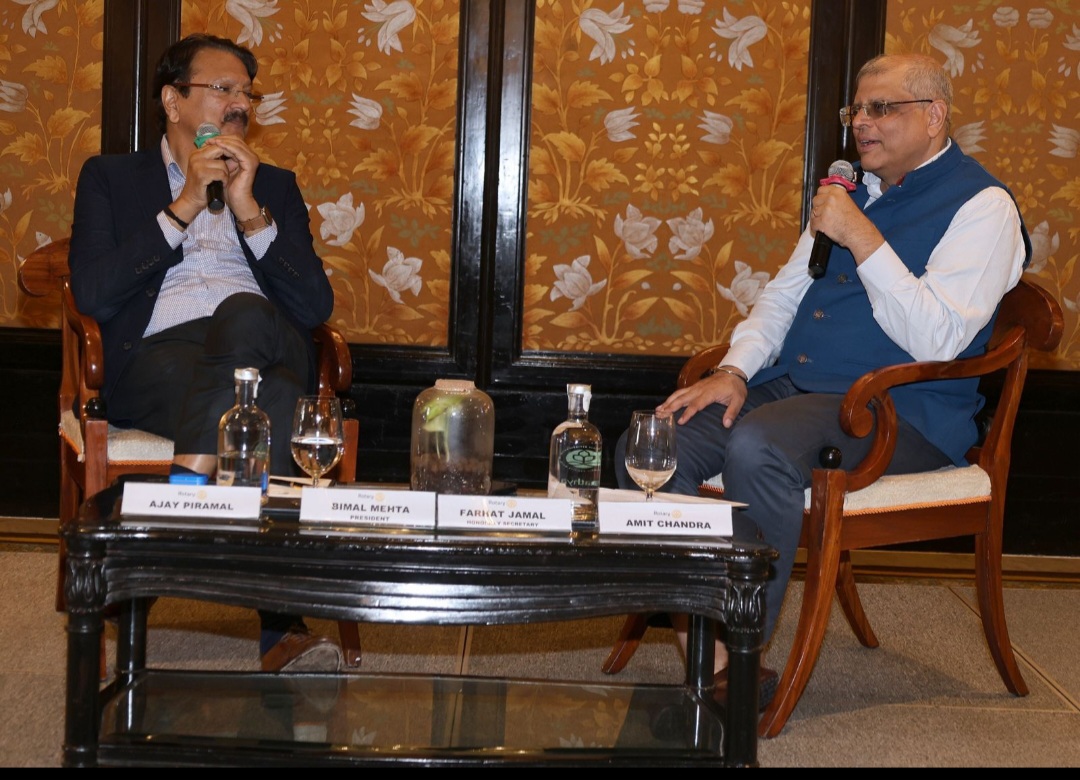
Hon. Rtn. Ajay Piramal, Chairman, Piramal Enterprises, in conversation with Amit Chandra, Chairperson, Bain Capital India Advisories,
Hon. Rtn. Ajay Piramal, Chairman, Piramal Enterprises, in conversation with Amit Chandra, Chairperson, Bain Capital India Advisories, on profit, purpose, and can making wealth coexist with spirituality?
Amit Chandra:
It’s truly a wonderful privilege to interview my friend, who’s been not just a friend for longer than I’ve known Archana, actually, but also an inspiration and a partner in a journey we’ve travelled together for 32 years. I’ve learned a lot from him, and I hope in the conversation today we can unlock some of these learnings for the benefit of the audience.
I’m going to start with a personal example because topics like this can get very esoteric and theoretical. Nandan did a great job with a personal anecdote, so I’ll follow suit.
Everyone knows Ajay’s incredible accomplishments. I remember being in complete awe of him the first time I met him at our family residence in Boston — I think the year was 1992. I just sat across from him; I couldn’t speak because I was in complete awe of this man. I came back to India, and he was on the board of the company I joined. He was this remarkable dealmaker.
Everyone’s known about his accomplishments in financial services sector and, before that, in pharmaceuticals. But what people don’t really know about is something I’m going to talk about now. I’ve seen a lot of leaders approach their 60s and 70s and focus on making the next billion, spending time with grandchildren, or travelling the world and enjoying life.
But I’ve had a ringside view of seeing Ajay do something very different. He’s been working on a project — probably the best-kept secret — to uplift 50 million Indians from abject poverty. Just soak in that number: 50 million. If they were ranked, they’d be the 30th largest country in the world. That’s equivalent to the population of 20 Indian states combined. To attempt this is not trivial.
He’s put together an army of 5,000 field workers. He’s stitching together an alliance of global and Indian leaders to work on this. I won’t go into all the steps involved, but I can tell you it gives him a lot of sleepless nights. He’s had to put aside his ego and bring back his convincing powers to get governments, leaders, and individuals to work together to make it happen.
To me, this is probably one of the best examples of ‘profit with purpose.’ So, I want to begin by asking Ajay: why are you doing this?
Ajay Piramal:
First of all, let me congratulate President Bimal and First Lady Aradhana for taking over as President of my Club. It’s a big honour — so congratulations and all the best.
Amit is a really good friend. More importantly, I’ve learned a lot from him — his commitment to doing good, his positive energy. He’s a truly great partner.
You asked why I do this. I want to take an example from nature — it gives us air, water, and food for free. We realised the importance of air, oxygen during COVID. Even if you were the richest person, with billions, you’d still be gasping for breath and using all your influence just to get a supply of oxygen.
Is there something to learn from that? Yes — it’s that we take for granted the things given to us freely. So, are we only going to be takers in this world, or are we going to give back?
That’s what every religion tells us — we must give back. The philosophy is simple: when we are born, we cannot be only consumers. Can we leave the world a slightly better place than it was when we came into it? That, I believe, is the only reason I do this.
Amit Chandra:
Yeah, but Ajay, it’s not easy to do what you’re doing. You’re literally building a new Piramal organisation with no profit motive. The conversations are difficult — you’re asking people to align with your values; that often results in rejection. Sometimes, people just string you along. It requires aligning so many people. This is tough work. What keeps you going? I mean — why do this at this age?
Ajay Piramal:
I take inspiration from my grandfather. He was born in a village in Rajasthan in the 1920s. He came to Mumbai with just ₹50 in his pocket. And before he made any significant fortune, the first thing he did was go back to his village and open a school.
Remember, this was pre-Independence, and Rajasthan was quite conservative. The first school he opened was for girls. The second was for people then called “Harijan” — today known as Dalits. That’s the legacy I come from. I’ve been fortunate to be born in a home that believes in giving back — just like your parents taught you.
So, why do I do it? Frankly, true happiness comes when you give. I’ve raised money in the good old days, as you know, and now I tell my team that I’ve become their salesman. But let me tell you, even the people you’ve connected me with — Amit is a partner in this crime, if I may say — have responded positively. I’ve not yet had a negative response. Maybe it’s out of respect for age, or maybe they genuinely want to help. But I truly believe most people want to do something positive.
Amit Chandra:
That’s wonderful. Maybe I want to shift gears a little bit. We are a deeply religious society, right? And you talked about the influence of religion as well. I follow Sikhism. I know you’ve read part of the Granth Sahib, as have I, and the most important prayer in the Guru Granth Sahib is exactly what you opened with — Pavan Guru Pani Pita, Mata Dharat Mahat, which means that unless we respect the elements of nature, we are actually destined to be consigned to dust.
How has religion influenced your spirituality?
Ajay Piramal:
I just want to make a little bit of a distinction here. Many people nowadays tell me, “I’m not religious, but I’m very spiritual.” I don’t understand what that means. I think it’s the same thing. Spirituality or religion — whatever you call it — the concepts are the same. These are principles you try and apply in life.
For example, I’ve been studying The Gita for more than 25 years. The opening of The Gita is in a battlefield. Krishna is Arjun’s teacher and best friend. Arjun is the best warrior in the world, and he is in his 20s. In the midst of the battlefield, this lesson of The Gita is taught. It is so relevant — that means it’s relevant for young people, for people who are stressed, and in the most challenging situations.
There’s a lot of learning there. In some ways, some of the principles are universal. Whether you talk about The Gita or the Granth Sahib, which has maybe 5,000 references to Krishna and Ram, some of us don’t like to acknowledge this. These are the extremists — not you, Amit, let me clarify. So, I think these principles are very basic, and they help life. They help negotiate the challenges all of us go through. That’s why they’re important.
Amit Chandra:
Picking up from that, Ajay — I think some of us old-timers in the room, people who’ve known you from your very early days — people don’t really realise and appreciate what you started with and where you took it. And people also think that that line was linear, which we know it wasn’t. There were lots of ups and downs.
Help us understand: how did your religious or spiritual bearings help you deal with some of those ups and downs? And maybe, if you could give us some instances of it.
Ajay Piramal:
I believe there is not a single person in the world who does not go through ups and downs. I’ll just give you an example from the Ramayan. The Lord is born — the Lord has chosen to come, it’s not that He is just born.
In Ram’s life, was there no stress? He was banished. His wife was kidnapped. Why did He go through all this? These are all lessons for us — that every life has to go through challenges.
In my life, too, I had challenges: my father passed away when I was 24. In 30 seconds, my eldest brother who was succeeding him passed away at the age of 33. He got cancer. My mill was on strike, etc., whatever it is. I went through that. But there is one prayer I want to share with you:
“Oh God, give me the serenity to accept
the things I cannot change,
The courage to change the things I can,
And the wisdom to know the difference.”
I think that is the basis of anyone having equanimity. There are some things you can’t change. The important thing is to act during those periods and see how you can overcome something. Something happens — you can keep blaming the world, but that doesn’t change anything. And sometimes I feel — actually, my son Anand also tells me — that when you go through crises while you’re young, it helps you face life ahead much better, because then nothing seems more difficult than what you’ve already faced.
So, if I look at every challenge in life, there is often an opportunity. Let me give you an example. When you travel in a plane, especially during monsoons, sometimes it’s really rough, and there’s a lot of turbulence. Some passengers are sweating away, doing their malas, doing everything possible.
There are others — like Amit — still having their wine and food.
Amit Chandra:
I don’t drink wine. But yes, you have your food for sure.
Ajay Piramal:
Actually, it’s not wine — because he’s always talking to the person next to him, provided she’s one of those friends of his! Whatever the point — the environment around you is the same. It’s how you react to it that makes the difference. It’s not that in a difficult time you’re not scared. It’s not that you’re not in pain. It’s not that you’re not worried about the future. Everybody goes through that. But how do you deal with it? If one is balanced, then actually you can see opportunities. So, coming to an example:
Had it been a normal life in the textile industry for us, believe me, I would not have gone into pharmaceuticals. It was the crisis that led us into pharmaceuticals, and then things changed. So, like this, there are several such examples.
Amit Chandra:
You talked about environment, and I remember the first time I walked into your office at Peninsula Corporate Park — it is the most remarkable office in Mumbai. People can spend as much money as they want, but they can’t create the vibe that office has. The ambience — I’m not trying to flatter you — but it is truly unique. It calms you down the moment you get out of the lift. Whether it’s the choice of paintings, the names of the rooms, the artefacts kept there — like the shivling, and so many other things — it just has this vibe and this energy. Something similar you’ve done in Karuna Sindhu as well. And I’m not giving you the credit for this — I know this is all Swati. But give us a sense of how environment interplays with mood, spirituality. What’s the philosophy behind that?
Ajay Piramal:
Environment does play an important role. There are some places you go where you can feel the vibration is positive — it’s more of a feeling. There are certain temples, certain churches — I’m being really uniform here — where you get that vibe. That’s because so many good thoughts have been offered there, so many people have come and prayed over years.
Similarly, I think an office is also, in some ways, a place for doing your duty — your right duty. It should have that kind of vibe. We actually got a really good sculptor — he later became the Chair of the NGMA. We gave him some verses of The Gita that were close to us, which conveyed the values we believe our business should have — and he interpreted them.
Whether the vibe is good or not — I personally feel it is, and many good-thinking people like you say that too, so that makes a difference. But trying to live what you read or what you’ve been taught on a day-to-day basis — that is the foundation of that.
Amit Chandra:
Ajay, before the CSR bill came in and made giving mandatory for people, everyone thought, “Okay, now we are going to do some good with the work we do.” But you had this philosophy already—of doing well and doing good. I remember it struck me when I joined the board of the company that there was a phrase like that, and it was discussed often in board meetings while evaluating decisions. What was the genesis of that, and do you think it came at a cost to growing the business?
Ajay Piramal:
So first, I’ll give the genesis. Later, let me say it never comes at the cost of doing business. According to me, if you have a value-based business—which I mean by doing well and doing good—it actually creates more economic value than anything else you do.
You’ve been an investor. Please tell me how much importance do you give to the company you’re investing in, or the individual behind it? Would you give a disproportionate multiple? We’ve seen it all our lives. Without exaggeration—everyone calls us an M&A-driven group—I can say every M&A that we’ve done, we’ve paid less than what the competing person has offered in an open bidding process. And yet we’ve got it. In fact, there have been some cases where the seller was asked, “Why did you sell cheap?”
Similarly, every transaction where we’ve sold something, we’ve got more than what anybody else got. So I want to abolish this myth that by doing good, you actually lose.
Why did we do this? I believe business should be a force for good. It is business that has changed the lives of everybody. But you have to perform well because profit is the oxygen for a business. It is not the purpose, but it is the oxygen. Without profit, what will you do? You can’t even do good. So, you have to do well—and it should be in the positive sense. That’s what I mean.
Similarly, for any philanthropic activity, of course, it has to be good, but we also have to measure that it does well. Whether that’s in parameters of performance or in delivering the impact you want it to deliver.
Amit Chandra:
It’s interesting you said that because that was Jamshedji Tata’s philosophy as well. Both of us have been board members of Tata. Since you’re still serving, you’ll remember that’s exactly the philosophy on which the group was built.
One of the wonderful things you do at Karuna Sindhu is you open the warmth of your home to invite your extended family to hear really inspirational leaders speak about their views on spirituality—and often other topics as well. As a consequence, many of us have heard some truly wonderful people. Is there one particular leader or teacher who has touched or inspired you—and why?
Ajay Piramal:
Actually, a lot of people have inspired me. It’s said in the Gita and in all scriptures that association with good people is absolutely one of the key things in life—because all of us go through what you might call a slippery slope. And that’s where these good teachers come in.
Our family guru—my mother’s guru—is Radhanath Swami, from ISKCON. In addition to that, even books are your friends. What I’ve learned from the Gita is immeasurable. And what you read from other people’s lives—whether it’s Swami Vivekananda, Ramakrishna, and so many others—you learn from all of them.
Closer to home, from the Chinmaya Mission, Swami Swatmananda ji has been teaching us for the last 25 years. So it’s that continuous interaction that helps. I don’t have a great memory—I need repetition. People need to repeat things to me, and then it gets absorbed.
And then I believe it’s worth sharing. This is priceless knowledge, which many of us seem to forget. We think, “We’ll do it when we are 60 or 70,” but who’s the timekeeper? That’s not the case. You have to do it on a daily basis.
Amit Chandra:
Wonderful. In fact, I would encourage those of you who are interested in this topic and who like to read to explore Radhanath Swami Maharaj’s book My Journey Home. It’s truly a…
Ajay, it’s been—as always—a privilege. In 32 years, I’ve done a panel discussion with you only two times. This is the second one. But it’s been truly an honour and a privilege talking to you. I always come away learning things from our conversations, and you often don’t realise that.
Thank you so much for being such a wonderful person to talk to. I’m very grateful for that.
ROTARIANS ASK
Both of you have very large minds, but even larger hearts. My question to both of you is: How can the system align both profit and purpose? You’re doing it on your own, Amit, and so is Ajay. But as a system, that isn’t happening. Would you like to comment?
Ajay Piramal:
No, but it is happening. All the time. Look at Rotary. People can contribute in different ways—it depends on how you contribute. I think one must contribute both time and money, depending on what you can offer.
You can do that through Rotary. Some of us want to initiate our own efforts. Amit does a lot of work on that, as do we. So yes, both are possible.
Amit Chandra:
I completely agree with you. I think the system is us. At the end of it, there’s no other system. As they say, at the end of the day, if we apply our minds with the same determination to purpose as we do to profit, everything is possible—whether it’s alignment or execution.
If by “system” you mean the government, look, the government is also in the business of solving problems. The scale at which Ajay’s work is happening is mainly because he’s trying to get governments to become more efficient. The work that Archana and I do in the area of water and agriculture can only happen if governments work better. And for all of this, you just need patience, perseverance, and commitment over long periods of time. I don’t feel that this is impossible—I think it’s very much possible. And when you achieve it, you see great change over time.
Ajay Piramal:
I want to add one thing. Sometimes there’s a misconception I want to clear—especially around working with government. Based on Amit’s and our experiences working for 20 years with government, regardless of who’s in power, I believe most people in government genuinely want to do good. If we can work with them in parallel, let me tell you—the government spends 20 times the amount of money you can on those projects. But you have to do it in parallel, and you have to show them the impact. For that, you need to work at scale. If you can demonstrate impact at scale, I can guarantee you—based on over 25 years of experience—that you can make a difference.
Amit Chandra:
I’ll make one more point because forums like this are about learning from each other, through both successes and failures. For a long time, my work was quite insular—I tried to influence only what I could and didn’t really partner with governments. I remember a distinct conversation I had with Ajay and Aditya, who used to run one of his key programmes and now leads the foundation. Ajay basically told me, “If you’re not doing work at scale and working with the government, you’re not doing serious work.”
That actually hurt my ego quite a bit, but I thought long and hard about what he said. It caused a major pivot in the work we did. And now, almost everything we do is in partnership with various governments.
Thank you very much for an absolutely delightful afternoon, Ajay and Amit. This is the first time I made sure my daughter attended a Rotary talk, and I hope she has learned a lot. My question is for you, Amit, if I may. I’ve been observing you for a long time. In fact, in 2012—I’m not sure if you remember—you supported Jaydeep and me when we were raising money for St. Jude’s and did a cycle ride to Mumbai–Pune. At such a young age and early point in your career, you’ve gone—if I may say so—way above and beyond in terms of the charity and work you’ve done. I know we’re in a room full of Rotarians and everyone is doing good, but what’s your driving force? Was there a particular event or moment that led you to go above and beyond what’s typically expected?
Amit Chandra:
Thanks, Ashish. I don’t think what Archana and I have done is above and beyond. I think it’s what anyone can and should do, first of all.
We’re just very fortunate. As Ajay put it, we began early on because of who our inspirations were—whether from family, spiritual influences, or people around us. We started giving small amounts of money the month we got married. We didn’t even have a roof over our heads—we were staying in a paying guest house on Altamont Road. But we decided we’d start writing scholarships that month. For us, giving began very early, and it grew as we progressed professionally.
Archana managed to pivot to the social sector full-time before I did, and that helped us understand the power of change. As Ajay said, there’s really no difference between religion and spiritual philosophy. For me, the teachings of Guru Nanak had a big influence. Two books also changed everything: The Chronicles of Jamshedji Tata and the biography of Chuck Feeney.
About 20 years ago, Archana and I decided to determine how much money we needed to maintain a comfortable lifestyle—and beyond that, everything else would go towards causes we cared about. Around that time, we started building Bain Capital, which turned out to be a far better business than investment banking. So maybe there’s a higher power who conspired with the ideas we had.
We were able to increase our giving. Archana led with time before I did. Eventually, I moved to the chair role at the firm I started, and now I spend half my time in the social sector while she spends all of hers there.
But truthfully, we’ve been selfish—we’re solving for our own happiness. I tell people all the time: do what makes you happy. If you get joy out of making your next billion, go ahead—there’s nothing wrong with that. For us, we’ve been lucky. I enjoy travelling through rural India and seeing how farmers’ lives can be transformed. Archana loves working with intellectually disabled children. We’ve built a hospital with Ajay, a couple of universities—and seeing patients recover, or students graduate, is what gives us joy.
Everyone should do what fulfils them. We’ve just been fortunate to know what gives us purpose, and we’ve been following that path for 25 years.
So, it’s not above and beyond — I think it’s what each person needs to do for themselves to feel happy.
Yeah, hi. Thanks for the inspirational stuff. Sorry to bring you down to a slightly cruder level, but some of the American philanthropy from real billionaires there really takes your breath away — Warren Buffett, Bill Gates, etc. And I think, by those standards, we are still relatively stingy so far, at least. Especially when you see, as society becomes more and more unequal — you’ve got 800 million people living on subsidised food and, at the same time, apartments going at ₹2,00,000 per square foot.
How much do you think this is due to the inheritance tax laws in the West, especially the US, as opposed to not having them here? And — I know it’s controversial — but if, for example, the government intervened and forcibly took away some of those billions and put them into useful efforts, would that make us more generous?
The government in India spends much more money on social issues than any private philanthropy does. To my knowledge, the total philanthropy, the total annual CSR contribution is about ₹30,000 crores.
The amount spent by the government on food, health, and education is about $200 billion. 97% of social spending is by the government. Only 3% is philanthropy.
So that’s the difference. I think, rather than worry about what everybody else is doing, why don’t we look at ourselves? Can we do more? Are we doing more? That’s enough. Otherwise, to say someone does more or less… and frankly, in the US, Bill Gates is a different person. Warren Buffett, partly. But the fact is, everybody who has signed the Giving Pledge — and given funds — has given it to asset managers. And the only role of the asset manager is to maximise returns on that capital and collect their fees. They don’t even spend as much as the annual return in philanthropy — it’s just parked. The annual contribution by US philanthropists in actual philanthropic work is less than the interest they get on the invested capital.
Amit Chandra:
I would add to what Ajay said. I completely agree. I don’t think you can legislate your way to solving the issue you brought up. You’ll have capital flight. A great example is the UK — despite being much smaller than us, the moment you have draconian tax changes, many wealthy people simply flee the country.
At the end of the day, this has to be a change in heart, not just a change in regulation. It may feel frustrating, but it will take time. When it does happen, you’ll get to a tipping point and start seeing greater change in society.
But I agree with Ajay — it’s not just about billionaires. There are lots of interesting examples of change. Archana and I are signatories to something called Living My Promise, where 170 Indians — with modest assets, not billionaires — have signed the Indian version of the Giving Pledge. Some of them are government teachers, IRS officers, professionals — with assets ranging from a couple of crores to ₹500 crores.
So, change is happening. It’s not that there’s no change. And we don’t have to expect only the billionaires to give. Each one of us can do something.
First, I’ve been quite touched by what both of you have said — your observations, and especially your reference to spirituality and our culture. But I just want to make an observation, which I’m sure everyone will share, and invite your views.
There’s a cynical saying in society — especially among those who are well-placed — that every person has a price. I’m saying this in the context of the judiciary — I’m a lawyer — and I’ve heard this said time and again, irrespective of who the judicial officer is: everyone has a price. I just want to say I completely disagree. We’ve had the best results without anything underhanded being done. In fact, our culture is so deep, and so values-driven, that sometimes you’ll find the lowest judicial officer — maybe a mamledaar, in some far-flung part of the country — for whom all the money in the world cannot sway them. Ajay, do you share this view? And is there a way to educate people that, if you touch the right sentiment, you will get the right response from a person? That money is not the be-all and end-all?
Ajay Piramal:
I 100% agree with you, Harish. That’s why I always say — 99% of government officials we work with, whether it’s a secretary or a block officer at the lowest level — they want to do good.
Sometimes, it’s just easy cocktail-party gossip to be critical or cynical. Yes, there are some bad examples — and someone will always say, “This instance, that instance.” But among 140 crore people, there will be a few like that. I believe one has to look at everything positively. I believe the glass is always half full, not half empty. You can always find something to criticise — but you can also find things that are good.