
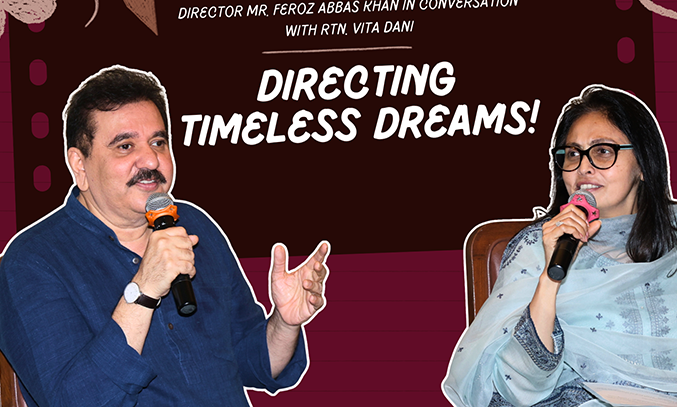
Indian theatre and film director Mr. Feroz Abbas Khan in conversation with Rtn. Vita Dani on directing timeless dreams!
Rtn. Vita Dani: Good afternoon, everyone. Our guest today is a man whose stories have made us laugh, think, and reflect — sometimes all three at the same time. Of course, you’ve heard enough about ‘Gandhi, My Father’, ‘Tumhari Amrita’, ‘Dekh Tamasha Dekh’, and ‘From Nation to Civilization’ — I can go on and on. But today is not about anything else but him and his work. Feroz has agreed to come here, which he never does, so thank you, Feroz, for this special appearance. It’s such a pleasure to have you here. You’ve told so many stories about the heart of India, and we’d love to hear more about the story of the storyteller.
So, let’s start with your personal journey. You set out to go to Germany for further studies — what happened?
Actually, honestly, this is the first time I’m doing something like this because it’s rather narcissistic and very self-centred to talk about yourself. So I would, with due respect, not talk about myself but about the work that perhaps I have done. Because when you do your work, that’s something that instructs you in life — you get from your work, and the work gets from you.
My journey, to put it briefly: I would have been an accountant. I had graduated from Narsee Monjee College and was going to do my CA. I did two years of articleship and handled public issues as well. That was the life chosen for me.
However, somewhere along the line, I must thank Mrs. Jennifer Kapoor. I met her at Prithvi Theatre when it was just coming up. I started as an actor, and some of the productions caught her attention. She said I should be doing more work in theatre. That’s when I abandoned everything and took a journey into completely uncharted territory.
When family members asked what I did, and I said “Theatre”, they would say, “That’s fine, but what else?” Because saying you do theatre is unacceptable in our society — they see poverty, destitution, irresponsibility. But after graduation, I tried to become a chartered accountant, dropped out, wanted to go to the USA to do an MBA — that also failed. Prithvi Theatre was just coming up, so I got very involved with it.
I became the first festival director; Jennifer and I started the Prithvi Theatre Festival. In between, I worked for a corporate house and handled two huge public issues because I needed to make some money. Then I abandoned everything and joined Prithvi Theatre fully. After the first festival, we learnt that Jennifer was suffering from terminal cancer. The family felt I should take care of the theatre, so one thing led to another — I became the artistic head of Prithvi Theatre.
Those were heavy days. Eventually, I had to choose between making a lot of money and being happy. I decided that if I could just make enough to live comfortably, I would pursue my passion. My first major production — actually the third play, but the one that changed everything — was Tumhari Amrita with Shabana Azmi and Farooq Shaikh.
It had a terrible beginning. During the technical rehearsal, eight out of ten people went to sleep. I thought it would be a huge disaster. Only Javed Akhtar said otherwise, that it was bad today, but would be great during the show, and that brought some comfort. Then Tumhari Amrita became history. That’s when I decided to become a full-time director.
Talking about working with legends, Anupam Kher, Shabana Azmi, Farooq Shaikh, Naseeruddin Shah and so many others, what’s the secret to bringing out the best in performers who already have such rich legacies? How do you do it so effortlessly?
Most of the big names you mentioned, Naseeruddin Shah, Anupam Kher, Shabana Azmi, Farooq Shaikh, Satish Kaushik, Seema Biswas, Boman Irani, and many others, were fundamentally theatre people. My rule with them was clear: when you come to rehearsals, you enter as actors. The star persona must be left outside.
Theatre cannot work without discipline. You have to be on time, rehearse, and work long hours. If you bring the ego of a star, it won’t work. A star comes with paraphernalia — assistants, support staff. I said there would be none of that. They would work as they did when they first came to theatre.
They were paid for their market value, but in rehearsals they were actors. If they ever slipped, I reminded them. My aim was to create a performance they had not given before. I pushed them. When you’re very famous, everyone praises you, and you stop getting a reality check. The actor diminishes because they lose insecurity — and an actor must embrace insecurity and uncertainty. If you feel you know everything, that’s the beginning of the end.
So, I pushed even the best actors to a place they had not gone before. That’s where the best work comes from.
Let me share something that happened around 2008. We were about to see ‘Gandhi, My Father’ before its release, as critics. We watched it at about 1:00 in the morning and asked Feroz if he would do another screening for our friends a few days later. Much to my delight, he said, “Of course”. That is his humility. But talking about ‘Gandhi, My Father’ — it gives such a powerful human portrait of not only Gandhiji but also his son. What drew you to that emotional core? And did it change how you personally looked at family, ambition, forgiveness, or the messages of Gandhiji?
Before ‘Gandhi, My Father’ the film, some of you know I had done a play called Mahatma vs Gandhi. So I was familiar with the terrain. I had travelled a lot in South Africa, where Gandhi is still very alive. We pay a lot of lip service here, but abroad, especially in South Africa, there is extraordinary reverence. Nelson Mandela famously said, “You gave us a barrister, and we gave you a Mahatma.”
Some of the things Gandhi did in South Africa were extraordinary. I met people close to Mandela and people who continue Gandhi’s legacy there. The play came about when I met members of the Gandhi family and others. With Gandhi, the problem is that there is either hagiography or undiluted hatred. We are ideologically skewed — Gandhi is seen as either flawless or entirely flawed. The truth lies somewhere in between.
Gandhi was not Gandhi from day one. If you watch David Attenborough’s film, you see a great man from the beginning. But great men evolve. He was an ordinary person. He was, in fact, a very bad lawyer when he came to Bombay. He went to South Africa not even as a practising lawyer but as a translator for a Gujarati family dispute.
In South Africa, he saw apartheid. He himself, being from a then-British colony, was not treated as badly as the African population. But as he saw discrimination, he kept improvising himself. Gandhi became Gandhi through a process. Many things he said or did can be controversial or unpalatable, but you must look at him holistically. All the tools of protest he used in India were first experimented with in South Africa.
His family life, however, was troubled. His relationship with his first son was very difficult. He was only 18 when he became a father. There is a very interesting Gujarati biography of Harilal Gandhi, Gandhi Ek Dukhadatma (English version titled “Mahatma Vs Gandhi).
It was important for me to know what happened to Gandhi. I wanted to humanise Gandhi — make him real and accessible — without damaging the idea of Gandhi. The heart of ‘Gandhi, My Father’ is the conflict between a parent’s values and a child’s aspirations. Gandhi was a loving father, but when his values were challenged, he stood firm.
I wasn’t making a museum piece. I was telling a contemporary story. Because standing up for your values is very difficult. Lecturing others is easy; but living your values — that’s where Gandhi was different from others.
You’ve spent decades creating stories that touch everyone’s hearts, from ‘Gandhi, My Father’ to ‘Mughal-E-Azam’. What is it about theatre — the magic of theatre — that keeps you coming back? Even after exploring films, why do you keep returning to the medium of theatre?
The first thing about theatre is the power and freedom of doing it with nothing. That freedom you cannot get in any other medium. If you’re doing a film or television or anything else, you need money, you need resources, and there is always somebody else pulling the strings.
The freedom you get from theatre is that I have done plays with no money at all. I can have two or three people onstage, and without any resources I can create a theatrical experience anywhere. If you see Tumhari Amrita, there were only two tables and two chairs — there was really nothing.
In fact, there is a play before that, which some of you may know: a musical called Khelaiya. It was the first musical, and we had no money, yet we pulled it off. And that power — the ability to tell stories with complete freedom and without restrictions — is something you cannot get anywhere else.
The other thing is thematic exploration . In theatre, you can explore three or four very important themes with very little resources and still give a powerful experience to an audience.
This is why I keep coming back to theatre. Theatre, in many ways, is my calling. Of course, in between I do films that I feel are right, but if you ask me where I reside — that is theatre. That is my abode, the place I keep returning to.
And let me tell you one thing: there is nothing like a live experience. Today, the biggest star can be in your pocket, but you cannot do that to a theatre person. You have to go and watch that play at an appointed time. You cannot put a theatre experience in your pocket.
As we move into a world where technology increasingly takes over our lives — now we are talking about AI and so on — human beings still want to see human beings. We could have had this meeting on Zoom, but it would not be the same. Human beings are social animals; they need to experience real human beings.
And when you’re participating in a live story with real people, there is nothing like theatre. As far as I’m concerned, I could drop everything and just do theatre.
You have turned cinema into a spectacle. If we talk about ‘Mughal-E-Azam’, it was not a musical originally, but I’m sure all of you will agree, it became a phenomenon. It revived a classic, yet felt so new. How do you take something iconic and make it feel fresh without losing its soul? It was a very rich and powerful film — not an easy conversion. How did you do it?
There is a bit of history to this. We used to watch plays on Broadway and were mesmerised by what we saw. But we felt we could never do something like that in India. We felt it was impossible. We had the stories, we had the audiences — so why were our productions not matching international standards?
It became a great ambition to create something that would set a new benchmark for Indian theatre. This was always at the back of my mind.
Years later, we were performing Tumhari Amrita in Hyderabad. At that time, ‘Mughal-E-Azam’ had been re-released in colour, so we went to watch it. After watching it, I realised the film actually has a theatrical structure. I researched and found out that the original ‘Mughal-E-Azam’ was based on a play called Anarkali.
So I felt that if anything could be done on a grand scale in India, it was this. A good musical needs great setup, great conflict, great music, great performances, and most importantly, a great script. ‘Mughal-E-Azam’ had all the ingredients for a theatrical experience.
At the heart of it was the desire to create something as big as ‘Mughal-E-Azam’, and also to create something India could be proud of — a production that could stand alongside international shows.
But let me tell you: that was the easy part. The tough part was that ‘Mughal-E-Azam’ carries people’s memories. The film gave a whole generation the vocabulary of love. You had Dilip Kumar, Madhubala, Prithviraj Kapoor — how could I get them?
People told me this was professional hara-kiri. You don’t tamper with classics; people get rattled when their memories are disturbed. Many thought it was going to be a disaster. I also decided it had to be a live musical — not pre-recorded voices. So, I chose people who were right for the parts.
Three days before the show, everything went wrong. In my entire career, that was the closest I came to an emotional breakdown. I thought, how will I face the audience? How will I face K. Asif? This production was a tribute to that great man. Even now, I still shiver thinking about that night.
We redid things, we corrected what we had to, and eventually it became what it became. It wasn’t meant to make money. The idea was to make something extraordinary and special. That is what drove us. And of course, I had Shapoorji Pallonji who owned the film, and the NCPA backing me. We needed resources, and at the time, there was only one venue — Jamshed Bhabha Theatre.
‘Mughal-E-Azam’ was never planned as a long-running show or a money-maker. By all accounts it was — and still is — perhaps the most expensive theatre production in India. Later, ‘Civilization to Nation’ became even bigger.
We never compromised on the production. Even when we went to the US — about 14 or 15 cities — the production remained exactly as it was in Mumbai or Delhi. We performed at some of the best theatres, including the Lincoln Center. And ‘Mughal-E-Azam’ makes India very proud. That makes me very happy.
When ‘Mughal-E-Azam’ came, we said this is the superlative. And then you came up with ‘Civilization to Nation’. What inspired you to make ‘Civilization to Nation’? And with NMACC now, where it debuted, you have surpassed every expectation. What happened on this journey?
Civilization to Nation also has a small history. Mukeshbhai and Nita Ambani met me and said they were creating this centre. While it was being built, I was consulted, mostly for the smaller theatre, which is closer to my heart.
There was always this dream in the making. When the idea emerged to open the place — remember, it was meant to open before COVID — Mukeshbhai said we should create something that traces our history. I thought perhaps it would be another production, but then we had a date to open. And this is where it all started: conversations with Mukeshbhai and Nita.
Nita insisted we must do something very Indian. At that time, we had the option of doing The Lion King or something similar. But that would be like event management — you have the money, you have the theatre, get someone and do it. We needed to create our own. Something that raises the bar internationally. And that had to be Civilization to Nation.
Let me tell you something: I have travelled all over the world. You can count on your fingers the best theatres globally — and the Grand Theatre at NMACC is one of them. The facilities are outstanding, which is why top world productions perform there and are amazed.
I was involved from the beginning, so I know the generosity with which the family has given India this theatre and this centre. Remember: a country may have the best GDP or profit margins, but the world respects you for your culture. That is what this place represents.
The two smaller theatres are extraordinary. The work happening there is stellar. The vision, commitment, and generosity of Mukeshbhai and Nita are truly special.
Today, you are restricted only by your imagination. You can do anything in that theatre.
When Nita said we should do something Indian, I thought: in India, everything we do begins with divine blessings. We are the only civilisation like that. Other cultures often have a tense relationship with art because they fear it interferes with religion. In India, art is an expression of religion.
We celebrate art, diversity, new ideas. We do not impose. We listen. And eventually, we say all paths lead to the same truth. Every time we do a play, we dedicate it to Lord Ganesh. We take his blessings.
So the idea was to trace the journey from the first Om — the first sound — from which came the word, the Vedas, the Upanishads, then the Mahabharata, the Ramayana, and the journey through dance, music, and theatre.
This civilisation eventually expressed itself in our Constitution. The Constitution may have been informed by influences around the world, but at heart, it is deeply Indian — a continuation of our civilisational ideas. That is what we encapsulated in Civilization to Nation in 90 minutes. When I said this, people thought I was joking or out of my mind. But we eventually did it in 85 minutes.
We were supposed to go to the Lincoln Center. As Nita will tell you, we were sold out in one week, with tickets at $1,500. And remember — it is pure Indian culture. No Bollywood. No stars. Just India and Indian culture. The world over, India’s influence has always been its culture, literature, music, and art. That resonates very strongly. Civilization to Nation is a tribute to that civilisation.
People told me not to do it without Bollywood or stars. But I completely disagree. If the work is good, you don’t need any support. If you rely on star power, the star becomes bigger than the content — and I have always avoided that. So, the idea was Nita and Mukeshbhai’s. I simply realised their vision.
After the grandeur of Civilization to Nation, what’s next? What’s next?
Sometimes, what happens is that nothing feels like success as far as I’m concerned. I’m very uncomfortable with success because the moment you start becoming successful with what you do, you start repeating yourself. Because then you’re chasing success. So you may grow in success, but if your journey is to create something better, or something very different, then you have to go back to the same uncertainty.
The uncertainty principle — the idea is that if I do work which I know how to do, then I should not do it. But if I see that I don’t know how to do it, but I will try to do it as I go along, that is when perhaps something new will happen. So I did two productions, very small. One was a very small production called ‘Letters of Suresh’, a very beautiful play, something very close to my heart. And then I did an a play called ‘Hind – The 1950s’, an adaptation of an American classic called ‘Fences’. And perhaps of all the work that I’ve done, it is one of my very, very favourite works. It’s highly contemporary in its exploration, and at the same time, it’s got some fabulous performances. So I’ve done those two things.
And there is a very interesting original play that we’ve got written. Actually, there are many things that I want to do now. But I don’t have any plans to do very huge or big productions. More intimate, more powerful, more drama, less spectacle, and more content — that’s where I’m going.
Some of your works haven’t shied away from difficult or controversial topics, if I may say so. How do you stay true to your voice, even when there’s pressure — be it social, political, or any other?
I have actually not shied away from it at all. If you speak the truth… There’s a film of mine called ‘Dekh Tamasha Dekh’. It’s a highly political film, based on a true incident. There was a man who died and there was a fight over his body, whether he was a Hindu or a Muslim. It’s almost akin to what happened to Kabir. So I never shy away from that.
‘1957’ is about a poet, a freedom fighter. After Independence, he is actually charged with being an enemy of the country, that he’s a spy of Pakistan. And a man has to prove his own loyalty to this country.
The thing is, what I have seen is that if you are honest and if you don’t have an agenda, there is no problem. It’s only when you carry an agenda, and when people see that you really have something that is not true and you’re trying to follow a certain kind of thought, or you want to propagate something. ‘Civilization to Nation’, we have even Pandit Nehru giving a long speech, which in today’s time would be frowned upon because we are trying to rewrite history in many, many ways. But that’s the truth.
So, honestly speaking, I have never feared. The only reason is because I am speaking the truth. The day I don’t do that, then, I should fear.
ROTARIANS ASK
Are you planning to have either of these two big extravaganzas again?
Yes. Yes, it is. ‘Civilization to Nation’ is going to be back in Bombay, in Mumbai. We don’t know the dates right now, but it will be back, and I think after that it will travel again. We are committed to going back to New York, to Lincoln Center.
‘Mughal-e-Azam’ is happening in January, from the 9th at NMACC — from the 9th to the 26th. So if you’ve seen it here, please see it at NMACC because the experience is fantastic. Fantastic.
I was delighted to learn that Jennifer Aunty pushed you into the theatre trade. I had the privilege of growing up with the Kapoors for 40 years as my neighbours. And to counter your statement about ‘Mughal-e-Azam’ spreading the vocabulary of love, I learned a term there. I have a friend called Kanaz, and I’ve started calling her ‘Kaniz’, and she gets really irritated.
Okay, anyway, coming to the question: I have a good friend, Rahul Da Cunha, who’s also a good friend of yours, and also Ashwin Gidwani. You may be an exception, but theatre in India is still not well supported. People producing shows are still struggling for funds. The audience — besides a blockbuster — is not willing to pay beyond a certain amount for plays. And even though people are passionate about creating plays, finances are tough. How do you change that mindset — that you’re actually seeing a live performance versus seeing something like a movie on screen that has takes and retakes? Because this is real-time. And in that sense, where do you see the solution to the problem?
This thing about funds is not new. The problem is quality. Let us be very clear: if you give quality, the audience will pay. But do not try to get subsidised for mediocrity. So, I am very clear on that. If you’re good, there will be funds; the audience will come and watch.
The thing is that you can’t impose culture on people — that it’s a cultural responsibility that I should be bored because it is cultural. That’s not on. You need to engage them. So, it needs to be of a certain quality.
So today, if it’s happening the other way — that mediocre productions are coming in and charging top dollars — that’s wrong. Because they say, “Okay, I must get more money because that’s the kind of ticket prices going on.” That’s wrong. You must raise the standard. You must give quality productions.
You tell me one quality production that has not been successful and has not made money. All of them. There was this production called Ramayan on that big stage in Bandra — it had a full audience. Today there’s another one called Rajadhiraj that is going on — it’s completely full. Of course, there’s a bit of a thing that today religion is becoming wherever we are, so there is a predilection to go and watch that kind of production also.
But yes, there is a problem. The problem of funds is not with big productions, but more than funds, we need spaces to perform. Theatre people will find money; they will dedicate themselves; they will do anything to perform — but give them spaces. And that’s why places like Prithvi Theatre, NCPA, and NMACC become very important.
Available spaces — like you give roads, bridges, coastal roads — give us theatres which are affordable and with good technical facilities, and you will see the explosion of creativity. We had only one Prithvi Theatre and see the kind of talent it produced for the country. That’s all I would say.
Excellent. Two fantastic films come to mind, like what you’ve done with ‘Mughal-e-Azam’. Have you ever thought of ‘Pakeezah’ and ‘Umrao Jaan’?
Yeah, this question comes to me even in America. Look, I’m not here to keep doing films into plays. ‘Pakeezah’ is a very peculiar film subject. It can’t be done.
Please — we cannot chase success. We have to chase what is called conviction. You chase convictions, not success. Because then you feel, “Okay, this was a successful film, so it will be a successful play.” Not at all. ‘Umrao Jaan’ hasn’t done as well as the movie has, because they have done it. I think there have been two productions of that. It doesn’t work like that.
And the excitement was to do something like ‘Mughal-e-Azam’. That’s over. I don’t think I will do a film into a play. At this point of time, I don’t have any.
So growing up, I watched a lot of Gujarati plays, and I found that the themes they picked were very different. They were not film-based; there were thrillers, family values, and family drama. So how come today there are no English plays in India that our age group can watch which have similar themes? So when we have plays for our age group, you know, we’d want more English plays, because I think a lot of people our age don’t watch Marathi, Hindi, or Gujarati plays anymore. So how come we don’t have more English plays?
You’re talking about English, which is a very peculiar problem. We have a lot of English plays that are American and British, written in Britain and written in America; two different kinds of English. They come from a typical social, political, and economic milieu. Now, it’s very different. For a long time, I watched English plays where Indians were trying to imitate Americans and the British, and they looked ridiculous, because you don’t need to do that. You can speak the language properly. So what was happening was that it became a caricature. They were doing a caricature rather than giving you the real experience of what that drama was, or what that theme was, or what those emotions were. So that was a problem.
There has been some original English writing now that’s very good. English theatre has had a good time, and at the same time it hasn’t soared like Marathi or Gujarati theatre. So I don’t know whether it’s part of the Macaulay-Putra story, [laughs] that these are people who have been brought up in a certain language, and a lot of them believed that speaking English was better than actually conveying the real feelings. That’s the kind of theatre I saw for a long time. So, in English, honestly, the kind of writing we have from India is very limited. There are just a very few writers. Unless you have original writing, but foreign writing is outstanding.
A lot of my plays are adaptations, but I take the theme, I take the story, and then completely make it very Indian. I remember there was a play — ‘It’s All Yours, Janaab’ — done by Bharat Dabholkar years ago, which was totally Indian but spoken in English. Those are the ones… today, audiences want something they can relate to and connect with. So English theatre will have to do that — write plays which can actually capture the imagination of the Indian audience, which does not want to believe that they’re watching an “English” play. It could be in the English language, but it should still be an Indian play. I think that’s where it should go.
And I think what you’re also saying is that the regional languages resonate more with our culture — Gujarati, Marathi, whatever. But my request then is: in Hindi, can you do more plays, and do more thrillers and different genres of plays, rather than sticking to films that are already made, or Broadway musicals, or whatever else is being copied? Since you said you’re not going to be doing more plays on films…
See, my problem now is that there are a lot more people who think of me as the person who did ‘Mughal-e-Azam’, and actually ‘Mughal-e-Azam’ is not, perhaps, I would say, my best work. My best work, or rather the one that I personally feel for, has always been very small. The work that has travelled more than ‘Mughal-e-Azam’ around the world is ‘Tumhari Amrita’. So those small plays are still the ones that are going to travel. And I have not done a thriller, but I have done practically everything. I’ve done relationships, I’ve done comedies, I’ve done intense plays — everything. I think I’ve explored everything except thrillers, so that I’ll continue to do.