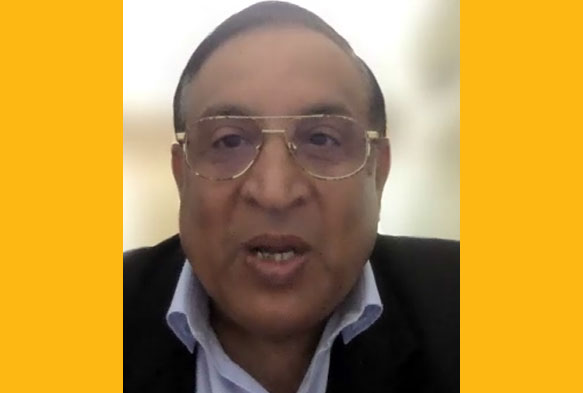
LT. General Shokin Chauhan (RETD) On What Ails The North-East And How To Integrate It With Rest Of The Country
I HAVE BEEN GUARDING INDIA’S BORDERS FOR 30 OUT OF MY 40 YEARS OF SERVICE, LOOKING AFTER THE NATION AND TRYING TO BRING PEACE IN A CONTENTIOUS LAND.
I wonder how many of you have actually visited the North-East? Most of you may have gone to Shillong, seen the beauty of Meghalaya. How many of have been to Arunachal Pradesh or Manipur, Nagaland or Mizoram? And, even if you have, how
many have ventured beyond the capitals? So, let me give you a brief idea of what ails the North- East today before I come to the North-East proper. It started in 1918 when the Naga Club was formed after World War I and the Nagas told
the British, who were then our colonial masters, that ‘once you leave India, please leave us where we are. That means
that we were not a part of any ancient kingdom, we are not a part of India, and we don’t belong to be in India. We have a different caste terms, a different lifestyle and we want to remain independent’. This further took a fillip when talk of freedom was in the air in 1946.
Once again, they said that they did not want to be a part of India. At that time, the Governor of Assam, Governor Akbar Hydari, had a nine-point agreement with the Naga groups or the Naga tribes. The basic issue in this agreement was that they would join the Union of India for a period of 10 years and after 10 years, they would be given a choice whether they want to leave or continue being a part of India. Unfortunately, after freedom, by 1948, we said that there is no question that India will ever be broken again and that everyone who had been a part of British Colonial India would belong to India. It was understood that because we were fighting war in Kashmir, there was no room for too much dissent anywhere else in the country. This problem has continued in the North-East since then.
We have had an armed insurgency from 1956 onwards. Sometimes, we have a cease-fire, sometimes it breaks and then restarts. The latest cease-fire was in 1997, and that seems to have lasted till now. We are still in a cease-fire mode but we have also started talking to them about integrating them with the Union of India.
What ails the North-East; why don’t we understand the North-East and what are the main situations?
When you talk about the North-East, you are talking of 15,000 km of borders of your country, 2.62 lakh square kilometre of area of land mass, 3.1% of India’s population, 40 million people from diverse origins, tribes, religions, and belief and over 220 languages and dialects. It is an amazing spectrum of people with different languages, tongue, thought-processes. But where did these people come from and why is it so important that we need to understand how important the North-East is? When you look at the North-East, the Nagas, the Kukis who also came to the Nagas, the Mizos and the Lushais came from the upper Burma and the Hunan province of China. In the 17th century, the Assamese were brought in as Kachin slaves into the Hukawng Valley and settled in what is now Assam. There are many more examples of this kind of cross connections across the region.
The first issue, when you go to the North-East, is that they say we simply don’t understand them. We don’t know where they come from, we don’t know their language, we have no clue about their culture and that they don’t belong to us – that is the first issue we talk about. On this basis, I decided to pass the message across that we are one nation! We may be different people, but we are one nation and as that nation, you and us have as much right to know about each other and what we have really failed in is understanding what the North-East is all about.
So, let me give you an idea. We first have Arunachal Pradesh; its tribes are: Tangsa, Nocte, Chakma, Tutsa and the Lisu tribes. In Assam: Assamese, Dimasa, Bodo, Bengali, Bronglai, Bronglais Naga, Kukis, Rakuls, Karbi, Khasi. In Meghalaya you have the Garos, Khasi, Hajong, Narangs and Tiwas, in fact the majority in Meghalaya are actually Catharsis. In Tripura you have the Tripuri, Riang, Jamatia, Noatia, Uchai, Chakma, Halam and in Nagaland which is actually the land of 60 major tribes, you have the Angami, Ao, Chakhesang, Chang, Khiamniungan, Kuki, Konyak, Lotha, Phom, Pochury, Rengma, Sangtam, Sumi, Yimchungru and Zeliang. In Manipur you have the Lamkang, Liangmai, Tangkhul, Tarao, Thadou, Thangal, etc.
The issue about the North-East is, firstly, that the kind of people there are, there are 220 dialects and more than 200 tribes. There is from the top, Arunachal Pradesh and towards south is Nagaland, Manipur, Mizoram. This is also the 1770 km-long Indo-Myanmar Border. In the recent coup in Myanmar, about a hundred people lost their lives and, later, 44 pro-democracy protestors lost their lives. Why is that happening and how should India behave as a neighbour? We should talk about it. The issue we are dealing with a country like Myanmar is that if those people want to come to India, there is very little we can do to stop them mainly because the tribes that are being targeted by the Burmese Army are also the tribes that are inhabiting the North-East.
Along with the North-East, there is also another issue called the ‘16 km free move regime’. 16 km between the two countries is an international boundary that divides the villages along the Indo-Myanmar border where people can come and go, share the border and trade with each other. The idea is that they can carry head logs and share those head logs between each other. It is difficult when you police the border and try to prevent people from coming in or going out. There is a free move regime with no land borders or fences, we have the Assam rifles along the 1760 km but it is very little, the jungle, the ground, the terrain is so difficult that it is difficult to find them. So, we can try and regulate the movement in 16 km.
But what seems to be the problem and why are we in the state of constant insurgency and why is there an issue? The Nagas said they don’t belong to India, we had the Hydari agreement that said that the Nagas can decide after 10 years if they want to be a part of India. In 1960, we had another 21-point agreement with them wherein the state of Nagaland was created and we pushed through the state of Nagaland, but we did not take everyone into account and this insurgency continued.
In 1975, we had the Shillong Agreement where, once again, we were able to bring the warring Nagaland tribes into agreement and to surrender weapons. Unfortunately, the Shillong Agreement also failed and now Mr Amit Shah, along with the Home Ministry, has been trying to do the best that we can into some kind of agreement. My job as the Chairman of the Ceasefire Monitoring Group is mainly to get the foreign tribes into agreeing to a certain system by which we can regulate the members and bring them under some kind of agreement so that they can be a part of India.
The second issue is that from the time the Covid pandemic began, a large number of young people from the North-East, who were studying or working in the soft skills industry all over India, had no place to stay within the states they were working/ studying in. They had to come back. At one point, the exodus in Gomantak became so heavy that unfortunately we could do nothing but accept these children who were coming by special trains and that is how the Covid epidemic reached Nagaland and other states. Till May, there had been no pandemic in any one of the North-Eastern states.
When talking of the North-East, what do you think? What is the kind of people they are? What is the kind of food they eat? What are their customs? What do the shawls or colours they wear say about their tribe? It is an amazing conglomeration of how they live. Nagaland is actually a state where each village is independent, there is no ownership of land and because there is no ownership of land, the village headman or the village owns the land of the village. They don’t have paper transactions or pattas where the land is given to a particular person. The land is distributed between the villagers. They do this based on an agreement with each other and who the land belongs to for the next seven generations. They are not allowed to sell this land. Secondly, in a village like this, nobody goes hungry, there are no beggars, no problems, no petty crime in Nagaland, their jails are empty. The police have nothing to do other than the fact that they might have to fight insurgency. When a hunter gets back from the jungle, the hunt is given to the senior citizen of the village who lays a clear description of how the hunt is to be shared. It is an amazing story of how the village looks after itself. All the food in the village goes to the people in that village. They live a very clean life; they have wonderful schooling but unfortunately beyond schooling they don’t have any education. So, this is where we have failed, we have been unable to take education further in Nagaland, we have not been able to take the industries to the North-East, or jobs or higher education.
ROTARIANS ASK
I have been to the seven sisters and I blame New Delhi for not assembling them after 70 years of Independence. What would you comment on the AFSPA [Armed Forces Special Powers Act]: there are plus and minuses to it, what is your comment?
The AFSPA was created in 1958 to give some legality to the Armed Forces operating in the North-East. It is an act that allowed us to operate there legally. There are certain issues that need to be changed in that particular Act but the legality of it, if the army needs to operate, you need some kind of enabling legislation.
I have been part of discussions with the previous government on whether they should rename this Act because the Act has got a bad name, and the name has gone haywire. Of course, we can. The issue is if you want to legalise our stay and operations, then you have to give us a legal framework. There is nothing else in there and we have taken great care to try and prevent it but the degree of insurgency and terrorism is such that people get killed, it is difficult to control fire, we try our best – we sensitise the soldiers and slowly we are trying to improve. I take a lot of lectures within the Army as well; it is important to understand the culture.
What is the stand of the major tribes on China and Tibet, right from when Dalai Lama escaped in 1959?
In 2017 when I was the Director General of Assam Rifles, the Government of India invited me to be one of the Chief Guests where we were to meet Dalai Lama at Guwahati. When we met, he said, ‘General, I owe my life to you.’ I asked in what way. He said, ‘because of Assam Rifle I am alive’. So, in 1956, Dalai Lama actually left Tibet and was received by a group of 20 soldiers of the Assam Rifles who went to Khinzamane in Arunachal Pradesh and brought Dalai Lama in to a safe region. Dalai Lama never forgot, so, when I knew I was meeting the Dalai Lama, I searched one of those 20 soldiers, only one was alive, Havaldar Das, I brought him back and told him that you could meet the Dalai Lama. It was amazing that when Dalai Lama met him, he hugged him, and he had tears in his eyes. Now, how does that impact our story? The issue is when India took the risk of saving the Dalai Lama, we understood from that time onwards we would be in constant conflict with China. Now, how do people in the North-East think about it? In 1955-56, or rather after Nagaland was made a state in 1960, there were a large number of people from the Naga Socialist Council, one of the insurgent groups, who decided to trade with China. So, from ’65 to ’75, China actively traded with the North-East. Slowly, the amount of trading reduced and today there is no trade. The insurgent groups have also stopped trusting the Chinese. There is a gap both ways.
I am told, in the 1960s, Naxal problems started there which spread all over India; what was done to control them? How bad is the situation of illegal immigrants and what we doing to deal with it?
There is so much noise and untruth in the system. When it was East Pakistan, there were a large number of Bengalis who did not leave East Pakistan and did not come back to India. Jinnah had told them that it would be a country that could accept minorities. But when Pakistan started the genocide on March 21st, 1971, a large number of East Bengalis stared flowing to India. So, the first issue of illegal immigrants were these refugees. That is why the Assam Accord says that everybody who entered India after the March 24th, 1971, is an illegal immigrant because they came during the genocide and they should have gone back after the genocide. What is the CAA – the Amended Citizen’s Act is that they have changed this date from 24th March 1971 to 31st December 2014 and that means all the people who have come in Assam and changed the demography of Assam – by this large number of Bengalis – they changed the Act that actually created this problem. So, that is the first issue of illegal immigrants. Then, it was a genocide and we had to open borders for people to come in, but we should have identified who came in and should have persuaded Bangladesh to take them back in, this didn’t happen.
The second issue is of the Rohingya Muslims. They belong to Rakhine province of Burma. The Rohingyas have to go through that Sagaing province of the China Province to come to India. The Chins are the Christians and Sagaing are the Myanmaris, they do not permit these people to come in. So, I can tell you that from the borders of Burma, not a single Rohingya came.
The Rohingya came in from the open border of Bangladesh because they entered the sea, went from Cox’s bazar and entered Bangladesh and created a problem in Bangladesh and not ours, they tried to enter the borders into India. We have identified them and are trying to send them back but the issue of illegal migration was mainly due to the genocide.
Why did Assam become a problem in ’70s? There are four districts in Assam whose demographic is changed and therefore this problem happened. These are not one people, but different tribes with different cultures. They are scared that if a large number of people come in their area, they will lose their culture. Now, the Naxals never affected the North-East, it was an issue in Naxalbari in Bengal and not in North-East, they are too tribal and there is no place for communism.
What is the difference you find between the earlier government and the current government in relating to the North-East?
The earlier government said ‘look North-East’ but it was only looking, we didn’t do anything more or better. This government is ‘Act North east’, certain projects are ready to come, but it has not made any difference as such. The relations on the ground are the same, we are trying to get the roads better, the electricity situation is bad, we don’t have good colleges there, no industries there. We have no idea about their agriculture, talents and no clue of how we can utilise them. Nobody has done a case study on what the North-East can give us by way of human resources, we have not done anything. So, the difference is very little. Noise-wise, this government makes more noise but how much it affects, we are not sure.