
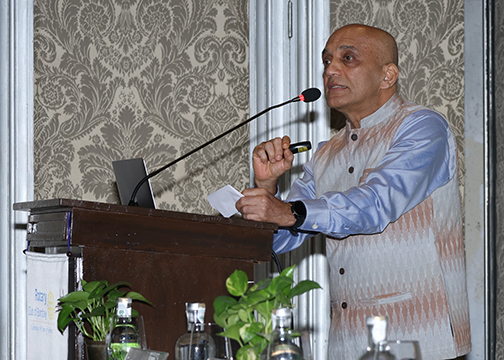
Lt. General Tinakar on the role of the Army and the Independence of the Indian State.
Rtn. Manish Reshamwala, President of the Rotary Club of Bombay, eminent Rotarians, ladies and gentlemen, it is indeed a great honour and privilege for me to be here, interact and speak with you, some of the leading lights of Mumbai. You have been leaders, achievers, and have done remarkably well in your own fields. But what makes you stand out clearly is the kind of contribution that you have made to individuals and societies who are not as fortunate as us. Rotarians have transformed lives, as you have just seen. You have given wings to dreams. You have made people self-sufficient and have lit the path for a very bright future. Heartiest compliments, and may your work continue to grow and expand with each passing year.
We recently celebrated our 80th Independence Day with great pride. We recalled the achievements we have made thus far. We spoke with confidence and resolve about wanting India to be a high-income country in the next 20 years. But as the world gets more competitive and interests start clashing, it is not going to be a very easy journey. We have our internal problems, we have our divisions, we have our politics, and there is the enemy at the gate. We live in a very unfriendly and hostile environment, very suspicious of our progress and ever willing to put a spoke in our growth story.
Let us now look at our neighbourhood. Our land borders are 15,106 kilometres, but the disputed portion of this land border is 4,343 kilometres, and most of it is in mountainous, high-altitude, and glaciated terrain in the north. This is fully manned by the Army. China is 348 kilometres, and Pakistan is 855 kilometres. The western borders and the eastern borders are manned by the BSF and the Assam Rifles. The largest land boundary that we have is with Bangladesh, 4,000 kilometres, but that is, again, a porous boundary, not related to the defence of the country, but there are internal security issues that you are well aware of. This is, of course, a legacy of British rule and of our Partition 80 years ago.
The principal role of the armed forces, you may have seen the armed forces here, or you would have noted their role in J&K, is to defend territorial integrity and national sovereignty. If a nation allows its President to be kidnapped by a foreign force, it is not a nation. It is certainly not a sovereign nation. If your land borders are violated and if land is stolen, more land is going to get stolen, and you will not have a nation to defend.
So little is known, particularly to people from Bombay, of the complexities of defending a nation as vast and as diverse as India in a very important geo-strategic location in South Asia. Again, very little is known, and most of it is hidden, of the trials, tribulations and sufferings that are endured by the defence forces in defending our territorial integrity and sovereignty. I am only talking of the Army. I mean, the naval and the Air Force role is entirely different. But the largest component of our defence forces and the largest percentage that takes over the budget of the country is, of course, the Army.
So, what I will do is recount very briefly the important events on our borders, which you may or may not know. Most of you will not know, and see it in perspective, so that you are able to appreciate the kind of challenges that lie on the borders.
The starting point has to be the independence of India in 1947. In 1947, we were a very fractured entity and in urgent need of political and territorial integration. There were 565 princely states. They had the technical right to become independent. Forty-eight per cent of our land area and J&K, was at the apex of both the dominions. We know that it is a mountain barrier; it is a source of all rivers, but that is beside the point. This particular state, with a Muslim majority and a Hindu ruler, is the symbol and keystone of both these dominions, India and Pakistan. It had to be fought over. And that state has strategic importance to both, not just because of the rivers, but the basic idea of India and Pakistan is contained in this state.
Then there are the frontiers in the north-east. In the north-east, you find another area that is now Arunachal Pradesh. Those are the frontiers in the north-east. These were tribal lands which were very sparsely populated, mountainous, forested, and where customary or tribal law worked. There was no representation of anybody there except for a single political officer of the British.
When we became independent, the borders were so structured that the connectivity to both these extremities abruptly ceased. The principal connectivity to J&K was via Pakistan, West Pakistan then. If Gurdaspur, as a district, which was incidentally Muslim-majority, had gone to Pakistan, there was no land connectivity to J&K. J&K was lost.
Similarly, the land connectivity to Assam and the north-east went through East Pakistan, and that got suddenly severed, so there was no land connectivity. That was a major problem. There was civil unrest. One million people had died, 10 million people were displaced, and where were the forces to guard the borders? There were no forces to guard the borders.
Let’s just focus for a minute on J&K. It is topographically vague, and the borders, nobody knows where the borders are. You see Aksai Chin, right? It is a plateau, uninhabited, with no person living there, 38,000 square kilometres, and a part of Ladakh. J&K itself was an amalgamation of five different disparate regions. Only two provinces were tightly governed, that is Jammu and Kashmir. Ladakh and Baltistan were semi-autonomous. Gilgit was a jagir, tribal, so there was really no control.
And sure enough, there was a land grab that started in 1947 when the tribal invaders came in. They were at the gates of Srinagar. Had it not been for Major Somnath Sharma, whose niece, I believe, is here, who fought and gave up his life to stop the tribal individuals just short of Srinagar, Srinagar would have been lost. So, the Indian Army then, because of the very tenuous land link, was airlifted into Srinagar, and there were about 100 sorties every day that put troops in Srinagar, and that is what saved it.
One of the pilots, a brave pilot, was, if you recall, Biju Patnaik. He was the Chief Minister of Odisha, and not much is heard about his bravery when it comes to flying aircraft in war-torn areas, but he flew all over. He flew in Russia, he flew during the Second World War, he flew all over. A remarkable person.
So, to cut the long story short, the tribal militias were driven off. The Pakistan Army joined the conflict in May 1948. They captured Zojila and Kargil. I am sure many of you would have travelled or would have been on the road from Srinagar to Leh, and they were there. Well, they did it once again in 1999. They were retaken by the military.
A ceasefire came into being on the 1st of January, and a ceasefire line was clearly earmarked. Just note the point: NJ9842. We will come to this point later on. There was no demarcation beyond NJ9842. So, during this war, 35 per cent of J&K was lost. It was occupied by Pakistan.
Let’s come to 1962. The entire Aksai Chin was uninhabited. There were no military troops there. And the Chinese had come in by 1958, unknown to India, and had already built a road. When the Indians found out that there was a road there, it was just too late. We tried to contest this; we were beaten back, and the Chinese unilaterally announced a ceasefire.
Indians were defeated, except for one or two brave actions, the one at Rezang La, which I have noted, where, out of a force of 120, 114 died at their positions. Only six managed to survive, and they were severely wounded. So, by this action of China, 20 per cent of the land of J&K was once again lost. The Chinese did not withdraw. They stayed there. They withdrew about 20 kilometres back, but they stayed put within J&K. This is very important.
Let’s come to the frontier tracts which we now know as Arunachal Pradesh. The McMahon Line, which divides Tibet and the tribal tracts then, was not accepted by China. Of course, it could not accept it. If Tibet was a part of China, then they did not give Tibet any powers to sign treaties with India. They rejected it.
The Tibetan district governor, incidentally, even after independence in 1947, continued to govern, being located in Tawang and governing parts of that territory. So, we were independent in 1947; we had not established control up to the borders, and there was a Tibetan sitting within our territory and administering the areas of the Balipara Tract, of which Tawang is a part.
So, in the 1962 war, I would call it an unfought war because we hurriedly sent troops to the border areas. They were underprepared. The Chinese were stronger. Our positions were overwhelmed. They came right down up to the Assam plains. I wonder if you have been to that part of the country. It is mountainous; it is wooded. Tawang is at the top, and if you go to Tawang and beyond, you can see the Tibetan plateau, which is completely flat.
So, they came down and up to the Assam plains in a matter of a month, and then declared a unilateral ceasefire. But the best thing to happen to India was that they went back. Had they not gone back, Assam was gone, the north-east was gone.
We did not have the capacity, or we just ignored it, or possibly we had so much going on within our country that we had no thought, and we did not have a person like Vallabhbhai Patel. If you read his books from that time, he said, ‘The first thing that we have got to do is to develop the border areas.’
Well, leave that aside. China today is not there down below, but it claims 90,000 square kilometres of Arunachal Pradesh. It is not going to get it, and it calls it Zangnan. But had they not withdrawn, this whole area would have been lost.
Let’s come to the 1963 border agreement between India, Pakistan and China, where Pakistan, to make peace with China, surrendered about 5,200 square kilometres to China. It settled the border dispute, and Pakistan became friends with China. That part, which is part of POK, was surrendered to China by Pakistan illegally. There is infrastructure development going on in that area. It is a part of CPEC, if you know the China-Pakistan Economic Corridor. And anything that happens there directly threatens Siachen and the Ladakh area, which is of concern to us.
Okay, let’s take the second attempt where Pakistan tried to seize Kashmir. Pakistan is not going to forget Kashmir. As I said, it is basically a keystone of the idea of both countries. So Pakistan infiltrated a large number of people inside to take over Kashmir through an insurgency. They were defeated. There was a war. There was no clear victor, but we captured more territory, and one of the key passes that we got was Haji Pir Pass.
We surrendered that pass during the peace talks, and it has paid us a high price. One is that it provides a path for infiltration, a highway for infiltration into Kashmir and the south, both into the entire Valley of Kashmir as well as into the Jammu area. It would have connected two major cities of Kashmir close to the Line of Control directly. It was a 60-kilometre distance, which is now travelled over 260 kilometres.
Now, it was a blunder. We should never have given back that territory, and we will never get it back.
The 1971 war, I will not dwell on. You all know about it. We had 93,000 prisoners, but we got no geopolitical gains out of it. We just gave them back on a promise that Kashmir would be discussed later on. The only good thing is that Kashmir has not been discussed in the United Nations since 1972. So, although there is a problem there, the UN does not interfere.
Let’s come to the 1984 Siachen dispute. I had pointed out NJ9842, where the Line of Control ends. Where does it go beyond that? It ends at NJ9842, and thereafter it is glaciated land. So, where does it go? In the view of Pakistan, it goes straight along the Green Line. In the view of India, it should go north along the Orange Line.
Had we not asserted our right, our claim, and occupied the Saltoro Ridge, this entire area would have gone, and that would have opened an axis to Leh.
One gentleman was telling me about General Kulkarni, who was lifted in helicopters and placed on heights at 21,000 feet and had to defend that area. Had we not defended it, the Pakistanis would have gotten it, and they would have had clear access to Leh.
So, this happened in the 1984 Siachen dispute. It is the highest battlefield in the world. You wonder why people fight there. Why do people fight in these areas? You are struggling against the weather there. There are avalanches, there are glaciers; you could fall into a glacier, and your body will never be recovered. In crevasses, your body will never be recovered, but we still hold on to that territory.
Of course, things have improved over time. They are getting better equipment and are being better provided for, but it is isolated. You do not know what isolation is. You do not know what it is to just live in a small tent, day after day, for months. And at that point in time, there was no communication. You did not know how your family was doing. But we held on there. We are holding it on.
There was a talk that you make it a zone of peace between India and Pakistan. Okay, fine, you make it. You withdraw. What if a crackpot like Musharraf comes and says, ‘This is mine now’? Are you going to go and recapture it again?
Okay, let me talk a little bit about violence in Kashmir. There are numerous factors. I am not going to go into it. It is cross-border driven. There are political factors, we know. I mean, over time, the special status was a major, major factor. Definitely, if a population in the border areas harbours the thought that, yes, I have a chance to be independent and that is supported from across the border, it is going to get active. It is going to capture people’s imagination.
But the silent majority of the population was certainly not with the separatist element. The state administration, for various political reasons, could not fully come over the situation. But I would say not just the Army, but the joint efforts of everyone have reduced violence. Spectacular attacks have diminished. Cross-border military strikes, as you have seen in Sindoor, Balakot, etc., have definitely imposed caution.
But do not expect changes so soon. The politicians will say what they have to, right? That it is completely normal. If you visit Srinagar, you will find the markets open, etc., etc., and people are coming in and going out. But it will take a lot of time for that thought in the mind to go off, that there is a possibility of insurgency, there is a possibility of becoming independent.
The 1999 Kargil War, most of you have followed it. I will not go into great depth again, but the intrusions were serious. They caught the Indian Army and the nation state by surprise. They had planned to cut off Leh and then isolate Siachen.
And why did Musharraf do it? Musharraf did it when talks were going on, when Vajpayee had been to Lahore. He was the brigade commander in Siachen. When the Siachen operation took place, he wanted revenge. He came back with a black face from Siachen. He wanted to do something back to us. He got his positions and established these areas.
You will ask me, how could they establish it? There was a generally accepted protocol that, come the winters, both sides would withdraw. It was too difficult to maintain troops, and once you go and sit on the top, which is at a height of 18,000 feet, and it snows, you cannot get back for six months. You cannot get back. You are just stuck up there. Whatever happens at home, if you fall sick, well, a helicopter could come and take you back, but you just cannot get back. So, it was generally decided.
So, the Indian Army withdrew; these guys came in, nobody knew it, and pitched battles were fought. Some very young officers knew they were going to die. If you have been to that area, and if you start walking uphill, if somebody drops a stone on you, you will fall, right? But these guys went. They left notes behind about what was to be done should they not return, and they died there to save the country.
Okay, we talked about Pakistan. We know what has happened in Ladakh, so let’s talk a little bit about the situation on the LAC.
This is a Line of Actual Control where there is no ceasefire line. It is a perception, and it is not a short stretch of road. It is 3,000 kilometres. So, you patrol to claim your area. You patrol to an area where you feel it should be yours. He patrols to the area where he feels it is his area.
You want to go and exert your claim, exercise your claim, because if you do not claim your area, somebody else is going to claim it. Same as possibly your land that some of you may have. If you do not build a boundary and do not claim it, somebody else will come and make a boundary there. Simple. So, you have to go.
And what happens is that when you take a patrol there, you take some Maggi noodles, you take chocolates, you take something and drop it there and come back. When these guys come, they get Chinese cigarettes, etc., drop them there, and come back. So, we have been here; this is our land. And if you meet each other, then you physically obstruct. Do not use arms, but physically obstruct. That was a protocol.
So, there were agreements which said that there should be self-restraint, there should be no change of the status quo, we should uphold peace and tranquillity, and there are institutional mechanisms to see that everything goes well.
Then you will ask, what happened in Galwan? Would you have heard of Galwan? Why the fight, isn’t it? I will come to that. Before that, let me talk of something called Doklam, which some of you may or may not have heard.
The Chinese asserted their claim on Doklam, which is in Bhutan, and now the Chinese are overlooking the Siliguri Corridor. Now, the Siliguri Corridor, as I said, the main connectivity with the north-east has gone after the coming up of East Pakistan and Bangladesh. So, the Siliguri Corridor is very narrow, 20 kilometres in width, which connects mainland India to north-east India. If that is cut, then your access to the north-east is over, land access is over. And it is a very vulnerable, sensitive, strategic location for us.
So, the Chinese came and occupied right up into the Chumbi Valley and Doklam. You see that Doklam, the Chinese were not there earlier. It is a part of Bhutan. Bhutan is a small state; it cannot resist any country. Most of you have been to Bhutan. If you have not been there, go there. It is a very beautiful land, free for Indians. Others have to pay $260 a day just to visit Bhutan.
Well, they went and occupied that place, because China is overlooking the Siliguri Corridor. How does the Siliguri Corridor look? I have shown Doklam, I have shown Bhutan, I have shown Sikkim, and what is lying in the front and what is visible is the Siliguri Corridor about 50 kilometres away. So, in, let’s say, about two days of march, uncontested, the Chinese troops would be sitting at the Siliguri Corridor.
Okay, what things went wrong on the LAC? I will just show you how the interaction between troops was developing on the LAC. Have a look at this short clip.
These are Indian and Chinese troops who have come in contact with each other and are now engaged in fisticuffs and thuggery. They are throwing thorns at each other, throwing stones at each other, injuring each other, and this is not supposed to happen. But what happens on the borders? Sometimes the troops are also full of energy, enthusiasm and patriotism, and they want to stop. And this is what happens.
It is a brutal hand-to-hand fight without weapons. Look at this guy kicking, him falling, throwing stones. I mean, this should never have happened. This should never have been allowed to happen, but unfortunately it happened. And this is what led to the skirmish in Ladakh, where one fine day we killed an officer of theirs. They came in strength with clubs and hammers, and they left 20 people dead.
And it was planned. They came at night, just as it was getting dark, or a little later. They came with very strong searchlights. They blinded the troops, and they came with clubs and hammers, and they clobbered them. It took four years of dialogue to settle the situation, and now we have strengthened the positions in this area.
I will just say a few words in conclusion. China was identified as a potential threat in 1998 by George Fernandes. Why did we not then develop the capability to combat or deal with this threat? India cannot afford delays in building a strong deterrence against China. China is very big. China is far more powerful. And if you take China lightly, they will do what they did to you before.
The LoC is stable, but terror infrastructure remains, as I told you in Pakistan, and terror could strike anytime, anywhere, including in Bombay. And vigilance, that is the most important thing, is our shared responsibility. You cannot say vigilance is only the responsibility of the police.
Pakistan-China collusion in a future conflict is assured, and in the next war, whenever it happens, you could face a two-front war. The possibility of a permanent border settlement with Pakistan is very low, so this problem is not going to end. And, as far as China goes, there is a possibility of achieving some agreement, but it is not going to happen unless India gives up some territory, and that is nowhere on the political horizon.
Independence, it is not free. It costs soldiers. Jai Hind!
ROTARIANS ASK
Q1. How many troops are in that area, both India and Pakistan, combined and separately, sir?
About five to six lakhs. About five to six lakhs at least, and we have to build up. Because that terrain suits China. Once you are on the Tibetan Plateau, you can move across very easily, but for India, it is all separated by rivers, valleys and ravines, so there is a restriction in how many troops, how much of troops you can build up.
But till about 10 years or more, there was hardly anything in Ladakh. It is a huge frontier, 800 kilometres. You need so many troops. It costs money. It does not come for free.
The capacity has to be built up. Roads, for example. The moment you start building a road, the Environment Ministry will raise its hand, right? So, there are issues that we face that are not faced by the Chinese, so we go by our democratic processes. It is very slow, but we should have taken this step 20 years ago. We finally realised that you cannot wait any longer, and we are building our capacity here.
Q2. Lieutenant General, I just cannot stop complimenting you on the world picture that you painted. It is absolutely fantastic. Apart from that, my hair is standing on end. I must plead complete ignorance of what is happening in this country, especially in the border areas, and literally I have got shivers down my spine. Now, before you go, please give us a reason to smile.
Yeah, the thing is that we have said that China is a principal threat. China is very powerful. It is five times our economy, and it is advancing even more. It will replace the US sometime. All you have got to do is to make the cost of war extremely expensive for China. You have to resist China where they are. And I think now we are doing it.
We finally realised that you cannot leave our Chinese frontiers unguarded. So, the reason to smile is that our frontiers are now getting stable. It will never be fully stable. Pakistan will not impact us on the frontiers. It is beyond their capacity, but they can do many other things. They control the tap of terrorism. Let me be very blunt about this. They control the tap. Should they decide to turn on the tap, there will be problems within India.
We are divided. We know it. India is what it is. So, looking into the future, it may not be very secure in the next five to 10 years, but beyond that I think India is reaching a stage where no power, Pakistan or China, can easily overrun or take India for granted.
So, we are reaching that. It is going to take some more time, but as of now I think we are safe. But that does not stop us from being eternally vigilant, even in Bombay. It is everybody’s responsibility, not just that of the security forces. Thank you.
Q3. I second what my colleagues said. It has been an absolutely fantastic presentation which you did, and thank you so much for that. Just a couple of questions on the Haji Pir Pass you mentioned. When did this happen? Have you learnt any lessons from that? And the second question I have is, recently the J&K Chief Minister interestingly supported the fact that the Indus Water Treaty has been kept in abeyance, because his complaint was that during 1947 India protected the Punjab side of the Indus Rivers and not the J&K side. Any thoughts on this? Would this cause a kind of a dispute between J&K and Pakistan, this kind of a tension, or whatever?
I will very quickly answer your questions. Haji Pir Pass was 1965. It is a strategic pass on the Pir Panjal Range. It was captured. It would have linked Uri on that side with Poonch across, that is in the Jammu area, directly and would have stopped infiltration, which happened on both sides of the Pir Panjal Range.
Now, it may not be easy for you to imagine this, but if you do some search on it and read about it, you will know the importance of Haji Pir Pass, right? So, we gave away because we were weak. We did what others told us what to do, and we had captured 1,300 square kilometres in 1965, or they had made some ingress about 400, 500 square kilometres, and we decided to go back to our original positions, and that is where it ended.
It was, I mean, it was declared nobody won as far as the result goes, so it is a loss. It is a serious blunder. We cannot get it back. As I was telling the others, the politicians say that we will get back the POK. It is impossible. You just cannot get a single post. If you have to capture a single post, you lose about 500, 600 people, right? And that is the cost that nobody is willing to pay. And there will be a series of posts.
So, Pakistan Army, I worked with them in the United Nations. They are a replica of us. They are a replica of us. Their soldiers are as good as our soldiers. We talk the same language, we eat the same food, we think the same, we are the same. We were once upon a time the same people. They are as patriotic as we are on this side of the border. Same, ditto, same.
So, we are not confronting Venezuela. We are not confronting a nation with a poor military tradition. You are confronting a nation with a very strong military tradition, so forget it, forget what they say, we will get back. Okay, you cannot get it back, believe me, you cannot get it back.
As far as the waters go, that was the leverage that you have with you, that you allowed three northern rivers to flow unimpeded into Pakistan. That is the Indus. The second is the Jhelum, third is the Chenab. You cannot block those rivers, and if you decide to block them, then you have to make storage areas for the waters that flow otherwise, your own area, your complete land is going to get inundated.
They are very fast-flowing rivers. You do not have those reservoirs in place. You cannot harness the waters of those rivers, so they are going freely into Pakistan. And if you, by whatever means, in future, some Prime Minister decides to stop, there will be a war because Pakistan will collapse.
Pakistan cannot survive without the water, and it is internationally not allowed. You cannot, as an upstream nation, block the waters to downstream nations. How can you do it? There are so many people depending on these waters.
What if China is doing something? China does not have a treaty on the Brahmaputra between it and the other lower riparian powers, as they are called. So, it is building dams, but it is not diverting the water. It is building dams, not diverting them.
Q4. How is AI and technology changing the way wars are being fought, and is India equipped in these areas?
It is impacting, definitely. I was not really, I was not into this technical field, so I am not able to give you a precise answer. But across the globe, you find AI is playing a very major role. How it is doing it, I don’t know.
We are into it. We are getting into it, we are adapting it, but as I say, India is very slow in making any changes, any changes. If you have to get a government contract, my God, I don’t know if many of you have tried. It is one wheel within one wheel within one wheel, so you don’t get anywhere.
Similarly, for defence production, you have to have very deep pockets to get into the defence industry. Very deep pockets and a great amount of time, with no certainty. And it is all lobbying in Delhi, etc., etc., whatever happens.
So, I cannot answer your question precisely, but we are getting drones. I don’t know, maybe target selection happens with AI. I have not dealt with it personally. I am a Special Forces guy. I am not a technical engineer or an EME fellow.
So, there are guys equipped with this. But I don’t know how far you reach.