
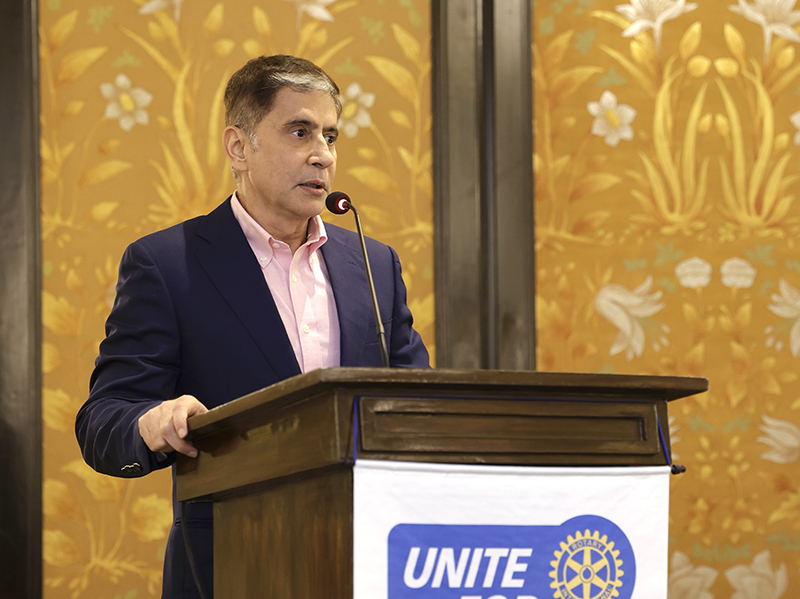
Mr. Bhushan Gagrani, Municipal Commissioner and Administrator, Brihan Mumbai Municipal Corporation on vision for the Mumbai city.
Before becoming Commissioner, I was a Mumbaikar, and afterwards also I will remain a Mumbaikar. The only difference is that I am now looking from the inside, and I would like to share some glimpses with you, so you can peep into what the BMC is doing for the city of Mumbai.
BMC and Mumbai are synonymous. They cannot be differentiated. You may love BMC, you may hate BMC, but you cannot ignore BMC. The entire bandwidth of life—from birth to departure—comes under BMC. The birth certificate is given by BMC and the final journey certificate is also given by BMC.
But how do you describe Mumbai? I have never fully understood. There are hundreds of fictional and non-fictional novels on Mumbai, countless Bollywood films and songs, yet everyone has their own interpretation of the city. There may be many more beautiful cities in the world than Mumbai. There may be many more organised cities than Mumbai. But there is no more diverse city in the world than Mumbai. Whatever you say about Mumbai, the opposite is equally true. This is what Mumbai is: diverse and challenging.
BMC, of course, is the prime civic body. The numbers are staggering: a 20 million resident population plus a couple of million floating population. These overwhelming challenges are managed on a small landmass where we must provide services. The building in which you live is approved by BMC. The water you drink is provided by BMC. The roads on which you drive are designed and maintained by BMC.
I am not here to list what we do or to boast of our commitment. In a gathering like this—where almost half the Rotarians are already working with BMC projects in health or education—I would prefer a bilateral exchange. Instead of me talking, I would like to hear what is on your mind about how Mumbai will transform.
Still, to put things in context, I will mention a few points. Right now, we are passing through a transition. Every major city in the world goes through life cycles. Mumbai has seen cycles in 1820, the 1860s, the 1950s, and in 1960 when Maharashtra was established. Today, we are experiencing another major cycle: a total facelift of the city, both public and private infrastructure.
Everywhere you look, Mumbai is under construction. Why? Because it was long overdue. Take one example: 1857 is remembered for the first war of independence, when freedom fighters rode horses with double-barrel guns and swords. That same year, London began constructing its first metro near Paddington. London now has 400 km of metro network. Within two years, Mumbai will also have nearly 400 km. We are trying to achieve in 10–12 years what others did over 150 years. This pace must be sustained, and I am glad that every Mumbaikar is supporting it.
No project remains on the drawing board. Every project is under execution. South Mumbaikars are already enjoying the Coastal Road, which will extend to Versova, then to Bhayandar, Dahisar, Virar, and finally connect to the ambitious Wadhwan Port. This port alone has the capacity to transform not just Maharashtra, but the Indian economy in the next five to seven years.
Other major projects include the Navi Mumbai International Airport and Atal Setu. Completion dates are often delayed due to operational issues, but projects are steadily progressing. At the same time, the private sector is contributing through redevelopment projects. Debates continue about whether we can sustain such redevelopment, but the trajectory resembles New York’s in the mid-19th century. Land reclamation, public debates, NGO activism, court interventions—Mumbai is going through the same trajectory. The transformation of Mumbai is truly on the horizon.
BMC’s primary role remains civic services, but in recent years we have invested heavily in infrastructure. In fact, 52% of our capital budget is dedicated to it. Yes, BMC is financially strong, but with that comes responsibility. We carry 150,000 employees with us—50,000 of them sweepers who keep the city clean.
Mumbai was once known for its underworld. Today, its real underworld is in terms of infrastructure. BMC provides more than 4,500 MLD of potable water daily, 365 days a year. We own seven dams across Thane, Palghar, and Nashik, along with the entire supply network, much of it underground and invisible to citizens.
The Sewage treatment project is underway. Until recently, 3,000 MLD of minimally treated water was discharged into the sea, damaging beach quality. By December 2027, seven new sewage treatment plants will be operational, releasing water treated to near-potable levels. By 2028, we expect significant improvement in sea-water quality around Mumbai’s beaches.
With infrastructure growth and private redevelopment, we are on the cusp of a new city with the old spirit. I will pause here, as I would rather respond to your queries than give a monologue. Thank you very much, and I take this opportunity to thank the Rotarians for their noble projects in health, education, and rehabilitation, in partnership with Mumbai and BMC.
Rotarians Ask
Hi Bhushanji, welcome to our club. Thank you for the work you are doing. You are doing a fabulous job. We also saw during Anand Chaturdashi how smoothly things went. So thank you so much. Just two small questions. One: you said we have about 150,000 employees—are we doing something to automate our services to reduce the cost burden? And second, why do we play musical chairs with our roads?
Satyan, you met me on Sunday. At that time you did not give any hint that you would be asking questions to me. See, the number of employees and the total population, if you see the ratio, if you see in isolation, 150,000 looks like a very big number. Of course, it is big. I am not saying that it is a small thing. But it is catering to about 22 million of population. So, the majority of it, almost one-third of it, is conservancy staff which is taking care of maintenance of the infrastructure, including sweeping and sanitation.
So, a lot of automation is already in operation. For example, I will just give an example. All the building permissions are automated now. All the building permissions are online to the extent that each and every citizen of Mumbai is able to see – what building permissions have been given in the last few days, to whom, and what kind of permissions are given. Everything is automated.
Likewise, there are many services: birth certificates, then marriage certificates – all these things have been automated. But despite that, the manual work, of course, cannot be automated. So this conservancy staff, and particularly since Mumbai Mahapalika is running five medical colleges and all sorts of hospitals, this staff, of course, cannot be automated. We have automated the service delivery system to a larger extent.
Second part on the roads – I must admit, the quality of roads which we are supposed to provide is not of very great quality in terms of construction as well as in terms of maintenance. I am not going into issues of why and what. But what we have started doing in a big way in the last few years is concretisation of the roads. Now, there can be debate about concretisation as well. But having said that, at the end of the day, concretisation has addressed, and is addressing, the issue of potholes.
Wherever concretisation has happened, particularly in suburban areas, there have been no potholes in the last few years. So, the quality of roads will be improved significantly. We have about 2,200 kilometres of road in the city of Mumbai, out of which 50% are concretised, 25% are not to be concretised. So the remaining 25% of roads will be concretised in the next two to three years. So, to a larger extent, the quality of roads will be addressed, I suppose.
Hi, thanks for your talk, Commissioner Gagrani, and I know BMC is doing a good job and we now have world-class infrastructure, but actually mine was a follow-up to this. Come monsoons and the city just again crumbles. And why? On the one hand, we have world-class infrastructure. On the other hand, we still have building collapses, and we still have potholes. You answered about the potholes. When do you think we will be totally pothole-free? Another thing is you mentioned that the UK started building its metro in 1857. We have a lot to catch up on. And, like I said, our infrastructure has been a game changer. But the thing is open spaces – balancing environment and infrastructure, not felling too many trees, also ensuring enough open spaces for the public. And what about the whole plan for the racecourse? What is the update on that?
Yes. So, I begin with addressing the issue of monsoons. Why do we crumble? Let me give you a little historic perspective. Many of you may know that half of the island city of Mumbai is reclaimed land. Entire Central Railway, Western Railway, Reserve Bank of India, Nariman Point—you name the icons—all are on reclaimed land.
Reclamation started in 1710. That year, the first embankment began near Mahalakshmi. It was so difficult that the ingress of water could not be stopped for 10 years. The contractor at that point built a small temple, which is now known as the Mahalakshmi Temple, to appease the Goddess. Only then could he stop the ingress of water, and the first embankment near the temple was completed. From there, land was reclaimed.
Entire Kapad Bazaar is reclaimed land. Entire BKC is reclaimed land. The first thing we should always remember is that 50% of the island city and 25% of the suburbs are on reclaimed land. And when you are taking this land from the sea, at least a couple of times a year there will be resentment from the sea—you have to honour that. Entire Lalbaug is underwater, below sea level. Entire Dadar-Parel area, Mahim area—also below sea level.
However much you pump the water outside—through Haji Ali Pumping Station, Love Grove Pumping Station, Britannia Pumping Station—if heavy rainfall coincides with a high tide of more than four metres, nothing can be done. Nothing except waiting. With the best technology in the world, nothing can be done.
Many cities in the world with such high rainfall would face the same problem. I am not defending anything; I am giving historical facts. The entire Coastal Road is also being built on reclaimed land. That is the fact of life.
Now, instead of defending or claiming that our infrastructure crumbles during monsoon, our real challenge is how quickly we can make it functional within a few hours. That is the challenge. We have a robust system—from Doppler radar to digitised response systems, control rooms, firefighting, pumping stations. The entire disaster management network is aimed not at avoiding the event, but at mitigating the wrath of nature during such phases.
If you see, we are getting better every year after 26 July 2005, when we saw abnormal rain—900 mm within eight hours. Even this August, we had 500 mm within 72 hours. Rainfall patterns are changing. The total volume is the same, but intensity has increased. The same amount of water now comes within shorter spans.
We need to find new technologies and build capacity to meet climate change challenges. That is my first reaction.
Now, about Mahalakshmi Racecourse. That is close to everyone’s heart here. The first statement I am making is this: on the surface of Mahalakshmi Racecourse, nothing will change. It will remain as it is. Maybe some greenery here and there, but no plantation or gardens. There are reasons, which I don’t think it appropriate to explain fully at this moment.
So, Mahalakshmi Racecourse will remain as it is. We are, however, considering a sports arena in the basement, and a parking facility of about 2,000 cars.
Interestingly, next to the Racecourse is the Nehru Centre, where a metro station is coming up. Near Famous Studio, another metro station is also coming. Both stations will be linked by a pedestrian pathway to the Racecourse. From there, another walkway will cut through Lala Lajpat Rai Road and Annie Besant Road, leading to Haji Ali.
Thus, Haji Ali and the proposed garden will be connected through an underground pedestrian network. This will also connect to NSCI, Nehru Centre, Phoenix Mills, and Famous Studio. The underground system is what we are planning. But on the surface, it will remain as it is—perhaps with a lounge or two, but nothing more.
The first impression we get of Mumbai is when we land. What we see from the aircraft is horrifying. Is there any plan to rectify that situation?
Of course, yes. Plans are always there. Some of what you see around the airport is Dharavi, some of it is airport land itself. Dharavi is one of the most ambitious rehabilitation projects, and it is now beginning to take shape. We in government are confident that within the next five years, Dharavi rehabilitation will be completed.
Exactly near the runway, there are many hutments. Some have been removed for widening the Mithi River. Some for developing Mahim Park. Despite the efforts of MIAL, MMRDA, and other agencies, only one-third of the hutments have been relocated.
But efforts are ongoing. Slowly. In India, every project has its own trajectory—it takes time. These rehabilitation projects are complicated. About 14,000 tenements were built near Kurla to rehabilitate airport slum dwellers, but that did not materialise for various reasons. Still, efforts continue.
I am Dr. Chowghule. I studied here in Mumbai. We give good health care, but we also bring in a lot of equipment. After some time, there is no maintenance. Within two, three, or four months, the MRI is not working. The poor people who really should get good care tend to go elsewhere. Why don’t municipal hospitals maintain their equipment?
No, I accept that criticism – that the constant maintenance and upkeeping, housekeeping, is very challenging. We need to do that. However, we are a public hospital. I am not defending it, but we are a public hospital. We are spending 7,500 crore rupees per annum from the municipal budget and providing 90% free services.
So, all services—our free services—are provided. And now, despite our policy intent, at the operational level we cannot differentiate between services for Mumbaikars and non-Mumbaikars. People from all regions—right from the MMR region, from across Maharashtra, and even other states—come to Mumbai for treatment, which we provide free of charge.
That does not mean your MRI should not function. The MRI was functioning, but due to some issues in KEM it stopped. Now we are refurbishing those machines. This is a constant process. Yes, there are issues, problems, and challenges, but we always keep planning and tackling them.
Thank you, Mr. Gagrani, for your talk today. A question about social and sporting clubs. Many of them are on expired leases. Just as you have done for the Racecourse, where you came up with a policy, is there any move to extend similar policies of lease extension to these clubs? And specifically, what will be the fate of the Amateur Riders Club at the Racecourse?
There are two types of leases in Mumbai—collector leases and BMC leases. For example, the Cricket Club of India is on collector lease land, while Wellington and Turf Club are on BMC lease land.
As per policy, there will, of course, be lease extensions for all clubs. There is no exception. However, government is insisting that, first of all, there should be compliance during the existing lease period. Most clubs are doing that, though there may be exceptions where building permissions are not obtained, or something requires regularisation.
Government is also insisting—not BMC, but government—that a 5% quota be reserved for government-nominated officers, specifically serving officers, not retired ones. Barring these issues, I don’t see any other obstacle to lease renewals.
And the Amateur Riders Club, sir?
The Amateur Riders Club—I may not react fully from this forum. Technically, in the 1930s the land was given to the Turf Club, which in turn gave it to ARC. So there is no contractual obligation between BMC and ARC. Regardless of ARC’s merit, which has never been disputed, the issue is that we don’t recognise them because they are not our tenants. They are, effectively, sub-tenants without BMC’s permission.
Right now, we are not stopping them from continuing their activity. That is all we can do. How to formalise this is a legal challenge, which we will try to address in due course.
Regarding the revenue model: earlier Octroi was a big revenue source. Now, with Octroi gone, how will you maintain the infrastructure you are creating? Hospitals were mentioned earlier—the same question applies to infrastructure. You are creating brilliant projects, but how do you sustain them without revenue? That is my first question.
My second question is conceptual: has BMC taken on too much? Should health, education, and infrastructure perhaps be separate verticals, especially in terms of soft infrastructure?
See, capital investment now is being done with a defect liability period, which covers maintenance for about five to ten years. After that, we will have to generate revenue streams.
But since we are a public body with a consolidated budget, there cannot be revenue streams project-wise. For example, we have a 12 km Coastal Road, but there cannot be a separate “Coastal Road” head for receipts and expenditure. Everything goes into the consolidated budget.
Now, in that budget, there are limitations, as you rightly point out. Octroi is closed. Property tax cannot be raised beyond a point—unless you agree. I don’t mind. Water charges also cannot be increased much; even if they are, it will be minimal.
One major source of income for BMC is premiums from construction activities. We get about ₹10,000 crore annually from premiums—FSI, fungible FSI, TDR, and so on. As long as real estate is booming, I don’t have to worry about servicing infrastructure.
If the quality of infrastructure is good, then maintenance costs will also be lower. Still, we must maintain proper depreciation and maintenance accounts for replacement purposes. And I am confident that Mumbaikars will cooperate in revenue generation—not immediately, but in the future.