
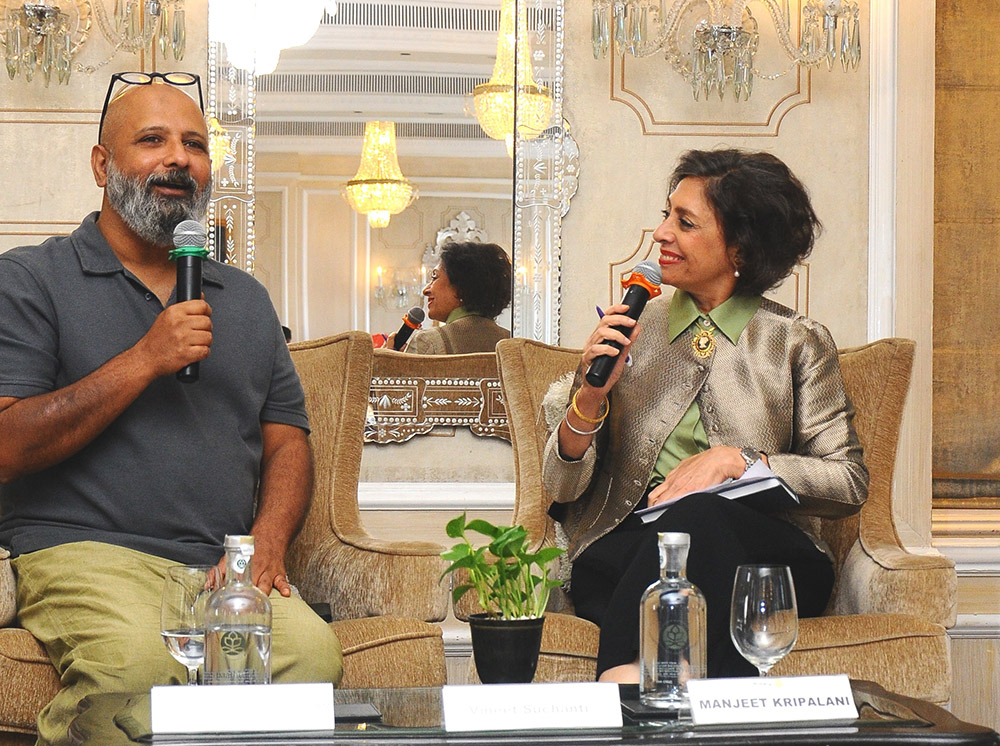
Mr. Jesh Krishna Murthy, CEO and founder of Anibrain, in conversation with Rtn. Manjeet Kripalani on Advanced Nature, and the world our children will inherit.
Mr. Jesh Krishna Murthy, CEO and founder of Anibrain, in conversation with Rtn. Manjeet Kripalani on Advanced Nature, and the world our children will inherit.
Jesh:
Thank you so much, Manjeet, and thank you to the Rotary Club of Bombay for having me here. It’s a real honour and a real pleasure, and I hope that we can do it justice. So we’ll just dive right in.
We’re called Advanced Nature, and essentially what we are doing is looking at waste, looking at things, we discard, and asking whether we can create entire worlds out of that. If you opened the window today, you can’t see far; it’s so hazy. Driving in from Pune this morning, as you come on Atal Setu, there’s big hill on the left side; in fact, there are a few hills, and you just can’t see them. The person I was with commented that you can’t even see the ocean, which is pretty much below the Atal Setu. What we call pollution is also nothing but waste.
Maybe it’s a bit hard for us to imagine today, as we sit here and look at the air around us, that the world that could be entirely circular. By circular, what we mean, and that’s the real goal we want to aspire to, is not merely sustainable, but circular. Circularity implies no need for a dustbin, because we have thought about everything we consume and everything we use so deeply that nothing enters the garbage can. It’s picked up well before that and reused in countless ways.
As Indians, we don’t actually have to imagine a circular world. If we look back 200 years ago, we were entirely circular. The concept of waste didn’t exist in our culture. Even if you look back 40 years ago, or 15 years ago, the kind of waste we generate today has grown exponentially. As kids, we’d have the kabaadiwala come, take the papers or clothes, give utensils instead, and then who knows what they did with those clothes. We all grew up like that. Imagining a circular world for us in India is not that hard, perhaps harder in the West, but not for us.
Six years ago, when COVID hit, we all had personal tragedies. We all had people who were affected. But one of the hardest things to watch was the masses of people walking back. I’m sure you all remember. That, for me, was the first major trigger. It was sad to watch them walk from here to Bihar or UP or wherever. That was the first time I began to question myself: why am I okay with this? Why am I okay with lakhs of people walking? And why do we have no place for them today? The city doesn’t have the infrastructure. We were scared to bring them into our homes. Their only option was to walk back thousands of kilometres.
Alongside that, I have two boys, young teenagers, and they were the second catalyst for me: what is the world we are going to leave behind for our children? Throughout the COVID-19 pandemic and afterwards, that was a recurring thought for me. Yes, I’ve done VFX and animation and movies, I still enjoy that, and we do it very well, but there had to be more.
Without any real plan in place, I took a few of these people, maybe five or six, who were walking back, and asked if they would like to stay and work with me. I had an idea: to look at waste, rural employment, and also question why migration exists in the first place. If you ask any of them, or a taxi driver from another part of the country, or someone working in delivery, they all say, “Bhaiya, home was a better place.”
As I explored this and interacted with these so-called migrant workers, I realised many of them didn’t want to be here. If they could get a job in their village, even at a fraction of what they earned in the city, they would happily go back.
So these thoughts began to take shape, and I wondered what kind of intervention an ordinary person could make. I ended up setting up an art practice called Advanced Nature. I called it an art practice because corporate life comes with problems, toxicity, and issues we all deal with. Today, everyone is dealing with a mental health crisis on some level. It seemed to me that there had to be another way to tackle these problems; this was not just about solving the waste issue, but also about creating large-scale employment in villages.
In India, we have a huge tradition of abhyas, practice. Whether you look at Madhubani, where they practised art, or places like Chettinad in the south, where they practised plaster and home-making, the knowledge our communities have had is massive. They never made a distinction between art and science. The artist was also the scientist, the metallurgist figuring out how to make an iron pillar that would not rust for a thousand years.
So much of my time went into researching our old ways of construction, manufacturing, and living, and how they managed to live cohesively and harmoniously with nature. I realised that in India, art, science, and mathematics must have moved collectively as one. If you look at Panini’s work or Aryabhata’s work, they also talk about art and music as if they were deeply familiar with those subjects. These were inspirations as I delved into what Advanced Nature is.
Essentially, Advanced Nature is an art practice combining art, science, and community, and looking at creating large-scale employment possibilities in rural India. Over the past four to five years, we’ve done R&D in materials, deep research in material science, using waste and chemistry, and also research into material science from 400, 500, even 1,000 years ago, to see how we can combine all of this to create solutions for a more naturally lived life today.
Plus, we love art. And I think that’s one thing we’ve forgotten today – when we look at glass buildings, glass facades, and our homes with flat, plain surfaces – the Indian need for our own aesthetics around us. A large part of what we do has also been to revive that over the years. Great thinkers who, without instruments, were able to deduce that there must be an atom… the history and culture we come from are truly tremendous. At Advanced Nature, we took these people who were walking back – no skills – window layer, bricklayer, taxi driver, it didn’t matter what they were, and we brought them into our facility and let them play. And, as they played with the materials we were making, we realised the tremendous skill set that exists in this country. We’re not meant to be delivering Amazon packages. We are meant to be creating sustainable products for this planet because nobody understands sustainability quite like we do. We’ve lived it. We are sustainable; it’s part of our culture. It is as hurtful for an Indian to harm a plant as it is to harm an animal.
Some of the innovations we have developed in these five years include a high-performance cement-free concrete entirely out of waste. This has a 70 to 80 per cent lower carbon footprint than traditional concretes and cements. And we’ve done it in a simple bamboo shed. It isn’t a fancy German factory. Looking back at our history, the metallurgist who made the iron pillar worked in an environment similar to ours. It wasn’t some expensive factory.
We ended up making an array of materials, some of which you can see out there. Our materials are binders made from waste, and in those binders, we can encapsulate plastic, textile waste, industrial waste, construction waste, paper waste, metal waste, even nuclear waste can be encapsulated within the chemistry. It is very possible for us Indians, based on our history, to create new technologies that aren’t necessarily “fancy” but are sophisticated in their low carbon footprint.
The other thing we’ve done a lot of work on is ambient curing. None of our materials require heat or external energy to cure. It has been a very interesting learning journey for us. I’m going to wrap up because I think we are short on time, but those are some of the things we make. You can have a look at them. And this is a bamboo shed, our R&D facility, where for five years we’ve worked with so-called untrained people. But in my five or six years, I’ve realised I have not met one unskilled Indian. They all have tremendous skills. They may not have computer skills or the skills to serve you in a fancy restaurant, but they’re not meant to do that. The kind of skills we have are the skills that gave us the Belur Temple, excellent metallurgy, and some of the best cuisine in the world.
So, I think we need to rethink and reimagine. As we are reimagining waste as potential, unlimited potential, I think the biggest value we have today is our rural workforce. The things we’ve seen them do and make have shown me that we can be a manufacturing powerhouse, but it need not be a replication of what the West is doing and what we are blindly following. That’s about it. Thank you so much.
Rtn. Manjeet:
Thank you, Jesh. Since I have the privilege of having been to your workshop and your factory, I can attest to everything you say. It’s a large, open area with several tables and a limited number of people. I would say you have about 27-30 people who come in through the day. They’re all working and all creating, from their own world, their villages, their knowledge of the gods, which I have to say is tremendous. And city folk like us have disconnected from our own… sort-of spiritual moorings. This is quite a revival. And, as you say, because villages are open places, it is very easy to replicate this across villages.
So, what exactly is this material that you use? Can you explain it to us? I’ve seen it, it’s a kind of grey sludge, a wet grey sludge.
We make multiple materials, and one of the materials you saw is what we call a geopolymer concrete. That is made out of mining waste and fly ash. There was a gentleman I was speaking to earlier about fly ash, and silicon industry waste. We make binders. The sludge you saw is the binder. It’s like an adhesive. And within that we can encapsulate construction waste, plastic waste, anything. The binder itself is waste, and what can live in it is also waste. So it’s a double barrel, you get two for the benefit of one.
You have people making casts, and when you put this material through this barrel, which is instantly cleaned, everything is very clean, you put it through and all of a sudden you’ve got a table lamp, you’ve got tiles. Everything is possible there. And tell us, when your staff are creating these casts, what is it that they think of? Because you allow them to do anything they want.
Well, not anything, but close to it. One thing I realised working with these guys, literally a window layer, a guy coming to your house, was that I would tell them: whatever comes from your heart, I want to see what comes out. In the first month, they would make something that probably wasn’t what you or I might find aesthetically pleasing. But the more they delved into their own selves and creativity, they were making Ganeshas, replicating temple art, or creating something entirely original.
We are all creative. Everyone is an artist. There’s nobody who isn’t. We’ve just been told we aren’t because we can’t draw like Michelangelo. But no Indian can. We can draw Warli, it comes naturally to us. It was just about remembering our roots and starting creativity from that point. We have no interviews in the art practice. There is no job interview. You show up, you say, “I want to work here,” and if we have a need, we take them in. Every one of them is immensely skilled.
As the staff told us during COVID, they can easily make a living in the village, because the rural Indian can do several things. They can work in a factory, they can work in a field, and they can work with artistry. That is one of the truly remarkable things.
I always joke with a lot of the boys who work in the workshop that I want them on the cover of GQ. I hope one day GQ comes and takes a photo of these guys. They can clean, they can cook, they can make. It’s incredible. They can do everything. They’re not scared of their hands. In a city, we get scared of our hands. They have no fear. That connection is so strong.
How do our traditional construction materials have a connection with the waste today, our traditional materials?
You’ll see a couple of lamps there, and also a big mask. You can touch it, you can feel it. For that, we researched our old lime technology. It was so sophisticated. We would cure the lime, then add things like molasses, which is sugarcane waste. They would add urad dal paste because it was a plasticiser, today we use chemical plasticisers. In the old days, they used urad dal, they used methi for certain things. They would ferment vegetables and put them in the mix, and they would let that mix sit for 60, 80, even 90 days. Every fort you see today, every temple still standing, is using that technology.
So we learnt that. There was a lot of learning, trying to understand, going to architecture, the ASI, the Archaeological Survey of India, studying what their research meant. And then we started to encapsulate waste into that. That became the basis of some of our early materials: using ancient mortar techniques and then adding waste into it. If you add plastic waste as fibre, or textile waste, each one will have a different use. It is a combination of the old and the new.
And when you said that Advanced Nature’s methods combine high-end chemistry with zero-heat technology, I’ve seen it, but maybe you can tell our audience how it works. It’s quite remarkable.
One of the things we wanted to do was reduce energy usage, because we’re not fighting the waste war, we’re fighting the energy war. Today, even if you look at AI, it is an energy hog. So, we did a couple of things. One was making our manufacturing based on the weather. When the sun is out, we manufacture certain things that require that heat, and everything cures in a few days. We also developed other technology, like the geopolymer, which cures in four hours in any condition without heat. That research has taken four to five years to perfect. The inspiration still came from our roots, using such simple methods to construct big ideas, temples that cannot be constructed today. Our construction is so mind-boggling that you can’t replicate it today. How could they do it back then?
And Jesh, when did you start to realise that you could make saleable products from what you were producing? When did you start your shop?
I think the whole purpose, even in the early days, was commercial. It wasn’t just experimenting, it had to have a strong commercial aspect; otherwise it’s just a hobby. My goal in setting up a bamboo shed was that if we can set up a ₹2 lakh shed in a place like Pune, then you can set it up anywhere in the country.
When you’re gripped by an idea, the idea speaks; it said: keep the expenses low, make sure this can give a city wage. That was my goal. And I think we’re very close to that. What we run in Pune as a pilot is: can you earn a city salary in a village? Because that’s when transformation happens, that’s when schools and hospitals come in, that’s when a person no longer has to come to the city for a ₹10,000 job. Imagine, would you move for a ₹10,000 job? And the conditions they live in. So we have to put them first, almost.
In a way, I was working backwards: if you need this much salary, then how much does the material have to cost? How much does the factory have to cost? It was a lot of reverse engineering from the ideal solution.
And now you’ve opened a little café. So you have lots of people from the area coming, but also people from Pune. Has this been word of mouth, people talking about Advanced Nature?
Yes, so we are IKEA, actually. IKEA serves meatballs; we serve vegetarian food. But the purpose was to create a space around community. We’re a little outside the main city, and community is important because only with community, me coming here, speaking to you, someone may tell a friend: “Listen, these people are doing something interesting,” or someone may want to get involved.
Community was very important from the beginning. We have schoolchildren visiting. We have people who come to learn how to make things because we’ve lost that touch. We have people who’ve quit, like one guy who quit his job at Accenture – he’s been coming every day for months, saying he wants to get in touch with himself again.
We make our own food, our own tables. Soon we will have tiles in the market. We already have many products we create and sell for the home. And there is no land left for landfills. But our homes can be landfills in a beautiful, safe, and aesthetic manner.
And you also conduct workshops for companies and for school children?
Yes. A lot of what we do is reaching out to people. Traditionally, we’ve all lived with waste, but in the way we are doing it, it’s not natural for people to understand what we are creating from waste. When you see the waste that comes in and then see the transformation, it’s remarkable.
Community is a big part of training and working. Very soon, in the next year, our material will be available. So if other people want to use it, they can. Community then becomes powerful, because whether you look at the construction market or the makers’ market, small manufacturers, nobody is providing these solutions to the manufacturing industry. And a lot of our manufacturing is handmade.
We’ve got paints, veneers, materials for tiles, and a large array of construction materials that others can use to build.
That’s terrific. So you’ve recently been certified by CII for tiles. Can you tell us how you started the process of getting certified? This is unusual. I know the government wants to do many things with manufacturing and sustainability, but thinking about it and actually doing it are different. How did you start, and what was the process?
It’s been a daunting and difficult process. You start with a dream, you ask: is it possible to combine this into a construction-grade material? Our cement-free concretes are as strong, when tested, as high-performance concretes used in constructing bridges. We reached that strength.
And who tested it for you?
Proper labs, you have to send it to accredited labs. There is a long process. You have to calculate the life cycle of the product. You must know where each component is sourced, how transportation happens, because you also calculate the per-kilo carbon footprint of the material. You must meet every benchmark that a high-performance concrete company meets. You send samples to certain labs for testing. You must run tests for toxicity, strength, and tensile capacity. It is a full process.
And how long did it take you from beginning to end, from the first application to the certification?
We got the certification earlier this year, so that’s just over five years.
That’s a long process. So now you’ve got Advanced Nature, and you’ve got Ambuja Cement, sort-of certified for the same thing.
Yes. In fact, Ambuja Cement doesn’t have the certification we do. We are the only sustainable, cement-free concrete certified by CII and GreenPro today, built out of a shed. It’s all slow, but we’re getting there.
And I have to ask you the last question. And this is the artificial intelligence question. Yesterday, the US government announced Mission Genesis. They’re going to put an enormous amount of money into using AI to solve the world’s problems. So I’m going to ask you: how are you going to compete with that?
We don’t need to. See, I think we’re trying to solve the world’s problems, at least some kind of problem. And that is just more of the mechanised, that’s more of the problem.
The problem can’t create the solution, right? Forget the West, we live in India. We’re Indians. We live a certain way. We like 20% of it, 30% of it, but we don’t like it all. But I think we have an employment problem, don’t we? Which we have to solve, which this can’t solve. And more than anything else, we have a problem of needing to decolonise as a culture and as individuals. So, I think that when we look at a lot of the solutions the West will bring, they will bring a solution just like this, because this is who they are, right? They will say, “Let’s bring in this efficiency, let’s do this, let’s do that,” and then they reduce people on the factory floor, but they increase people going to the therapist. So, the flow must go somewhere, right? They’re just redirecting the flow from work to therapy. Whereas we want to live, we want to live a good and healthy life, and we have a large population to support that is without jobs today. So, I think it’s very counterintuitive, I know it’s counterintuitive, that in the age of AI, I am saying hand-manufactured. But it makes a lot of sense when you think about it because it’s the lowest carbon footprint manufacturing.
We’re not in the age of AI. AI is the smokescreen. We’re in the era of sustainability because your child needs it, and their child needs it. So that, to me, is the difference in approach, and the West actually has very few solutions. I haven’t seen them. So I’m a big proponent of: I’m done with the West. I don’t understand what they say, and I don’t agree with half of what they say.
And this comes from someone who is probably using AI in his animation works. So you know what you’re talking about.
I use it extensively in Advanced Nature also, there’s nothing wrong with it. But I just ask a simple question: we’re all familiar with corporates and all those rigid rules and all of that. It makes nobody happy. No one’s happier. So we’ve got to start questioning the Western method through and through and asking: why are we doing this? Why are we doing this? Why are we doing this? We were happier. And the more I delve into India’s scriptures or our way, like our Shilpa Shastra, our architectural texts, it’s profound. What they’ve done is profound, and we just don’t understand it.
ROTARIANS ASK
Thanks, that was a really enlightening talk, and congratulations on all your achievements. I had actually a couple of questions. Firstly, it’s commendable that you’re providing rural employment to stop migration. I just came back from Bihar, and that’s the biggest problem there. Any able-bodied person in Bihar has left to come to the cities for jobs. So, it’s amazing that you’re doing that. These facilities that you’ve set up, you provide employment to a lot of rural people. I want to ask two things. One is: what is the earning potential for these people if they leave a job in the city and work in a facility like yours? Two: it’s often a roadblock that sustainable products are high-priced. So, this concrete that you have, this geopolymer that you use, and the cement-free concrete, what is the price if you were to use an alternative material like that? I mean, is it much more expensive than using regular concrete?
That’s a great question. If I were making bricks right now, it would be much more expensive. Brick has no value-add. No one really cares what’s in a brick as long as it does those three or four things it’s supposed to do. We’re happy and willing to pay 8, 9, 10 rupees a brick. But when you get into, and that’s why we started with tiles or artifacts, but predominantly tiles are going to be what the art practice makes, then you have a price range you can play in, which is anywhere from 50 rupees a square foot to 800 or 900. So, I think it will start there. As volume increases, and as your unit price reduces, it can come into bricks; it can come into prefab as well. I think prefab is another way we can do that.
But it’s still a very nascent idea. Waste is a very nascent idea in that sense. No one’s doing that much research into it. Over the next ten years, you’ll see price points. A lot of things we sell are at very low-price points, and some things are expensive. That depends on two things: one is how much a person is willing to pay. Sometimes people are willing to pay that high price. If it’s a one-of-a-kind thing that nobody else will have, then people are willing to pay. But as we go more into a mass market, and not just us, there will be many others, your price will play a very significant part. And it can’t be more expensive than a regular product. It should be the same price. It’s competitive. It might be higher at the start, but that’s because people don’t want to pay more; they want to pay what’s right.
So, earning potential, there are people… I can give you my own example in the art practice. Initially, when they came, some of them were at 10,000 or 11,000. Today, that salary has gone up to 25, 27, even 40 in some cases. And it’s possible to go even higher if you really think about it. Now imagine even 25,000 in a village.
Manjeet: And Anushka, you can see some of his products, we won’t notice them, but across, can I say across the Hyatt Group, for instance, they’ve got a lot of his artifacts made from waste. So it’s already commercially viable.
Yeah, we supply to stores, we supply to individuals, we supply to architects, all of that.
Congratulations, Jesh, for making a difference. My question is: have you thought of replicating your model pan, India or all over the state, so that maybe 1,000 Jeshs bloom, for the good of everyone?
You tell 1,000 Jeshs to my friends, they’ll say one is enough, okay? No more. But yes, it is possible. We haven’t done that. What we’re running, I’d like to invite all of you to come. In fact, we need participation. We need people like you to come in and say, “Hey, this would work really well in wherever”. Ideally, how I see this: we’ve got an excellent pilot working. It’s viable, it works, and the entry barrier, the training barrier, my idea when developing things was: if you know how to apply gober on a wall, that is all the training we should need. So that became a directive. It has to be that easy, because when the barrier to employment is easy, you can get more people to enter the fray. But we need support and you’re all doing such amazing work.