
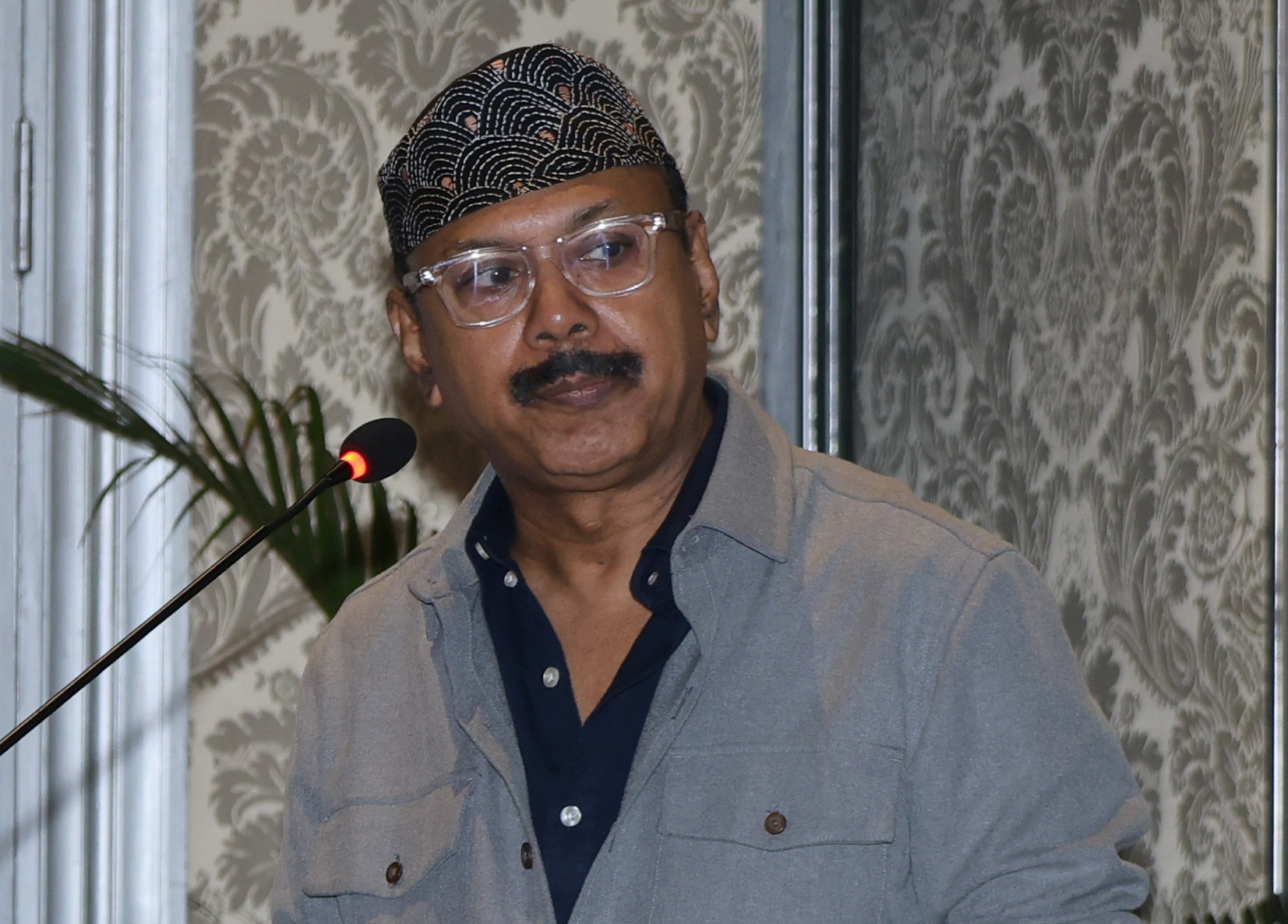
Mr. Josy Paul, Chairman and Chief Creative Officer of BBDO India on meaningful communications that work.
Thank you for having me. Being introduced to many of you, I sometimes feel a bit like I’m not worthy, but let me try. I’m not an expert. I’m a lover. The thing about being an expert is that an expert has a shelf life. After a point, the world moves so fast and change happens so quickly that the expert is not able to keep pace. But the lover will always be in love. When you’re in love, change does not matter. You receive it and you embrace it. So, for me, I see myself as a lover and not as an expert.
I’ve been in this business for a while, and I’m grateful to be in this business. I thank all of you for having me here. I want to start by saying that when we talk about meaningful communication that works, the first piece of work I saw when I was in college, which made me fall in love, was a print advertisement. It was not an Indian advertisement, but that didn’t matter because it connected with me. I’m sure it would connect with everyone.
It was simply a picture of a man running in the distance on a beautiful morning at dawn. You could barely see him because he was running so far away. It was a powerful, beautiful image. But there were some words on the side that caught my eye, and even today I can still remember them. They said: “They don’t let you into their schools. They don’t let you into their compounds. They don’t let you into their clubs. They don’t let you into their neighbourhoods. But the road… the road is wide open. Just do it.”
You realise they were talking to the African American community. For me, that was hair-raising. It told me that communication has power, that it can do meaningful things, and that it can speak to people in a way that truly connects. That’s when I realised that content is king, but context is King Kong. If you can sense the context, then you can truly move people.
I’m going to start by sharing a piece of my work, and then we’ll talk about it.
[Advertisement plays] https://youtu.be/vwW0X9f0mME?si=IGntkkCp4ecqmHav
When I wrote the line, “Is laundry only a mother’s job or a woman’s job?”, it didn’t sound like a very creative line. It didn’t sound like something written by a clever copywriter. But deep in my heart, I knew that this question was going to provoke people. This question was going to change something.
Not everybody got it, but I’m grateful that our clients did. The people at Procter & Gamble embraced this thought. Then I asked, what if we could break patriarchy? What if the father of a household said, “Sorry”? I love my dad. He’s an amazing man. But I’ve never heard him say sorry. I thought, what if he did? Oh my God, the world could change.
So we wrote a script around that and asked that question. The reaction from people around the world was extraordinary. I got calls and letters from people like Melinda Gates, Prime Ministers, and I thought, “Oh my God, I just made another advertisement. What happened here?”
If you go to the YouTube page, you’ll see at least 10,000 comments. People aren’t commenting about the advertisement. They’re commenting about their own lives. They want to share. It’s almost like therapy. That’s when I realised there’s something incredibly powerful about what we do in this industry.
When I say content is king, but context is King Kong, I mean that if you can sense the context, if you can understand what people are feeling, what the nation is going through, what the mood of the world is, and then bring that into your work, you can create meaningful work. Your work is not really about being creative. It’s about understanding how human beings feel. You’re simply trying to connect.
I put up a poster in my office after there was a big merger that said, “I report to humanity.” I don’t report to my holding company. I report to humanity. My holding company is humanity.
This is also why I started the agency with the philosophy, “Create Acts, Not Ads.” I felt that young people were telling us something important. Albert mentioned that I spent nine months starting the agency from the back seat of my car. That’s because I spent those nine months sitting in coffee shops, listening to young people in 2008.
Everywhere I went, people were saying, “We don’t believe in advertising. We don’t believe in what people are telling us. There are too many promises, and promises get broken.” It’s very easy to say, “I love you,” but people wanted proof. They wanted action.
That’s when we came up with the thought, “Create Acts, Not Ads.” Young people were saying, “Don’t tell me. Involve me. I want to be engaged.” Social media had just begun, and people wanted participation rather than persuasion.
I want to show you where this idea went. It’s been ten years. Year after year, we’ve stayed committed to this thought of Share the Load. Every year we discover something new. Every year we uncover a hidden truth, something that no one is saying but everyone is feeling. When you finally say it, people thank you for saying it.
I just want to share a two-minute case film that tells you the journey of this campaign that we have been very fortunate and blessed to be a part of.
[Case film plays]
The long-term impact of the Share the Load movement has been seen both on the brand and on society. When we began in 2015, 79 per cent of men believed that laundry was a woman’s job. Today, that number has come down to 25 per cent.
Sometimes, when you think about context, you’re fortunate to find a platform that can last this long. So how did we arrive at it? We have a room called the White Room, and I’ll tell you a little about it. It’s a room where people make confessions.
In 2015, we found that women spent five hours a day doing household chores, while men spent just 19 minutes. We felt that this was deeply unfair and wondered whether we could do something about it. So, when Ariel came to us, we thought it was the right time. As I said, content is king, but the context was important. The context was the unspoken conflict of inequality at home. Everybody was talking about inequality outside the home, but inside the home no one was talking about it. No government, no celebrity, nobody.
So we rewrote the expectations. The original brief from the client was: “Ariel washes away the toughest stain in just one wash.” That’s what they told us. We changed it to: “Ariel washes away the toughest stain in just one wash, and anyone can do it.” Those five words changed everything.
From there, we connected with retailers and introduced an additional instruction on wash care labels that read, “Can be washed by both men and women.” This was launched at a major PR event by Masaba Gupta, and many retailers and brands adopted it in their own wash care labels. As you saw in the film, we also replaced the names on Ariel packs with the names of men. These were all ways of growing the conversation.
I believe brands should be part of the conversation. But to be part of the conversation, you need to have a sense of the world. You have to feel what’s happening in the room. It’s that intuitive vibe you receive that helps you.
Conversation creates sentiment, and sentiment creates desirability. The thinking is that if I can provoke the world to talk about my brand, it creates sentiment, and that sentiment creates desirability, which ultimately helps the product sell.
I want to show you the secret behind our work. It’s called the White Room. Everything in the room is white because we feel it’s a place where you can surrender, talk and share. It’s a listening room. When people come together there, beautiful things happen.
I call it soul-storming, not brainstorming. People talk a lot about brainstorming, but I find that in brainstorming everyone is trying to be clever and show off. In soul-storming, the soul cannot be clever. The soul simply is what it is. We use that approach to discover deeper truths.
I’ll give you an example. We were asked by eBay, the e-commerce giant, to help define its purpose. I thought, “What a joke. eBay needs a purpose? Why would they come to an agency like us? You’re one of the biggest companies in the world. Surely your founders and consultants already know your purpose.”
But they said, “No, we want you.” I honestly felt we might not be up to it, but I thought we could at least try.
So I brought everyone into the White Room. Not just creative people, because I believe everyone is creative. Every one of us in this room could have sat there. I asked everyone one simple question: “Why do you buy things?”
At first, people tried to be clever. They talked about brands and tried to sound cool. Slowly, as we continued talking, I became more vulnerable about my own reasons for buying things. That encouraged others to become more honest.
After about two hours, one woman said, “I’d like to say something.” We said, “Of course.”
She said, “I’ll tell you why I buy things. I buy things because I was born a girl. My grandmother wanted a boy, and every time she looks at me, she looks disappointed. So I buy things to prove to her that I’m better than any boy.”
What a revelation.
Everyone broke down. People began to cry. I said, “Let’s stop the session.” But they said, “No. Don’t stop. We want this.”
For three hours, people shared the most honest stories. From that session, we developed nine beautiful territories for the brand. The one we finally chose was a very simple thought:
“eBay has 100 million things that don’t judge.”
A skipping rope doesn’t judge whether you’re 75 years old. A ring doesn’t judge whether you’re straight or gay. A diya doesn’t ask whether you’re Hindu or Muslim. Objects don’t judge people.
That became the idea: 100 million things that don’t judge.
That was the idea, and what was amazing was the response we got from the seniors at eBay across the world. They all began to write to us saying, now we know why we come to work. And imagine all this happened in this one humble room.
[Advertisement plays] https://www.youtube.com/watch?v=prNnTFKLJZM
As a writer, I don’t think you can come up with something like that unless you have the ability to listen. I can never feel something until I understand how you feel. That’s what we try to do in our work. We try to hear people. We try to listen.
People are looking for meaning, not brands. Everyone talks about brands, but what people are really looking for is meaning. If we can give people meaning, that’s enough. We simply try to understand what’s happening in their lives.
It’s not about big data. There’s a lot of talk about how the world is moving towards big data. But big data will never take you to the place we reached in that room. What happened there was confessional. It was someone speaking their own truth.
That’s why I say it’s about emotional data. It’s about confessions, not insights.
Insights look at groups of people and identify patterns. A confession is singular. But the beauty of a singular confession is that it becomes universal. When someone is truly honest, what they say connects with everyone.
That’s why we believe the personal is the universal. One person’s story becomes everyone’s story. When you’re genuinely honest, people connect with you. They feel for you. That’s what we try to do through our work.
When Ramesh asked me what I wanted the title of today’s talk to be, I said, “Meaningful work.” He said, “Yes, that’s probably what we should talk about.” It’s about impact.
I’ll share one last example; this one was particularly interesting. Procter & Gamble invited us to create a campaign for Whisper sanitary pads. Can you imagine? Four men attended the briefing. There was no way we could truly empathise or fully understand the subject. It was probably the most foolish thing we did.
There were six wonderful women from Procter & Gamble who briefed us. Because I didn’t know enough, I tried to sound a little smart. I said, “This brief is all very well, but why do you show blood as blue?” Back in 2014, every sanitary pad advertisement showed blood as blue. I don’t know if that’s still the case today. I said, “Everyone knows blood is red. Why are you fooling the world?”
They smiled and said, “You’re trying to be smart, Josy. Let us tell you something you don’t know.”
Then they began sharing their own personal experiences. It was an eye-opener. I realised there were so many things I had absolutely no idea about.
At that point, it stopped being a brief. It became a deeply emotional conversation. It’s like Martin Luther King Jr. didn’t say, “I have a brief.” He said, “I have a dream.”
That’s what happened in that room. Suddenly, it wasn’t about an advertising brief. It was about what young women dreamed of and hoped the world could become.
For me, that was extraordinary. It opened my heart.
I came back and said, “Let’s not make a 30-second television commercial. Let’s do something bigger. Let’s create a platform where women can speak. Let’s talk about an issue that nobody is talking about.”
That’s how we arrived at this campaign.
[Advertisement plays] https://www.youtube.com/watch?v=25jhsCOKScs
I must give credit to Procter & Gamble. It was a very sensitive subject and, at the same time, a very bold one. They conducted extensive research with women to understand whether this was something we could put out into the world. The women simply said, “You’ve got to do this.”
After that, the campaign took on a life of its own. There were volunteers, supporters and many others who carried it forward on the ground. It genuinely changed a lot of things in society.
I’m very fortunate to have had experiences like these because I’ve seen first-hand that the work we do, the work any of us can do, can have a real impact. When you experience that and it comes back to you, you realise that what made you fall in love with this profession is still what keeps you in love with it.
Of course, all this eventually led to us winning the Glass Lion Grand Prix at the Cannes Lions International Festival of Creativity. It was the first Glass Lion Grand Prix, which was a very significant moment. They even said, “We’ll send you a private jet.” Unfortunately, I couldn’t go because I didn’t have a French visa. So my team went on stage carrying a mask of me. That was incredibly kind of the team at BBDO and everyone at Procter & Gamble.
I believe creativity is the return gift of empathy. If you genuinely care about the world, if you sit with people and understand what they’re going through, you can create work that makes a difference.
That’s why I say creativity is sensitivity in a world where no one is listening.
Thank you so much.
ROTARIANS ASK
Q1. My question is about AI in the world of advertising. We all understand the use of AI in production and output. But I want to ask about the soul of what you’ve shown us. You spoke about soul-storming and the emotion behind these campaigns.
Do you see AI failing to replicate that? Is there a danger that too much AI could reduce the emotional depth of creativity? Or do you see a way of leveraging AI without losing that emotional core?
Mr. Josy Paul: Right now, I’m trying to make my ChatGPT cry with me, but it doesn’t show its tears. ChatGPT and AI can certainly generate beautiful stories. But I think it may take some time before they can truly express the truths that human beings live through.
When it comes to the early stages of strategy and creative thinking, the seed of an idea, I believe that still belongs to us.
In fact, I feel AI is making me more human, and it’s going to make all of us more human. The more we witness AI’s intelligence grow, the more we’ll realise that our real strength lies in our humanity. I think we’ll embrace that even more. We may eventually outsource our intelligence, but we’ll never lose our humanity. At least, that’s what I believe.
Q2. Josy, that was a fantastic presentation. Let me put you on the spot a little.
We’re going through an extraordinary phase in the country right now. We’re witnessing this huge youth phenomenon. Much of what you’ve spoken about is rooted in understanding people’s emotions and movements. We’re seeing people become passionate over a single remark. Someone has 22 million followers. People are flying from Mumbai and elsewhere just to participate in what’s happening. I’m talking about the youth movement we witnessed yesterday.
How do you read this? And if I were to make Josy Paul the campaign manager for Cockroach Party, that movement, what would you do? How would you approach it?
Mr. Josy Paul: That’s an amazing question. You really have put me on the spot. You know what? They don’t need an advertising agency. That’s honestly how I feel.
There’s something very organic happening. I don’t think we should try to bring science into it. It’s natural. It’s organic. It’s authentic. Why would you interfere with that flow?
Unless there’s a genuine issue that requires help, I don’t think there should be any intervention at this stage.
Let it flow. Let it grow. When the energy reaches a point where it genuinely needs support, then perhaps we can contribute. But right now, I wouldn’t touch it. It’s happening naturally. You don’t interfere in the fourth month of a pregnancy.
Q3. Very effective, Josy. Your advertisements are often quite long. When you have less time, how do you compress that storytelling? I also wanted to mention movements like One Billion Rising. Women make up nearly 50 per cent of the world’s population, so they’re an enormous market as well. Perhaps advertisers haven’t fully recognised that.
Mr. Josy Paul: On your first point about the attention economy and the idea that people only give you six seconds, that’s what everyone says. If you can’t communicate your message in six seconds, you’ve lost them.
Personally, though, I prefer not to think of it as the attention economy. I think of it as the affection economy.
When you offer people something that genuinely connects with their lives, they’re willing to give it time. People binge-watch for six or eight hours because they’re saying, “This is relevant to me.”
We’ve never really faced that problem. Some of our work takes time, but people want it. They watch it, they share it and pass it on to one another. It becomes viral because, sometimes, people don’t know how to express something themselves. They need your work to say it for them.
I remember sitting in a theatre when the Share the Load film was playing. I saw so many women gently nudging their husbands. That was their way of saying something without having to say it. When you give people language for what they’re feeling, they don’t mind giving you their time.
Q4. Josy, I find that your advertisements always begin with empathy, particularly empathy for women. For generations, men have often viewed women as inferior. Then you came along with the Ariel campaign and showed that men should share the laundry. It was a fantastic story. Where does that empathy come from in your own life?
Mr. Josy Paul: That’s a beautiful question, and I find it difficult to answer because I honestly don’t know. If I were to be completely honest, I think it comes from watching my mother. That’s probably where it began.
The other thing is that I’ve always felt I could create the kind of world that I would want to live in. Every piece of work I try to do is really an attempt to paint that world. I think, “Wouldn’t it be wonderful if the world could be like this?” In a way, I try to become my own Pied Piper. I want to lead myself into the world I dream of.
Perhaps that’s where it comes from.
Q5. Josy, I loved your talk. Tell me, how often do you use puns? People say puns are the lowest form of wit, but sometimes they can be very effective. While you were talking about menstruation, I thought of a line such as, “We finally got to the bottom of things.” What do you think of puns as a creative device?
Mr. Josy Paul: In the early days of advertising, you tend to want to be clever. You want to show off. You want people to say, “Look how smart he is. Look how brilliantly he writes.”
Over time, I’ve realised it’s not about you. It’s about the other person. If I can say something that enables someone else to express themselves better, then I feel rewarded. So my perspective has shifted over the years.
Q6. Josy, I wanted to ask about one of your punchlines: “Think like the Navy, act like a pirate.” In today’s world, with so many conflicts, one might instead say, “Think like the military and act like a soldier.”
What’s the real meaning behind that line?
Mr. Josy Paul: I wrote that a long time ago, when I felt there was too much strategy and too many people saying too many things in a room. Everything had become intellectually claustrophobic. There was too much order.
I felt the foundations that the Navy gives you are extremely important: discipline, principles and values. Those fundamentals matter. But after that, you have to surprise yourself. You have to surprise the world. That element of surprise belongs to pirates.
If I can combine the strong foundations of the Navy with the fearlessness and unpredictability of pirates, then I have the best of both worlds. That’s how I thought about it.
Q7. One thing that really bothers many of us in this room is the number of celebrities endorsing products that are clearly unhealthy. We see it all the time. Whether it’s junk food or other products, well-known personalities continue to promote them.
I understand why they do it, but what are your thoughts? And how can we put a stop to it?
Mr. Josy Paul: I think that’s an important question because, ultimately, it comes down to where you stand as an individual. It’s difficult to judge the world. You can only decide what you yourself are willing to do. You always have the choice to say no to that work. We simply don’t do that kind of work.
When we do work with celebrities, we don’t use them because they’re celebrities. We use them because they’re actors who help communicate the message we’re trying to convey. For us, the message is always more important than the celebrity.
We focus on the message, not the celebrity.
Q8. Josy, could you also tell us about a campaign that didn’t work? What did you learn from failure?
Mr. Josy Paul: That’s an important question, but, for some reason, I haven’t spent much time thinking that way.
I’ll tell you why.
There’s this concept called SWOT: Strengths, Weaknesses, Opportunities and Threats.
I’ve always felt it leads me in the wrong direction. This is just my personal view, but I prefer to focus only on strengths and opportunities. If each of us focuses on strengthening our strengths and expanding our opportunities, our weaknesses and threats gradually begin to take care of themselves. That’s probably my rather childlike way of looking at the world. So I don’t spend much time dwelling on what didn’t work. If it didn’t work, it didn’t work.
Of course, it’s valuable to discuss failure. Failure is an essential part of learning. In fact, my thoughts on failure are a completely separate subject. If you ever invite me back, I’ll happily speak about what I call the seven stages of pain, and what it means to build a career through the setbacks you’ve experienced.
I understand failure. I know what it feels like when things go wrong. I just don’t dwell on it for very long. I’ll leave you with one story.
We were pitching for ICICI Prudential Life Insurance, a very important account. This was for an agency I had started earlier called David. We had reached the final round.
Our campaign idea was, “Life is unpredictable. How prepared are you?”
The presentation was going extremely well. Then I made a very foolish mistake.
I thought, “What if we ended this presentation with an unforgettable act?” After all, my philosophy was Create Acts, Not Ads.
So I jumped onto the table, ran towards the Marketing Director, leapt on him and said, “Life is unpredictable. How prepared were you?”
We were immediately thrown out of the room.
We didn’t win the pitch.
But, in the end, you don’t have the account…you have a story.
Thank you. On that lighter note.
Q9. More and more young people are opting for ad-free subscriptions on YouTube and other digital platforms. What do you think the future of advertising looks like? How will you continue to communicate powerful messages to younger audiences?
Mr. Josy Paul: To be honest, we don’t think too much about it. We simply try to be true to ourselves and to the work. When we do that, we find that the right mediums naturally begin to carry the message.
Not everyone sees the work at the same time, so we can’t rely entirely on broadcasting. One person may be deeply moved by something, and that person then becomes the medium. That medium is an open one.
If Albert sees something and genuinely loves it, he’ll probably share it with your group. That’s not a subscription model. That’s a love model. That’s an affection model.
So we try to create work that is authentic enough for people to want to share it. We’re not completely dependent on broadcast media. The message travels through people, and eventually it seems to find its audience.
You’re right, though. There may well be more scientific ways of navigating subscription models by using Instagram and other platforms more effectively.
That’s also where the whole influencer ecosystem has grown. In many ways, it’s a form of subversion. You’re almost playing the pirate. You’re putting your message out into the world without it appearing to be a conventional advertisement.
There are many ways of subverting the traditional broadcast model.
Thank you.