
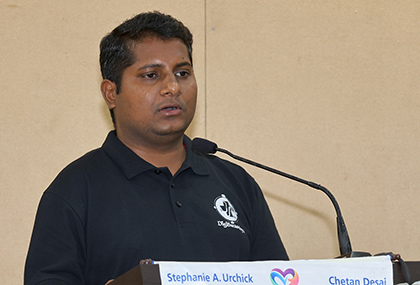
Mr. Sandeep Kumar, Founder & CEO of DigiSwasthya Foundation, on Bridging the healthcare gap in rural India
Ladies and Gentlemen, a very warm thank you to everyone. Today, you have allowed us to share our journey with you. The vision and objective of the DigiSwasthya Foundation is to reach those places where healthcare services are either minimal or severely limited. With this very thought, we began this foundation, with a small idea: to serve where the need is greatest.
We begin recounting our journey with a story — the story of Manisha.
Manisha was 20 years old at the time when a lump developed on her right leg. That lump gradually grew, and after medical tests, it was confirmed to be cancer. She was taken to the Tata Centre in Varanasi for treatment, where chemotherapy was initiated. However, when it was time for surgery, doctors informed the family that there was a possibility that Manisha’s leg might have to be amputated. Hearing this, her entire family became frightened. The thought of losing her leg terrified them so much that they discontinued her treatment and took her to a ‘Baba’ in Rajasthan for alternative therapies.
Around two months later, we came to know about Manisha through another patient who was receiving treatment in Varanasi. During our conversation, she said, “Bhaiyya, Mum told me not to tell anyone, but we’ve stopped the hospital treatment because the doctors said the leg might have to be removed.” I was stunned to hear that even in the middle of active treatment, the family had walked away from it and chosen a different path.
I then spoke to her uncle, and later to her mother. Eventually, we brought Manisha to Mumbai for a second opinion and showed her to a renowned orthopaedic surgeon, Dr. Manish Agarwal. After that, she underwent the surgery, treatment resumed, and her leg was saved. A knee replacement was done, and she made a full recovery. She then underwent two more cycles of chemotherapy.
After completing her treatment, Manisha resumed her studies and worked with DigiSwasthya for two years. Today, we are delighted to share that just last month, she joined the recently operational Tata Hospital in Muzaffarpur, Bihar and is now employed there under the Government of India.
Perhaps, had we not met her at that time, had we not spoken, the story would have turned out very differently.
My own journey began in 2007, when I was diagnosed with bone cancer. A lump had appeared on my right arm. What followed was a long and uncertain road — visiting hospital after hospital, one doctor after another. I wandered relentlessly.
After around eight months, I went to Gorakhpur, nearly 60 kilometres from my home. The doctor there said my arm would have to be amputated. Not only that, they also said they could not guarantee my survival even after amputation.
When my father came out of the OPD, he broke down in tears. I couldn’t understand what had happened, what went so wrong with me. The very next day, he said, “We need to go to Mumbai.” And so, we came to Mumbai and reached Tata Memorial Hospital. My treatment began there — several tests were conducted, and then a 14-cycle chemotherapy regimen was initiated. The treatment was long, but the doctors gave us a lot of courage. They said, “We’ll do our best to save the arm.”
Months passed with multiple cycles of chemotherapy — pain, exhaustion… but with the support of my family and the unwavering efforts of the doctors, things started to turn around. Eventually, I underwent surgery, and my arm was saved. The humerus bone was replaced, and gradually I began to recover.
After treatment, I slowly started returning to a normal life. I resumed my studies and began to rebuild myself. But that experience changed me completely. I came to understand what a patient and their family truly go through — the fear, the uncertainty, the mental and financial stress.
All this had happened to me by the time I was just 12 years old, and back then, I had no idea what I wanted to do or how I would move forward. Once the treatment was complete, I returned to my village. I completed my education there and later came back to Mumbai.
In 2015–16, I did a short course at TISS. After that, I began working with a few NGOs in Mumbai, including CanKids, ICS, Axis Life, and We Care Foundation. While working with them, I returned to my village during the COVID-19 pandemic. During this time, I had the opportunity to observe and understand the lives of people around me in depth.
Even 17 years after my own treatment — nearly two decades later — I noticed that people are still facing the same issues: no timely or accurate diagnosis, and a severe lack of awareness. Patients are still going from one hospital to another in search of answers.
The struggles were especially evident among women. Many couldn’t even tell their husbands or guardians about the pain and suffering they were enduring. When they experience discomfort, they first try balms, oils, or home remedies — or buy some pain relief tablets from a medical shop. Only when the pain becomes unbearable do they speak to their families, by which time the disease has often progressed significantly.
Some people do manage to reach the city for treatment, but despite our best efforts, we are not always able to save them. So the question arose: What more can we do?
We delved deep into this. We studied the situation around us, combed through government data, and examined the condition of rural healthcare. And it was from that point that a new journey began.
But before I tell you more about that journey, I’d like to share a short video with you — a 90-second film. In 2023, I had the honour of representing India in Ireland and, during that time, the Ministry of Information and Broadcasting (MIB) created this video.
VIDEO (transcript)
Access to timely and appropriate medical care in rural areas has long posed a challenge, leading to compromised health outcomes and heightened vulnerability to a range of diseases. Sandeep Kumar experienced this first-hand in 2007. He fell seriously ill but was unable to receive a timely diagnosis. Owing to a lack of qualified doctors and inadequately equipped hospitals in his region, it was only after several months of uncertainty that he was finally diagnosed with bone cancer.
Determined to turn his difficult experience into something meaningful, Sandeep chose to dedicate his life to supporting others facing similar healthcare access barriers. Understanding the unique challenges rural communities encounter, he went on to establish five DigiSwasthya telemedicine clinics across three states.
These centres are equipped with essential infrastructure, trained local staff, and telemedicine technology to offer remote medical consultations and treatment.
Through DigiSwasthya, Sandeep and his team have harnessed the power of technology to improve rural healthcare in India. To date, they have served over 23,000 patients, organised approximately 650 health awareness camps, and onboarded 119 specialist doctors. The organisation now aims to establish DigiSwasthya centres across the country. DigiSwasthya is transforming India’s primary healthcare system by creating a network of standardised clinics. The nation salutes changemakers like Sandeep for their unwavering commitment to improving the lives of the rural poor.
This video, created by the Government of India, was shared on their official social media handles. I wasn’t even aware of it until a friend sent me the link and said, “Your photo’s in this!”
I replied, “Really? Is that so?” I watched the video and only then realised that the government had posted it on Twitter. We saved that video so we could share it with our donors and others.
So, as I was mentioning earlier about data — this video became an important piece of that narrative.
Roughly 65% of India’s population lives in rural areas, where access to qualified doctors is extremely limited. Even today, 80% of medical treatment in these areas is carried out by unlicensed practitioners. Nearly 80% of healthcare expenses are paid out-of-pocket by individuals.
Although the government has launched several health schemes, most people are unaware of them, of which treatments are available under which scheme. And even if someone does have a health card, many dismiss it, thinking, “What’s the point? We’ll deal with it if we fall ill.” These are some of the ground-level challenges we’ve encountered time and again.
Our vision and mission remain clear:
Mission Statement: Making healthcare services affordable and accessible for rural communities across India by leveraging technology.
We work in places where hospitals and doctors are absent. We rent spaces of around 200 square feet to set up telemedicine centres. At each centre, we hire 3-4 local individuals, such as a patient navigator, a nurse, and a community mobiliser. These staff members go door to door in villages, raising awareness about diseases, their symptoms, and the availability of treatment.
Each centre is equipped with a medical kit that allows for basic vital checks. If required, the patient is connected to a doctor for a teleconsultation. If the doctor recommends a referral to a larger hospital, we guide the patient on which government scheme, NGO, or support group could help cover their treatment. We provide hand-holding throughout — not just information, but active assistance through the next steps of the medical journey.
Before opening a centralised clinic in any area, we always carry out a needs-based assessment to ensure the intervention is genuinely required.
Our Work So Far – We have implemented this model in the states of Uttar Pradesh, Bihar, and Maharashtra.
To date:
- Over 74,000 patients have received specialist consultations.
- We have organised 1,851 health camps.
- More than 78,000 health check-ups have been conducted.
Through our data, we’ve also demonstrated how DigiSwasthya has helped patients save time, money, and long travel distances that they would have otherwise incurred by travelling from rural areas to cities for medical care.
Our model is: “By the community, for the community.”
It is a scalable model that offers specialist teleconsultations and is entirely operated by members of the local community. Let me share an example — a patient named Balu ji developed a serious problem in his foot: his toes had begun to rot due to excessive chemical exposure while working in the fields. After medical tests, it was discovered that he had diabetes. With proper treatment, his sugar levels were brought under control and his foot healed. Earlier, someone had incorrectly told him that he had cancer, which turned out to be a misdiagnosis. Cases like this are not uncommon, where incorrect diagnoses lead to unnecessary and sometimes harmful treatments.
We now aim to bring healthcare services to 100 locations. And to achieve this, we need your support. Whether it’s helping us connect with communities, identifying areas of need, or building partnerships with the government, such as with Primary Health Centres, Community Health Centres, or Ayushman Arogya Mandirs, we aim to integrate our model with these existing systems so that more patients can benefit.
So, if you are connected in any way or know someone we can reach out to, please support us, guide us, and help us extend our services to more people.
We also have an advisory board, but the journey so far has not been easy. Running a not-for-profit organisation without a strong background or support system is especially challenging. My father comes from an agricultural background, and so this entire journey has involved tremendous struggle.
Despite that, many individuals have come forward to support and guide us, making everything we’ve achieved possible. We have a small but dedicated core team that works together to take this mission forward.
We’ve partnered with the government at several levels and also tied up with national and international organisations and conferences, such as:
- FICCI India
- Nagpur Municipal Corporation (NMC)
- Childhood Cancer International
- Atal Incubation Centre
On the donor front, we’ve received valuable CSR support from several institutions, including:
- IRCTC
- ICICI Lombard
- Dr Lal PathLabs
- JDA
- SBP India
- Coal India
- CII Foundation
- Agnito
I would like to take a moment to speak about Agnito. We met Mr. Rustom Lawyer, the founder of Agnito, in 2021. Since then, he has consistently supported us, and it is thanks to him that I’m even able to share our journey with you all today.
We’ve also received media coverage over the years. Most recently, we signed an MoU with Nagpur Municipal Corporation (NMC) to collaborate with their existing health centres and scale our work further.
In some of the photographs, you’ll see how we conduct basic vital checks, how we’ve set up patient waiting areas, and how patients are connected to doctors via teleconsultation. Where required, referrals and follow-ups are also arranged.
This has been our humble journey so far.
ROTARIANS ASK
- Where are your centres located?
Sir, our centres are in: Uttar Pradesh – in Sant Kabir Nagar and another district called Sonbhadra, Maharashtra – in Palghar, Pune, and Nagpur and Bihar – in Muzaffarpur. - How many centres do you have?
Currently, we have five telemedicine centres of our own, and two centres that operate in collaboration with the government. So in total, we are operating at seven locations. - When you enter a new area, how do you communicate with the local people? Because often the patient doesn’t even know how to explain what’s wrong. So how do you take the patient’s medical history? For telemedicine, you need data — whether it’s the doctor at this end or understanding what the patient’s issue is. So how do you train local-level people to collect that data?
Right, ma’am. So whenever we start a new centre, we hire three to four staff members, which typically include: a patient navigator, a community mobilizer, a centre manager and a nurse. Whoever we onboard undergoes a one-week to ten-day training programme, where they are taught:
- How to conduct vital checks
- How to make data entries in the software
- How to manage follow-ups
- How to communicate effectively, i.e., how to convey the patient’s concerns to the doctor
All of this is done under close observation during training. Once training is complete, we continue to support them through:
- Weekly calls to check specific parameters and progress
- Monthly visits to the centres for further monitoring and support
- In telemedicine, patients are present everywhere, but doctors are not always available. So how do you manage that? For instance, I’m a doctor—I’m busy, and your patient is waiting. Since you are coordinating, how do you manage my time and the patient’s time?
Right, ma’am. So far, we have 207 doctors onboard, of which around 60% are specialised or super-specialised, and 40% are general physicians, with a minimum qualification of MBBS.
- MBBS doctors are available from 8 AM to 10 PM.
- Specialised doctors follow a scheduled slot system from Monday to Saturday, depending on the type of disease. Some are available for 1 to 3 hours per day depending on their specialty.
Every type of illness has designated doctors and a schedule. We also send reminders to the doctors. For example, if we need orthopaedics, we have 6-7 orthopaedic specialists available. - We also take prior confirmation from the doctors about their availability in the assigned slot. If a doctor isn’t available, we immediately arrange for another.
But yes, as we talk about scaling — like reaching 100 centres across the country — there will be a much higher need for doctors.
So again, a humble request to everyone: if you know any doctors in your network who can give even a few hours per week, it would be immensely helpful. Please connect them with us. Even ma’am (on stage), I would kindly request that if you could help us connect with doctors, it would be a great support.Thank you, ma’am.
- Sandeep ji, you’ve made a very good point. You’re currently operating in seven locations and your target is 100. So, could you share what your current expenditure is and what the estimated cost would be for reaching 100 locations? That is, if it’s not confidential. Since you’re also working in collaboration with the government — Ayushman Bharat, for example — how much of the budget currently comes from the government, or could come from them in the future? Because ultimately, this kind of social work should ideally be taken up by the government.
Sir, actually it’s now been five years since we began this journey. And in these five years, we’ve struggled a great deal, particularly just to get basic introductions with district-level officials like Chief Medical Officers (CMOs) and District Magistrates (DMs). We would often go to their offices and be turned away at the gate, because without references or contacts, it’s nearly impossible to get a meeting in any government office.
But just recently, after a lot of effort over the past year, we signed an MoU with the Nagpur Municipal Corporation (NMC). Showing that one MoU, we have now started discussions at the state health department level in Lucknow. Similarly, we’re in talks with the Zilla Parishad in Pune to work together in rural areas.
You’re absolutely right, sir — health is a state subject. And although funds are being allocated and work is happening on paper, the ground realities remain unchanged. That’s probably why there’s still a strong need for NGOs and donor support.
As for the costs — on average, one general consultation for a patient costs us ₹300. Each centre serves around 8,000 to 10,000 patients per year, so you can calculate the annual cost per centre from that. Of course, it varies: some centres see as few as 6,000 consultations per year, others up to 10,000, depending on geography.
Once we start working with the government in an integrated manner, it usually takes six to twelve months of collaboration to be able to clearly demonstrate outcomes. For example, we can show them: “Here’s a gap we identified, here’s how we addressed it.” Then moving forward, the government can take over—whether by hiring staff on their own payroll or by allocating funding accordingly.
In the case of NMC, we’ve received a verbal assurance… sir told us, “For the first year, you work through CSR support. From the next year onwards, we will fund your work under NMC.”
- Tell me one thing — when doctors prescribe certain medications that are actually needed, those medicines must be difficult to obtain, right? So how do you manage that? Where do you source them from, and how are they funded?
Sir, as I mentioned earlier, at some of our centres, donors provide us with medicines to distribute. But in locations where medicines aren’t available, we do face quite a few challenges.
We request the doctors to prescribe generic medicines. However, the doctors often say, “Sandeep, the patient’s condition has persisted for 3 to 5 years. Generic medicines will work, but their effect will be slow and gradual. If we prescribe patented medicines, they’ll work faster.” So there’s often a back-and-forth discussion with the doctors — our aim is to provide whatever is feasible for the patient.
When we approach CSR partners, many say, “We won’t deal with the medicine component. If something is happening on the ground, you’ll be responsible.” So we encounter different questions and challenges from different quarters.
The solution, sir, is that we tie up with local pharmacies. We manage to get discounts of up to 50% on medicines for the patients. For patients who absolutely cannot afford the medicine, we sometimes cover the cost ourselves—but not for everyone, as we too have limitations and expenses.
This remains a challenge, sir. For instance, we did try collaborating with Cipla, but even there the issue was that they weren’t ready to provide free medicine donations. They said, “As we’re in the pharma industry, we cannot directly donate our products. However, we can offer a 73% discount.” That still meant we had to cover the remaining 27% of the cost. So, there are always these sorts of challenges, sir.