
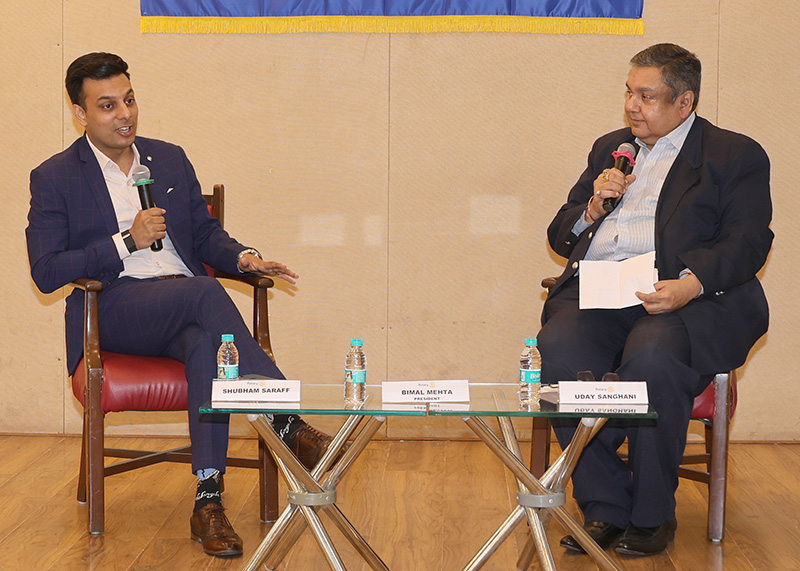
Mr. Shubham Saraff, Futurist, TEDx speaker on AI, in a fireside chat with Rtn. Uday Sanghani on ‘From Mumbai to Palo Alto: What AI Means for Indian Business and Society’.
Rtn. Uday Sanghani: Congratulations on your awards and the great work you’ve done in the field of AI at such a young age. Let’s start at the very beginning — how did your AI journey begin?
Mr. Shubham Saraff: Firstly, thank you so much, Uday. Thanks, Bimal, for inviting me, and I’m looking forward to talking today in front of all of you, especially in front of somebody who’s been my guiding light. So thank you, Shailesh uncle, for being here today.
My journey started in an interesting fashion; I always told my parents that even though I would become an engineer, they should never call me one, because I was pursuing engineering purely out of curiosity about how the world works. I didn’t want to do the typical work of an engineer. But God has his own plans, and I actually became an engineer, as deep as one can get.
It started with reading books. The first book that really got me into AI was The Phantom in the Brain by Dr. V.S. Ramachandran, the father of modern neuroscience, when I was in the 9th standard. This was around 2013-14. Each project I worked on at that time was driven by a desire to solve a problem.
My neighbour used to stutter, and his son, Aryaman, one of my favourite little kids, initially spoke normally until the age of three. But by the time he turned four, he began to stutter quite frequently by observing and imitating his father. He didn’t have a speech disorder — he simply acquired stuttering by mimicking his dad’s speech patterns. That incident led me to combine what I had read in Dr. Ramachandran’s book with practical application.
For three and a half years, I worked on creating my first application — one aimed at curing neurological disorders like stuttering and stammering using natural language processing, what we now call AI. That project was later recognised with an award. I never planned to become an AI researcher; it happened very organically.
When I presented this research — through 9th, 10th, 11th, 12th, and my first year of engineering — I learned that every year in London, three awards are given: the Michael Faraday Award, the Benjamin Franklin Award, and the PATW Award. In 2017, the Michael Faraday Award went to Bjarne Stroustrup, the inventor of C++; the Benjamin Franklin Award went to the inventor of the blue LED light; and, by God’s grace, the third award went to my research on curing neurological disorders. That’s how my journey started.
From there, the world of AI research opened up to me. I was invited to the Cambridge University World Summit to present research on how to impart emotional intelligence in autonomous systems, and then to Harvard in 2018, where Google picked up my research as a global case study.
That led to advisory roles, including being on the board of the IET — one of the largest technology bodies in the world, patroned by the Queen of England (now the King). I was the first Indian to serve on its 10-member board from 2018 to 2021, handling AI, IoT, and blockchain. So, that’s how my journey in AI began, and it’s been eleven and a half years since.
Rtn. Uday: Phenomenal. Given that you have such a great body of work, you had a clear path to continue in Palo Alto or London. So why did you come back to India?
Mr. Saraff: The reason is an individual sitting here — Shailesh Haribhakti — who inspired me to return to India. I had spent significant time in the UK and was preparing to move to the US, after serving on the board in the UK for about three years. I had also been advising venture capital and private equity firms making deep-tech investments in AI.
I spent some time with ICICI Securities, working in the broking space alongside the Managing Director. After that, I returned to the UK to study at Oxford, which opened an opportunity to move to the US. I had even found a house two blocks away from where Steve Jobs lived and planned how I’d commute to Stanford and Berkeley to hire for my next venture. Everything was set.
Then I met Shailesh uncle, who had come to Oxford. We spent three wonderful days together, during which I described the work I’d been doing in research, policy, and advisory, and the startup I planned to build. He told me, “Shubham, you should probably see what’s happening in India — it’s moving faster than what you see in the UK or Europe. Just spend three or four months in India before you decide to shift to the US.”
Those few months I spent in India led me to permanently settle in Mumbai. Shailesh uncle and I co-founded a company called Stair Digital, which focuses on bringing enterprise-grade artificial intelligence to mid-sized, listed, and large organisations — enabling them to truly be AI-powered.
I can confidently say I have zero regrets. In fact, the opportunities available in India trump those in the US or the UK today — and “trump” is indeed the right word to use here.
When I was at Oxford, most of my friends were between 35 and 38 years old — former strategy heads for the Australian Army, ex-McKinsey associate directors — highly accomplished professionals. Yet, the kind of work they were getting in the UK, across Europe, and even in parts of the US was relatively limited. Apart from a few tech-forward regions such as Palo Alto, California, Seattle, Boston, and now perhaps Miami, other areas were not as tech-friendly or as quick to adopt emerging technologies as one might expect.
The same can be said for Europe, Australia, and New Zealand. In contrast, the work happening in India is truly deep and impactful. The acceptance of these technologies here is far greater, and we’re seeing adoption at a population scale.
What surprised me most during my work was how India is looking at technology and AI not in isolation, but as part of population-scale systems — through digital public infrastructures such as UPI and Aadhaar. Our banking and financial systems are among the fastest and most deeply integrated with AI in the world.
And this isn’t just post-2022 “GenAI hype” — it’s real, deep integration of artificial intelligence into how the country operates. So, the journey from Mumbai to the UK or Palo Alto and back to Mumbai has been truly fulfilling. I genuinely see the wave of AI in India as a tsunami — stronger and more transformative than anywhere else in the world.
Rtn. Uday: So now the base is India, Mumbai?
Mr. Saraff: Yes, it is.
Rtn. Uday: Wonderful — so we can meet you more often.
Mr. Saraff: Of course. We’re right at Free Press House, so you could always meet us very soon.
Rtn. Uday: That’s great, Shubham. There’s so much about your body of work that we could go on discussing, but let’s deep dive into the subject of AI. I’m sure there are many questions here about how we can implement AI into our own areas of work. In one of your TEDx talks, you said, “AI is the new fire.” Tell us a little more about that.
Mr. Saraff: That’s an interesting one, Uday. I often compare AI to fire in two very distinctive ways. The first is the discovery — or rather, the control — of fire. When humankind learnt to generate heat and light at will, it changed civilisation forever. It allowed humans to explore places they never could before. Until then, civilisation was confined to regions with comfortable temperatures, but fire enabled us to survive in colder areas, explore the Arctic and Antarctic, and have light and warmth at night. This discovery evolved human capability almost overnight.
Similarly, today, the ability to compute and generate intelligence using artificial systems allows human civilisation to explore realms we never could before. One very obvious example is space exploration. If we ever have to send humans to Mars, we will first send probes. However, a probe communicating with Earth takes about nine minutes for a signal to reach here and another nine minutes for a response to return. That’s 18 minutes before a decision can be made, which is too long in a critical scenario. Hence, autonomous systems trained to think and act independently are essential. They allow for discovery and exploration beyond the limits of human capability — just as fire once did.
The second way AI resembles fire is in how it exponentially expands human capability. Fire didn’t just make us slightly better; it transformed civilisation in one shot. Similarly, AI enables us to perform repetitive tasks at scale, with greater efficiency and hyper-personalisation. It opens up use cases we’ve never imagined before. In that sense, AI is as instrumental to humanity today as fire was in ancient times.
Of course, we can extend that comparison to other pivotal inventions — the automobile, or even written language. All of these innovations changed the trajectory of human progress. Interestingly, when written language first appeared in Mesopotamia on clay tablets, it wasn’t welcomed. There were uprisings because people feared that writing things down would erode memory and intelligence. It’s the same kind of fear we hear today about AI.
I remember my grandparents telling me, “You don’t remember phone numbers or addresses the way we did,” because we now store them in our phones. But that doesn’t mean our memory is worse — it simply means we’ve evolved. Likewise, AI isn’t taking away our capability; it’s augmenting it. So yes, I truly believe AI is to our era what fire was to early mankind.
Rtn. Uday: Absolutely. And the other analogy that comes to mind is that AI is like electricity — it’s going to be omnipresent, in everything and everywhere. Brilliant. Let’s go further down and make this relevant to our audience. Many of our members here are business owners and leaders from BFSI, healthcare, retail, and other sectors. Give us some specific use cases of how AI has been adopted to transform these industries — maybe start with BFSI, healthcare, and retail. We can then talk about professionals like doctors, lawyers, and chartered accountants, since nearly half of our Rotary members belong to those fields.
Mr. Saraff: Lovely. So, of course, banking and financial services have been among the biggest adopters of AI — and India is leading that charge. One of the most fascinating and impactful use cases has been credit inclusion. Traditionally, people without formal credit histories couldn’t access loans because they didn’t have a bureau score. AI has enabled financial institutions to assess the creditworthiness of low-income workers using alternative data, evaluating their ethics, repayment intent, and capabilities. This wouldn’t have been possible without AI’s computational power. It’s a beautiful example of how technology can drive social inclusion.
Another major use case in BFSI is fraud prevention — particularly anti-money laundering and anti-financial crime. Every day, across the world, millions fall victim to scams and fraudulent schemes. Today, AI-powered systems can detect money-laundering trails, trace fraudulent networks, analyse call patterns, tonality, regions of origin, and even predict targets. These systems can stop financial fraud in real time, protecting both institutions and individuals.
What’s remarkable is that these technologies are not only cost-efficient but also revenue-generating for financial institutions. They create safer financial ecosystems while expanding access to credit and economic growth — truly a win-win.
Moving on to healthcare, the United States currently leads in AI adoption in this sector, but India is rapidly catching up. AI is now used at scale to analyse medical imaging — MRIs, CT scans, endoscopies, colonoscopies — to detect disorders early, even before symptoms appear. It can predict complications without invasive procedures like biopsies. That’s like having an early warning system for the human body.
Beyond imaging, AI is also driving hyper-personalised medicine — mapping DNA and genetics to predict health outcomes unique to each person. The result is better diagnosis, reduced costs, and, ultimately, longer life expectancy worldwide.
In retail, AI has completely flipped traditional business cycles. Earlier, companies manufactured inventory and then pushed it to marketing and sales teams to sell. Today, sales and field data drive production decisions. Retailers now forecast demand months in advance. Fashion and e-commerce brands can decide in January what they’ll produce for December.
We’re even seeing this transformation in traditional industries like dairy and ice cream. AI enables them to automate operations, forecast demand, assess markets, personalise pricing, and optimise delivery — ensuring products reach the right place at the right time. From small D2C brands to large enterprises, every retail player in India today is using AI in some form.
Rtn. Uday: Thanks, Shubham. Anything that comes to your mind for professionals — doctors, lawyers, chartered accountants?
Mr. Saraff: Of course. Uday, you were asking how professionals or individuals can adopt AI in their day-to-day work and how to introduce it into their professions. Across the spectrum — both in professional and personal life — there is a simple way to bring in artificial intelligence or emerging technologies. Any form of tech that enables faster growth begins with tracking every single action you take daily — whether for your business, professional activity, or even at your job.
Once you journal your actions and observe them over a period of five to seven days, they can be categorised into two buckets. Category A includes the things you’ve cracked — the ones that work like clockwork. These could be tasks in your profession as a lawyer, doctor, chartered accountant, or employee within an organisation — things you do efficiently and successfully. The second category includes areas that need improvement — things that aren’t working because of missing data, limited market information, or a lack of expertise in pricing or scaling.
AI can percolate into both these areas, but in different ways. For what you’ve already mastered, AI helps replicate and scale it up. If you can currently handle five clients efficiently, AI can help you manage 500 with the same team — with greater efficiency and personalisation. For the second bucket, AI acts as a companion or team that generates market insights at your fingertips, provides targeted analysis, and replaces the need for multiple people performing research or data tasks.
In every profession, AI can enable growth at scale, with sharper client focus and better anticipation of market trends — allowing you to stay ahead of the curve.
Rtn. Uday: Thanks, Shubham. So, we’re not talking about the hype around GenAI or Agentic AI and all of that. We’re referring to writing algorithms that help solve real business problems, right?
Mr. Shubham Saraff: It’s actually a combination of both. The advent of large language models — OpenAI, ChatGPT, Perplexity and others — has deep-rooted implications for solving language-related problems that were previously impossible, especially in vernacular contexts. For instance, during the Mahakumbh in India, people could query a bot in 18 different languages and get accurate responses. That wouldn’t have been possible without generative AI or LLMs.
Anything subjective or previously difficult to contextualise is now far easier to process and deploy in a human-like, understandable format. On the other hand, algorithmic AI — the non-generative form — is used deeply across enterprise departments. We’re seeing its use in traditional businesses: automating factories, optimising logistics and supply chains, designing marketing strategies, streamlining finance operations, and even building large-scale digital public infrastructures that reduce fraud and generate value for millions.
So yes, both forms of AI — generative and algorithmic — integrate depending on the problem at hand.
Rtn. Uday: Great. So, to achieve this, do I need to hire a Chief AI Officer or a Chief Digital Officer, or bring in a data scientist? Or should I approach a consultancy firm to help identify the low-hanging fruit and transform my legacy processes into AI-enabled ones?
Mr. Saraff: The world is moving rapidly, and for large enterprises, it’s challenging for existing leadership — CEOs or CTOs — to fully take on this task alongside their existing responsibilities. That’s why the role of the Chief AI Officer has become so relevant globally. Such a role allows every department to be viewed through the lens of AI, without conflicting with the other priorities of a CFO, CTO, or CEO.
For large enterprises, appointing a Chief AI Officer makes sense. But for mid-sized organisations, it may not be feasible to maintain such a role daily. In those cases, consultants or third-party experts become essential.
At Stair, we believe that before an organisation becomes AI-enabled, it should undergo a diagnostic across all departments to identify where AI can move the needle — whether by upgrading legacy systems or adopting digital-first processes before advancing to AI. Sometimes, businesses can leap directly from legacy to AI, while others need an intermediate phase of digitisation. So, consultants work best for mid-sized firms, while larger ones should have a dedicated Chief AI Officer and team.
Rtn. Uday: Talking about the flip side — there’s a lot of discussion around ethics, bias, hallucinations, and fear that AI might generate results misaligned with a company’s vision or customer values. What are your thoughts on this, and what progress has been made globally?
Mr. Saraff: Ethics and biases are indeed major topics in every boardroom discussion today. Biases do exist in large models, but the fear business owners have — that AI might produce irrelevant or biased outcomes — is somewhat misplaced. The key is to understand that AI isn’t an all-encompassing solution; it’s a tool for specific tasks.
When businesses adopt AI, they must clearly define the desired outcomes. Ethical considerations and bias management are crucial, and global efforts are underway to address them. For instance, in the capital markets, we’re working on a bias management system to help investors avoid behavioural biases in stock trading. Using AI, we can predict and prevent such tendencies and design unbiased investment strategies — something already achievable today.
Rtn. Uday: Just one last question before we wrap up. Many people ask — my son or daughter is graduating soon, and the line between domain knowledge and technology is becoming increasingly blurred. What should young professionals do to better understand AI, so that when they enter the corporate world, they’re already comfortable with it? Any advice for this next generation entering the workforce?
Mr. Saraff: Well, that’s a good one. Shailesh uncle and I always say that whoever joins the team must be “AI first.” The simplest way to approach it is to think of AI as a companion. For enterprises, it’s different, but for young people — or any individual, really — AI should be viewed as a companion in both professional and personal life. The moment you start using AI wherever you feel there’s a lack of information, or where better decision-making is possible through data consolidated at scale, you’ll begin to see its real value.
That’s exactly how young individuals should enter corporates — by using AI and large language models as companions to enhance their work, generate better inputs, and support more informed decisions. Whether in a creative or professional field, AI should be a collaborative partner in every activity.
Rtn. Uday: Very well said. If you had to describe India’s AI future in one word, what would that be?
Mr. Saraff: That’s an interesting one. Instead of overhyping it, I’d say India’s AI future is young. I use the word “young” because while we’re a powerhouse today — ahead of several regions like Europe, Australia, and parts of Canada — we still face risks. We’re full of energy and potential, with immense manpower and talent, but we also need maturity in policy and ethics. We must ensure AI is adopted across industries responsibly, just as China has done, far better than even the United States.
So yes, while we’re young and full of potential, we need structured policies and a mature approach to fully harness this power.
ROTARIANS ASK
Hi, thanks. Wonderful talk — one of the best I’ve heard recently. One quick question: you spoke about ethics and the risks involved, but what about what’s happening now with Common and Perplexity, with indirect prompt injections? For a layman who’s just using these tools while someone in the background is creating an AI model to act based on those prompts, what kind of risks does one run in such cases?
The ongoing conflict in the West between Perplexity, OpenAI, and other LLM providers is really about each trying to establish its niche and specialisation. In the process, some practices may not always benefit the consumer, which is what we’re seeing today. This is exactly why regulatory oversight is becoming essential to manage such systems and ensure consumer protection.
Shailesh uncle recently wrote that nearly $1 billion is being spent every single day on developing AI technologies. However, this investment shouldn’t be limited to building models or data centres; it must also be directed towards balancing these systems to prevent the misuse of consumer data. Technologies like self-sovereign identity (SSI), which return data control to users — including data entered on platforms like Google or chatbots — will become crucial over the next five to seven years.
Europe has already implemented such data protection laws, and India is moving rapidly in that direction. Given our strong digital public infrastructure, we are well-positioned to be global frontrunners in establishing standards for data protection, digital identity, and consumer ownership of information.
Earlier, the buzz was around language learning models like ChatGPT, then it shifted to generative AI, and now everyone’s talking about agentic AI. Can you throw some light on how transformative agentic AI can be and how prepared India is for it?
Agentic AI is going to be even more transformative than people realise. It’s genuinely one of the most evolutionary pieces of technology developed so far. To clarify, agentic AI differs from generative or LLM-based AI in that it performs specific, repetitive tasks end-to-end — from sensing information, researching, and generating insights, to actuating an action — independently and autonomously.
It can still involve humans when needed, but functions largely without human intervention. This makes it one of the most revolutionary innovations of the past 20 years. Agentic AI will be used widely — for example, we’re currently developing an agentic AI use case for the pharmaceutical industry, which is highly regulated and allows zero tolerance for non-compliance. An agent can perform a thousand times better than a tired employee reading thousands of pages of regulatory guidelines and missing a key clause.
Agents are already the future — they’re performing exceptionally well in industries using AI. India is well prepared, given that ERP systems across industries are established and mid-sized firms are increasingly becoming data-driven. This readiness enables quick adoption.