
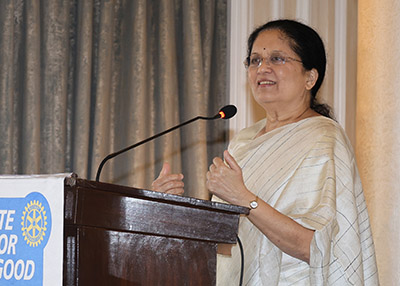
Mrs. Jaya Row, author, Vedanta speaker, and leadership mentor on the Power of One
Mrs. Jaya Row, author, Vedanta speaker, and leadership mentor on the Power of One
The subject for this afternoon is the power of one.
In modern times, where we spend a lot of time number crunching, the field of emotions is often neglected. In fact, the finer aspects of life are neglected. As Shabana Azmi said recently, “To be an actor, you cannot just do a course for three months and say, ‘I’m an actor,’ you have to have exposure to life.” She rightly said that every child must have exposure to theatre, even if the child does not understand it, to classical music, even if it is boring initially, to a good movie. But if your world today is just scrolling on Instagram, what are you going to convey to people? How can you become an excellent actor? How can you become a good businessperson if you do not have this exposure?
My generation, fortunately, was brought up without all of this, so we were forced to have this exposure. I remember telling my grandfather that I found classical music boring. He said, “No, you must listen to it,” and then you develop a taste for it. This is true of literature and poetry as well; you do not take to it immediately. Similarly, the soft power of emotion. Emotions have power that we do not understand initially, and so we ignore it.
Many of us are arrogant, many of us look down on others, many of us speak rudely, and unfortunately, in India, this rudeness has become part of our lives. We do not know what it is to be pleasant or accommodating of people. Emotion has power.
During the Second World War, there were two people who used emotion for completely opposite reasons. One was Hitler, who used hatred and negativity, and the other was Gandhiji, who used positivity even when fighting the British. He very famously said, “We don’t hate you; we hate what you do.” With love, you can conquer a lot. This love, this emotion, must be inclusive, not exclusive, and this is the hallmark of India.
In India, you do not just pray to God saying, “Please look after me and my family only.” What is our culture? Sarve bhavantu sukhina. Vasudhaiva Kutumbakam. Sarve bhavantu means let everyone be happy. Why should only my family and I be happy? The universe is one family. When you do not have this, you cannot consider yourself a developed person, a mature person, or a person of any standing in society.
Yet today, what is ruling the world is hatred, negativity, and otherness. You flout all kinds of rules and laws to do what you want, and if you have the power, so be it. But it does not work. In the long run, it does not work.
The test of spiritual development is the ability to feel one with people who are different from you. India has traditionally been like that. You can travel the length and breadth of India, and every hundred kilometres or so, the language changes, customs change, everything changes. And yet we have this feeling that we are Indian.
You go to Kolkata, it is a totally different world. You go to Delhi, it is different. You go to the south, it is different. Yet we enjoy the differences because we understand the oneness that binds us together.
However much we speak of oneness, we are still strongly entrenched in feelings of separateness. Why is this so? Let us go back to physics. When you pass a ray of white light through a prism, it refracts into seven distinct and different colours. From one side, you see differences, beautiful colours, but you understand that they emerge from one ray of white light.
Similarly, when you look at people, we are all different. Diversity is the beauty of nature. No two flowers are alike. No two peacocks are alike. No two human beings are alike. That does not mean you should feel insecure about difference. Why can’t we applaud differences, admire differences, and enjoy differences?
Someone asked me just now how many languages I know. I know five different languages because I have had the good fortune of exposure to different cultures within the country. Language connects. You go to Chennai, speak a few words of Tamil, and you have made friends. You go to Ahmedabad, you do not need to know Gujarati; just say “Kem cho,” and you are done.
Otherness is the cause of all our problems, and the Mahabharata and the Bhagavad Gita exemplify this beautifully. Dhritarashtra, the blind king, in the very first verse of the Bhagavad Gita, asks Sanjay, his commentator, “What are my sons and the sons of Pandu doing?” This immediately demonstrates why the battle is taking place. The moment you say “my sons” and “the sons of Pandu,” when Pandu was his brother, separateness has begun. If you cannot see oneness within your family, who will you see oneness with?
Unless you see oneness, you cannot be successful. Success comes when you feel one with your team members, employees, bosses, government officials, and people who influence your fortunes. When you feel one, they go well beyond the call of duty to do things for you — not because they have to, but because they feel for you. And this comes only when you feel for them.
In modern times, particularly in the United States, loneliness has become a serious issue. People feel lonely because they do not feel one with others. Loneliness is very different from being alone. You can be alone and yet feel connected with the whole world. But you can be surrounded by people and still feel lonely, and that is a horrible feeling.
There has to be an effort to stretch beyond your comfort zone and connect with people. When was the last time you asked your driver, “How is your family?” When was the last time you asked your neighbour, “Are you okay?” In a city like Mumbai, it is natural to become insular, so the effort has to be conscious. In smaller towns, that connection still exists, and it is wonderful.
What happens when you feel one? What are the benefits of oneness? First, you see the best in the other person. Ask any mother about her child. She knows the child has faults, but will she start by saying, “My son is disorganised and undisciplined”? No. She will say, “My son is wonderful.” She sees the best, and so she connects with the best.
When you see the best in others, they see the best in you. Then you are not insecure. Most of us are constantly competing, looking over our shoulders. But your greatest competitor is yourself. It is not about competition; it is about connection. You can even connect with your competitor and still succeed.
When we were children, things like papad were made at home. People of my generation will understand this. It was difficult work, so my grandmother would get her friends together — twenty or twenty-five women sitting together making papad. It was the highlight of our summer holidays. The labour was done in an environment of fun, laughter, good humour, teasing, and inclusion. When this togetherness stopped, papad-making stopped, and now you buy papad from the shop.
The same applies to weddings. We did not have wedding planners. We were all wedding planners, regardless of age. The family had in-house talent — someone could sing, someone could dance — and we put together wonderful entertainment. Later, we realised that preparing for the wedding was more exciting than the wedding itself. Today, all of that is outsourced.
Togetherness creates success. Everyone comes together in a spirit of camaraderie, friendship, and oneness to achieve a common goal. That spirit is missing today. The question has become, “What is my commission? What do I get? What is in it for me?” instead of “What can we do together?”
It is not difficult to bring it back. Start with yourself. Start small. Begin with the family. Simple things, like eating one meal together. I know families in Mumbai and Delhi, even with three generations under one roof, who never eat together, never really see each other.
That is where we need to begin.
So, you have a routine: one meal a day, or at least a few times a week, where you eat together. And it is such fun. My family had four generations — my mother, me, my son, my daughter-in-law, and my granddaughter — and we had such fun over dinner because that was the only meal we had together. My mother is no more now, but these three generations still meet, and we have fun because my granddaughter, who is a teenager, uses terms that we do not understand. So I ask, “What’s that?” and it makes for a good laugh.
But even when people sit at the table together or go out for a meal, there is complete silence because each person is on their phone. Ban phones, at least at meal times. There are little things you can do. If you understand the importance of this, it makes for happiness.
If your brother-in-law buys a fancy car, how do you feel? Heartburn. If something good happens to your neighbour, the same feeling. But if you feel one with the person, the rewards are enormous. He has to work hard to buy that car, he has to take care of it, and you enjoy it as if it were yours. Is that not possible? Learn the art of finding happiness in other people’s good fortune.
I often tell Americans when I go there that we Indians are at a distinct advantage. When you feel one with the country, your happiness increases. What is the population of the United States — 350 million? Take us. We feel one with the country straight away, 1.4 billion times over. And then you grow into a wonderful personality.
I heard a podcast this morning with two Americans, one living in New York and one in San Francisco. One calls himself Jagannath, the other Kaustubh. They have named themselves that. They were talking about how it is not possible to be happy if you are obsessed with yourself. And that is what we all are. Obsession varies in degree, but it is there.
Earlier, and even now, it is food, looks, bags, where you go on holiday. It is all about me — “I, me, myself”. To the extent that you are obsessed with yourself, you are setting yourself up for misery. This is a law. It is not possible to be happy unless you think beyond yourself.
So, find purpose in life. Find a cause to work for — not to talk about at cocktail parties, please. That is not it. Genuinely, from the bottom of your heart, you must feel for something or someone. Then life becomes magical. Every morning, you wake up excited that you have one more day to fulfil your mission in life.
Do not get obsessed with the body. Today, it is all about being slim, going to the gym, doing Pilates, this and that. It is all body-centric. Of course, you must look after the body, but do not be obsessed with it. Understand that it is only a vehicle that takes you from one place to another. One day, you are going to have to discard that body, however fit you are.
Out of the 24 hours, spend at least one hour on the state of your mind. What is going on inside you? Are you full of dislike? Are you snapping at people? Are you getting angry over the slightest thing? Are you irritable? That is not worth living. You must examine why you are like this. It is a disease that needs to be addressed, and the whole world is like that.
In the United States once, at a check-in counter, an agent made a small mistake and there was a complete conflagration. If you snap at every little thing that goes wrong in life, you are going to be unhappy.
When you connect with people, something changes. I lost my husband about sixteen years ago. Two days after I lost him, I got a call from a young girl. I will never forget that. She said, “I am twenty-five years old, I have a six-month-old daughter, and I have just lost my husband.” That was a wake-up call for me. I asked myself, “What am I feeling sorry for?” Look at this girl.
When you see others who are less privileged than you, you stop feeling sorry for yourself. You stop saying someone else has more than me. We all have enough and more. I do not know many of you, but I can say with complete confidence that we all have enough and more. Then why complain? Why look at the one thing you do not have and make yourself miserable?
You must develop an abundance mindset: I have enough and more, and enough to spare. Reach out to those who are less privileged — those who are unhappier than you, have less money, poorer health, or any other disadvantage. As someone said, if there are so many things going wrong in our country, thank your stars that you have that many opportunities to do service.
This seva bhaav is very important, and this is what Rotary is about. But it is not about organisations; it is about you. It is about how you feel within yourself. Shift from entitlement to gratitude. The sense of entitlement is deeply rooted in us, and even more so in our children today. Change that to gratitude. Change your attitude, the way you look at things, and you will be tremendously happy.
Then stretch yourself to actually do service. You may wonder why the United States is a prosperous country. Do you know why? Because Americans think about community service. Sixty per cent of charitable giving in the United States comes from middle-class people, not the rich. The rich in any country rarely do service. It is the ordinary person who does.
Have we ever seriously discussed, as a family, how much service to do, which cause to donate to, or what to support? We never do. There is a man in Mumbai who worked at what was known as Grindlays Bank. He was an ordinary clerk. After retirement, he received a cheque of arrears that he had not expected. He said, “Maybe this is God’s way of telling me to do service,” and he donated the entire amount to an orphanage in Karjat. How many of us would do that?
You make a killing on a share you bought — do you think of giving it away to a cause? No. You think, “Great.” I know a lady who took her entire family to Switzerland after making a huge profit. We think of that, but we do not think of giving. Yet this is what makes a huge difference in life.
You know why? Because givers receive. The law is simple: give, you gain; grab, you lose. You do not even have to grab — just think of grabbing, and you are impoverished. Think of giving, and you are enriched, even before you give. This is a law.
Do not misunderstand me. I am not saying you are not giving. Maybe you are. It is not about how much you give; it is about the attitude of giving that you carry within yourself at all times, everywhere, with everyone.
When you meet a person and shake hands, if your thought is, “What can I get from you?”, the relationship ends there. But if, from the bottom of your heart, you genuinely think, “How can I add value to you?”, that day you are blessed.
Our relationships are often based on expectations — what will you give me? Even with children. Love gets tainted by expectation. Between husband and wife, expectations cause conflict. The husband expects something, the wife expects something. Even with children, parents often favour the child who performs better academically. Why? Because they want to say, “My child scored ninety-nine per cent.” Love must be unconditional. You must say, “I love you for what you are, not for what you do for me.”
You may do a lot for me or nothing at all — why should that determine love? Look at a dog. How many of you have a pet dog? Do you think the dog cares whether you wear Nike shoes or live in a fancy mansion? The dog loves you regardless. That is how we should be.
Especially with children, please do not put pressure on them. Leave them alone. Whenever there is a problem with children, I tell parents there is nothing wrong with the children; it is the parents. Get off their backs. Let them be. Whatever has to happen will happen anyway. The difference is whether you add stress or allow them to grow peacefully.
The most important thing, as we come to the end of this presentation, is to understand that everything in life is temporary — passing and fleeting.
Money, name, fame, good looks, health, energy, vitality — all of that is there only for a while. You have been seeing photographs of Asha Parekh, Waheeda Rehman, and Helen. Our children and grandchildren will say, “Well, these people don’t look good now,” but at one time, they ruled the screen. Good looks do not last. You can Botox yourself however you want, but it still does not work.
What you should do is what Meryl Streep said: age gracefully. There is beauty in ageing. You understand that when you have invested in cultivating the beauty within you, which does not die with age. The body declines with age, but your inner beauty multiplies. However old you may look, your inner beauty still connects. So cultivate that. Cultivate unselfishness. Then your children will not throw you into an old-age home.
Spend time on the permanent aspects of life. As someone said, “Read not times, read eternities.” That was a pun at a Times — the London Times — event. The point is the same. What you read in a newspaper is valid for today; tomorrow it is irrelevant. Read not things that pass. Read eternities. Read good poetry. Read philosophy. There is wisdom everywhere in the world; you just need interest and the willingness to pick it up.
For those of you who are interested, we have some books and other material available. We also have a community that you can join for free, where we post positive ideas. We are about to launch a podcast this week. Most of what we offer is free. Take it and see what miracles happen. When you tap into your inner potential, you become a different person altogether.
You do not need to read book after book. You just need one idea. Michael Phelps was asked how he managed to win so many Olympic gold medals. He said, “Very simple. Practice every single day — whether you are well or not, whether the sun shines or not, whether it is a holiday or not.” That is it. One idea.
Virat Kohli once heard a coach mention in passing that cricket was the only sport where fitness was not given importance. Remember Arjuna Ranatunga from Sri Lanka? He had a pot belly and was the captain of the Sri Lankan team. Virat picked up that idea. Fitness became non-negotiable. He became fit and inspired his teammates to become fit. You just need one idea.
I hope you go home with the idea of giving. Ask yourself, “How do I become a giver?” and see how life changes for you. Thank you very much for your patient listening. Thank you.
ROTARIANS ASK
What you say is self-evident, and I wish people like you were given platforms in schools and colleges, Jayaji, to teach Vedanta and philosophy. But if you look at tribal communities — Native American Indians or the Aborigines, without getting into politics — they were all-encompassing and giving, yet they were decimated by rulers. Today, they live in reservations. They were givers, but they got the short end of the stick. How do you reconcile that?
It is not true that if you are a giver, you will be decimated. What decimated them was a lack of intelligence in understanding what was happening around them. It is not enough just to be a giver; you must be an intelligent giver. You must have the attitude of giving at all times, but there are times when you must withhold giving.
A parent wants to give a child everything, but a good parent is one who denies the child when the child does not deserve it. That parent is still a giver. If you ask the parent, “Does this mean you no longer want to give?” the answer is no. In not giving, the parent is giving. There must be an interaction between the intellect and the heart.
What is the importance of forgiveness?
Very important. If you do not forgive, it does not harm the other person. They may not even know. You are the one carrying the baggage, and it becomes unbearable.
When Nelson Mandela was released from prison after thirty-eight years, the first thing he said was, “As I walk out of this prison, if I do not forgive the people who did this to me, I will still be in prison.” Forgiveness is about letting go.
You cannot hold a grudge against a dog for barking; that is the dog’s nature. You cannot hold a grudge against a leopard for biting you; you came into its territory. Similarly, when you understand the nature of people and recognise where you related wrongly, grudges naturally drop.
That was a wonderful talk. How do you explain what is happening in the world today? Everywhere you look, there is conflict. Why do you think this is happening?
Because it is happening within us.
See, what happens in the world is a projection of what is happening in the minds of each one of us. The totality of our thoughts and desires is what functions in the world.
Look at us. Indian courts are crowded with cases of brothers fighting brothers, sisters fighting brothers, parents fighting children, and children fighting parents. This never happened before. It is not only in India; it is happening all over the world. Everywhere there is bitterness, negativity, and hatred.
On social media, it has been found that negative posts get more followers. I am not joking; it is a fact. Positive posts do not get the same attention, and that is how platforms make money — on our madness. Something negative immediately catches our attention. It is human nature.
Once, when I was very young, in my early twenties, I went excitedly to the resident editor of a leading newspaper in Mumbai. I said, “This knowledge that we are talking about is very good for everyone.” He looked at me and said, “You are not newsworthy.” That sparked a realisation in me. I said, “You are absolutely right, and I am very happy I am not newsworthy.” How would I become newsworthy? If I went and murdered somebody, I would become newsworthy. That is what it is. Breaking news is always negative. It is called breaking news because it breaks you. When you are positive, you are going against the tide.
So how do you change the world? By understanding that I am responsible, in a way, for the way the world is. How do I change my thoughts? If all of us change our thoughts — or even a few of us — Mumbai will change. I am not joking. Spread it a little more, and the country will change.
You do not need the majority. You need a handful of positive people, and that is enough to bring about change. How do you think we got independence? The bulk of three hundred million Indians did not even know what was happening. A handful of people with vision and knowledge worked for it, and India became independent.