
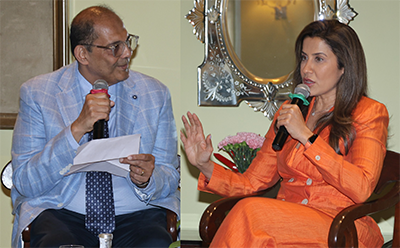
Mrs. Yasmin Karachiwala, celebrity fitness instructor, in conversation with Rtn. Mahesh Khubchandani on ‘Staying Fit as We Age!’
Rtn. Mahesh Khubchandani: Yasmin, thank you so much for your time. First, I would like to introduce Yasmin’s husband, Minhaz Karachiwala. I would say her sweeter half, given that I have known both of them long enough. I also wanted to mention that Yasmin’s brother is not here, but he is an outstanding Rotarian. Saif Qureshi, Yasmin’s older brother, is an ASK Club member from the Rotary Club of Bombay Pier, and they have a strong association with Rotary as a family. I think he has been a Rotarian for over 40 years.
Yasmin, coming from an entrepreneurial family, with a dynamic father, a very enterprising brother, and later a husband in business, how did you decide to pursue fitness as a career choice? What did your parents feel at the time? Was it something that started as fun, or were you thinking of it seriously as a career even when you began?
Mrs. Yasmin Karachiwala: Thank you all for having me. Though I come from this amazing family, I was the black sheep, written off by my parents and my brother. They thought I would never do anything because I started things and never completed them. I did not really find fitness; fitness found me. I stumbled into an aerobics class because my best friend was dating someone and wanted to lose weight. The club had an offer: two for the price of one, and she forced me to go because she could not afford it alone. Like most teenagers, I did whatever my best friend wanted, so I went along.
She knew exactly what she wanted to do. I, on the other hand, was the laziest person you could imagine. I would not even get up from the sofa to get a glass of water. We had athletics in school every morning, and I would pretend to either have a stomachache, a fever, or pain in my legs. The only things I participated in were shot put, javelin, and march past, because you just had to stand in one place.
When my friend took me to that class, I realised I was so bad at something that it shocked me. I kept going back just to prove to myself that I could not be that bad at anything. It was an aerobics class, more like dance, and until then, I had thought I was a great dancer. As a teenager, you think you have everything sorted.
One day, when the instructor was unwell, she asked me to take her class. When I did, I realised I knew all her routines and could do them without a hitch. After I finished college, I went abroad to study fitness because I thought it was fun, I was earning money, and I could earn more. However, when I went abroad, I was in for a rude shock. You needed to know anatomy, and I failed. I realised this could not be happening, so I studied harder, got my degree, and came back.
In those days, fitness was all about teaching aerobics for women and was not taken seriously. That is what I began with. Soon, people started asking me questions beyond aerobics, and I did not have the answers. So I started reading and learning more, eventually becoming a personal trainer. I realised that fitness comes with great responsibility because people look up to you for their health and wellness. It was no longer about earning pocket money. The more I learned about the human body and how it works, the more passionate I became. At that time, I never imagined this would be my path. It was something that kept growing on me, and I suppose my entrepreneurial background helped shape where I am today.
Rtn. Mahesh: Given that you had begun training people professionally, how did marriage and motherhood affect your training schedule?
Mrs. Karachiwala: Marriage taught me the importance of a supportive husband. One could not have done what one did without that support, especially in the early 1990s. I used to leave home at 8 am, teach kindergarten, then go to Bandra to train clients. I lived in Cuffe Parade and would return home around 8 pm. My husband and in-laws were very supportive, and that is why I could continue.
When I had children, I learned what patience truly means, and that helped me in my profession. My body also changed. I started fitness in my early twenties and had my children in my late twenties. That gave me a different perspective on women, motherhood, and body changes. I understood how confidence can be affected and how training should go beyond appearance to building confidence.
In those days, my training schedule revolved around my children. I worked when they slept, woke up, or went to school. A positive outcome is that both my sons are into fitness because that is what they have seen growing up. They eat healthy and make good choices, so it has shaped their lives as well.
Rtn. Mahesh: Given that you are observing Ramadan fasting right now, you are, in a sense, already intermittent fasting. What is your view and advice on intermittent fasting?
Mrs. Karachiwala: Let us first talk about Ramadan. It teaches a lot of discipline. At least in India, we continue our daily schedules. You may have clients at 9 in the morning, and you cannot tell them you are fasting, so you cannot train. Intermittent fasting is different because it is not a dry fast; you can drink water, which makes it easier.
I do intermittent fasting, but Ramadan is a completely different experience because the dry fast is more tiring. Intermittent fasting is great if it works for you. Not everything suits everyone. If you feel irritable, impatient, or get headaches, then it is not for you. It works for me because I can manage it well, but it does not work for my husband. He needs breakfast before work.
Each individual has to find the right nutrition that fuels them without making them tired or weak. It is also important to be careful about what you eat when you are not fasting. You cannot justify eating unhealthy food just because you have fasted, as that defeats the purpose. Nutrition plays a very important role, and fitness without proper nutrition is not sustainable, and vice versa.
Rtn. Mahesh: During COVID, you were doing podcasts and exercise videos to help people stay healthy. You also shared cooking advice and healthy recipes. How did that interest develop, and have you integrated nutrition into your vertical at YKBI?
Mrs. Karachiwala: I am not a nutritionist, but I know enough about nutrition from being in the fitness industry for over 30 years. I understand how my body works and how people’s bodies work. It is about choosing the right food. A balanced plate should include protein, a smaller portion of carbohydrates, fibre, and good fats. While cuisines may vary, these components remain constant.
During COVID, I started cooking because my cook, who was Nepalese, had gone on leave and could not return due to the lockdown. I was cooking for my family and realised that healthy eating could be simple and enjoyable. I wanted to share that with others because many people believe healthy food lacks taste, which is not true. You can make it both interesting and delicious.
Rtn. Mahesh: Given that there are so many trainers and so many gyms today, what gives you the edge over them and attracts the entire Bollywood community to you? Of course, besides the fact that you look like a Bollywood star yourself, what is your main USP?
Mrs. Karachiwala: I think it is intelligent training. It is also about making the people who work out with me understand their body type, what their body requires, and then giving them that kind of training. It is not that one size fits all. Each individual’s body is different. Their age, lifestyle, needs, and strengths are all different. You have to understand that and make your client understand it as well. When people work out with intention, their body shows the difference. Many times, we go into gyms or studios, and the trainer simply says, do this, do that, go heavy, push harder, but that is not the way it works. You need to understand why you are doing functional training, whether your body is ready for it, and whether you have enough strength to support those movements. That is where the difference lies. When you have an instructor who helps you realise these things about your body, you tend to stick with them because you feel empowered. Anyone who feels empowered in any field, even while working out, is more likely to remain consistent. We also have an education programme. That is the reason I started the YKBI Pilates Teachers Training Academy, which I have been working on for the last year. We teach instructors and train people to become Pilates instructors. For me, that is one of the best things I have done because I now have a strong team of instructors who can reach out to more people and train them with intention and intelligence.
Rtn. Mahesh: A common affliction that most people post-40 have is chronic backache and knee pain. Would you recommend Reformer Pilates for them to get out of these chronic conditions or at least mitigate them?
Mrs. Karachiwala: Most definitely. The fact is that with every decade, we lose bone density. Our muscles protect our bones. It is as simple as that. Strength training becomes non-negotiable as you grow older. You also need to increase your protein intake. Even for vegetarians, there are now many sources of protein, including plant-based protein powders made from pea and hemp. Building muscle is essential as you age, whether through strength training or Pilates. The beauty of Pilates is that it is a gentle form of exercise that strengthens you from the inside out. It is easy on the joints and highly effective for muscles, especially the spine. Joseph Pilates, who invented Pilates, used to say that you are as young as your spine is flexible. The more flexible your spine, the younger you remain.
Rtn. Mahesh: The average age of our club is about 56. What advice can you give to people who do not go to gyms and are not very exercise-oriented, for their daily physical and mental fitness? I know you trained your father in his late 60s and early 70s, and you have a very fit 61-year-old brother. What would you say to this group?
Mrs. Karachiwala: As I said, work out, and work out with intention. Find a form of exercise that you enjoy. It should not be something temporary that you do for a wedding or a holiday. It needs to become part of your lifestyle, just like eating or showering. The only way to achieve that is to find a form of exercise that you genuinely enjoy. Many people say they hate working out but feel they have to do it. That does not have to be the case. There are so many forms of exercise available today, and you are sure to find one that suits you and makes you want to go back to it. When you enjoy your workout, it makes you feel good and stronger. The stronger you feel, the more confident you become. That is the key to longevity, finding the right exercise along with the right nutrition.
Rtn. Mahesh: Given that you have expanded across the country and into Dubai and Dhaka, and your sons have now joined you, what is your vision for YKBI going forward?
Mrs. Karachiwala: We have just opened a studio on Marine Drive. The vision for YKBI, as I mentioned earlier, was to start the Pilates Teachers Training Academy so that we can have more instructors teaching Pilates. I believe Pilates offers the perfect combination of strength and stretch. It strengthens your body while also improving flexibility. It works for every age group, from 10 to 100. Anyone can do Pilates. For me, the goal is to reach as many parts of the country as possible and encourage more people to experience Pilates if they enjoy it. Ultimately, it is about helping people live longer, healthier, and stronger lives with greater confidence.
Rtn. Mahesh: Since you opened your studio at the NKM Centre at Marine Drive on March 8th, what can you offer our Rotarians if they wish to join? Could you offer them a session with you or one of your senior trainers?
Mrs. Karachiwala: Most definitely. All Rotarians can avail one complimentary session. I am not always present at that studio, but we do have group classes there, and all Rotarians are welcome to attend one session free of charge.
ROTARIANS ASK
Thank you, Yasmin. That was very insightful and encouraging. A few weeks ago, we had a session on weight loss drugs, which was also very motivating. We understand that within a year, these drugs may become more affordable, around 400 or 500 rupees per shot. I would like to hear your views on these products.
Mrs. Karachiwala: I believe that if you medically need to take these drugs, for instance if your obesity level is very high or your weight is causing serious health concerns, and your doctor recommends it, then it can be life-changing. Some people genuinely struggle to lose weight because their body is accustomed to a certain pattern, and in such cases, medical support can help. However, if you are taking these drugs for cosmetic reasons, there will be side effects. These may not appear immediately, but as you age, they will surface. One of the major side effects is muscle loss. Many people assume they do not need to exercise because they are losing weight, but they are losing muscle along with fat. Muscle takes years to build, and losing it can lead to long-term issues such as arthritis and osteoporosis. So, if you genuinely need it, take it under medical supervision. If it is for cosmetic reasons, be aware that there will be consequences later.
Thank you for the talk. You are a pioneer in introducing Pilates in India, and you mentioned it is about strength and stretch, which sounds like yoga. Given that we are the home of yoga, how challenging was it to introduce Pilates here?
Mrs. Karachiwala: I do not see Pilates as competing with yoga. Both can coexist. People should try both and decide what suits them. When I first introduced Pilates about 20 years ago, people would say they already get strength and flexibility from yoga. I would simply invite them to try a class. I knew that once they experienced Pilates, they would understand how their body feels after a session. I have many clients who practise both yoga and Pilates. While they may appear similar, they function very differently. Both are beautiful disciplines.
What is the benefit of Pilates over yoga?
Mrs. Karachiwala: I prefer not to compare the two. It is interesting and quite different. Pilates uses equipment that can either support or challenge you. Yoga is primarily mat-based, unless you are practising Iyengar Yoga, which uses props. In Pilates, we have the reformer, chair, trapeze, and barrels. These help support senior citizens, individuals recovering from injury, or those with back problems. At the same time, the same equipment can be used to challenge athletes. That is the key difference.
I am 56 and have osteoporosis. I started going to the gym about a year ago. Would Pilates be an equivalent, or should I continue both?
Mrs. Karachiwala: You can divide your time between the two. Pilates does build strength, but weight training may give you faster gains. Pilates works more gradually but has long-term benefits. I would suggest trying Pilates as well.
I am 88 years old. I have exercised most of my life and played tennis. I had a knee replacement last year, but I still experience pain and difficulty walking. How can Pilates help?
Mrs. Karachiwala: First of all, a big round of applause for you. You are 88 and look incredibly fit. My mother also had a knee replacement, and while the pain may not disappear entirely, it does improve over time. Pilates helps strengthen the muscles around the knee, which in turn reduces pain. At your age, muscle strength takes time to rebuild, but strengthening those muscles is essential. Pilates can certainly help, and we have worked with many clients post-knee replacement. My oldest client is currently 90 years old.
Can a PFOA patient with anterior knee pain benefit from Pilates?
Mrs. Karachiwala: Yes, absolutely. We would approach it carefully. Initially, we may not use machines. Instead, we would work with resistance bands and focus on strengthening the VMO, the vastus medialis oblique muscle, which supports the patella. Gradually, we would introduce the reformer with light resistance and increase intensity as strength improves.
I wanted your opinion on creatine for muscle building, and whether it is suitable for senior citizens and younger individuals.
Mrs. Karachiwala: Creatine is naturally produced by the body, and its production decreases with age. A dosage of around 3 grams is generally safe. However, it is important to stay well hydrated, as creatine draws water from the body. It can be very effective when used correctly. For senior citizens, I would recommend taking it under medical advice.
There are many wearable technology apps available today. What are your thoughts on them? People seem to become overly dependent on tracking everything.
Mrs. Karachiwala: If it is causing stress, then it is better not to use them. These tools are meant to enhance performance, not create anxiety. We already live in stressful conditions, and we do not need additional pressure. I used to wear an Oura ring, which tracked my sleep. Sometimes it would indicate poor sleep even when I felt well rested. I realised I could judge my own sleep better. During Ramadan, my sleep pattern was irregular, and the device constantly showed stress. If technology makes you feel like a prisoner, it is better to step away. Focus on living a healthy life, exercising regularly, and maintaining good nutrition.
Everyone says we need more protein. How do we determine how much we need?
Mrs. Karachiwala: For sedentary individuals, approximately 0.8 to 1 gram of protein per kilogram of body weight is a good guideline.
What is the relationship between muscle stretch and pain? How much pain is acceptable, and when is it too much?
Mrs. Karachiwala: There is a common belief of no pain, no gain, but that is not entirely correct. If the pain is unbearable, you must stop. In activities like hot yoga or hot Pilates, muscles relax more, making it easier to overstretch them. Muscles are like elastic bands. If stretched too far, they can tear and not return to their original state. Listen to your body. If the pain feels sharp or uncomfortable, stop, reduce the weight or repetitions. Post-workout soreness is normal, but severe pain that prevents movement is a sign you have overexerted yourself. Start gradually, especially after a long break. Do not try to compensate for lost time in one session. Recovery is equally important as exercise. The body builds during recovery, not during the workout. If you train six days a week, ensure one day of recovery. This could include a massage, infrared sauna, or simply light activity, like walking or swimming. If your body is in pain, allow it to rest before resuming exercise.