
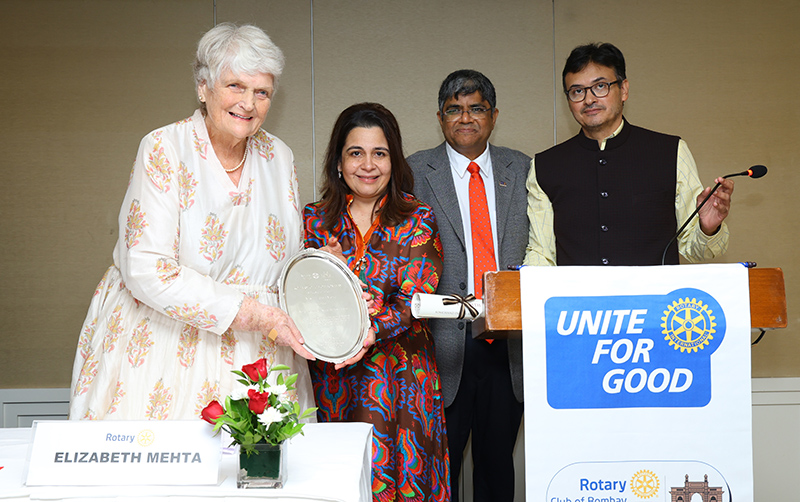
Ms. Elizabeth Mehta, Founder-Director of Muktangan felicitated with RCB Somchand Parikh Award for Best Teacher
I want to thank you very much for this honour. In doing so, I think you are also honouring hundreds of people who have helped me grow over the years, and I am very grateful for that.
I want to share a few ideas as an educationist with a passion for education. I could talk for two hours, but I assure you I will not. I have had a wonderful life travelling in rural areas, travelling back and forth to Pakistan and to East Africa, and looking at education. What amazed me was that I was the only one who could get to the Aga Khan University in Pakistan to represent India, and I have done so on countless occasions. It has been a very interesting life.
Now, since the award is for teaching, let me talk about that. I always say I am not a teacher; I am a learner. I have learnt from everybody, especially from observing children. During our teacher training – which I did after teaching for 22 years because I thought it was time I got a teaching qualification – one of the things we had to do was observe the syllabus being delivered in the classroom. Often, the children were bored, and I began to realise that we were observing the wrong thing.
Every child is different, with different experiences and interests, but we put them into a formal classroom, teach from a textbook, and they get bored. In all my work, I have stressed the need for child observation. I have learnt that all of us are natural learners. We are curious, we can be creative, but something happens. I went to a formal school where they thought a blackboard, a teacher, and rows of desks were all you needed. We were all taught in the same way.
Although I had already taught for 22 years and was called a teacher, I asked myself: how should I actually view myself? Could I become a genuine learner, facilitating the natural learning journeys of my students? I have never been comfortable with the word “teacher”. Immediately, people say, “You’re only a teacher” – low status. But I say it is the wrong word. We are there to facilitate, to create an environment in which children are keen to learn. To do that, you need to be an observer and a facilitator, creating an environment which enables each child to follow their own innate interests and potential.
We all know what happens when a child enters school: “I am the teacher, I know what you need to learn, I will teach you.” But learning does not happen that way. Even as adults, we continue to learn until the day we die. Many people have come to us in Muktangan asking, “Can you train our teachers in classroom management?” But why do you need to manage children? Management implies control. And why is control needed? Because you have put 40, 50, even 100 children in a classroom with a textbook. It is an impossible situation, so the poor teacher has to control them.
My mission in life is to create classrooms where students are engaged. If they are engaged in what they are learning, you do not need classroom management. That has been part of my journey.
For me, the most important factor is the relationship between the teacher and the child, and the child with the peer group. That is where children truly learn.
Let me share a story. There was a massive World Bank-funded project in India called the District Primary Education Programme. In the Aga Khan network, we were partnering with the government. The Secretary of Education, Maharashtra, asked us to get involved in Nanded district. This was when I was in Aga Khan.
We went on a needs assessment in Nanded District during the peak summer heat. The government jeep arrived late, and when we reached the school – a typical U-shaped village school with the Indian flag – the children had been standing at attention for two hours in the blazing sun. We arrived as honoured guests, and the children sang a song about joyful learning. Then we all danced with them and with the teachers.
When we went into the classroom, the children were sitting on benches, the teacher writing on the blackboard. This was supposed to be a quality improvement programme. The children were copying questions and answers from the board. I asked the project director if I could speak to the class. I do speak Hindi, a little bit peculiar, but I speak it. I asked the children to draw a picture of themselves and write one sentence. They stared at me blankly. It was not my Hindi – the gentleman said they only spoke Marathi. So I drew a picture of myself, wrote a sentence in Hindi, and said, “Now you do it.” Within five minutes, every child had copied my picture and my sentence.
That is when I realised that the programme was talking about two components: increasing access – which the government was doing well – and improving quality. But there were no models of quality. Unless teachers had seen quality, how could they bring it about? That, in a way, was the origin of Muktangan.
At that time, I was about to retire at 59. We started Muktangan by taking women from the local marginalised community in G South Ward. They were educated to 10th standard – pass or fail, it did not matter. We trained them in a child-centred, well-researched preschool methodology and opened our first preschool. It was meant to be a small retirement project.
But the community embraced it. Parents noticed that while their older children cried about going to school, the younger ones cried on weekends because they wanted to go to school. The community and the BMC demanded that Muktangan expand into primary. Eventually, we gave in. We started six more schools, each beginning with preschool and growing to 10th standard. Today, we have around 2,500 alumni.
These children have been taught by members of their own community in English-medium schools. Most of our teachers themselves had poor-quality education in vernacular schools, yet they got their students through the 10th standard. The children excelled. Our schools often top the BMC rankings in board exams.
The teachers have become leaders, rising from within the community. The demonstration schools are now recognised nationally and internationally, generating interest as intended. We have shown that good quality, inclusive education can be developed at an affordable cost in the mainstream – the very schools where 95% of Indian children study.
The outcomes have been remarkable: committed community teachers who have risen to leadership positions, and empathetic children who are excelling in diverse fields – medicine, accountancy, music, art, even teaching. I am especially proud of those who choose teaching, because vocational guidance rarely encourages it. Our children are fantastic – they spend weekends helping other children. In colleges, professors tell us, “We know the Muktangan children – they are the ones who ask questions. Others remain silent.”
Today, we have 17 academic departments built on our learnings over the last 22 years.
And they are not only helping the Council improve the internal schools, but also going out for outreach and advocacy with great commitment. We have a forum in Wadala – 12,000 square feet of rented property – where we have brought all the departments together for our outreach and advocacy programme.
We are all learners, though we are called teachers, and we learn from one another. We call ourselves a learning community – the parents, the support staff, the management – everybody learning from one another. Education for the community, by the community, really works.
We are receiving tremendous demands for our support, and we need to sustain and expand our outreach. It is becoming ever more difficult to raise funds, but please do visit us. I have lots of visiting cards here.
Lastly, and by no means least, thank you for the recognition you have given me, my colleagues, and our work today. Thank you very much.