
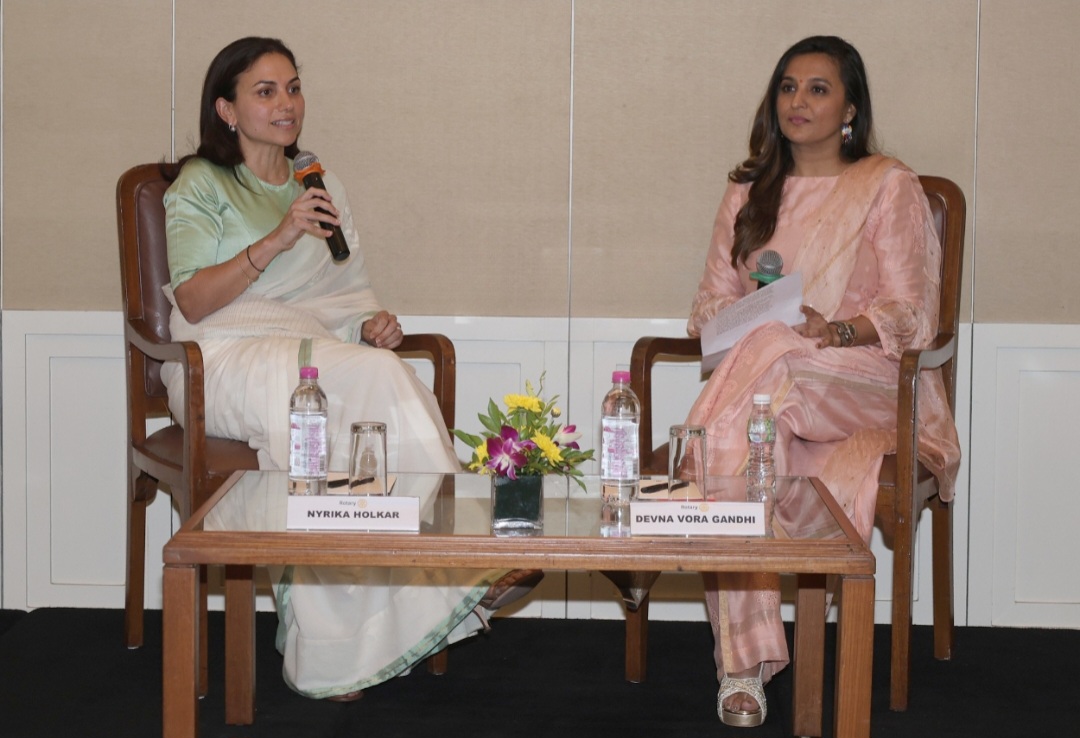
Ms. Nyrika Holkar, Executive Director, Godrej Enterprises Group, in conversation with Ms. Devna Vora on the New Consumer.
Ms. Nyrika Holkar, Executive Director, Godrej Enterprises Group, in conversation with Ms. Devna Vora on the New Consumer
Let’s start with the Godrej legacy and the wonderful Godrej name. Growing up with it, what did it mean to you? What were conversations like? Your father, your grandfather, and of course, anecdotes about your great-grandfather, who launched the first product, which was the lock.
Thanks, Devna. It’s a pleasure to be with you all today. Thank you so much for inviting me. Reflecting on conversations around dinner, I think the ethos of the company has always been very closely tied with India, the Independence movement, and building self-reliance from an economic perspective. My grandparents and great-grandparents were very much involved in the freedom movement and in building up a manufacturing backbone for the country. That is what drove them.
I remember a story my grandmother always used to tell: once, on the radio, there was a call just before Independence for people to give up all jewellery and gold, as we needed money. She immediately, without blinking, gave up whatever she had. I think that was an incredible story, not only of her belief in the freedom movement, but also how much of an impact it had on every Indian and how invested everyone was. That made a very big impact on me growing up.
Also, I feel like the legacy of the Godrej name, like some other legacies, is inherited, but there is also a responsibility within family members to uphold the name with integrity. That’s not extremely common. Of course, you were a lawyer; you qualified as a lawyer, you worked as a lawyer. Then why the transition into the group? And what is the training process like to undertake a leadership role of a group of this magnitude as a young girl entering the business?
I was always very fascinated by law and wanted to study it. My parents said it was better to have a broader education and do it later if I wished. I finished my undergrad and still felt I wanted to study law, so they said fine. I remember speaking with my uncle Adi, and he said that if I wanted to join the business, I should do an MBA instead of law. So I studied corporate law and worked in M&A when I came back.
I think the idea of bringing a different skill set and perspective was important, because law sits at the intersection of everything and is always useful — more importantly, as a way of thinking. It has helped a lot. It always comes up in one way or another in everyday work. When I first joined the business, I was thrown into the deep end. We were in energy distribution and transmission as EPC projects, and the company had taken up contracts it was unable to execute. Coming in with a legal background helped in looking at contractual arrangements, negotiations, and tightening those processes, which doesn’t naturally come to engineers or salespeople who want to get business at any cost.
In long-cycle businesses, where risks come up five or six years later, being able to mitigate risk without losing business is very important for us.
So, after the realignment — or split, or whatever you call it — your group, Godrej Enterprises, owns Godrej & Boyce and a vast tract of land. Godrej & Boyce is now 14 businesses, including appliances, engineering, and furniture. But you’re a privately held company. In terms of valuation, there are so many numbers doing the rounds. It’s incredible that you’ve been private all this time and remain so, and can fund all your needs internally. Was that a definitive strategy that you wanted to follow?
To date, we’ve always been able to fund whatever the requirements were. We are not opposed to listing if the need arises in the future. The idea is that if there is a financial requirement, then we would look at it. If there isn’t, then the focus remains on having a vision that isn’t overly bold but also not purely centred on shareholder value.
Shareholder value remains important, but not the only requirement. As India develops — hopefully towards Viksit Bharat — our MSMEs, suppliers, vendors, and larger stakeholders also need support. The ecosystem today requires one to look at profit but also at other elements of development that may not directly benefit a particular shareholder.
If we’re able to balance those needs and fund our requirements, then this approach works for us. When it doesn’t, we would reconsider.
And it’s an enviable position to be privately held and grow at this pace as well. Kudos to you! Tell me about the new consumer now, post-COVID in India. What the demands are — you operate across so many sectors. You know the Indian consumer inside out. What has changed post-COVID, not just in urban India but also in tier-2 towns?
The demographic in India has changed rapidly since COVID. The access to technology and rising aspirations are very evident. We conducted research across India over the last year and a half to understand how people use their homes. It was palpable when I visited many of these homes: it wasn’t a question of if — it was when. It wasn’t “Will I move into a 2BHK?” or “Will I have this appliance?” People believe it will happen.
Aspiration is strong. Being relevant and providing products that truly serve a need is top of mind. There is so much competition, and though we’ve been around for nearly 128 years, one must constantly pivot and stay relevant.
We’ve had longstanding relationships with families. People talk about the Godrej almirah being passed down through generations, holding the family’s valuables, or symbolising the space of a newly married couple in a joint family. It had a deep emotional connect. To recreate that today and address the needs of a young demographic — who may not be buying yet but are definitely influencing decisions — is vital.
Understanding their mindset is important. We may not fully understand it, but we must provide what the younger generation needs.
And you would also be hiring people of that age to help you navigate the mindset of a consumer that age.
Yes, and it’s fun. Many people speak about the negatives of Gen Z — not having routines, not wanting a nine-to-five job — but the ability to capture and inspire them is powerful. Working with them brings energy, creativity, and curiosity. If one can leverage that, it becomes very compelling.
Absolutely. And Gen Z today has a voice which many of us growing up did not, at home. The middle-class consumer in India has always loved Godrej. There are certain segments, like furniture, where you’re the leader, which is incredible given players like Neelkamal and even IKEA. But there are also segments like ACs and refrigerators where you have a great share but are at #4 and #5. I know you’re trying to change that. So tell me what the strategy is there, Nyrika.
So I think for appliances and interior, the starting position is very different. With furniture, 70% of the market is unorganised. So there’s a lot of unorganisation driven by carpenters, driven by customisation, and people want that, people need that. And as an established brand in the space, I think being able to also provide, moving beyond just products, configurable solutions where you can personalise at scale, where you can customise to a certain level. Because Indians are creative. We like to have our personal touch in our spaces. To be able to give people the tools to create that for themselves, I think, is our objective. We’ve just relaunched the brand and changed the retail format, the online experience, a strong emphasis on service because customers are changing so fast, trying to keep up and understand customers more objectively than surveys, which tend to be subjective, as good as the questions we ask, and tend to be one-sided. So we have to find different ways to understand our customers better. Technology, especially digital interfaces, can really help us do that in a better way.
With appliances, the situation is very different. And credit to the Koreans. They’ve managed to tap into consumer sentiment, provide innovation at a rapid rate, with large investments in R&D. So it’s very difficult to come up against. And I think that in categories like ACs, for instance, where penetration is about 7 to 8%, the scope to grow — along with the rapid heating of our planet — and also the GST cuts which were recently made, are welcome to the extent that an AC can’t really be considered a discretionary item anymore, because it becomes more of a productivity tool. That, coupled with the rapid rate of development, becomes very interesting from both a sustainability perspective as well as a market perspective, but it is a very difficult and competitive space.
It’s so interesting that you just said that the AC is now a productivity tool rather than a discretionary item. And I know that you’re modernising the group and there’s a huge digital focus as well. As you said, for this segment and this market, the Koreans really have made tremendous strides. But talking about sustainability and given what is happening to the planet — and it’s so tangible now — how do you implement change in the group from a manufacturing perspective? I know you have a massive tract of land in Vikhroli, which you are developing and will develop. How do you create sustainability as a culture in the group?
I think sustainability has always been very much part of the Godrej ethos. It was championed by my grand-uncle, also a Rotarian, Sohrabji Godrej, who really took it upon himself to talk about the value of green spaces. We’re blessed to have on our campus a beautiful mangrove ecosystem. Today, the trade-offs of grey infrastructure versus green and blue infrastructure become a zero-sum game. Looking at examples of other countries that have developed but planned infrastructure in a way that doesn’t always compromise green spaces — and the importance of that for our overall health, mental and physical — is essential.
From the company’s perspective, and also from my uncle Jamshyd’s perspective, championing sustainability has always been front and centre. To his credit, what he’s managed to do is make it part of doing business, not an afterthought, not the 2%, but the 98%. It’s baked into the way our engineering processes and factories run. We’ve taken a goal for 2032 to double our energy productivity and reduce the carbon intensity in our factories by 60%. A very strong focus on ensuring that running a business doesn’t come at the expense of the environment.
Today, with policies changing and priorities shifting, a country like India doesn’t need to use a Western blueprint. We can create something specifically Indian, valuing what we have, going back to traditional knowledge and ways of thinking that prioritised nature. Using that knowledge in the way we build and look at materials allows for a different paradigm of growth. I think we really have the opportunity today to do that.
There’s also so much patriotism that comes with Godrej, as you talked about your grandmum. You’ve been part of some important missions — ISRO missions, space missions. Godrej Aerospace is not widely known. But tell me how important it is for you to be part of this story.
I think our company culture has always been one of not talking about the things we do. I feel there are some wonderful stories, and stories help us understand ourselves better and showcase things that may be lesser known. My grandfather was first approached by Mr. Abdul Kalam when we started the space programme. We had a tooling business which was repurposed into doing work in space for the government. We’ve been privileged to be part of all of India’s space missions.
It was also the foresight and vision of my grandfather and my uncle to keep the business running for many years, even when it was making losses — not driven purely by the bottom line, but by a sense that we had to do this as part of nation-building. Even with criticism, they kept the business going. Now is a very interesting time in India, with the industry opening up to private players and startups. There’s a lot of innovation and R&D. Credit to them for holding their ground. We have an opportunity today to play a small part in India’s growth story.
Earlier, a year ago, there was a realignment in the group. There was so much dignity in the way family members conducted themselves. While it was written about endlessly, family members kept a very dignified silence. Do you think that’s because, at the heart of it, you’ve grown up believing that values and grace are above everything else, and that the Godrej philosophy must remain intact?
I think we all realise the brand and legacy we share is much bigger than any one of us. We share a sense of trusteeship — that we are here for a moment in time to leave things in a better place than we found them. That has been the driving force. Yes, there are differences of opinion, but that should not come in the way of good work. Our values of respect and integrity helped us get through a difficult moment. I think that is what keeps us together even today.
And I think it also gives both sides the opportunity to be more nimble in your individual parts of the group and make decisions according to your philosophy.
As a mother of two young children, Nyrika, it must be a constant struggle. Your hours are very long. In fact, you replied to me on WhatsApp yesterday at 1.30 in the morning and said you couldn’t look at it before that. Of course, you’ve seen your mum working as well. How do you think you’re dealing with the struggles of it? And what advice has she given you?
I think she did a much better job of time management than I do. She managed to be around much more than I am. I still have a lot to learn.
And I think she probably wasn’t bombarded with emails from schools the way we are today, so that’s to your credit.
But I think it’s a constant balance of priorities. You’re not always successful at managing everything, but you try your best.
And you actually remind me so much of your mum with the sari and the simplicity with which you carry yourself. I think the valuations, the group, the material benefits of being a Godrej sat very lightly on her shoulders. She didn’t take it incredibly seriously in terms of the material aspect. Do you think that has made a huge impact on you as well?
It’s definitely made a huge impact on me. My mother has always been a role model — balanced, nurturing, warm. I hope I can be even half the mother she is. In this day and age, we struggle a lot with social media and technology.
And how do you protect your children from that, given what the media glare is, today, on promoters and their children?
I don’t think media glare is the material thing. It’s more about how we deal with technology in our own lives. The other day, I opened ChatGPT to a long conversation my daughter Ariane was having. We were about to get a puppy, and she was asking what to do because her friend was coming over with another dog and our puppy wasn’t vaccinated. ChatGPT told her to be honest and explain that the puppy might get ill. She said, “But won’t it make my friends feel bad?” And it replied, “I’m sure they’ll be fine.”
It was funny to read the exchange because they use technology so differently. We might use it to ask a specific question or get a response, but she was using it as a chat.
And I have to say that response is much better than what I would have been able to give my children. But yes, on that lovely light note, thank you so much for this conversation.
Thank you for having me. It’s been wonderful.
ROTARIANS ASK:
G&B has announced an investment of 7,500 crores in new-age technologies such as green hydrogen, advanced engineering, aerospace and IoT-based digital solutions. How do you balance capital allocation between legacy revenue-generating businesses and emerging technologies? And how are you engaging the alpha and Gen Z generations to build acceptance of the G&B brand, especially on the digital side?
The whole balancing of capital is an important question. The ethos has always been to look, at least for our smaller businesses that we are incubating for the future, at the whole idea of nation building and how we can play a role in that. Important priorities for the group are renewable energy and battery storage, and also semiconductor chips, which we use in our appliances. So those would be three businesses that we are incubating. They are joint ventures of technology, but we have helped to scale them. We do the prototyping, we set up the manufacturing lines, and we help to stabilise and commercialise them.
Even in established businesses, digital becomes hygiene today. Those investments have to be made regardless and as business as usual. But also, in terms of possibilities today, even with AI, we are looking at use cases within the company in terms of efficiency and consumer experience. There is a strong appetite not only to look at cost-saving, but also to create a better experience and engage with customers better.
As president, I’d like to ask: you do a great deal of social impact work. Could you briefly speak about that, and also tell us more about your Conscious Collective event?
Yes, absolutely. From the social-impact perspective, the three key priority areas for us are skilling — where we are doing a lot of work not only in traditional skills but also new-age skills, engineering skills — and education and sustainability. Those remain the core focus areas.
The idea of Conscious Collective was to look at three key pillars every year: one is sustainable built spaces, the second is circular materials, and the third is biodiversity. We explore these three pillars with different themes, and this year’s theme is heat mitigation. We are looking at how we can create building solutions that can withstand heat, how we build resilience into our ecosystems, and how we look at alternative materials.
I’m happy that this year we also have a lot of start-ups, and it’s meant to be a brand-agnostic platform — a platform to encourage ideas and give them a voice, and importantly, connect them to funding. We have venture capitalists and also mentors. More importantly, beyond funding, it is about providing mentorship opportunities that extend beyond the annual event to help commercialise and bring those ideas to scale.
As Chair of the CSR Committee, what causes does the Godrej Group prioritise, and what do you look for when someone approaches you with a proposal?
From a CSR perspective, because we have locations pan-India, our CSR looks primarily at community development and skilling. Those would be the two primary focus areas of funding. Every year, we do a study in the area to find out the pressing needs and issues.
For instance, we have moved to a new campus in Khalapur, an hour from our existing campus towards Pune. There, a lot of the priorities include infrastructure development, skilling opportunities, and women’s empowerment. It is really about understanding the needs of the region, looking at whether projects are short-term or multi-year, and how we can engage better with people on the ground and provide lasting impact through the projects we choose. I don’t know if that answered your question.
With your background in environmental studies, psychology, law, and six years with Zia Mody — followed by leading digital transformation at Godrej — how does your legal training help you as an industrial leader? And, is there any possibility of a political future?
I don’t think I’d be the right candidate for politics. But having studied law, I think it has a touchpoint in everything. Definitely from a commercial-contracts perspective, but also in the evaluation of risk. We have two businesses which would be, on a scale, the riskier of our businesses. One would be aerospace, especially the civil aviation side. We deal with a lot of foreign OEMs that have very onerous terms. They don’t really budge on anything. Something that came out of COVID was the whole force majeure element, especially supply-chain risk being excluded from force majeure. These are elements that really play into how we grow and can have a huge financial impact. So being able to assess the risk and properly price it in are consequential benefits of what I studied.