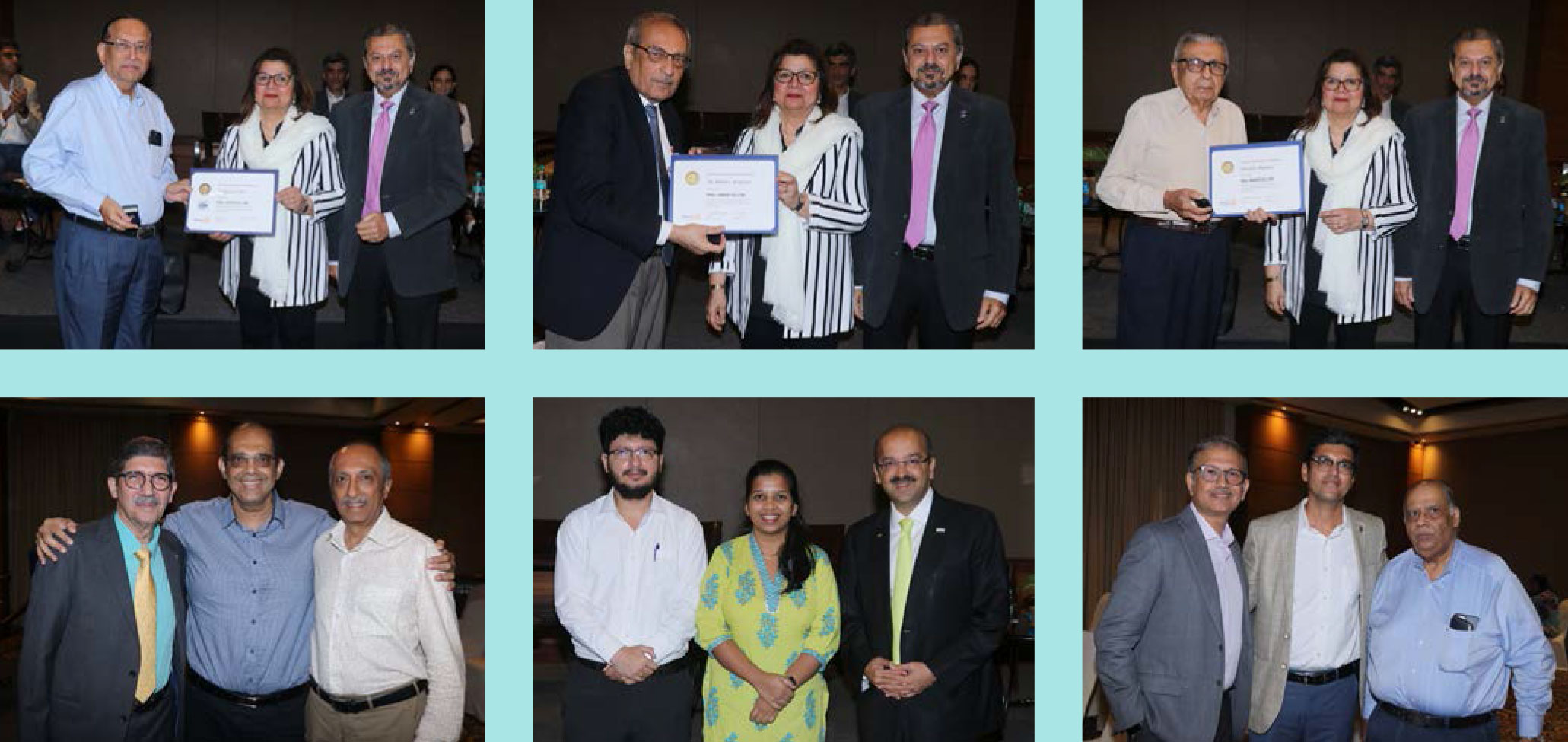

Panel Discussion On A Healthy Heart With Rtn. Dr. Sharukh Golwalla & Consultant Nutritionist Niti Desai, Moderated By Rtn. Dr. Aashish Contractor
Rtn. Dr. Aashish Contractor (AC): Today marks almost two years since the lockdown. All that we have spoken about is the big C but there are two other big Cs that we mustn’t forget – cardiovascular disease and cancer. Cardiovascular disease is the leading cause of death across the world in both men and women. It is a common misconception that more women die due to the breast cancer. In fact, cardiovascular disease kills more women than all the cancers put together. While cancer is on the rise, cardiovascular disease is still a leading cause of death both in rural and urban India. So, it is a topic close to our hearts, pun intended, and it is an area where prevention is better than cure. So, what is the difference between a heart attack and a cardiac arrest?
Rtn. Dr. Sharukh Golwalla (SG): A heart attack occurs when a coronary artery supplying the heart muscle called the myocardia is obstructed, narrowed, or blocked. That causes the death of the heart muscle and results in a heart attack. A heart attack results in several complications such as irregular heartbeat, a fall in blood pressure, and sudden stoppage of the heart. That stoppage of the heart is called a cardiac arrest. So, a cardiac arrest can occur because of the heart attack but they are not the same; they are a little different.
AC: So, a cardiac arrest occurs when the heart stops functioning, and a heart attack is a common cause that may lead to it but there are other reasons such as electrocution or shock which can also cause a cardiac arrest. So, what are the reasons that heart attacks occur and what can we do prevent them?
SG: One cannot pinpoint the cause of a person’s heart attack. But there are many risk factors which lead you to a heart problem or a heart attack: everyone experiences stress, right from the womb to the tomb. So, you need to train your brain to destress or neutralise environmental stress. Secondly, as we say, the longer the waistline, the shorter the lifeline. Other issues like nicotine intake through cigarette smoking cause thickening or narrowing of arteries. When a person smokes, we worry about it affecting his lungs, but it will also affect his arteries. Similarly, someone may stop smoking and say that they are chewing nicotine instead. But he is probably chewing more nicotine that he was smoking, which will affect his arteries. So, whether nicotine or cigarettes, they are a risk factor for heart diseases.
SG: When I was a student, nobody mentioned that depression led to heart-related issues but in the last 10-15 years we have found that environments leading to depression make people susceptible to heart disease. Other issues are lack of exercise; you have couch potatoes who exercise their forks and knives but don’t do any aerobic activity. The commonest type we face in most patients is high cholesterol, high blood pressure, high uric acid. All these levels can be easily monitored with blood tests and controlled to prevent the future onset of heart-related problems.
SG: There are a couple of new issues that we have come across. Earlier, we did not check LPA in blood tests. Unfortunately, there is no one drug to reduce LPA, but it warns you that you are genetically susceptible to heart-related issues in the future. Other things like dietary care – we often feel that our blood reports are so good that we can be careless with our diet. But we need to be careful of our diet always. If you put these risk factors together, whichever may contribute to your developing heart-related issues should be corrected at an earlier age. Diabetes is also a factor.
AC: Unfortunately, India has the title of the diabetes capital of the world. So, Niti, in terms of diet are there any general principles for a heart-healthy diet?
Niti Desai (ND): There are three pillars on which the whole treatment rests: pharmaceutical therapy, dietary intervention, and exercise. When we talk about diet, there are a couple of issues that may not be common with the western world and western literature. We eat a lot of carbohydrates and take in very little protein and that leads to weight gain, insulin resistance which then leads to diabetes much earlier and in larger numbers than we see here. So, we need to control carbohydrate intake, avoid processed and refined grains like our regular wheat and rice which are highly polished. We need to replace them with our traditional millets and the other grains that we have had in our culture.
ND: Secondly, there is a lot of hidden fat in bakery products like khari biscuit, and the coconut and peanut that goes into cooking; it all adds up. So, we need to look at fat intake. Often, it is only when I ask patients how much oil they buy that they realise that there is too much oil consumption. We are looking at half a kilo of oil per person per month. That will lead to weight loss and lower triglyceride levels. Thirdly, we need to include foods such as nuts, seeds, dark-coloured fruits, and vegetables in our diet. Just make it a rainbow plate to achieve a heart-healthy diet.
AC: Is there a percentage of the micro-nutrients, meaning protein, carb or fat that you suggest?
ND: Yes, we are looking at 0.8 grams of protein per kg (i.e., body). If you weigh 60 kg, we are looking at 48 grams of protein. If we get that right, then, automatically, the carbohydrate intake gets managed. For fat, we are looking at less than 30% which, in layman terms, means 3 teaspoons of oil and one teaspoon of ghee in our diet daily.
AC: Two risk factors which are said to be unavoidable are family history and age. So, in western culture, you have males over 45 and females over 55 who are labelled as risk factors. But different studies have shown that in the Indian population, heart disease often occurs 8-10 years younger than in the average western population. Any thoughts on why that is so?
SG: I think lifestyle is responsible for the early onset of heart disease in India. A poor diet with a lot of junk food, not getting adequate sleep, people being busy on their laptops all the time and not getting a full night’s rest. Many such factors contribute to the early onset of heart disease due to blood pressure not being checked or controlled, blood reports and high cholesterol not being investigated. So, I think it is poor lifestyle that causes this.
AC: Do you suggest a particular age from when a person could start checking their blood reports?
SG: If there is a family history of heart disease, probably at the age of 21. I have had a couple of patients who had by-pass at the age of 28, so, their kids had their blood tests done at the age of 12. I have also found horrendous cholesterol issues in kids as young as 13, so they have been put on statins to prevent them becoming heart patients at the age of 25. It all depends on family history or genetics. For anyone else, I would say from the age of 30 onwards, you need to check your blood reports regularly.
AC: I remember reading that you can start testing yourself as early as at the age of 12 if many people in your family have abnormal or high cholesterol levels. Niti, we spoke about the percentage of fats and cholesterol; I remember, in the early ’90s, Dr. Dean Ornish wrote a book on reversing heart disease. I spent two-three months with him when I was a student, looking at his method which was very, very, high carb and almost no fat in the food, and a vegetarian diet. Then again, you have Dr. Robert Atkins who had the exact opposite diet which said that it must be all fat and protein and no carbs. So, that is lot of confusing information. In terms of both these diets, what are your views?
ND: Diets come and go like flavours of the season. It is a huge industry, and everyone is still looking for that magic bullet where you do something small, and you lose weight. So, the high carbohydrate-low fat diet was suggested by Americans 30 years ago but then the obesity rates didn’t go down. Then, they said, ‘oops this is wrong, carbs should not form the base of the food pyramid.’ For us as Indians, the main thing is that if we can manage 0.8 to 1 gram of protein per kg body weight, then most of the numbers fall in to place. The carbohydrate content also comes down to 45-50% of the calories. As for the fat intake, nobody eats fried food or pure desserts; these are obvious fats. But people do not realise they are eating hidden fats and that is what we need to look out for.
AC: The latest fad is intermittent fasting; what do you think of it?
ND: Yes, that is the latest kid on the block. The keto diet came and went and now it’s intermittent fasting (IF). It has a lot of health benefits. Many people are looking at it for weight loss. So, if you do IF with caloric restriction, it will work; but if you think that this is an opportunity to eat anything and everything in those eight hours, it doesn’t work. We have had enough people who did IF without restricting calories; they did not lose weight. The other issue we face in youngsters is that they sleep late, at 2 or 3 am, wake up late, skip breakfast and then tell us that they are doing IF. If you have your first meal at 1 pm and eat up to 10 pm, it does not work. If at all, it must be an early time range, and restrictive feeding, where you start your day early and finish your last meal early. That still has some scientific evidence but 1 pm-10 pm IF doesn’t have any scientific basis.
AC: And there are people who go on increasing the fasting time; is there a safe upper limit?
ND: Again, there are guidelines for that. What is practical is 16:8, 16 hours fasting and an eight-hour window during which you can eat. Yesterday, I had a patient who said I also do IF, I eat 16 hours and don’t eat eight hours. So, yes, I mean, but 16:8 is more practical and doable, anything beyond that becomes difficult to sustain. But if you are doing IF for weight loss then it must be calorie-restrained. It is not like you can eat as much as you want during those eight hours.
AC: Dr. Sharukh, your thoughts on IF?
SG: If it works, I am fine with it but my first question to them is, are you sure you are not prone to hyper-acidity? Because if you fast for 16 hours, there is a good chance of acidity. That is what I worry about. And many of them take Aspirin as per my prescriptions so that can add to the issue of hyper-acidity due to being on an empty stomach for so many hours.
AC: In fact, one of the interesting things I found while going through research papers is that diametrically opposite diets like Ornish and Atkins – they followed these patients for a year, and they found that both were successful. If you followed a plan and you ran that plan through your doctor and/ or nutritionist, you got success. The mistake people make is that they try to do a little bit of everything, and they end up putting on weight.
ND: A conventional calorie restriction gives the same results as IF and is perhaps more sustainable than IF. So, follow something sustainable and make it a lifestyle change.
AC: Consistency is the key, something that you can do over a lifetime. You can make a dramatic change in four-five months, but it is hard. That is why so many people who went to the Jindal (a naturopathy hospital in Bengaluru), lost six-seven kgs in 10 days but then put on 12 kgs in 11 months.
SG: Yo-yo dieting is not a good idea.
AC: Dr. Golwala, in terms of testing at 21 years, what about other tests? Like, the most common question these days is, ‘Should I do a CT angiography?’ What is your view?
SG: Supposing there is a history of heart disease in family members, I would tell the doctor that I want to know the status of my coronary arteries. And the doctor would say go ahead and do the CT Angio. But if there is no risk factor, no family history of heart disease, the person is otherwise physically fit and exercising, then, radiating yourself is not a good idea. It all depends on the patient’s profile and several factors like blood reports, genetic history, physical examination of the patient and then take a decision as to why to do a CT angiogram knowing that you are going to radiate a patient. You should have information that is relevant.
AC: So, do not test just for the sake of it; there must be a specific indication. It should not be done as a matter of routine. Just this Saturday, a classmate sent me a prescription for a whole-body MRI, brain CT, and angio. I said, ‘No, you cannot do it because imaging is so good that you pick up non-specific things and you go on doing test after test when it is not indicated at all.’ So, for CT Angio you can say that. What is your view on stress tests or a 2d Echo?
SG: An echo is a sonography and a baseline. You may do one sonogram and echo a year and that is fine without any harm to body. A stress test may or may not be informative but if someone is exercising regularly and wants to ensure that he is not straining himself during exercise, then, I’d say, do your stress test and do whatever level of exercise you do because we know that your stress test was okay to this level of exertion. So, a stress test can be informative depending on the scenario but that doesn’t mean you do a stress test on every patient. It is informative in some cases and not in others.
AC: Niti, you were speaking of three teaspoons of oil, but there are fads; Hollywood has now woken up to two teaspoons of coconut oil and there are desi ghee proponents. So, where do you stand on this?
ND: With the current level of knowledge, as I said, three teaspoons of oil and one teaspoon of ghee. There are two-three ways of doing this; you can rotate different types of oils. If you don’t want to rotate, then a blended oil – a combination of oils – works very well. Rice bran works very well. In eastern parts of India, some dishes are made in mustard oil and some in another oil. So, if that is happening in your house, it is great. Olive oil is good for Italian or continental cooking, but we do not need to go to Crawford Market and buy 10 litres of olive oil to replace all the oil in the kitchen. The oil we use needs to be suitable to Indian cooking which is done at a high temperature. So, virgin olive oil and extra virgin oil are not for Indian cooking; they are both for cold use. And Washington Post has an article saying the ‘Death of Coconut’; last year there were coconut cookies and everything was coconut in the west but we have come back a full circle and we are saying that coconut is still saturated fat and it does have to be taken in moderation. You do not have to replace your cooking medium with coconut oil or start having bullet coffee with two teaspoons of coconut oil in it.
SG: Many of my patients say that ghee is healthy and that they must have ghee every day. Then, I see their cholesterol report which is anyway horrendous to start with. Ghee may be healthy but not for such people because it is going to have an issue with their cholesterol.
ND: Absolutely, and that is why I said it is one teaspoon of ghee and three teaspoons of oil in a day. A lot of people have changed their cooking medium to ghee, and they are cooking everything in ghee because ghee is good. They come up with ghar ka ghee, asli ghee, pure ghee, cow ghee, so, we have a whole range, and they have all kinds of excuses. Ghee is still ghee; it is not as bad as it was thought to be 15 years ago. Ghee can be used but in moderation. The ratio is 3:1 oil and ghee.
AC: Dr. Golwala, if someone is having a heart attack as we speak, what should be the immediate step?
SG: If the person has complained of chest discomfort and is likely to be having a heart attack in progress then the best thing to do is give a soluble aspirin; it is available in the market as Disprin, it dissolves in the water. The first treatment for any impending heart attack or paralytic stroke is to give an aspirin tablet. Even if there is bleeding in the brain which is part of stroke, the aspirin will not at least go against the treatment. So, aspirin is very important. Some patients carry a sublingual sorbitrate which is a nitrate tablet which we use under the tongue for a patient who is getting a heart angina. Now, for someone who know that he is a heart patient, and he uses this medication, it is appropriate. But if you don’t know that someone has a previous heart problem and you are not sure about whether to give the tablet or not, giving the tablet may actually drop the blood pressure a bit which may make matters worse. So, using a sorbitrate below the tongue may be useful in some patients but not as a blanket in all patients as an aspirin would be.
SG: In medical terms, any uneasiness in the chest which is usually brought on by any physical activity would be suspicious of a heart-related symptom called angina. I get asked many times where will I get pain: on the left or right? But there is no one description of anginal pain, it could be in your throat, shoulder, it could be between your shoulder blades in your back, in the epigastria. So, one cannot ignore a symptom related to physical activity or Effort Angina. Many people get Rest Angina that is without any exertion. It can be dangerous and can predict the early onset of a heart-related issue. This cannot be concluded very easily by just symptoms; it requires further investigation in the form of an ECG and examination.
SG: Many diabetic patients do not get chest pain because they have a diabetic condition of the nerves called neuropathy which manifests in shortness of breath. So, they walk a short distance and sit down, saying they must sit down; so, even that should be looked at suspiciously. Often, we get symptoms of localised chest pain, and it turns out that the patient has low Vitamin D. So, no chest pain is necessarily serious; on investigating you may end up with a minor issue such as Vitamin D deficiency. So, while warning signs should not be ignored, one should not be hassled because of chest pain.
AC: I often tell my patients that any pain from the naval to the nose, especially after exertion, could be angina unless proved otherwise. In an emergency, one thing I would like to add is once you take an aspirin, go to the nearest hospital. That is the biggest mistake people make; time is essential. It is best is to go to the hospital when in doubt.
AC: We come across a lot of fads, I don’t take sugar, I take jaggery, I don’t take sugar but I take honey, I don’t use normal salt but rock salt or pink salt. So, what are your views?
ND: White sugar is a no but, unfortunately, most people replace it with honey or jaggery and if you are a normal weight person and you don’t have diabetes, you can replace it. But if you are trying to lose weight or are diabetic, then honey and jaggery behave the same way as white sugar, so they are complete NO. Similarly, for salt: a lot of who don’t use iodised salt and use sendha namak or pink salt or rock salt, they all behave the same. In fact, in women who have hypothyroid and have not used iodised salt for many years, it has added to their problem because iodine is required by us. So, there is no need to say no to iodised salt completely; you can rotate the salts. But thinking that just because you have pink salt you can use any amount, no. The cut-off still remains the same. It is all about consistency and discipline.
AC: True, there is no magic food and there is no poison food. It is all about the quantity and moderation.
ND: There is no good food or bad food, it is good diet or bad diet. It is the combination, the quantity, and the frequency. There is no food that is too bad which you cannot have at all, or any food that is so good that you can have it in excess.

ROTARIANS ASK:
Shane Warne died, and he had just finished a 14-day liquid detox diet of fruit, vegetable juices, herbal teas, and low-calorie soups; he had dropped 14 kgs and there is speculation that this was the cause of his death. But there are still people who are doing it; what are your views?
ND: These are fad diets, they are almost starving diets; if you do them for a week, maybe they won’t harm you. But if you continue this routine for longer, you are surely going to get into trouble in terms of rapid weight loss. If you are diabetic, and you have not changed your medicines, not consulted your doctor, then you can be in serious trouble. So, these are crash diets; do them for a few days if you want but be sure that the weight that you have lost rapidly is sure to come back on. If you have lost three you are sure to gain five. That is a guarantee.
SG: When somebody dies, a 14-day fad diet is not usually what killed that person; it might be a trigger for an underlying problem. Keep that in mind as well.
There have been so many talks about covid and cardiac disease, lots of young people have died due to rigorous exercise, can you throw some light on it?
SG: Unfortunately, covid does affect the heart. It causes irregular heartbeat and high or low blood pressure. It affects the heart, and even vaccines can cause such conditions. So, there are cases of covid looked at by cardiologists and these are cases with severe covid issues simultaneously affecting the heart; it is not common. The first phase has a lot of lung involvement, and we see irregular heartbeats and up and down blood pressure. So, it is not uncommon but not as common as other complications.
It is a unique problem when, on a Sunday evening, I tell Niti, let’s go out for a nice meal and what would you like to have? She often tells me I’ll have 400 calories; so, how do I solve this problem?
AC: I don’t want to step in to this one, I don’t want to get in to trouble. So, I will sidestep and say that let’s not look at food as calories or sets of carbs and proteins. When you are going out with your spouse, just enjoy the flavour and the taste of the food.
We make vegan proteins ourselves and there is a lot of talk around useful and less useful amino acid profiles, can you throw some light on them?
ND: Any protein which has a complete amino acid profile is called a first-class protein. So, for non-vegetarians, it is meat and egg. For vegetarians, it is dairy, soya bean and, of course, you combine your dal and cereal to make it a complete protein. So, it is essential to get essential amino acids in your diet because the body can’t make them. Perhaps what you are alluding is to BCAA brand chain amino acids which are used in gyms, so, BCAA definitely helps the gym population.
Post-menopausal women are taking too much calcium which is causing coronary artery disease and it is now emphasised all over the world that more than 500 mg a day is not necessary but I see prescriptions with 3-4 calcium preparations. Your views.
SG: A very good observation; in fact, I tell women to consume dietary calcium in the form of dairy, particularly low-fat dairy, rather than pop a tablet. You are absolutely right.
ND: The absorption of calcium especially from dairy is highest. Calcium absorption from plant sources can be a challenge, the best way is dairy. The only challenge is people going off dairy for various reasons and then it is a challenge to get adequate calcium intake, though it can be planned by your dietician. Also, when you take 500 mg the absorption is 40%, so, we are getting around 200-250 depending on the salt.
Any comments on alternative therapies like ayurveda and homeopathy?
PP Dr. Mukesh Batra: Sure, everything works; there is no one medicine that is complete. A lot of clinical trials are being done which say that homeopathy works in certain heart problems and that is the way forward. So, where it is proven clinically, use. But don’t be stupid to use it just by reading on WhatsApp dictionary.