
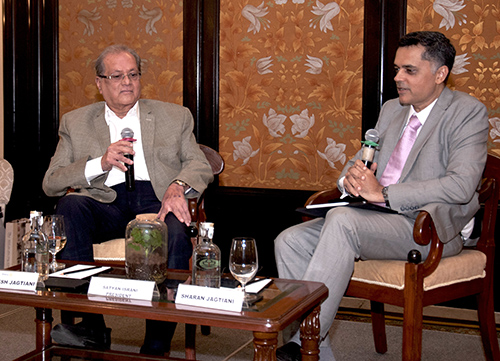
PP Haresh Jagtiani and Rtn. Ptn. Sharan Jagtiani address the Club on the Lighter side of Law
Rtn. Ptn. Sharan Jagtiani:
Thank you, Akhil. And let me start by saying what a singular honour it is for me to be addressing this particular Rotary Club because of the several years of association. And there’s another thing which comes to mind. When I was listening to the two introductions and thinking of the topic at hand, I heard the introduction of my father — the expulsions from college, the long hair, the rock music, the rock band. It occurred to me that there’s clearly only one person who is authorised to speak on the lighter side of the law.
When I heard my own introduction, it was completely devoid of any lightness whatsoever, and I asked myself why, in my debut at the Rotary, I’m addressing you on the lighter side of the law. That said, let me say a few words before we begin what I think is going to be more of a conversation.
I was eight or nine years old when my father joined the Rotary. I was thirteen years old when he was the head of Programmes, and I was 23 years old when he was the Past President. For all of these years, Rotary was an absolutely integral and essential part of our lives. In the year 2000, he, and by extension the family, took somewhat of a semi-retirement from the Rotary — till we came back with a vengeance when my wife, Ami Jagtiani, joined the Rotary about a year ago.
In those peak Rotary years, what transpired at the Rotary Tuesday meeting was a common dinner table conversation that generally revolved around the speaker. If the guest was a poor speaker, a dry speaker, or a boring speaker, my dad, in his typically exaggerated ways, would come home and tell us that the speaker was so bad that at the end of the Rotary meeting, people were taking money out of the sunshine box. We all know that he is prone only to a little exaggeration, but that was generally his way of describing a boring or a drab afternoon. Conversely, when the speaker was an entertaining speaker or an enlightening speaker — and as we know, good speakers have the ability and the capacity to both captivate and elevate — they were praised to high heavens.
So I find myself today, in my foray as a Rotary speaker, being put to the test of what everyone over here is going to say to their families when they go home this evening. And the only comfort that I have, despite the pressure of whether you’re going to be taking money out of or putting money into the sunshine box at the end of today’s Rotary meeting, is that today I’m doing it as part of a jugalbandi with my father. And as with all jugalbandis, you sink and you swim together.
A couple of disclaimers before we start. The first is that this topic — the lighter side of the law, which means everything and nothing at the same time — was chosen by my father. I had little to do with it, and like most sons, my instinct was to feel that he chose wrong. And another perhaps common view that I have on my father’s decision-making generally is that when it’s done without consulting the family, it tends to be wrong — with the only exception being his decision to marry my mom. So, with this, if the afternoon falls into the category of taking money out of the sunshine box, he’ll indemnify at least half of that.
Now, when we look at the subject of the lighter side of the law, the challenge in coming up with anything meaningful to say is that whenever I interact with anyone, they only tell me about their darkest experiences with the law. Before I came in today, I spoke to a Rotarian who told me about the miserable time he spent in court — the long years and the lack of any fruitful result. And these are years which are spent sometimes with uncertainty and prohibitive costs, often driving a litigant to penury regardless of the outcome of the case.
What adds to and compounds this dismay about the law and your interaction with lawyers is that lawyers are often compared with doctors. We are service providers and are supposed to be noble professions. But when we speak of experiences with doctors, we often come out of that experience with glowing praise. I’ll give you an example, and it’s one that connects with the Rotary. I consulted Rtn. Dr. Sharukh Golwalla some time ago. I was diagnosed with chronic fatigue syndrome, and I went to his clinic. He looked at me and said, “All rubbish. The prescription that I have for you is that you have to go and spend three days in Goa — alone. Without your wife!”
What makes it worse, when lawyers are compared to doctors, is that at the end of that, when I asked him, “What do I pay you?” he said, “No, I’m not charging you anything, because of the fraternity that we have.” So, by contrast, and by juxtaposition, lawyers are always seen — and the experience with lawyers is always seen — in a bad light.
Again, when we look at the process of litigation and the process of law, there is always going to be two sides to any story. The truth is never black and white; the truth is always grey. And the litigant who consults a lawyer expects to be told with some degree of certainty what the outcome is going to be, what the future is going to be. But any reasonable and sensible lawyer is bound to be guarded in his or her opinion, because of the vagaries associated with the process of the law and the manner in which it operates in each of our lives. So, with all of the stresses and strains that go with the practice of law, it’s really hard to find what is truly the lighter side of the law.
Another part that I want to share, as a matter of personal experience, is that what again contributes to the stresses and strains of the practice of law is the extremely public environment in which we practise our trade. We don’t have the luxury of sitting in a room where nobody is scrutinising or observing us — especially as litigators. Your work is in a courtroom, where often times you’re being viewed and scrutinised by two hundred or three hundred people at the same time. Your work is an open book.
In fact, in one of my very early days as a counsel, my senior, Mr. Dwarka Das, told me that arguing in court is like being one of those acrobats — those tightrope walkers in a circus — where the people who are in the courtroom are like those who go to the circus. Many of them are there to watch the act, but some are also there to watch the acrobat fall. And it’s with this kind of pressure that we must function.
That said, coming closer to the subject at hand — what is the lighter side of the law, and is there, in fact, a lighter side of the law — the last point that I wanted to share with you as an introduction is that in this high-stress environment, one of the real attributes to advocacy, when you’re arguing a pressure matter or a matter involving high stakes with significant outcomes, is the ability to introduce wit. It is the ability to make a light-hearted comment or crack a joke or say something that’s going to reduce the pressure in the courtroom.
And oftentimes, that’s an extremely effective tool of advocacy. It’s in those moments that some of the giants of this profession have really made their name — in their ability to connect with another human mind and engage another human mind at different levels. You can engage them intellectually; you can engage them in a more human way. And that’s really what we’re going to try and explore when we discuss and delve into the subject of the lighter side of the law.
We’ve grown up on many tales and anecdotes of legends and incidents that have happened in court. That’s part of legal folklore. I think the idea of today’s conversation is not to repeat what is part of folklore, but to draw on my father’s and my collective experience of almost about 80 years in the profession collectively — the lion’s share being his, of course — and with those collective experiences, we’re going to give you some anecdotes and incidences which I think will show the human drama and the human side of what the law is all about.
Now, as they say, when you hear this conversation and you’re hearing these accounts — as they say — never let the truth come in the way of a good story. So don’t hold us to that standard. Don’t ask us about details. But listen to it, and they’re by and large quite accurate. So, with that, I wanted to introduce the subject of what is the lighter side of the law and take it over with the conversation between me and my father. Thank you very much.
PP Haresh Jagtiani : Sharan, that was a wonderful perspective. But when I heard myself being talked about, I couldn’t make up my mind if they were saying good things or defaming me! So anyway, I’ll presume that they were good. Alright!
Rtn. Ptn. Sharan: So Dad, let me begin this conversation by asking you about some of your formative and early experiences at the Bar. Is there anything that comes to mind as an early experience, as an early exchange which stayed with you through all these years and perhaps shaped your view of what was going to be your future in the law?
PP Haresh: Well, when I started my profession, I was a brief-less lawyer — like most people are, unless you come from a family of lawyers, otherwise. As a youngster, you want to find a role model. So, you basically go around, and you’re told so-and-so is a fantastic lawyer, go and sit in his court when he’s arguing. So, I was looking around and as I left the library, I found a gentleman — whom I didn’t know, and obviously he didn’t know me — so he stops me and says, “Young man, have you just joined the Bar?” So, I said yes. His name was Mr. Mukhi — I’ll come to that later. So, he says, “You know, young man, I’ll give you three maxims to live by in this profession, and if you do, your life will be a breeze.” And without waiting for me to ask what they were, he says:
“One: Remember, a judge will always be perverse.
Two: Your senior will always let you down.
And three: Your client will never be satisfied with what you do.”
Now, it sounded so utterly cynical, but I said, well, OK — if with these three maxims I’m able to live, my life will certainly be a breeze. And so that’s how I was initiated into the legal profession.
Incidentally, he went on to become a judge of the Bombay High Court — Justice Parsa Mukhi — and contrary to what he had said about judges being perverse, he was one of the most humane judges. Totally in command, full of integrity. That was the sort of character that he was — that’s my early experience.
Rtn. Ptn. Sharan: Another somewhat unique thing about your trajectory is that you were also a professor at the Government Law College during your early days as a practising lawyer. Now one thing strikes me — it’s that you must have taught a number of students who have then later gone on to become lawyers, and I think some of them judges. So how does that relationship of professor and student impact what may otherwise later on be a relationship of you appearing in their court or as counsel opposing each other? Does one bear upon the other?
PP Haresh: Well, I’ll tell you — something amusing comes to mind. Now, of course, when you’re teaching students, you don’t know who’s going to blossom, and you don’t know what their career paths would be. Now this happened just about eight or nine years ago. I was arguing before Justice Shriram of the Bombay High Court, and we got into an issue — it was a question I used to teach, the Evidence Act for a while. So, we had a bit of a disagreement, and we joined issues on certain aspects of the Evidence Act. I tried to canvass a point of view, he said no, he didn’t agree with me. Then with a little twinkle, he says: “Mr. Jagtiani, you know I’m right. After all, it was you who taught me this subject!”
PP Haresh: Now, I wasn’t going to let him get the last laugh, so I said, “My Lord, in all these years since I’ve given up teaching, no one ever told me I was such a bad teacher!” So, this was it. Mind you, he took it very — he tossed his head back and had a good laugh as well. So, these are some of the things which come your way.
Rtn. Ptn. Sharan: Also, unlike how I practise the law, which is to deal largely with law firms and solicitors and advocates, you have much more direct contact with clients because you have your own firm. And when you deal with laypeople, or at least laypeople to the law, how do you — I mean, any particularly quirky episodes or incidents between you and clients, especially given that your sense of humour is not something that everyone will understand?
PP Haresh: Well, very early in my practice, I used to take lessons in Indian classical music. Rightly so, I didn’t pursue it. I was about three or four years at the Bar, maybe even less, and my Guruji once comes to me and says: “You have to defend my brother.” So, I said, “Why? What has he done?” He says, “He’s just been found guilty by the Sessions Court for theft of railway property.” So, I said, “But you know, I’m very raw to all this.” He says, “No, no, no — I have complete confidence in you. You have to.” So, I said alright. He said, “But my brother is so sensitive that he says if he gets even one day’s imprisonment, he’ll commit suicide.”
I said, “Oh God, but that’s not the punishment for theft. You don’t get a death sentence for it.” Nothing doing. He wouldn’t hear of it.
So I went. Now, obviously, with that pressure hanging on you, I went, I studied. I must have considered more than 150 authorities, and every time the matter was listed, I would go and sit in court — the Justice Bhasme — and I would take about 40-50 authorities with me. And he looked at this young lawyer very curiously — never seen me before. And each time I would come, my peon would spread the books out and he’d look at them. I did this for a whole month — and finally, after a month, the matter was called out and he says, “Are these all your books, young man?” So I said, “Yes, they are.”
He said, “Well, what is it about? What is the case about?” Now I got up. I said, “My client has been convicted of theft of railway property, and I am in appeal against that.”
Just then, my opponent gets up — the public prosecutor, whichever — and he says, “Mr. Jagtiani needn’t argue. Your Lordship may acquit him because there’s no evidence against him.”
I was aghast! I looked at my books and I said, “But… but…?” So, the judge says, “Mr. Jagtiani, you seem unhappy that you succeeded.”
Then the chap who had been accused, he comes out and touches my feet in front of everyone. My God. So, I didn’t realise I had saved a life in this manner. But the credit should have gone to the public prosecutor.
But there was another, quirkier client of mine. And this was much later, when people had confidence in me. Now, this was a guy who comes to me and he says, “You know, I’m being blackmailed.” So I said, “Yes? What are the circumstances?” And he said they threatened that they’ll have a tax raid on me. And it’s a relative of mine who knows all my dealings. So I said, “OK.”
Then, he said, “But I want to pay him the money.” I said, “You needn’t. Blackmailing and extortion is an offence in law. Why should you do it?” So he says, “No, I want to do it because I want to humiliate him and make him say sorry to me — that he extracted money in this manner.”
I had to blink a bit to see whether I was understanding correctly and I said, “And if he doesn’t apologise?” He says, “If he doesn’t apologise, I’ll commit suicide.” I said, “Oh God, what sort of crimes am I getting?” So I said, “Let me get this clear. You’re being blackmailed. You want to pay him for his blackmail. And then you expect him to apologise. And if he doesn’t apologise, you’ll kill yourself?”
He says, “Yes.”
I said, “Mr. So-and-so, where are you staying?” He says, “Right now, I’m from out of town. I’ve taken a room on the fifth floor at the Ambassador Hotel.” So, I repeated his instruction to me. I said, “I’ll tell you what you do. You move from the fifth floor to the eighth floor.”
So he looks at me and says, “How will it help?” I said, “That’s very simple. Because when he doesn’t apologise after you pay him, then jumping off the eighth floor will be a surer way of committing suicide than jumping off the fifth floor.”
So there’s no shortage of quirkiness in this business.
Rtn. Ptn. Sharan: Now, Dad, I think — the postscript to that story when you told it to me last — is that at the end of this conversation, he actually asked you what your fees were.
PP Haresh: Yes! In fact, that’s another tip you must give to all young lawyers — that if someone says he’ll kill himself if you lose, take your fees in advance. That’s it!
Sharan, on this note, you have, of course, had so many of your colleagues with you. Some of them have become judges — a couple of names come to mind like Gautam Patel and Arif Doctor — and all of them whom you used to, obviously, as pals in Dubai, you’d say, “Hi Gautam, hi Arif,” etc. Suddenly, you want to change their names to “My Lord,” “Your Lordship,” etc. Now how does that strike you? What do you feel when such a thing happens?
Rtn. Ptn. Sharan: One would think that it’s a difficult transition to make. But it’s actually not that difficult, because when you see them in a courtroom environment, in a court setting, you immediately look at them differently. And automatically, it’s one of those unwritten and unstated things, that when anyone that you may have known as a colleague, as a friend, takes up judgeship, then it’s unstated, but your relationship with them is put on pause for the next 12 or 15 years till they demit office.
At the same time, you can’t erase from memory what they are like as people and what their likes and dislikes are. So, I think the one thing that comes to mind is when Justice Patel took up judgeship — one thing that we both knew about each other is that we had a lot of exposure to music, and different types of music. And my exposure came through Dad. So a couple of times when I was arguing in his court, he would — in the course of arguments, disagreeing with me, which he did most of the time — start throwing titles of songs at me, expecting me to respond with titles of other songs, in the context of a particular matter.
So literally, during a hearing in court — and this is something I could be certain everyone else in the courtroom must have thought — that we have to be certified insane. Because it didn’t make sense to anybody who was not tuned in.
So, I’ll give you an example. I was appearing for somebody who owed a lot of money and trying to resist the consequences of not paying. And he was, of course, coming at me, and coming at me, and it was quite unrelenting.
And then in that moment, he said, “So Mr. Jagtiani, do you think that this is all ‘Money for Nothing’?” And we all know where that title comes from. It comes from the very famous Dire Straits song. And I, of course, knew that it came from a Dire Straits song. And I knew that he was particularly fond of Dire Straits. So I looked back at him and I said, “My Lord, do you know what the next line of the song is?” And I threatened to say it in court, and he bellowed to me, saying, “You dare not say it! You dare not say it!” — because the next line of the song is “chicks for free,” you know.
So you do sometimes have these back-and-forths. And there was again, with him, an even more abstract and offbeat reference to music. He took a chance, and I caught on to it.
Again, I mean, it’s not that I appear only for people who owe money — but it just happens to be one of those stories. And again, he spoke of — in the middle of a hearing, and this was a COVID hearing, so it was done online — he spoke of how, if you’re not paying someone and you’re defaulting and defaulting, at some point the hammer comes down. And he made a reference to that famous Beatles song — Maxwell’s Silver Hammer.
It’s a very famous Beatles song — probably not one of the most famous, but I knew it because of Dad. So, he made a reference to it during the arguments — “Mr. Jagtiani, bang bang, Maxwell’s Silver Hammer.” And again, thanks to my exposure to music, I had to remind him that one of the macabre lyrics in that song is that Maxwell’s Silver Hammer, in that song, ultimately goes on to kill the judge.
So, what I’m saying is that sometimes you can be on the same wavelength as a judge. Sometimes you will have opportunities. And when I gave my opening remarks, I gave you some examples of how you can just diffuse the situation by something completely outside and alien to the law. So, I was fortunate again — because of your general exposure to something like music — to be able to use it in the course of what are otherwise serious hearings.
Coming back to you, Dad. Again, on the subject of clients. Do they take everything that you say to them seriously? I mean, are they not able to gauge that everything is not meant to be taken at face value?
PP Haresh: Well, let me tell you, in one case it was taken at face value — up to a point, of course. I had this client, and we used to go to Bhopal for a hearing. Now this is a very heavy matter. And we were trying to get a city court judge to injunct the encashment of a bank guarantee issued from Singapore. Now it’s almost impossible to injunction a bank guarantee from being encashed, but we said this has been actuated by fraud.
Anyway, it just so happened, we were appearing in this case in this court before a lady judge who probably had just come out of college and been made a judge. Much younger lady, so shy that she wouldn’t even look up at us. And here I was, there with one of my juniors, and of course, Rtn. Soli Cooper was with me in that matter, and another lawyer friend of mine. And the other side was again a well-established lawyer. So, we were arguing before her. Obviously, everything went above — not simply because we were standing and she was sitting — but it just did.
And at one stage, we were so nervous that she would adjourn the matter. Because that would be — that would be all over for us. So, I told her, I said, “Madam, whatever you do — you decide against us or for us — but please don’t adjourn the matter, because then I won’t be able to challenge this in appeal.”
And guess what she did? She adjourned the matter.
Now, when we came back, my friend — or my client — was a young man in his late twenties. Very good-looking, tall, elegant, etc. So myself, Rtn. Soli Cooper, this other friend of mine — we were sitting at the Jehan Numa Hotel, having a drink, etc. Now, you know, after a drink, you’re not going to continue being grumpy about what has happened. So, in the course of conversation, talk about the case, what the next steps were.
I suddenly looked at my client and I said, “You know, Aileen, I think it’s your fault that we got this order.” He was stunned. He says, “What do you mean?” I said, “See, you’re such a good-looking person, and this is a young judge — “All you had to do was give her the benefit of your left profile, and she would have melted.”
So now, how seriously he took it? He looks at me and says, “But Mr. Jagtiani… I’m married!”
Now, I’m not going to take that as an answer. So I said, “Married how long?” He says, “Four years.” I said, “Four years? That doesn’t count. Your marriage won’t be recognised in your own society. You have to be married for a sufficiently long, long time for people to realise — accept your marriage as a valid marriage.”
And then Soli also chips in. He says, “See, I am married for about 12 years.” I said, “Yes, Soli is married 12 years. That means his marriage is recognised in 12 states in India. But if he goes to Meghalaya or Assam, that is not recognised. I’ve been married 25 years, so my marriage is recognised all over India but not abroad, in all the states here.”
This man is looking at us incredulously and thinking, “Is it a correct theory of matrimonial jurisdiction?” Just then, my other colleague burst out laughing and it dawned on him that I wasn’t to be taken seriously.
Now Sharan, you’ve done an apprenticeship in Charles Russell in London. I just want to know, generally, what is the approach of law practices there, and especially to young youngsters and juniors? You know, that must have been unusual coming all the way from here and doing an apprenticeship with the lead. Charles Russell, by the way, had the reputation of defending Oscar Wilde in his trial. So that’s the reputation of the firm.
Rtn. Ptn. Sharan: So, I mean, not going to get into the differences and similarities — that’s not for today — but in keeping with the lighter side, let me tell you about an incident that centred around me. And it’s a rather unusual experience. I can say that very few lawyers would have been in the position that I was in.
So, when I was 19, my dad was collaborating with a lawyer from the UK. His name was Peter George, with a law firm called Charles Russell. Peter George used to specialise in the area of matrimonial law in the UK, and so my parents thought that it was a good idea that instead of spending a pointless vacation, I should go to London and spend four weeks as an intern at Charles Russell.
And so, when Peter George was in India, they spoke to him, and he was, of course, very welcoming and very excited because he told me that my dates in London coincided with a matrimonial trial in the UK in the Royal Courts of Justice. And he said that because of the high percentage of amicable divorces, trials happen very, very rarely. So he said, “As a law student, this is going to be a golden opportunity for you to witness a trial in the Royal Courts of Justice, because you’ll be with Charles Russell.”
So, the entire internship, the entire plan, centred around being a witness to or being present for that trial. As we got to the first day of that trial — and these are in-camera proceedings, where, because it’s personal law, members of the public are not permitted to be inside, unlike any other type of dispute where members of the public are allowed inside — so it’s called in-camera.
It was before a judge of the Royal Courts of Justice in London. I was 19 years old. Name: Justice Coleman.
And the entire week was the trial. It was an American lady on her third divorce, divorcing her English husband, who was Baron of an estate, on his second divorce. And she was making a multi-million dollar claim. So it was high stakes.
I was there waiting, and five minutes before the judge came in to preside, the Queen’s Counsel — now they’re known as King’s Counsel — on the other side, a person called Mr. Poznanski, started engaging me in conversation. And generally, British stiff upper lip, crusty — and moments before a trial, even more impregnable — but he started engaging in a very pleasant conversation: “Where are you from? How old are you? What are you doing over here?”
And I thought to myself, “What a remarkable chap,” you know? I mean, he’s not worried about the trial at all, and he’s asking all these questions.
Then, after he elicited that information from me — first of all, as an intern, I shouldn’t have been doing any work in the UK to start with — he turns to our side and says, “This young man has told me that he is only an intern, that he lives in India. These are in-camera proceedings. I’m going to be raising an objection before the judge asking for him to be removed from the courtroom.”
And there I was, absolutely petrified. Forget about being removed from the courtroom — I was more likely to be thrown out of the country. I was all ready to leave. I had no interest whatsoever in the trial. There was a betting shop nearby; my father always thought that’s more important than law, so I thought I’d make him happy.
But anyways, I was on my way out. My solicitor apologised to me profusely and said, “I’m extremely sorry, but we don’t want to start this high-profile trial on this embarrassing note, so you will have to leave.”
And just as I was about to exit, the Queen’s Counsel on our side, Bruce Blair, told me — he said, “Young man, you will not leave this courtroom till you are ordered to leave this courtroom.” So, there I was, as a 19-year-old, in the Royal Courts of Justice, detained in a court by my own counsel. And when the judge came in — believe it or not — the first application in a high-profile matrimonial trial was whether yours truly should be allowed to stay in the room.
Both sides made arguments on the application. They made arguments. I was sitting on the last bench there — I could have buried a hole and just been there forever — sitting on the last bench, hearing two Queen’s Counsel arguing about whether my presence in a courtroom is legitimate or not.
Our side argued that “He comes from a family of lawyers, he’s studying law, he is doing an internship here, and therefore there’s no reason for him not to be in the courtroom.” And the judge had to give an oral ruling. And I remember his words all these years later. He said, “Because of what you said, I treat him to be an adjunct of the firm, in which case the only problem is — why is he sitting on the last bench? He should be up front on the solicitors’ bench.”
So that was my personal — I mean, here I wasn’t a litigant, I wasn’t a lawyer. I just happened to be at the wrong — or the right place at the right time. So that was, I think, a fairly unique and unusual experience that I had in my formative years outside of India.
PP Haresh: You’ve also done a stint with Sidley Austin Brown & Wood in America after you graduated from Georgetown — did your Masters. I just want to know, what’s the attitude? You know, how do they approach the law? Do they treat it as a profession like we are meant to? Or is it, for them, more business?
Rtn. Ptn. Sharan: You know, yeah, that’s a great question. And I think that’s relevant to the Indian context today, especially amongst corporate law firms, transactional law firms, so much time that lawyers spend today is in trying to get work. You have the “rainmaker” idea — the rainmaker concept. It’s what we call business development. Fortunately for us, we, as counsel, we don’t have to do any of that. But I’ll tell you a story, which I think again has a Rotary connection, on this point of business development.
So when I finished my Masters, I got a one-year position with a very big American law firm called Sidley Austin. And I was in their international trade practice group as a foreign associate because I had my law degree from India. And as an associate, you of course want to make your presence worthwhile. It so happened, by sheer chance, that one of the disputes the firm was hoping to get engaged in involved seafood exporters from India. And believe it or not, at the centre of the seafood exporters from India was none other than Uncle Gul — PP Gul Kriplani — who was my double agent in India to try and score this big, big mandate for my US law firm.
And I thought that if I, as a foreign associate, can bring in this work to the law firm, they’re going to make me the leading partner overnight. So anyways, I had all these aspirations. I thought I would harness all of Dad’s connections. And there was Uncle Gul, fanning the flames from India, saying, “Yes beta, yes beta, you know, I’m talking to everyone, they’re going to come to you, they’re going to come to you.”
But we always knew that being an elite firm, our charge-out rates were high. There were much smaller firms who were more economical. So it was: how do you get this business? So, Uncle Gul said that there is this Expo of seafood exporters in Goa, and all these important seafood exporters are going to be over there. And if you really want this business, you have to chase it. So why don’t you and your partner fly down to Goa, and I will arrange that your partner will address all of these seafood exporters. They’re going to listen to him speak, and then it is a given that this business will come to your firm.
So here I was, trying to get business for my firm, but first telling them — like any prudent businessman — you have to expend some money. So, I persuaded my partner to buy us tickets from Washington, DC, to fly down to Goa to address these seafood exporters, because Uncle Gul of the Rotary Club of Bombay told me that this is your passport to the deal.
So, we come down to Goa. My partner, who is a Yale graduate, fully prepared his speech on what is anti-dumping law, what is countervailing duty, how we are going to defend you, what the US trade authorities are going to say. So we come to Goa. He’s flying with me and we reach this Expo. And I am completely aghast, because far from this Expo being made up of people like Uncle Gul who are going to take this decision — it is nothing but coastal fisherfolk from all over coastal India who had come there with samples of all the prawns and crab that they wanted to sell.
And so my partner is there in this room. First default: I couldn’t understand a word that they were saying. Most of them didn’t speak English. And even if they did speak English, it didn’t sound like English. So my partner is there, addressing this room of fisherfolk, OK, flying down over there, and he gives his presentation. And of course, to save face, I had to keep g-ing him on, saying, “No, no, these are the business people. These are the decision-makers.”
But where I was caught out was that after he finished this great 20-minute speech on countervailing duty and anti-dumping, all these fisherfolk saw this white man in the room come from Washington, DC, and they thought that he is the business development for them.
So after this lecture gets over, Neil Ellis from Sidley Austin is accosted by every fisherman from coastal India, offering their cards to him and telling him at what rates they will send prawns and crab to him. So that was really my one and only experience with the world of business and law and business development and the law. That position at Sidley got done in a year’s time, and I’m back to doing what I’m doing.
And now, just before we end, I have one more question for my dad, which is that — you’ve practised in trial courts where the spoken language is Marathi, and you’re a dead loss in everything outside of English. How do you cope with that? How do you make your submissions or cross-examine in the vernacular?
PP Haresh: Well, forget about the vernacular — but there was an incident once. I was doing a murder case, a genuine murder case — not a chap who threatened to commit suicide if I didn’t succeed, no. And this was before Judge Makhijani. The witness happened to be a Sindhi witness. So the judge says, “Mr. Jagtiani, what are the odds — the judge is a Sindhi, lawyer is a Sindhi, witness is a Sindhi. You will now cross-examine him in Sindhi.”
Now, yes, it’s my mother tongue, but I can’t speak Sindhi. What can I do? I mean, if you grew up in a convent school and all that. So I tried to hem and haw. I said, “But nobody will understand.”
He says, “I will interpret. You cross-examine him in Sindhi.”
So finally, overcoming my embarrassment, I said, “I can’t speak Sindhi, but I can cross-examine him in a Sindhi accent.”
Of course, that was completely shot down.