
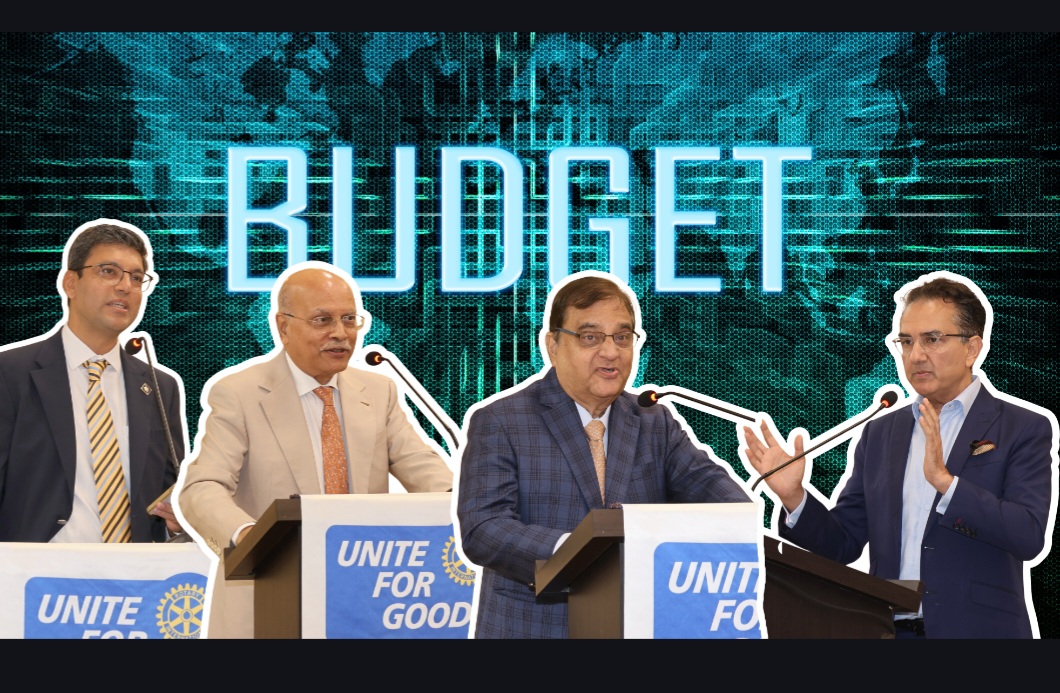
PP Shailesh Haribhakti, Rtn. Anil Harish and Rtn. Gautam Trivedi decode the Budget 2026, moderated by IPP Satyan Israni.
IPP Satyan Israni:
Good afternoon, friends. We are again at that time of the year when everybody seems to have an opinion on the fiscal deficit, GDP and taxes, whether it is a chaiwala or the chairman. This year too, Budget 2026 is no different. There has been a cross-section of reactions. Critics have called it anti-people, directionless, a masterpiece of deception, garbage of lies, and a Kursi Bachao Budget. Supporters have called it futuristic, balanced, growth-oriented, and a roadmap to Viksit Bharat.
And how do we forget those iconic lines of Ramdas Athavale in 2019? They ring true even today. He said, “This budget is very important for the middle class, the Scheduled Castes, the Scheduled Tribes, the OBCs, and the farmers. It is a very good budget, the best budget. It is also a very good budget. It is also a challenge to Rahul Gandhi and his opponents, as it will help Modi win. All taxes have been waived. This budget is the best budget.”
To come to a conclusion, whether it is the best budget, a good budget, or a garbage budget, we have a stellar panel with us to help make sense of it all. First up, we will have the Past President of our Club and renowned chartered accountant, PP Shailesh Haribhakti. This erudite auditor will give us the big picture while leaving no fiscal stone unturned.
He will be followed by eminent property and tax lawyer, Rtn. Anil Harish. This legal eagle will decode the Budget and its fine print so cleverly that even the Finance Minister may take notes.
And finally, we will have our own financial wizard, Rtn. Gautam Trivedi, who will tell us the real story behind the biggest stock market crash on Budget Day, to one of the biggest comebacks today, and derive for us the options we have for the future.
PP Shailesh Haribhakti:
Thank you very much to our Rotary Club for having us, at least once a year, for this interaction. I also love the way you introduced everybody in two sentences. This should become the next best practice for Rotary.
Let me describe this Budget as India’s quiet ascent. That is how I see it. It has switched from arithmetic to architecture, and over the next ten minutes, I will share why I believe this is the case. This Budget is not about the markets, nor is it about the trade agreements we have reached. It is about a moment.
Moments in history are rarely announced; they are recognised much later, as we will do in hindsight, when patterns suddenly reveal themselves. I believe we are living through such a moment for India. These are not isolated events. We have had three phenomenal treaties, with the UK, the EU, and just yesterday, although details are still unclear, with the US. As one of my Rotarian friends pointed out, President Trump may change his mind tomorrow morning, so we should be careful about how enthusiastic we become.
Let me share what I experienced at Davos this year. Davos showed me that the global attitude towards India has changed dramatically. In the past, we went to Davos seeking investment, partnerships, and relationships, looking to gain something. This year, Davos was a true evaluation of India’s greatness. Some of the announcements made were phenomenal. One of them was Devendra Fadnavis stating that Mumbai will have clean air and clean water. He stood alongside N. Chandrasekaran of the Tata Group and announced a mega transformation of Mumbai once again, including ₹11 trillion worth of data centre investments.
These announcements made Davos sit up and take notice. India is no longer asking for anything. India is managing everything together. It is growing, it is digitising, it is decarbonising and it is doing so quietly and steadily.
Why do I believe this Budget is a blueprint? It had nothing immediate for taxpayers, which is why the general public switched off. The new tax law was already in place. GST had already been amended. The rationalisation of how the Income Tax Department and GST Department would interact with us was already on the anvil.
This is a blueprint that has unleashed five major forces. I will cover them briefly.
The first force is corridors as the new national spine. Multiple corridors have been announced. This is how a great economy should function. Just as our body has arteries that carry blood throughout, economies need corridors. We will have high-speed rail connections, dedicated freight corridors, expanded inland waterways, twenty of them, tourism circuits, rare earth value chains, chemical parks, and biopharma parks.
This is corridor thinking. It is physical, sectoral, and digital. Corridors compress distance, reduce logistics costs where India is among the highest, and convert science into scalable production.
A major, largely unreported change is that PSUs will no longer depend on markets for borrowing. They will monetise reachable assets, convert them into REITs, and use that monetisation to finance the next level of growth. India will export not just goods, but velocity.
The second force is AI infrastructure and the new digital world. Budget 2026–27 quietly acknowledges a fundamental truth: intelligence is now a factor of production. Intelligence is being manufactured in gigafactories. This is what AI is doing.
Through this Budget, any data centre established anywhere in India will enjoy tax exemption for twenty-two years. One might ask whether this is a giveaway. This is the biggest insight of the Budget. All announcements are future-oriented. We have never earned a single rupee from a data centre that has not yet been built. Therefore, granting a twenty-two-year exemption to future data centres costs us nothing today.
Every incentive in this Budget is rooted in the future, not as a giveaway for the present. AI infrastructure will deliver compute capacity. Imagine a Hyperion coming up in Khavda. Meta had to go to Louisiana to build a giga data centre; we can do it right here in Khavda, where there is sufficient power and water.
Trusted data centres, digital public infrastructure, integration of identity, consent, payments and governance, multilingual AI platforms, together these will form a sovereign AI ecosystem. For the first time, the Finance Minister’s speech was simultaneously available in four Indian languages using Sarvam AI. It was an exceptional experience.
The word ecosystem has entered the vocabulary for the first time. It is not about individual companies or individuals, but about creating systems. In a world worried about data misuse, algorithmic opacity, and digital authoritarianism, India offers democratic, rule-based, population-scale digital systems that are the envy of the world. I say this with full authority. We are currently implementing three digital public infrastructure projects across the world.
The third force is a tax and customs system built on trust. Hardly anyone in the media has commented on the phenomenal change coming in customs administration. Rationalised TDS rates, decriminalisation of technical offences, proportionate penalties, extended return timelines, risk-based customs processes, and reduced litigation thresholds are embedded in the fine print.
The message is clear: trust first, verify intelligently. There is no organisation in India with more sophisticated AI and digital capabilities than the Government of India. The world wants to work with the Indian government to build digital infrastructure, and that is why this is possible.
The fourth force is employment at scale with dignity. Safe harbours for services are an extraordinarily insightful provision. Global Capability Centres are expanding and require these safe harbours. MSMEs will now access funding through the DREDS mechanism and receive professional support through the ICAI and ICSI. They will also have access to equity from a special government fund.
Manufacturing will scale up, and trade deals will amplify this because we will have markets across the world. EU access lifts textiles, leather and footwear, while US reciprocity supports services and advanced manufacturing. Aspiration is finally meeting architecture.
The fifth force is infrastructure with fiscal maturity, something you referred to at the beginning. We have worked some magic. 4.4% fiscal deficit, very modest inflation, and a debt-to-GDP ratio better than any other large economy in the world, by far. The comparative numbers for China and the US would make us fall off our chairs. If we were to reach those levels, God forbid, we would be deeply distressed.
Capital expenditure will remain robust. The fiscal deficit trend is downward, and debt follows a credible glide path to 50 plus one. Asset monetisation and PSU dividends have delivered ₹3.5 lakh crore this year from the Reserve Bank of India and PSUs. This is an exceptional amount, unseen for many years. This reflects confidence without bravado.
Growth without macro stability is fragile, and India is doing both. Why did the markets respond the way they did? The knee-jerk reaction was purely around whether the F&O increment of STT would affect us directly or indirectly. I said the moment the market fell 2,000 points that it would recover, and thankfully, I was vindicated.
This Budget builds infrastructure without fiscal recklessness, opens trade without surrendering sovereignty, deploys technology without eroding trust, and encourages enterprise without chaos.
Corridors move goods and people. AI moves intelligence. Trust moves trade. Employment moves aspiration. Fiscal maturity moves global confidence. Expect a phenomenal increase in FDI. We are emerging from zero net FDI this year, and we will reach heights not seen before, particularly in the data centre and AI space.
India is not advancing noisily; it is ascending structurally. When history looks back, it may well say this was the moment India stopped chasing the future and began shaping it. We are not on the menu of any restaurant, we are setting the table at the world’s best restaurants. Thank you.
Rtn. Anil Harish:
Fellow Rotarians and friends, very often we hear in Budget speeches about plans for the future, things that are proposed to be done. For instance, in 2015, we were told that 100 cities in India would be developed as smart cities. Eleven years later, only 18 cities have become smart, and even those continue to face problems. Naturally, there is not much talk about that now.
Last year was different. In the 2025 Budget speech, the Finance Minister announced that we would get a new Income Tax Act. Sure enough, on 21 August, she introduced a new Income Tax Act. We assumed that enough had been done for income tax and that we would enjoy stability for at least five years. But no — she has given us a bonus.
In addition to the 536 sections and 16 schedules in the 2025 Act, she has now introduced 87 clauses amending an Act that has not yet come into force, and 13 clauses amending the existing Income Tax Act, which will cease to exist on 31 March. I am sure no Finance Minister anywhere in the world has done this before. This is unprecedented and surely a world record. Is anyone from the Guinness Book here today?
We must examine tax laws from two perspectives, what is being done, and how it is being done. I feel the how is not good. Frequent changes, including several retrospective provisions, are problematic, and I will touch upon some of them. However, as far as the what is concerned, these 87 clauses, by and large, though not all, are necessity-friendly. They are small, not very significant, but they do help in certain ways. So we must be fair on that front.
Let us first look at the figures. Last year’s Budget estimated tax collections at ₹25.27 lakh crore. The revised estimates show this has risen to ₹26.87 lakh crore, an increase of 6.6%. The expectation for next year is ₹28.87 lakh crore, an increase of 7.5%. This broadly aligns with expected GDP growth.
I will now touch upon some amendments. Under the Income Tax Act, there is a concept of assessment year and previous year. What we commonly call the financial year is referred to in the Act as the previous year. Currently, the previous year is Financial Year 2025–26, and the assessment year is 2026–27. This will now change. The terminology of assessment year will be removed, and everything will be referred to as the tax year. Therefore, the period from 1 April 2026 to 31 March 2027 will be known as Tax Year 2026–27. We can, therefore, forget the assessment year concept altogether.
Another set of changes relates to the Black Money Act introduced in 2015 by Mr. Arun Jaitley. This is a very stringent Act. It requires any resident of India who has foreign assets or foreign income to declare the same. In the income tax return, this is done through Schedule FA (Foreign Assets) and Schedule FSI (Foreign Source Income).
Many people fail to do this. For example, a student returning from overseas may have a small bank balance abroad and omit to declare it. Others may have foreign properties or insurance policies acquired before returning to India. There are also those who have transferred funds abroad under the Liberalised Remittance Scheme (LRS). Many people have assets overseas, and some have assets that were acquired unofficially or illegally.
However, everyone is required to declare such assets. There is a CRS – Common Reporting Standard under which countries exchange information with one another. The Government of India receives an extraordinary amount of information. They even receive information from the UAE, which does not levy tax on individuals.
We have seen cases where a person who had been a non-resident for forty or fifty years was questioned about a flat in Dubai. The ownership was entirely legal, as he had lived there for decades. However, because he remained an Indian citizen, the Income Tax Department questioned him. He was able to explain the source of funds. I mention this only to stress that everyone must be extremely careful.
One example involved clients who had incorporated a company outside India with a paid-up capital of just one dollar. They spent around $2,000 to $3,000 to form the company but never used it. After four or five years, they closed it down. However, the Income Tax Department became aware of this one-dollar company. The owners were two brothers, and penalties were imposed under the Black Money Act of ₹10 lakh per year per individual. As they had held the company for five years, the total penalty amounted to ₹1 crore for a one-dollar asset. Prosecution was also initiated against them.
PP Haresh has managed to obtain a stay from the Magistrates’ Court in respect of the prosecution, but the proceedings are still ongoing. Therefore, if you have any foreign assets, please be extremely careful and ensure they are declared.
Now, the changes proposed in this year’s Budget state that, with retrospective effect from 1 October 2021, if you have movable assets outside India valued at up to ₹20 lakh and have not declared them, you will not be prosecuted. In this example, had the discovery occurred after 1 October 2021, there would have been no prosecution. However, because it was discovered earlier, the risk of imprisonment remains. There is therefore some relief for movable assets below ₹20 lakh, but caution is still required.
There is also a disclosure scheme being introduced, known as FAST for Small Taxpayers. Under this scheme, if a person has overseas assets of less than ₹1 crore and overseas income of less than ₹1 crore, they may file a declaration and pay 30% tax plus an additional 30%, totalling 60%. Upon payment, they will not be prosecuted. This provides a possible exit route, and those with such assets should seriously consider the scheme.
Another set of changes relates to share buybacks. Many companies undertake buybacks, releasing funds to shareholders. Buyback provisions have changed several times over the years. This year, it has been provided that when a shareholder tenders shares in a buyback, the proceeds will be treated as capital gains. The amount received, minus the cost of acquisition, will be taxed at 30%, irrespective of whether the holding period is long-term or short-term. Surcharge and cess will also apply.
This is not a major relief; it is merely a procedural change. For domestic companies, the rate would be 22%, as they are taxed at a lower rate than individuals. This should be factored in while considering a buyback.
A provision that affects many of us relates to TCS – Tax Collection at Source on remittances under the Liberalised Remittance Scheme (LRS). Whether the remittance is for education, medical treatment, travel, or investment abroad, TCS is required. This is not the final tax liability; it is collected upfront to enable monitoring, and credit is available in the income tax return.
Under the revised provisions, for remittances for education or medical purposes, there will be no TCS up to ₹10 lakh, and beyond that, TCS will be reduced from 5% to 2%. For overseas tour packages booked through an operator, TCS up to ₹10 lakh will also be reduced to 2%. However, if the tour package exceeds ₹10 lakh, TCS will remain at 20%.
This becomes particularly burdensome when a resident wishes to buy property abroad. Each resident is permitted to remit up to USD 250,000, slightly over ₹2 crore. On such a remittance, TCS of 20%, amounting to approximately ₹40 lakh, must be paid upfront. While credit is available against advance tax and final tax liability, the cash outflow remains significant. Relief has been provided only for education, medical treatment and overseas tours, not for general LRS remittances.
There are also changes to MAT – Minimum Alternate Tax. Domestic companies shifting to the new tax regime will be allowed to set off unutilised MAT credit up to 25% per year against their regular tax liability. For foreign companies, however, the credit utilisation will be 100%. I do not understand the rationale for this discrimination. If anything, Indian companies should be favoured over foreign companies.
There is, however, another benefit, the MAT rate itself is being reduced from 15% to 14%. This is the pattern we continue to see.
Finally, for payments to non-residents on sale of property, tax is currently required to be deducted at source under Section 195 of the Income Tax Act. When purchasing property from a resident, tax is deducted at 1%, and this can be done using a PAN without obtaining a TAN. However, when purchasing from a non-resident, a TAN – Tax Deduction Account Number is required, which adds procedural complexity.
With effect from 1 October 2026, it has been provided that a TAN will no longer be required when making payments to a non-resident. While many amendments are retrospective, this particular change will apply prospectively.
I have been examining the fine print, and it appears that if a non-resident purchases property from another non-resident, then the purchasing non-resident is required to obtain a TAN. However, if the purchaser is a resident, a TAN is not required. Once again, there seems to be no logic to this distinction.
A new scheme is being introduced whereby a person who has been a non-resident for at least five years may come to India for employment under a scheme to be notified by the Central Government. At present, we do not know what these schemes will be, the nature of activities covered, or when they will be introduced. The details are yet to be notified.
Under this scheme, if a person comes from overseas and takes up employment in India, bringing with them skills acquired abroad, they will be taxed in India only on their Indian income for five years. Their overseas income will not be subject to tax in India for that period. This effectively alters the RNOR (Resident but Not Ordinarily Resident) framework. Currently, RNOR status generally applies for two years. In effect, this extends a similar benefit to five years.
Another useful change relates to individuals with low income who do not wish to suffer TDS on interest from banks, dividends on shares, and similar income. Until now, such individuals were required to submit declarations separately to each deductor — banks, mutual funds, and others. Now, if assets such as shares or mutual funds, including exchange-traded funds, are held with a depository, a single declaration to the depository will suffice. The depository will then inform all relevant deductors.
The due dates for filing returns are also being revised. For most individuals, the due date will remain 31 July. Those carrying on business or profession without a tax audit will have time until August. Where a tax audit is required, the due date will be extended to September. Companies will have time until 31 October. In cases governed by Portuguese law, applicable in Goa, where spouses are required to file joint declarations, the due date will be extended until November.
The time limit for filing revised returns is also being extended. Instead of 31 December, revised returns may now be filed until 31 March, subject to a fee of up to ₹5,000.
In recent years, the concept of updated returns has been introduced. A missed return may be updated by paying the regular tax along with an additional tax of 25%, 50%, 60% or 70%, depending on the category into which the taxpayer falls.
Several penalties are now being recharacterised as fees. When an amount is termed a penalty, the Income Tax Officer is required to apply their mind and establish wrongdoing before imposing penal consequences. By calling them fees, discretion is reduced, and the scope for contesting such levies is also diminished. While the amounts have not changed significantly, the method of calculation has been altered. Many of these provisions may appear unnecessary, but they remain part of the law.
Certain offences are now being decriminalised. It has been provided that where tax evasion is up to ₹10 lakh, there will be no prosecution, although additional taxes may still be imposed and could be substantial.
Another significant change relates to interest deductions. If a person borrows money to invest in shares and earns dividend income, they were earlier permitted to claim a deduction of up to 20% of the dividend income towards interest paid. This deduction is now being completely withdrawn. Consequently, even where there is a corresponding interest cost, tax will be payable on the full amount of dividend income without any deduction.
PP Shailesh Haribhakti referred to data services earlier. The position, however, is slightly different. The Government is not directly encouraging the setting up of data centres. Instead, it is proposing that a foreign company that avails the services of a local data centre will receive a tax exemption on income earned from cloud services.
There is an organisation called the Bharat Digital Infrastructure Association, which has strongly criticised this provision. They have articulated their concerns in today’s Economic Times. Under the proposed law, companies such as Amazon, Microsoft and Google, the three largest players, currently pay income tax on the cloud services they provide to users in India. However, if these companies use the services of a local data centre, they will not be liable to pay income tax on the income earned from such cloud services. That income will effectively be tax-free.
On the other hand, an Indian company providing identical cloud services will continue to pay income tax. Additionally, these foreign companies will enjoy a 20-year tax holiday. This creates a clear imbalance and is, in my view, deeply unfair. However, that is the position the law is moving towards.
To conclude, as I have said earlier, the manner in which these changes are being implemented is deeply disturbing. It is not good at all. Just a few days ago, we read in the newspapers about the suicide of a person named CJ Roy, following a raid by the Income Tax Department.
There are fewer raids today than there were earlier, but the manner in which assessees are treated has largely remained the same. The pressure that is exerted is enormous. Capital punishment is debated in many forums, but in situations like these, it almost feels akin to capital punishment, because of the extent of pressure applied. We are aware of numerous instances where clients have come to us and narrated these experiences.
To end on a positive note, while the Finance Minister and the Government must seriously examine these pressures, there will be no change in tax rates, and we are fortunate that there is no estate duty, which places us in a far better position than many other countries. For that, we must thank the Finance Minister. And perhaps, even more than the Finance Minister, we must thank Mr. Ambani and Mr. Adani. Thank you.
Rtn. Gautam Trivedi:
Good afternoon, everyone. I am Gautam Trivedi. If you are not already scared or confused after Harish’s commentary on the Budget, try being in my position, attempting to make money in the stock markets over the last eighteen months or so.
I will speak about the Budget largely from a capital markets perspective, focusing on the challenges facing India’s stock markets over the past eighteen months, and how domestic investors, foreign investors, family offices and others are viewing India, what they are buying, selling or shorting.
On the Budget itself, I will make a few quick points. My biggest personal takeaway was the tax holiday on data centres, although Harish has provided a very different perspective, which suggests it may not be as beneficial as it first appeared. Many domestic data centre companies saw a sharp rally, though some of that enthusiasm may now be tempered following further clarification.
The markets were clearly spooked on Sunday, primarily due to the increase in STT on futures and options. Today, however, we have seen a complete reversal, driven largely by the historic trade deal, assuming it holds within the parameters discussed earlier. We should see more detail on trade policy soon.
Let us now look at the markets more closely. I want to explain what has been driving the markets. Over the past three years, the Indian economy has, in fact, been under strain. Many of you, across different professions, will have observed issues related to consumption, demand slowdown and overall economic momentum.
So the obvious question is, why is the stock market still rising? This is particularly relevant given that over the last twenty months, we have seen consecutive months of net FII selling. In calendar year 2025 alone, FIIs sold nearly USD 19 billion worth of equities. Additionally, IPOs and QIPs absorbed another USD 28 billion.
The good news is that the market has been supported almost entirely by domestic retail investors. To put numbers to this, USD 88 billion has flowed into domestic mutual funds and insurance companies from retail investors. I draw a clear distinction here between retail investors, high net worth individuals and family offices, they are very different segments.
Let us understand this flow of money. These investments are coming in daily, weekly, fortnightly and monthly into mutual funds and insurance companies. Why are people investing in equities when the economy is slowing, numbers are not great, political uncertainties exist, and foreign investors are selling? Do these investors know something that we do not?
The good news is, they do not. Most of these investors are effectively bypassing the banking system. For them, investing in the stock market has become a savings mechanism, not an investment decision. Many do not fully understand the stock market, but they trust the system.
I was recently in Surat for a wedding and met one of the largest mutual fund distributors in the country. He told me they have 55,000 people on the ground and 200 offices across India, and yet they have barely scratched the surface of the potential retail inflows into equity markets.
To put this into perspective, Indian equity investments as a percentage of household savings were 1.8% in FY 2012. By 2025, this had risen to 8%. That is the scale of money still entering the markets every day.
Another statistic that may surprise you: the top five states account for 48% of the unique investor base of approximately 12 crore investors in India. I repeat, 12 crore unique investors, with nearly half concentrated in just five states.
In order, they are Uttar Pradesh, with a population of about 250 million; Maharashtra; Gujarat; Rajasthan; and, surprisingly, West Bengal. Few would have predicted such strong equity market participation from Bengal, but there it is.
The implication is clear, the potential inflow of capital into Indian equity markets remains enormous. From a long-term perspective, this is very positive. More people investing through professional fund managers, rather than trading independently, improves market stability and outcomes.
That covers the domestic retail flow. Now let us turn to foreign investors. Why are foreigners selling? I was in the US in October, speaking with asset allocators and FII fund managers, and I asked them exactly this question. Their response was simple: they have been willing to tolerate India being the most expensive equity market in the world but only up to a point.
If we look at the Nifty 50, it is currently trading at roughly 22 to 23 times one-year forward price-to-earnings (P/E). India today is the most expensive stock market in the world.
We are trading at almost double the valuation of China, South Korea, and Taiwan. Interestingly, these three markets were the best-performing markets last year. The Korean stock market delivered a 75% dollar return, while India delivered a 2% dollar return.
So investors are asking a very simple question: if earnings growth has slowed, why pay such a premium? At one point, Nifty 50 earnings growth was in the range of 20–25%. Today, it is in single digits.
If we look at earnings growth in the United States, which is where the bulk of foreign institutional money originates, the numbers are telling. The S&P 500, representing the top 500 US companies, is expected to grow earnings by 15% this year. The NASDAQ 100 has an estimated earnings growth of 23%, and the S&P Mid-Cap Index stands at 19%.
Given these numbers, investors naturally ask: why should they pay 23 times earnings to invest in India, where the currency is weakening, the economy is under strain, and earnings growth is muted?
I do not want to be pessimistic. I sincerely hope that the Budget, to the extent that it helps, along with the two major Free Trade Agreements, one with the European Union and one with the United States, contributes to higher economic growth. However, this is the stark reality of where India stands relative to the rest of the world.
Many people I meet say things like, “The United States is finished.” I strongly disagree. They argue that President Donald Trump does not know what he is doing. On the contrary, Trump knows exactly what he is doing. If I were President of the United States, I would have done much of what he has done, perhaps not all of it, but certainly a significant part because he is protecting his country.
The United States has been taken advantage of for a long time. India, for instance, has some of the highest tariffs in the world. If you want to sell to the US, you often face pressure to reduce tariffs, yet in many cases, Indian tariffs are five to ten times higher than those imposed by the US. That imbalance is unfair, and to some extent, these FTAs help iron out such tariff differentials.
Coming back to markets, in calendar year 2025, India delivered a negative 2% dollar return, which was clearly disappointing. Even this year, the ability to attract foreign investment back into India remains limited.
We have started the year with an estimated 15% earnings growth, but the S&P 500 is also at 15%. South Korea, the best-performing market last year, has a 69% consensus earnings growth forecast for this year. China, Hong Kong, Korea, and Taiwan are all in the 12–15% range. Earnings growth is therefore not unique to India; it is visible across Asia. India is competing for foreign capital with many other markets, and we must remain mindful of that.
The third leg of the Indian capital markets after retail investors and foreign institutional investors is family offices and high net worth individuals. Over the past twelve months, this group has been selling almost continuously.
Foreign investors have largely been selling large-cap stocks, where they are predominantly invested. Domestic high net worth individuals and family offices tend to be invested in mid- and small-cap stocks, and the sharp correction in these segments has been caused largely by Indian investors themselves, not foreign institutions.
Is the market attractive today? I am anticipating that question. My view is that investors must roll up their sleeves. You cannot sit in an air-conditioned office in BKC, Lower Parel, or Nariman Point and expect to identify opportunities. You have to travel across India, go deeper, and discover businesses on the ground.
From a Nifty 50 perspective, the market remains very expensive. However, India continues to offer substantial bottom-up opportunities. Data centres are one such area, not necessarily Indian data centre companies, particularly after Harish’s clarification but the ancillary industries around them.
We are looking at approximately USD 80-90 billion of investments flowing into this space over the next five years. To power data centres, you need electricity, which means power generation, transmission and distribution will see massive growth.
There are many such opportunities in India, but investors must go out and find them. I am happy to discuss these in more detail with anyone individually after this session. Thank you.
IPP Satyan Israni:
Thank you to all three of them. Those were wonderful insights. You have unravelled the Budget for all of us with very interesting analysis.
Gautam, that was very incisive. May I ask you about your views on precious metals gold and silver?
Rtn. Gautam Trivedi:
I think my wife may have a better answer than me, because I do not really understand them, and I do not know why people buy them. Stay away from diamonds — that is the only thing I know. Yes, I was saying that partly in light humour. But seriously, demand for both gold and silver has expanded significantly from different quarters. Gold is being accumulated largely by central banks, while silver demand is coming from EV companies and battery manufacturers.
And the new gold, in my view, is copper, so I would include that in the mix as well.
We have heard both the good and the bad about the Budget. One issue that seems to have escaped attention is the interest India pays every year. Effectively, all the direct taxes collected are going towards interest payments. Would you like to comment on that?
PP Shailesh Haribhakti: We have been coming out of this trap, and we now appear to be on the way out. I would highlight three points.
First, the stock of REITs in our country has increased dramatically. Second, InvITisation of infrastructure assets is now taking place at scale. Third, with PSUs focusing on asset monetisation and InvITisation, the crowding out of private borrowing that we experienced two years ago will not continue.
Because our macroeconomic fundamentals are among the strongest in the world, certainly among large economies, we will continue to enjoy strong access to capital, both equity and debt. As Gautam pointed out, secondary markets may be influenced by other forces, but India will have access to money at scale, and that is what will ultimately take us out of this situation.
Look at our debt-to-GDP ratio. It stands at 56% and is falling. If it comes down to 50 plus 1, we will be in good shape. The challenge we face is finding resources to fund populist measures during state elections. That appears to have been addressed through a disinvestment target of ₹80,000 crore, which will act as a significant buffer.
At present, there are no penalties on state governments for fiscal profligacy.
Sir, the rate of borrowing, the interest rate we are paying on government borrowing is among the highest in the world.
Yes, that will have to come down, and it will come down.