
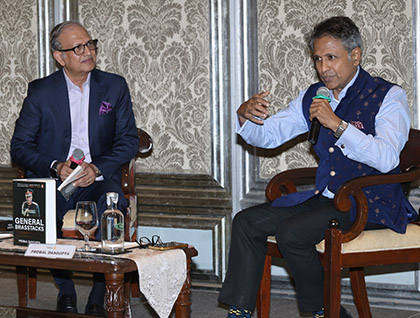
Probal DasGupta in a fireside chat with PP Vineet Bhatnagar on General Brasstacks: The Sundarji Story
PP Vineet Bhatnagar:
So I want to congratulate you first. Your book is rated as bestseller number one on Amazon in the Public Affairs category. So congratulations.
Probal DasGupta:
Thank you. Thank you, Vineet.
PP Vineet Bhatnagar:
I want to start this entire conversation with what I recently received, which is an endorsement from Shashi Tharoor on this book. He calls this book a fast-paced thriller. He also calls it a very serious academic work. He says that it is an exhilarating portrait of a general, an army general, in independent India, who had also seen the pre-Partition days of the colonial era. He says that you have portrayed the man behind the medals as someone with indomitable courage.
I want to dive straight into the way you start the book, by talking about the stormy decade of the 1980s, with no punches pulled. You talk about how that decade was the defining period, not only bringing out the best and perhaps the worst of General Krishnaswamy Sundarji, but also shaping the destiny of a nation. Your take on the 1980s decade is striking, and you very aptly call it a decade with five assassinations and an arms deal.
Probal DasGupta:
Thank you, Vineet, and thank you everybody for this wonderful opportunity to interact on a Tuesday afternoon.
The central era of this book is the 1980s. Of course, I have also tried to pull out the early life of Sundarji, but the 1980s are central. You rightly call it the stormy decade of assassinations and an arms deal, which is Bofors scandal. Many of our personal histories and our historiographies are linked with the events of the 1980s. Not a single month passed without an event, and not a single year passed without drama. The entire decade was complete box office theatre, that is how I describe it.
You had the five assassinations. You had the Indian Army operating in the religious temple in Amritsar, in the deserts of Rajasthan, in the world’s highest battlefield in Siachen, in the jungles of Jaffna, in the swamps of the North-East, and even in the island of the Maldives and the plains of Punjab. All of this also had a political impact and shaped the choices of the country in that decade. It bore the imprint and the signature of General Krishnaswamy Sundarji, the mercurial and highly ambitious general who divided opinion. He was either revered or reviled.
The fact is that he left a lasting impression in the transformation of the country from a socialist form to a more modern orientation as we moved through the decade and as the world around us changed. To me, he was arguably one of the most important military leaders who also influenced the political choices of this country.
PP Vineet Bhatnagar:
Allow me to get into the events one by one. Operation Blue Star was initiated by then Prime Minister Indira Gandhi. Jarnail Singh Bhindranwale had put together the entire force at the temple complex. Who was leading the operation from his side? I believe it was Lieutenant General Shabeg Singh. I want you to share with our audience the history of Shabeg and how he joined Bhindranwale.
Probal DasGupta:
Before I come to that, I will talk a little about the five assassinations. It was one decade that saw so many important political assassinations. We talk about Indira Gandhi. All of us remember what we were doing on the day when the news came in that she had been shot. Each of us has a different story to tell, so that became a shared public memory. I will tell you why I am referring to these assassinations.
The second was Rajiv Gandhi. Again, it is something we are familiar with. In 1991, which is technically part of the next decade, but it can still be counted in the continuum of the 1980s because it was connected to what had happened with the Indian Peace Keeping Force in Sri Lanka. Then you have General A. S. Vaidya, who had led the military campaign during the Golden Temple operation.
There are two other assassinations that I will not talk about right now. I will keep you waiting for those because they are less well known, but they are connected to this story.
Coming back to Blue Star, you mentioned Lieutenant General Shabeg Singh. His story has always intrigued me. Shabeg Singh was a war hero of the 1965 and 1971 wars. He was revered by his troops and by his regiment. Incidentally, he also came from my regiment.
Shabeg Singh had acquired considerable glory. At the National Defence Academy, where he served as an instructor, he had a cadet named Kuldip Singh Brar, popularly known as Bulbul Brar. Shabeg Singh was the instructor, and Bulbul Brar was his cadet.
In 1971, when the Bangladesh Liberation War took place, the Mukti Bahini force was formed. It was a militia that went inside Bangladesh and helped the Bangladeshi freedom fighters against the Pakistani army. Shabeg Singh led the Mukti Bahini with Bulbul Brar, who by then had become a major, as his deputy. They had first been instructor and cadet, and later colleagues in the 1971 War, fighting shoulder to shoulder.
After the war ended, Shabeg Singh returned and continued his career. He had been a brigadier in 1971 and later became a major general. A day before his retirement, he was dismissed by then Prime Minister Indira Gandhi. He was stripped of his pension and the retainable rank of his service. After more than three decades of service, he had nothing left to fall back on. He retired into relative oblivion in Punjab.
Around this time, the militant leader Jarnail Singh Bhindranwale, who had risen to prominence by the early 1980s, approached Shabeg Singh and asked him to join the movement, saying that he had been wronged by the Indian government. Shabeg Singh initially refused. Bhindranwale approached him again, but again Shabeg Singh declined.
By then, Shabeg Singh had filed a case in the High Court challenging the decision against him. Over time, he won the case. Bhindranwale returned once more and asked him if he would join. By that time, Shabeg Singh had become deeply frustrated with the system. Eventually, he agreed.
Inside the Golden Temple, when the militants had stockpiled weapons and fortified their position, Shabeg Singh was the one who designed the complex as a defensive fortress against the Indian Army. He understood how the Army would approach and how it would attack.
But the story does not end there. It also involves Bulbul Brar. When Shabeg Singh positioned his militants inside the Golden Temple in 1984, awaiting the Indian Army, a journalist came to him and said that the army had appointed General Bulbul Brar to lead the attack against him. Shabeg Singh reportedly replied that he had heard Bulbul was there and that it would be a tough fight.
The journalists who recorded this were Mark Tully and Satish Jacob. I spoke with them, and that is how I learned what had happened. Shabeg Singh and Bulbul Brar had been colleagues and friends at the academy, and now they had become adversaries.
General Brar lives about 200 metres from here (Taj Hotel) in a heavily secured residence. He became India’s first civilian with Z-plus security after 1984. I spent half a day with General Brar and asked him what he thought of Shabeg Singh. He said that he had the highest professional regard for him. He said Shabeg Singh had made a wrong choice, but he was a fine man and an even better soldier.
This was the ethos that prevailed between soldiers. We know the broad outlines of Operation Blue Star, and I will not go into the entire detail here, given the time. But this particular episode was one aspect of the story that I wanted to bring out.
There is a small tailpiece that I would like to end with. We all know about Bhindranwale. I will not go into his story in detail. He led the militancy movement and was associated with the demand for Khalistan. Bhindranwale died during the Operation. Shabeg Singh also died during the Operation.
But there is another detail. Bhindranwale’s brother continued to serve in the Army. Only a month ago he retired after completing his full service in the Indian Army. He never left the Army and continued to serve in uniform.
PP Vineet Bhatnagar:
Yes, and that really speaks about the institution that the Indian Army is. I also want you to give us a small insight into who was the first person to volunteer to lead Operation Blue Star. Interestingly, it was another Sikh.
Probal DasGupta:
Sometimes the Operation is spoken about as an Operation against Sikhs, which is the biggest mistake and falsehood. It was not an Operation against Sikhs. It was an Operation against a militant organisation that propounded the theory of an independent Khalistan.
If you look at who the people involved in the operation were, you had Kuldip Singh Brar, popularly known as Bulbul Brar, who was a Jat Sikh. In fact, Jarnail Singh Bhindranwale and Bulbul Brar came from neighbouring villages if you trace their backgrounds. General Brar led the operation, and he was a Sikh. There was also Lieutenant General Ranjit Singh Dayal, who again was a Sikh. In the Operation, there were many Sikhs involved.
To answer your question, on the morning of June 6th, when Operation Blue Star was to be launched against Khalistani militants in the Golden Temple, General Brar stepped out and asked who would lead the assault. A hand went up immediately, and that hand belonged to a young officer. The young man was Jasbir Singh Raina. He was a young Sikh captain who volunteered to lead the assault, and he did lead it.
But remember what I mentioned earlier. Lieutenant General Shabeg Singh knew how the Indian Army would approach because he himself had led the same Army during the 1971 War. He had positioned machine guns barely a foot and a half above the ground, anticipating that soldiers would crawl in. In that initial phase, a large number of people were killed. Captain Jasbir Singh Raina was hit in both legs. He had to be evacuated even though he wanted to continue fighting. He lost both his legs. Jasbir Singh Raina was a Sikh.
So you had Jasbir Singh Raina, you had Ranjit Dayal, you had Brar, and at that time, even the President of India, Zail Singh, was a Sikh. Years later, Jasbir Singh Raina became my instructor when I trained at the Indian Military Academy.
PP Vineet Bhatnagar:
That I did not know. Let us turn to Jaffna and the Liberation Tigers of Tamil Eelam. I want to refer to an interaction that Rajiv Gandhi had with Velupillai Prabhakaran after hosting a dinner for him in Delhi following the signing of the Indo-Sri Lanka Accord. I want you to briefly share what happened when Prabhakaran was leaving the dinner.
Probal DasGupta:
Let me begin with an earlier part of the story. When Prabhakaran was to come to Delhi, a helicopter was sent to Jaffna. The idea was that all parties needed to be brought on board before the Indo-Sri Lanka Accord was signed with the Sri Lankan government and before Indian troops were sent as part of peacekeeping in the civil war that was taking place.
A helicopter landed in Jaffna to bring Prabhakaran. An official from the Indian High Commission had gone to fetch him. I will tell you who that was. Prabhakaran got into the helicopter. Several of his aides were around, and they did not want him to go. The helicopter landed amid dust and confusion, and the Indian High Commission official assured them that he would bring Prabhakaran back safely.
They left Jaffna and made a stop in Chennai, which was then known as Madras. At the airport, they had lunch. The Indian High Commission official asked Prabhakaran what he would like to eat. Prabhakaran ordered chicken and chapati. The official asked him why he had chosen that instead of rice. Prabhakaran replied that if he ate rice, it would make him sleepy and slow his finger on the trigger.
The Indian High Commission official who brought Prabhakaran from Jaffna to Delhi was Hardeep Singh Puri, who was then posted at the Indian High Commission in Colombo.
Coming to your question, after Prabhakaran had met Rajiv Gandhi in Delhi, it was assumed that he had agreed to the arrangement. Rajiv Gandhi hosted a dinner for him. After the dinner, Prabhakaran was about to leave, and Rajiv Gandhi stepped outside to see him off.
Just before Prabhakaran left, Rajiv Gandhi asked everyone to wait a moment. He called his son, Rahul Gandhi, who was a young boy at the time, and asked him to fetch something from a chair inside the house. Rahul Gandhi went in and returned with an item which Rajiv Gandhi took from him. Rajiv Gandhi then wrapped it around Prabhakaran. It was a bulletproof vest. He told Prabhakaran to keep it with him so that he would remain safe.
The irony of the story is that a few years later, it was Prabhakaran who was responsible for the assassination of Rajiv Gandhi. That is the tragic irony.
When Prabhakaran left Delhi, he was accompanied in the helicopter. And later, feedback about the meeting was conveyed. But this episode between Rajiv Gandhi and Prabhakaran carries an irony that history remembers.
PP Vineet Bhatnagar:
Let us turn to the title of your book, General Brasstacks. This takes us to Operation Brasstacks, which was launched after General Krishnaswamy Sundarji became the Chief of Army Staff in February 1986. I have read that this was the largest deployment of military operations seen anywhere after the Second World War.
Interestingly, it began from the southern part of Pakistan. There is also something people rarely talk about, which is Operation Trident. I would like you to take us through Brasstacks, Trident and the episode of cricket diplomacy.
Probal DasGupta:
When Rajiv Gandhi became Prime Minister, he was a young and energetic leader who wanted to move beyond the bureaucratic inertia that had characterised Indian political systems for a long time. He called the three service chiefs, the chiefs of the Army, Navy and Air Force, and asked them whether India was prepared for war and whether a major military exercise had been conducted recently. The answer was no.
That is how Operation Brasstacks was conceived. It was largely the brainchild of General Krishnaswamy Sundarji. It was an exercise on a scale never seen before. It involved nearly 400,000 troops, perhaps even between 400,000 and 500,000 personnel overall. Around 150,000 troops were positioned at the forward front. The exercise was four times the size of a typical NATO exercise and was considered the largest military exercise conducted anywhere after the Second World War.
Brasstacks unnerved Pakistan to a great extent. Pakistani forces were also moved to the front. Sundarji had observed that Pakistan had historically performed well on the Punjab front during earlier wars. If you look at the map of India and Pakistan, the Punjab region is characterised by canals and plains. Pakistan had performed well there in the wars of 1965 and 1971.
Sundarji’s idea was that Pakistan would expect India to focus on the Punjab front. Instead, he considered drawing Pakistani attention there and then launching a thrust through the deserts of Rajasthan. The idea, according to some interpretations, was to drive deep into Pakistan and potentially dismantle the developing nuclear facility at Kahuta. The concept was to push hundreds of miles into Pakistani territory. Sundarji had prepared the army in such a way that armoured formations could move at very high speed.
Muhammad Zia-ul-Haq was extremely alarmed by this development. There were also debates about whether Sundarji intended to bisect Pakistan into two parts. Historians and analysts hold differing views. My own view is that he wanted to provoke Pakistan into making the first move, after which India could respond by advancing through the desert and potentially splitting Pakistan strategically.
At the same time, there was another plan that some believe existed in parallel. According to this view, Brasstacks may have served as a smokescreen for another concept referred to as Operation Trident. This was said to involve the possibility of regaining territories such as Gilgit and Skardu in what is now Pakistan-occupied Kashmir. As Pakistan concentrated forces in the western deserts and the northern plains of Punjab, the idea was that India might seize certain areas in that region.
However, events did not unfold in that manner. Rajiv Gandhi, who had been holidaying in the Andaman and Nicobar Islands, returned, and several developments followed that changed the course of events.
This brings us to the story of cricket diplomacy. Once Pakistan understood the scale of Brasstacks, Zia-ul-Haq became deeply concerned. He reportedly believed that Sundarji had both the capability and the intent to launch a blitzkrieg that could divide Pakistan. At the same time, Pakistan was developing its nuclear capability.
Then one day, during a cricket match between India and Pakistan in Jaipur, a flight arrived from Rawalpindi and landed in Delhi. On that flight was President Zia-ul-Haq. He came to watch the cricket match. Photographs from that occasion show Zia shaking hands with players such as Imran Khan, Sunil Gavaskar and Kapil Dev during the match in 1987. It became known as the episode of cricket diplomacy.
Zia’s visit was essentially an attempt to open a channel of communication and propose peace. As the powerful leader of Pakistan at the time, he may also have seen an opportunity to improve relations with Rajiv Gandhi and possibly bring stability to the region. Talks began about demilitarisation along the border and the Line of Control. Meetings took place in various locations, including Geneva and Oman. For six to eight months, there were discussions between Indian and Pakistani officials about easing tensions and exploring economic cooperation.
Then, nine months later, Zia-ul-Haq boarded an aircraft along with the United States ambassador in Pakistan after attending a military demonstration. A crate of mangoes was reportedly loaded onto the aircraft. Shortly after take-off, the plane exploded, and Zia-ul-Haq was killed.
Years later, in 1994, after General Krishnaswamy Sundarji had retired, the former United States ambassador to India, John Gunther Dean, who was then in Paris and shared a cordial relationship with Sundarji, invited General and Mrs Sundarji for dinner. During dinner, he leaned across the table and asked Sundarji who he believed was responsible for the death of Zia.
General Sundarji reportedly leaned back and replied that it was the Americans, asking whether they themselves did not know that.
That is how the story of Brasstacks concludes, ending with the death of Zia-ul-Haq and the many debates that followed about what truly happened.
PP Vineet Bhatnagar:
So now we have the fourth assassination. Let us move to the fifth assassination of that decade, which surrounds the arms deal with Bofors.
Probal DasGupta:
Yes, Muhammad Zia-ul-Haq was the fourth assassination, again a very significant leader. Let us go back a little. Now this man (fifth assassination), do you know who he is? Let me explain why I am bringing him up, and how General Krishnaswamy Sundarji connects to this story. That is why I kept it for the end.
When Rajiv Gandhi assumed office as Prime Minister, Sundarji was in Delhi as the Deputy Chief of Army Staff and later the Vice Chief. They initiated plans to induct heavy weaponry into the Indian arsenal. One of the guns under consideration was the Bofors FH-77B howitzer. We all know about the Bofors controversy now, but the matter created a huge political storm at the time. I will not go into the entire controversy here, although my book provides detailed accounts of who said what and what exactly transpired.
What is interesting is that Rajiv Gandhi, based on the recommendation of Sundarji, decided that the Bofors gun should be preferred over the French Sofma gun and the Austrian gun. The Bofors system was eventually inducted into the Indian Army.
The Swedish Prime Minister, Olof Palme, had come to India, and discussions were held between Rajiv Gandhi and Olof Palme about the deal. One morning, they went for a walk together and discussed the matter again. They concluded that the deal should be sealed, and during that morning walk, the decision on the Bofors gun was finalised. The details of that conversation and what exactly was discussed are described in my book, including questions about whether there was a middleman and how the decision unfolded.
Let us return to this man I mentioned earlier. He was out with his wife in Oslo, Sweden. They had gone to watch a film. After the movie, they were returning home. On the way, a gunman approached them and shot the man, missing his wife. The man died on the spot. Soon, people gathered around and realised that the victim was the Swedish Prime Minister, Olof Palme.
If you see the next image, that is Olof Palme during his visit to India. In that photograph, you can also see Giani Zail Singh. The assassination of Olof Palme remains another great mystery. A suspect was arrested years later, but around 2015 or 2016, it emerged that the authorities had likely arrested the wrong person. Even after decades, the inquiry did not reach a definitive conclusion. We still do not know who killed Olof Palme, just as we do not definitively know who was responsible for the death of Zia-ul-Haq. That is why I left these two assassinations for the end.
PP Vineet Bhatnagar:
From the 1980s, let us go back to the 1960s and 1970s, because the man behind the General was in the making then. In 1962, when India was confronting China, Sundarji was part of a United Nations mission in Congo. In the same decade, he also attended a course in the United States at Fort Leavenworth, where he topped the class. I believe he was the only officer considered fit to lead NATO forces, which was extraordinary at that time.
I would like you to take us through the 1960s and 1970s when, as a senior army officer, Sundarji was in the making. What was he doing during those decades?
Probal DasGupta:
That is a very good question, Vineet, because it gives us insight into the journey and the origins of many of the decisions he later took.
In the 1960s, he was a young officer who had been commissioned just before Independence. In fact, he was the last officer commissioned before Independence who eventually became the Chief of Army Staff. After him, all subsequent chiefs were officers commissioned after Independence.
During the early 1960s, India was still a young country. We had been independent for barely thirteen or fourteen years. You mentioned the war with China in 1962. At that time, the Indian Army was engaged in the Sino-Indian War, and the political system in India was under enormous strain.
However, Sundarji, who was then Major Sundarji, was not in India at that time. He was serving in Congo as part of a United Nations mission during the Congo Crisis. He was dealing with conflict situations there. Some may remember Dag Hammarskjöld, the United Nations Secretary-General who died in a plane crash in the early 1960s during that crisis. That entire episode was part of the intense geopolitical contest surrounding Congo at the time.
Sundarji’s experience there exposed him early in his career to international insurgencies and complex geopolitical conflicts. These experiences made him bold in his thinking and decisive in his approach. He developed the habit of making quick and firm decisions. That exposure played a major role in shaping his personality and leadership style.
You also mentioned Fort Leavenworth. United States Army Command and General Staff College at Fort Leavenworth was, and remains, a global centre for military academic excellence. Just as the United States served as a laboratory for scientists and innovators, it also became a laboratory for military leadership. Officers from around the world trained there.
Sundarji attended the course and was recognised by the Americans as an exceptional officer. He was even considered capable of leading a NATO formation, which was almost unheard of for a foreign officer at that time.
All of this shaped his strategic thinking. In the 1960s, the Vietnam War was also ongoing. While studying in the United States, he observed American military doctrine, technological advancements, mobility in warfare, and the importance of speed and precision.
When he returned to India, he believed that many aspects of the Indian military system needed to be changed. After the victory in the Indo-Pakistani War of 1971, the armed forces entered a period of relative calm during the 1970s. There were fewer active conflicts, and the military environment was somewhat relaxed.
However, Sundarji was already thinking about restructuring and modernising the armed forces. He began to rethink how the army should function in terms of technology, mobility and doctrine. These efforts during the 1970s are less widely discussed, but they formed the intellectual and strategic foundation for his actions in the 1980s.
By the time the 1980s arrived, he was ready. I often call him destiny’s child. When critical moments arrived, he was present and prepared to act. He worked with two Prime Ministers, including Indira Gandhi and Rajiv Gandhi, under very different circumstances and during extremely dramatic events. Much of his later leadership can be traced back to the exposure and learning he had acquired earlier in Congo and in the United States.
PP Vineet Bhatnagar:
Yes, and it played out in a significant way. He was the only Army Chief to have sent a force of around 80,000 soldiers to a foreign country, Sri Lanka. At the same time, you mentioned the period of relative inactivity during the 1970s. Sundarji apparently had a vision that Indian tanks, which were earlier moving at about 10 kilometres per hour, needed to move at speeds of 85 to 90 kilometres per hour. That thinking later proved useful as well.
Probal DasGupta:
Yes, indeed. He completely transformed the mindset of the Army. He pulled its thinking forward into what was essentially twenty-first-century thinking, even though these developments took place during the 1980s.
PP Vineet Bhatnagar:
And which gun was used during the Kargil War in 1999?
Probal DasGupta:
A few months after Sundarji’s death, when the Kargil conflict took place, the Bofors FH-77B howitzer proved to be a decisive weapon. The thunder of those guns during the war was, in many ways, like a symbolic salute to the departed general.
PP Vineet Bhatnagar:
Krishnaswamy Sundarji. I have not come across any Indian name that includes a “Ji” in its formal description. How did this come about? How do we refer to him as Krishnaswamy Sundarji?
Probal DasGupta:
You know, Vineet, that is something I discovered during the process of writing the book. When you start a book, you believe you know a great deal. By the time you finish it, you realise that you probably knew only ten per cent when you began. That is the beauty of the journey of discovery.
This was one such discovery I made while researching. I remember meeting Jairam Ramesh, who is himself a Tamilian and one of the many sources I consulted. I was sitting with him at his home and asked him about the name. When I mentioned Sundarji, he said, “Oh my God, I thought he was a Parsi.” I said no, his name was Krishnaswamy before Sundarji. He replied that he had always been puzzled about how someone named Krishnaswamy could also have Sundarji attached to the name, because in Tamil culture that would be unusual.
The story actually has a link to Mahatma Gandhi. In the 1920s and 1930s, Gandhi was making headlines with his political campaigns and public appearances. In 1931, he went to London to attend the Second Round Table Conference. During that visit, he met the King of Britain while dressed in his simple loincloth.
After the meeting, a journalist approached him and asked whether he felt underdressed when meeting the King. Gandhi replied with his characteristic smile that the King was wearing enough clothes for both of them. Stories like this about Gandhi’s wit and simplicity were widely discussed across the country.
In one household in Madras, a young couple were discussing Gandhi and referring to him as Gandhi Ji. Their four-year-old son overheard the conversation and asked who Gandhi Ji was and why people used the word “Ji”. The parents explained that “Ji” was an honourific used as a mark of respect for the Mahatma.
The young boy then said that he also wanted a “Ji” in his name. His parents subsequently registered him as Krishnaswamy Sundarji. That boy would grow up to become General Krishnaswamy Sundarji. In a way, it was one of the earliest instinctive decisions of his life, long before the many decisions that would later shape the course of his career and the destiny of the country.
PP Vineet Bhatnagar:
Biographies of Indian Army generals are quite rare. The only Field Marshal who immediately comes to mind is Sam Manekshaw, who had an illustrious career and was known for his flamboyant and charismatic personality. How would you compare Sam Manekshaw and Sundarji?
Probal DasGupta:
I sometimes refer to it as the saga of Sam and Sundar. General Krishnaswamy Sundarji and Sam Manekshaw were separated by about a decade in their careers. Sundarji served during the 1971 campaign as a young colonel and later a brigadier in the XXXIII Corps, which was part of that campaign. Through this, he had the opportunity to observe Sam Manekshaw closely.
There were both similarities and differences between them. One clear similarity was that both worked closely with Indira Gandhi at different points in their careers. Another similarity was that both found themselves at critical moments when Indira Gandhi sought their advice about major decisions.
In 1971, Indira Gandhi asked Sam Manekshaw whether India should move into East Pakistan. Manekshaw advised waiting until the monsoon ended before launching the operation. In 1984, Indira Gandhi asked Sundarji whether the Army should enter the Golden Temple to confront the Khalistani militants. Sundarji advised proceeding with the operation.
Both men were decisive, confident and very clear about their professional judgement. However, their styles were different. Sam Manekshaw was more pragmatic and balanced in his outlook. Sundarji was more instinctive and far more aggressive in his thinking.
Many sources say that Sundarji did not suffer fools easily. He could be impatient and sometimes appeared arrogant, but he was also extraordinarily sharp and intellectually far ahead of his time. Manekshaw was more rooted in conventional warfare doctrines. Sundarji, on the other hand, was thinking about future warfare much earlier.
He spoke about nuclear doctrine and about preparing India for the twenty-first century. In the early 1980s, he even introduced computers into military war games. At that time, most people did not even understand what those computer screens represented. When international journalists visited and saw the digital simulations used for planning troop movements, they were astonished.
Another difference was the historical moment in which each man served. Sometimes a leader’s greatness is also shaped by the events unfolding around them. Sam Manekshaw found himself at a crucial moment in the nation’s history during the Indo-Pakistani War of 1971 and achieved a decisive victory.
Sundarji, on the other hand, straddled the entire decade of the 1980s, which was full of crises and dramatic developments. Sam may well be regarded as India’s greatest military chief, but Sundarji is arguably the most important one in terms of the breadth of events he influenced.
PP Vineet Bhatnagar:
I like that observation. Yes, he was either the hero or the fall guy, but certainly not someone who could be ignored. That comes through clearly in the book in terms of the underlying character of the man. Bold and brazen.
Probal DasGupta:
Yes, even the discussions on social media reflect that perception.
PP Vineet Bhatnagar:
Absolutely. I would like to conclude by referring to two things you mentioned. First, what India Today wrote about him when he passed away. They described him as a man with the flamboyance and showmanship of George S. Patton, the drive and conceptual vision of Erwin Rommel, the stubbornness and ego of Winston Churchill, the ambitious hawkishness of Douglas MacArthur, and the manipulative skills of a politician. In short, a man of towering intellectual capacity.
I also want to end with what you have written in the closing lines of your book. You say that Krishnaswamy Sundarji is arguably the most important military leader in India’s history, an intellectually towering presence whose legacy remains profound, disputed and unresolved because of his foresight, his seminal impact, the political volatility surrounding his actions, the controversies, the mistakes, the successes and his own unrivalled ambition.
For a man who is either revered or reviled, and who divides opinion and sparks debate, the one undeniable truth is that there were no half measures in the dramatic spectacle that his life represented. Many comments are already appearing on social media questioning why you describe Brasstacks as an operation rather than an exercise, and I believe you have already responded to that.
Probal DasGupta:
Yes, thank you. The book is also available here.
ROTARIANS ASK
Audience Member:
How do you see the nature of warfare evolving today? Earlier, we were accustomed to seeing soldiers and tanks on the ground. Now we mostly see aerial and missile attacks. What is your view on this shift?
Probal DasGupta:
That is a very relevant contemporary question. I will try to answer it briefly. General Krishnaswamy Sundarji once wrote an essay titled Vision 2025. In that piece, he spoke about how the world would evolve into a system of dispersed and competing powers. He predicted that China would attempt to reclaim a dominant position and that the United States would continue to exercise significant influence. He also spoke about the rise of digital warfare and how future conflicts would increasingly take place in technological domains.
Coming to your question, we do see missiles and aerial strikes dominating the headlines. However, in more than a century of modern warfare, aerial power alone has rarely produced regime change. Unless those strikes are accompanied by boots on the ground, they rarely produce a decisive outcome.
If we take the example of conflicts involving Iran or other regions, aerial strikes by themselves do not bring closure. One lesson remains consistent. Without boots on the ground, political change is extremely difficult to achieve through warfare alone.
The second point is that wars today rarely produce permanent victors. We can see this clearly in the ongoing conflict between Russia and Ukraine. If the size of an army or the scale of artillery were the only deciding factors, then Afghanistan would still be under American control today.