
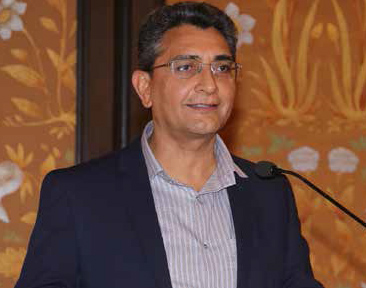
Rajiv Jalota, Chairman, Mumbai Port Trust, on the Port’s vision for Mumbai in 2047 and the creation of a marina
Rajiv Jalota, Chairman, Mumbai Port Trust, on the Port’s vision for Mumbai in 2047 and the creation of a marina.
I am honoured to be here and share some of the initiatives of Mumbai Port for the city. I will also touch upon the history of Mumbai Port, the story of containerisation, the emergence of cruise tourism, some projects related to the marina, and the Port’s vision for 2047, the Amritkaal, for Mumbai city. The most interesting part is how the port came into existence. The port’s origin can be traced back to the American Civil War in 1861, when President Abraham Lincoln’s blockade of Confederate ports caused a cotton shortage and a price spike.
This led to a cotton boom and a financial bubble in Bombay that lasted till 1865. Bombay earned 81 million pounds sterling in cotton trade during that time. This spurred significant investments in land reclamation schemes and the development of dockyards. The port did not exist then, but many
private docks and wharf-like areas had developed.
By January 1865, Bombay had 31 banks, eight
reclamation companies, 10 cotton pressing
companies, 10 shipping companies, 20 insurance
companies and 62 joint stock companies, all
because of cotton.
In 1869, the Suez Canal opened, which was the
real turning point for Bombay’s port because it
substantially reduced travel time to reach Europe
and America. Bombay Port, along with London,
was one of the two deep-drafted ports in the
world at that time. Around this time, Bombay Port had clusters of
docks and quays owned by private companies,
rented separately, like Sassoon Dock, the Kulaba
Land Company, the Freer Land Company, and the
Elphinstone Land Company. These companies
were made public when acquired by the British
government in 1873 to provide uniform pricing
services to the trade and industry at the behest
of the Bombay Chamber of Commerce and
Industry. Thus, Bombay Port Trust was formed
in 1873, and for over 100 years, it has been the
country’s major port.The Bombay Chamber of Commerce and
Industry played a pivotal role in creating the port
and held a trusty position at Bombay port for a
long time. Mumbai Port, known as Bombay Port,
was the largest port then.
From 1873, several docks were created: Victoria
Dock, Alexandra Dock, and Princess Dock, due
to increasing business. The earth dug out from
the areas of Victoria, and Alexandra Docks was
used to reclaim the Ballard Estate area.
Construction on these docks began in 1875 and
was completed by 1883-1884. The port building’s
construction started in 1888 and was completed
early in 1891. Before that, the Mumbai port office
was near the seaside, in what we now call the Old
Customs House. It was housed in two or three
shacks.
From the near 1970s, the containerisation era
began, signifying efficiency in transport and a
reduction in logistics costs. Bombay port became
the first to have container ships, with a lot of
activity starting during that period. However,
by the late ’80s, it was realised that Bombay port
had shallower drafts, and container ships were
becoming bigger, leading to changes in port
dynamics.
Bombay Port established its satellite port, the
Jawaharlal Nehru port, in 1989. Though the
Adani port of Gujarat has slightly pipped it,
Jawaharlal Nehru port still handles about 6.5
million containers yearly and can handle up to
10 million. It is believed that by 2028-29, the
port will be choked, so plans have been made to
build another port, Wadhwan port, in the district
of Palghar. The environmental clearance for this
port has been received, and it will have a handling
capacity of more than 30 million containers when
completed. Some berths are expected to come
into operation by 2028-29.
While this was happening, when Jawaharlal Nehru
port was already formed, no containers were
coming into Mumbai port. An offshore container
terminal was planned deep in the sea between 2008
and 2011 on a PPP model. However, due to delays
and the establishment of new berths at JNPT
port, the PPP operator went into liquidation, and
the project became an NPA. Now, this offshore
container terminal serves as a point from where all
automobile exports are happening from Mumbai
port. About 1.25 lakh automobiles are exported
annually from around Pune, down from two and a
half lakh due to the closure of the General Motors
plant.
Now, while Mumbai port deals with general cargo,
crude, chemicals, steel, agriculture commodities,
and some fertilisers, it has also focussed on
attracting cruises. The port aimed to position
itself as the cruise capital of India and engaged a
consultancy firm, Bermello Ajamil & Partners,
in 2016. The report at that time suggested that
the cruise outlook for India was bright and
that domestic cruise tourists would eventually
outnumber international ones. Before Covid-19,
the Costa Neoclassica ship was placed at Mumbai
port for about three years, travelling to the
Maldives and the Middle East, marking a success
story for cruising from Mumbai.
In 2016, about 120,000 Indians cruised worldwide,
but most flew to Singapore and then cruised
in Southeast Asia. Additionally, approximately 126,000 international passengers cruised through
India, mostly foreign tourists. The report stated
that cruise calls had grown from 124 in 2012-13
to 144 in 2016-17, and passengers per cruise call
grew from 791 to 1223.
Indian tourists travelling on cruises within India
numbered just Rs 24,000, spending less than
when travelling abroad. With the latent demand
for cruise tourism and very few Indians having
passports, there’s a desire to travel within India.
This led to a redesign of cruise tourism in India,
starting with the Costa ship in 2016-17.
The number of passengers and tourism potential
is predicted to grow more than tenfold, with an
average of 4,500 passengers per ship by 2047.
However, there are already three ships with 9,000
passengers each in China, and similar ships may
come to India in the next 5 to 7 years. The current
infrastructure being created in Mumbai can handle
up to 10,000 passengers a day or 5,000 passengers
per trip. That is what we are aiming for.
But we have to grow even bigger to meet the
demands of the cruise industry. India, along with the
Philippines, is the largest supplier of the workforce
on international cruise ships, contributing to more
than 25 per cent of seafarers. This industry has
tremendous employment potential.
While planning the cruise terminal, we also
established a domestic terminal. Angriya Cruise
brought a proposal to play between Mumbai
and Goa. They said they would need a smaller
draft. They bought a ship from Japan, and this
cruise went very well for about two years until
COVID-19 hit. Unfortunately, the boat they had
purchased was a fuel-guzzler, so the cruise became
unsustainable following the rise in fuel costs, and
the ship has been lying at our port for the last three
years. There is a proposal to make it into a flotel, so
we have floated a tender.
The domestic cruise terminal serves as an arena
for various programmes, festivals, and events,
such as Mahindra Blues and Independence
Rock Festival, and there are demands to increase
its area. However, I am cautious about making
seaside areas private, as they belong to the public.
I’ve introduced a policy for free use of the Eastern
Waterfront for non-ticketed festivals, offering it as
a venue for cultural and historical events accessible
to the public.
Two to three music festivals have already taken
place. It is also an open offer to Rotarians that if you
want to offer something cultural and historical to
the public of Mumbai where anybody can attend,
that is a great place to have. About five-six acres
of land is developed on the sea beside the Roro
facility and is available to everybody.
Currently, the international cruise terminal is in
the final stages of construction, and its design has
been altered several times due to various concerns, including wind resistance. The project costs
around Rs 365 crores by Mumbai port, with some
support from the Government of India, and is
managed by J.M. Bakshi and Company. We have
used it as a transit terminal for the last two cruise
seasons, and Cordelia Cruise will resume services
from this terminal on September 23rd, 2023.
We are making significant changes at the terminal,
and the first international cruise ship will arrive
on November 3rd. This year, we expect about 10
occasions when more than three cruise ships will
arrive in Mumbai on the same day, presenting a
challenge. My cruise terminal berth is only 440
metres long, and the Costa Serene, which is 290
metres long and was recently launched, will be
stationed in Mumbai for two months between
November and December. I will have to do a lot of
manoeuvring with my other cargo ships to handle
three ships when all of them are together.
While many international ports accommodate
8-10 cruise ships at large terminals, space
constraints prevent us from achieving this in
Mumbai. However, we have identified Kochi as
a location where four ships can berth at a time.
During the Global Maritime India Summit in
October, we will discuss with industry leaders
how to increase the number of river and ocean
cruise tourists to 50 million by 2047.
We will also explore the possibility of creating
a large cruise terminal at sea, seeking ideas for
developing major cruise locations. The demand is
strong, with Cordelia’s occupancy rates reaching
90 to 95 per cent on their trips between Chennai
and Sri Lanka. The Costa Serene, arriving in
November, will have a capacity of almost 3800
passengers, a testament to the growth of cruise
tourism in the region. If this venture succeeds,
other significant players like the Mediterranean
and Norwegian shipping companies may consider
bringing their ships from 2024 onwards.
If Mumbai can only accommodate three ships,
we might station a couple of ships in Kochi, one
in Goa, Mangalore, Chennai, and possibly Vizag
if that cruise terminal is inaugurated. We aim
for about 10 to 12 cruise ships to be stationed
across India for short trips to destinations like the
Maldives or Oman, as Omani port authorities
have shown interest in a Mumbai-Oman route. It
is an interesting phase for the cruise industry in
the country, a sector I am well-acquainted with as
the nodal officer for cruise for the ministry.
As we develop the cruise terminal, we are also
looking at nearby attractions, such as Kanhoji
Angre Island, located near Thala. Although it’s
just 15 minutes from Thal village, the sea is rough,
making the journey around 90 to 100 minutes.
This pristine, 16-acre island houses a prominent
150-year-old British lighthouse. We have
invested around Rs 20 crores to develop the area, including a jetty, gazebos, and walkways. The local
villagers have started picnicking there, and we’ve
selected a concessionaire to develop it further,
likely as a tent city, once archaeological issues are
resolved by the government of Maharashtra.
We have been working on a unique 8-kilometre
ropeway project over the sea, but it has been held
up due to landing permissions at the archaeological
preserved site of Elephanta. If granted, it could
become an important tourist attraction for
Mumbai.
Regarding the marina project, Mumbai used to
house yachts at the Princess and Victoria Docks,
which were later converted into a storage yard
for the container project. Now, we’re planning
a marina project there. After failing to attract
bidders twice, we are revising our approach. If no
takers emerge, Mumbai Port will build the marina.
Our financial position is slightly better. I have
35500 pensioners to care for, so my thousand
crores of operating profit goes into giving
pensions. So, I come in the red at the end of the
financial year. But if the marina happens, it will be
a great place because of the commercialisation. I
am only offering 2 hectares of land. So, there will
be 6 to 7 hectares of land remaining. Plus, if my
port operations reduce in about 8 to 10 years, I
can again open about 20 to 25 acres of more land.
So, it will become like any other marina to be
enjoyed by the public of Mumbai. Environmental
clearance has been received, so we are hopeful.
This is another interesting project involving the
management of two fish jetties in Mumbai, one at
Sassoon Dock and the other at Mallet Bundar, also
known as Bhau Cha Dhakka. With the number
of fishing trawlers increasing to 1,200, it’s become
one of the significant markets for fishermen. We
are in the final stages of obtaining environmental
clearance to accommodate the growth and
hope to commence work by October. The new
development will include all the modern facilities
needed by fisherboats.
Behind the jetties, we plan to transform
an area of about 10 to 12 acres into a
space where fisheries and tourism can come
together. This master planning is ongoing,
inspired by places like Sydney Harbour.
Sassoon Dock recently hosted a large urban arts
festival. With an intention to make it a biennial event, we are exploring ways to promote urban
arts and culture in various old areas with godowns and warehouses. Collaboration with entities such
as the Cotton Association of India to showcase cotton’s history, Japanese garden planning, and beautification near the Cotton Exchange all aim to preserve and highlight the city’s rich history
and legacy.In addition to managing domestic cruise and RORO terminals, we are working on enhancing public spaces and urban water transport around the Mumbai region. With support from the Government of India,several RORO jetties are being developed to introduce modern green boats in the coming years.
The Mumbai port continues to play a vital role, handling about 63 million metric tons of cargo
this financial year, the largest in its history. Though declining in some areas, the port is still
active 24/7, providing essential facilities for ships and contributing to various industries. Ranked number 2 in efficiency among the 12 major ports, it focuses on multiple activities, including lighterage activities, facilitating cargo transfer from bigger ships into smaller barges.
The Hughes dry dock inside the port, built in 1914, is a significant repair area for large ships,
including Navy and defence ships. Managed by Cochin Shipyard Limited, it contributes to a growing demand for ship repair facilities on the west coast. As cargo reduces over the next 10 to 15 years, the docks in Mumbai Port may become repair hubs, further solidifying its role in the maritime industry.
Lastly, Mumbai port hosts India’s largest crude oil terminal, Jawahar Dweep, receiving the most
massive crude carriers and gas carriers. Your Rotary club can visit and explore these unique aspects of
the city’s port.
This vision for 2047 outlines key areas of focus for Mumbai’s port. Cruise and light-rage activities
in the sea will continue, emphasising creating more sustainable urban water transport. Pilot
projects are in the planning stages to explore how boats travelling from Gateway and other places
can become greener, transitioning from current fuel sources to electric or other environmentally
friendly options.
Mumbai port is already leading the way in sustainability, with 90% of its total energy requirements now met through green energy. The goal is also to enhance ship repair capabilities, using green fuel for operations and positionin the port as a research and development hub. In line with this vision, a centre of excellence on ESG (Environmental, Social, and Governance) and circular economy for port and maritime trade has been started, with the company already registered and operations commencing.
This roadmap sets the course for Mumbai’s greener, more sustainable future in 2047, emphasising
innovation and environmental responsibility.