
RCB members discover symbolic ceremonies, teachings and influence at Freemasons’ Hall
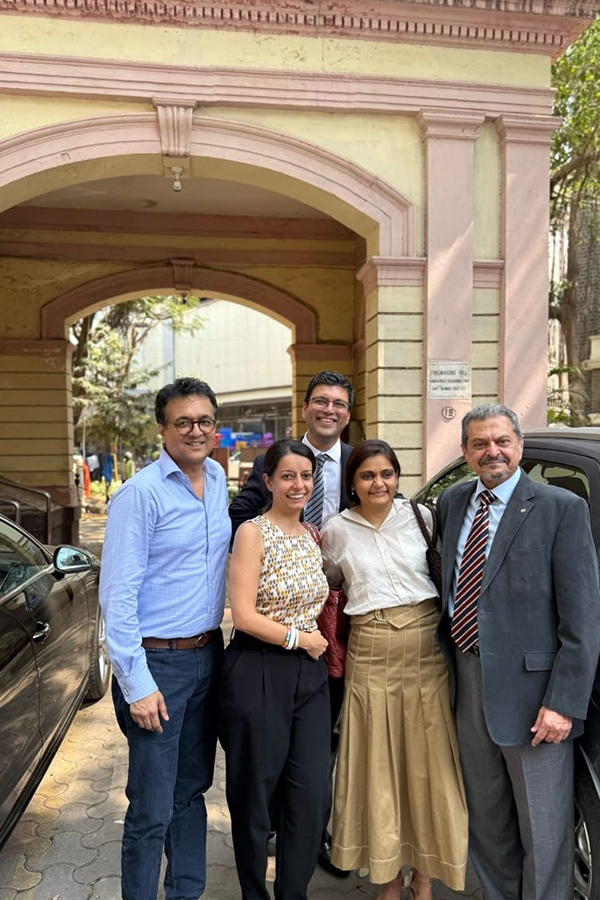
Members of the Rotary Club of Bombay entered the mysterious and secretive doors of the Freemasons at their Mumbai headquarters at Fort, for our meeting held on Tuesday, April 8th, 2025. The meeting was organised by the Heritage Art & Culture Committee and held in what is called the Temple. Due to the Freemasons being extremely conscious about their secrecy, no photos or recordings were allowed at the venue.
Worshipful Brother Shreevardhan Sinha, District Grand Director of Ceremonies, addressed our members. He was joined by Worshipful Brother Jeff George, Master, Lodge St. George No. 549, and Worshipful Brother Tehmton Toorkey, District Senior Grand Warden (Bombay).
Freemasonry is one of the world’s oldest social and charitable organisations. Mutual intellectual, social, and moral improvement are the tenets followed by all Freemasons. They do not distinguish between religions, and they emphasise the duties of citizenship. Religious or political discussions are not permitted in Lodge meetings.
Masonry offers no monetary advantages and supports a wide range of charities, both Masonic and non-Masonic. From its symbolic ceremonies and moral teachings to its influence on enlightenment ideals, Freemasonry continues to intrigue and captivate individuals around the world. Freemasonry is rooted in the traditions of medieval European stonemasons. Their history can be traced back to the early 17th century. On June 24th, 1717, four London lodges came together at the Goose and Gridiron tavern in St Paul’s Churchyard to form the Premier Grand Lodge (now referred to as the United Grand Lodge of England or UGLE). The core values of Freemasonry are integrity, friendship, respect, and service.
UGLE is headquartered at 60 Great Queen Street, London. It is led by the Grand Master, HRH The Duke of Kent, who was elected more than 50 years ago and is now its longest-serving Grand Master. The Pro Grand Master, who acts for him when his Royal duties supervene, is Jonathan Spence.
Freemasonry is organised under the United Grand Lodge of England (1717), Grand Lodge of Ireland (1725), and the Grand Lodge of Scotland (1736). The District Grand Lodge of Bombay was formed under the United Grand Lodge of England. The District Grand Lodge of India was founded in 1838 under the Grand Lodge of Scotland. The Provincial Grand Lodge of Ireland in India was formed under the Grand Lodge of Ireland.
The symbolism in the Temple was explained, including the form of an eye on the top of the East wall of the Temple, which signifies wisdom, insight, power, and a capacity for seeing beyond the ordinary, but can also signify distorted perception or a focus on one perspective. The chequered or mosaic floor at the centre of the Temple, which has a pattern of alternating black and white squares, is a symbolic representation of the duality of life and the path of good and evil and is found in most Masonic lodges. There is also a table with different religious scripts of different religions, signifying that the Lodge doesn’t distinguish between religions. The ceiling is painted blue to resemble the sky, with symbolic elements and featuring the letter “G” hanging from the sun, representing a Supreme Being.
Some of the questions asked were:
Whether women could become members?
Yes, there were separate lodges for women as well.
How can one become a member of the Lodge?
Much like Rotary, the candidate is interviewed and it is ascertained if he/she has the attributes of a Freemason and if they would fit in.
Are membership numbers dwindling?
Yes, numbers were lower, but there were still those keen to become members.
Is there a correlation between Freemasonry and the Knights Templar?
Yes, and in fact, there is a Lodge of the Knights Templar as well in India.
Is there any relation between the Lodge and the Illuminati?
No, it’s more of a myth.