
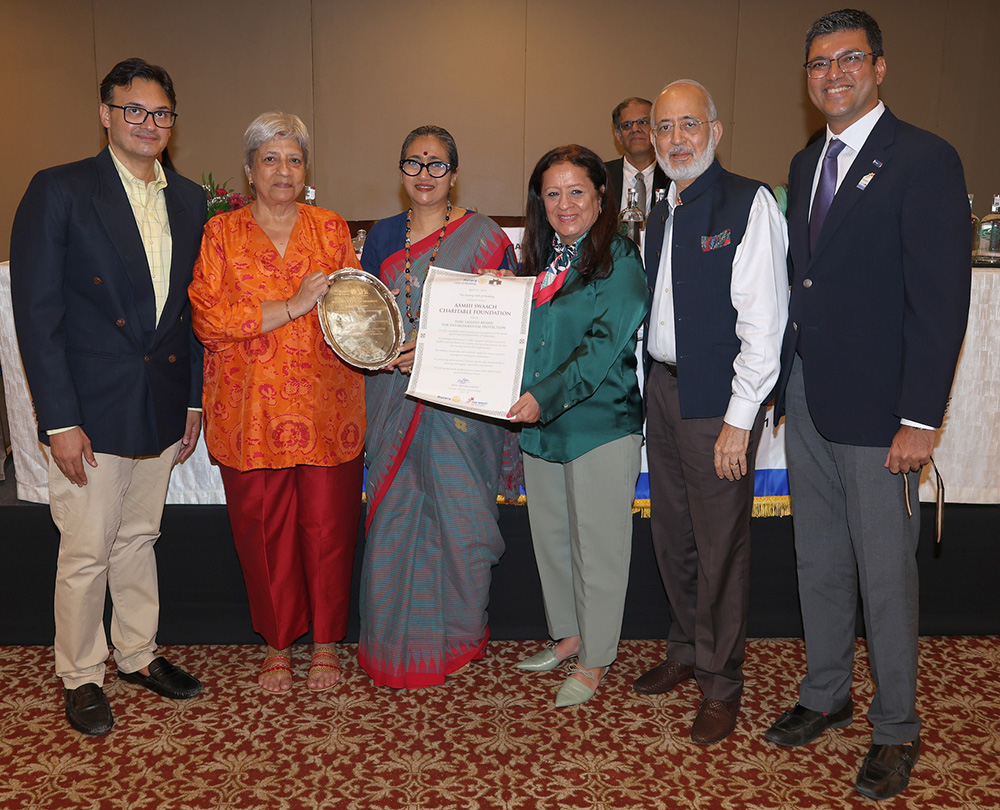
Rosalind Pereira, co-founder of Project Aamhi Swaach Charitable Foundation receives Rotary Club of Bombay’s Taru Lalvani Award for Environmental Protection.
Thank you so much for this honour. I never imagined that I would be standing here accepting the award for something that most people would not even think about — garbage — but here we are. And I couldn’t be prouder. I thank Swati for the introduction. I don’t know about everything she said about me, but Aamhi truly deserves it, so thank you all.
I’ve been told that I have to talk a little bit about Aamhi, and I would like to. But we’ve all had lunch, and I thought it would be easier to have your attention if we had something on film. So we’ve put together a little film on what we do, to give you a perspective on the problem and how we look at it — the Aamhi way.
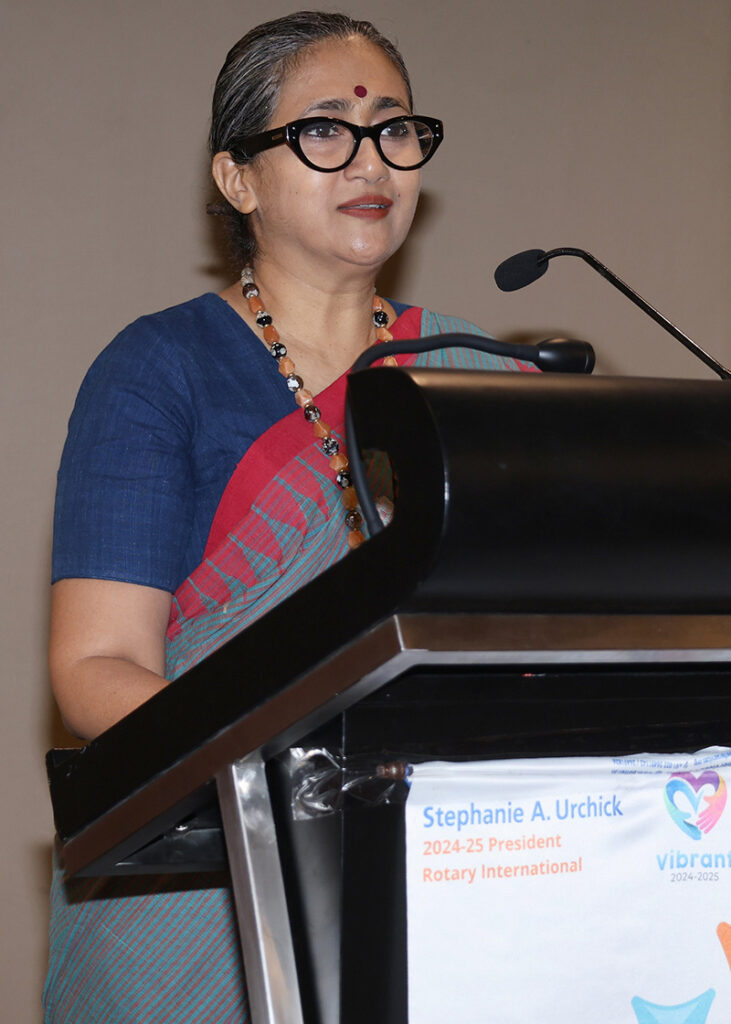
From the Video:
We, at Project Aamhi, have always collected data. But our touchpoints now have increased to almost 11 villages, approximately 5,000-odd homes. So our data was becoming extremely unmanageable, and that’s where Tres — our CSR partner who has committed to 1,000 hours of CSR service of their employees — came in. They’ve developed a very interesting dashboard which tells us the composition of the waste, where we collected it from, the periodicity of the collection, and the kind.
This helps in understanding our processes, in our partners’ understanding of the transparency of it, and what exactly we collect, and then go towards creating an impact.
To map the waste and where it comes from, we assigned different colours to different villages. So, the waste that comes from, say, Nagaon would be marked in a bag which has a green colour. When it comes to the centre, we have a collection form that gets filled — that collection form is fed into this dashboard.
You can see the number of villages that we have serviced, the number of safai-sathis, bags collected by the safai-sathis, the number of bags collected through door-to-door collection, and the total number of bags. This is only from October to date.
You can see that in Nagaon we have collected 2.8K through door-to-door collection, and 1.81 through the safai-sathi collection. It also gives you the trend. It also says that our bag collection was most in Feb. Based on this, we can actually see which village we need to emphasise more in terms of IEC education, increasing our touchpoints — and it gives us some good insight.
Our segregation dashboard tells you what is the waste that we collect. It gives you the total amount — you can actually even go and set a range to the actual monthly figures. But it shows all the waste that we collect, all the different components that we collect. And from here we can look at — and it’s very easy to make a statement — that what we collect is low-value waste.
You can see the glass bottles, beer bottles, etc are the most within the 50 metric tonnes that we have collected from October to date. Showing it transparently is also important when we are looking at partners because it is a confidence-building measure, and the partner is aware of the exact processes — what are the segments and what is one collecting.
One of my key responsibilities is leading fundraising efforts through CSR and donors. Our participation in the Tata Mumbai Marathon serves as a dynamic platform to raise awareness, mobilise resources, and build a wider network of supporters.
I’m also actively liaising with the Alibaug Solid Waste Management Association (ASWM), facilitating funding opportunities, stakeholder engagement, and collaborative support for Aamhi.
Project Aamhi is supported by the Zilla Parishad of Raigad. And with the Zilla Parishad’s help and the MoU signed with it, we are able to penetrate into villages beyond our hub. The Zilla Parishad also gives us infrastructure — in fact, we had two incineration machines given to us by the Block Development Officer. These will be used to burn sanitary waste.
Sanitary waste is a huge problem in these areas, and typically, it is either chucked into the sea or burned. A project sponsored by Hexaware looks at recycling and upcycling marine waste textiles. We have, as of date, made over 8000 double-layered bags. Now, each of these double-layered bags has the potential to replace 700 single-use plastic bags. And all of this is made by marine textiles that have been cast away or would have been left in the environment for many years to come.
A lot of the waste that we collect cannot be recycled because there is no calorific value. Marine spaces collect a lot of footwear that gets washed away. It gets stuck in mangroves and on the beaches. We collect almost 600 to 700 kg of footwear and non-recyclable items every month.
Typically, the practice would have been to just get it together and chuck it into a landfill or to burn it openly in the open. Instead, we collect this non-recyclable component and send it to waste-to-energy factories. And we’re really grateful to Godrej Industries, who sponsor our transportation cost from here to the recycling and incineration-based energy factories. Transportation cost itself would make this whole process unviable.
Finding recycling partners close by is not possible because we are 160 kilometres away from any recycling hub. Most of this material has a huge volume, so compressing it into bales is what we’ve always wanted to do — and we’re thankful to the Bombay Education Society, who have given baling machines. So we compress it into bales, and that reduces our transportation costs and makes recycling more viable.
Rosalind:
We work with 12 villages and as of date, we have collected 300 metric tonnes of waste. To just put this into perspective, one truck would carry around 5 metric tonnes. So we have extracted around 74-odd trucks from a small part of rural Alibaug. This should just indicate the waste — the problem of waste — that we’re looking at.
If a rural area can give us this kind of waste, can you imagine how much waste there is in Bombay?
Waste is not a glamorous thing to do. We clean up well, but ‘waste’ is the long hours of work. We start work at 8:15 and we work till 7. It’s very low in terms of return, and the gap between selling the waste and the cost of collecting it, segregating it, and sending it for recycling — the gap is ₹32 for every kg of waste that we collect and recycle.
Waste has to be a priority when we look at development, and typically, it’s often ignored. We just hope that now that we have the attention of the audience and the recognition, that we look at supporting initiatives like this, which are important, especially in rural areas. Because in rural areas, the habit of waste is a recent phenomenon, and so it’s easier to make inroads, to make changes in behaviour.
Finally, this award is not mine. It belongs to this incredible team of safai-sathis and the guys who support us — the people who show up whether it is rain or shine, who do the right thing even when nobody is watching.
It also belongs to the communities that sort and recycle the waste when they could easily burn it or chuck it. In rural areas, it’s so easy to burn or chuck it — so, in the rural areas that support our initiative, we’re grateful for that.
And we’re grateful to all our supporters — Vishal at ASWM — they have been our strongest supporters; we’re so grateful for all the support that we’ve got.
And I would like to thank you all again. Thank you once again for this recognition. I promise that we’ll keep doing this dirty work so that our rural areas stay clean.
ROTARIANS ASK
- Where do you buy these bags from?
We’ll pass you our contact details, and we’ll be very happy. We get our Diwali gifts in these paper bags, which are often made of virgin grass and leaves. And this is marine waste, which can replace the virgin paper bags and can be used again. It also makes fabulous gifts — you know, with weddings etc.
- Do you also take garden waste in Alibaug? In the sense, because we have 3 or 4, you know, tempos of garden waste — do you also take that?
Yes, absolutely. Our areas of operation are on the other side of the Revdanda bridge, we’re in the Bronx of Alibaug — not in the fancy part of Alibaug — but yes, we’ll be very happy to take garden waste. Or, what we can do is, set up a small compost pit — either a community compost pit, or we can teach your staff how to manage it.
It’s fairly simple. And, you know, it’s often the support staff who make it a bigger problem than it is, but it’s fairly simple. And we’ll be more than happy to support you either way.
- I’m truly humbled by your work. How can you scale this across India and inspire others to follow your example? While not glamorous, your impact is remarkable. Have you considered establishing a school to replicate this model? Twelve villages is just a beginning. Your thoughts?
Absolutely. We designed this model with a very small footprint: a small MRF, very tight operations, no major organisational structure because we want it to be replicable.
Now that we have tested it for three years, we are at this stage where we want to replicate it in other villages. And we have. Just last month, we signed an MoU with the Nagaon panchayat, which is a large panchayat with 9,000 homes, where we are replicating the Aamhi model.
The model is actually on the government website, and we get called to disseminate the information. Not only do we share information but we also monitor, give them linkages, etc. We are more than happy to share the intelligence that we have collected.
- Tell us more about ASWM
Hansu and I are a part of the Alibaug Solid Waste Management Association, which is the apex body that most of the small organisations like us operate in. The ASWM sponsored a one-day clean-up between Mandwa and, I think it was Agarsuri, and we collected around 3.5 metric tonnes of plastic waste in a day.
But something like that needs to be supported by the community. We’ve often asked for the community for support so that we can take that further. And we are happy to do it again and again and again.
We have just two months before the monsoon, so very happy if anybody from the community says, “Hey, you know, come and clean up Awas or Girad,” and is willing to sponsor it. And it’s not really expensive — that entire day, the collection, segregation, and transport cost was ₹28,000 for 3.5 tonnes.
- Has waste collection programme assisted in overall hygiene in villages? What about the commercial establishments there — small shops, shacks, etc. Like, you’re talking of Nagaon — it has a lot of shacks on the beach and they really litter a lot, I think. Do you have some thoughts?
The model that Aamhi follows is a three-step model.
In the first, we would like to enlighten and get local support. We go into villages and clean public areas — no questions asked. When people appreciate that — “Hey, you know, this is looking clean and this is nice” — then they start questioning: “How can we help?” Then the panchayats come in and say, “Hey, can you do this more often?”
Then we go to the next step, which is segregation at source. That’s the most difficult part, because you’re aiming to change practices. We start that with the commercial organisations, because frankly, under the Solid Waste Management Rules of 2016, commercial establishments by law are mandated to separate their waste. And more — the bulk generators are by law required to spend for recycling. However, no one is monitoring, so that slips under the radar. But we work closely with commercial organisations.
Then our last bit is to go to homes. Out of all the 12 villages that we work with, we have total waste management only in one village — which is Nagaon — and we extract almost 4 metric tonnes of waste.
All the rest of the villages can also be done, or we can use this formula, as the gentleman said, and take on more villages. It’s a question of funding, which is often very, very difficult.
- You said that the shortfall is about ₹34 a kilogram. So what are the variables that give rise to that ₹34? And how do those variables change between rural and urban areas?
And, if you were to take this at a state level, given the number of urban centres, I guess transportation costs would be less? Has any modelling been done to come up with an aggregate cost, let’s say for the state of Maharashtra? Would there be any interest in doing that? Because once there’s a number, you’ve got the project, right? So it would give some sort of monetary value to what the bottleneck is to make this possible.
The problem of waste in an urban area and in a rural area is very different.
In the rural areas, the biggest component in terms of waste is the collection cost. The distance between the two villages is sometimes five kilometres. So, you’re spending longer hours to collect the same waste that your ghanta gadi or a van in urban areas will get from a society. So, your collection costs are high.
The other thing in rural areas, which should also be mentioned, is what gets left behind is the low-value waste. You have a fabulous network of bhangarwalas who pick up all the Bisleri bottles. Now, Bisleri bottles are sold at ₹25 a kg, whereas single-layered plastics are sold at two or three rupees a kg.
And what organisations like us get — and are meant to get — and that’s one of the cornerstones of our philosophy, is to collect low-value waste.
So, the disconnect — on a state level — there are research papers done, there are numbers done, and I would be very happy to share them with you although I don’t have them at the top of my head.
But when you’re looking at the urban waste problem and the rural waste problem, rural waste problems are very complex. I must mention that it’s really important that we look at the rural areas in the perspective of waste, not only because we share the same environment. You know, if the Alibaug dump burns, we will get the pollution here in Bombay. Not only because of that, and the sea, probably what gets dumped into Alibaug ends up in Marine Drive during the monsoon.
In Bombay, the problem of waste is very complex. The patterns are ingrained, the kickbacks are ingrained for many years. Whereas in rural areas, waste is a nascent problem — so it’s easy to intervene. And it’s important that we get into it as a community from urban Bombay, to support the rural waste initiatives. Thank you.
- Do you conduct awareness drives in schools? Because we’re associated with several municipal as well as non-municipal schools, and it would be fascinating for them to learn about waste management. We can collaborate with you, at least for the awareness drive?
Hansu: So, we do it collectively in Mumbai. We have 2–3 organisations that have partnered together. We have Clean Mumbai Foundation headed by Kunti Oza; Garbage Free India headed by Chitra Hirama; and me.
We all go around — as of yet, we’ve mainly done schools like Cathedral and Campion, who call us for these — but we will be more than happy to partner with you.
Because this is where the problem stems from. The whole city should be involved in this endeavour. So we’ll be happy to take this discussion further and partner with you. Thank you.