
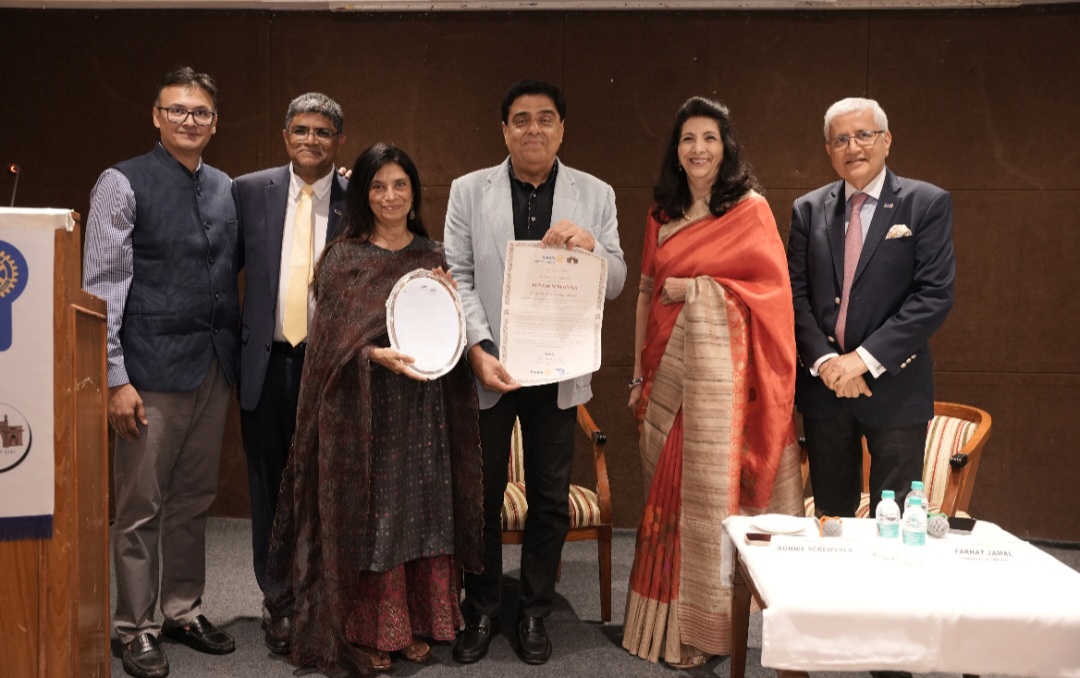
Rotary Club of Bombay Citizen of Mumbai Award to Mr. Ronnie Screwvala, Indian entrepreneur, in conversation with Rtn. Farhat Jamal
Rtn. Farhat Jamal:
It is as diverse a journey as it can be. Ronnie’s love for TV goes way back to when he was just out of college and became a TV anchor on Doordarshan. Am I right?
Mr. Ronnie Screwvala: Yes, it was called Young World.
Young World, yes — correct. So we’re not supposed to be that old now in life. So what is it that excites you every morning when you get up, after all that you have done? What do you look forward to?
Mr. Ronnie Screwvala:
I think that’s quite romanticised, this idea that we all want to jump out of bed every morning. Does anyone really jump out of bed every morning? It’s genuinely a romantic thought.
Over time, it’s not about what it takes, on a day-to-day basis, but what it takes on a much more regular basis. For me, the word outlast plays a big role in what I want to do. Most people look at how to feel good on a day or in a week. But how you feel good over a longer, sustained period is important.
As you grow up, I wouldn’t say grow old, your younger days are much more opportunistic. That’s what gets you up. Over time, you go through failures, successes, ambition, and reach a certain level. After that comes the phase where you look at making an impact, while still wanting to be disruptive.
My whole working career has been about disrupting and doing something different and pioneering, knowing fully well there is a very small sliver between being before your time and being a pioneer. You usually realise which one it was only after you fail.
Rtn. Farhat Jamal:
Was there a moment of uncertainty in your life that eventually turned out to be a breakthrough?
Mr. Ronnie Screwvala:
Uncertainty is the road to both success and failure. It needs to be harnessed. Without uncertainty, confidence can easily turn into arrogance. It balances confidence and overconfidence. Uncertainty forces you to seek feedback. Otherwise, you wake up believing your way is the best way. It allows introspection and brings in outside views. Ultimately, this builds self-confidence.
If I were advising young founders today, I would say: if you haven’t built your own level of self-confidence, you won’t be able to manage failures. Once you have that reservoir, it makes a big difference.
Rtn. Farhat Jamal:
If you had to start again from scratch, what would you bet on?
Mr. Ronnie Screwvala:
If I had to start again today, the world is very different. Ideas in technology and the consumer space would certainly change. But what doesn’t change is that you need to enjoy what you do. That has always been my North Star.
Staying constant to something where I feel I can make a difference, where I understand it deeply rather than superficially, that’s important.
I’ve been blessed to do things I enjoy most of the time. Even if that’s 70% of the time, that’s what gets you up in the morning, keeps you up at night, and then gets you up again the next morning.
Rtn. Farhat Jamal:
You’ve built, sold, and rebuilt again. What’s been harder?
Mr. Ronnie Screwvala:
There’s a misconception around exits. A lot in business is about timing and serendipity. Most people define the combination of these as luck. Being in multiple places at multiple times increases your chances of being at the right place at the right time. If I started again, it wouldn’t necessarily be the industry, it would be the sector.
Rtn. Farhat Jamal:
When you built UTV and then sold it, that must have been a hard decision. Letting go of something you had nurtured like a baby.
Mr. Ronnie Screwvala:
In retrospect, there’s a big difference between being emotional about something and being passionate about it. If you can separate passion from emotion, decision-making becomes clearer.
Secondly, if you truly want to exit, wait for someone else to approach you. That’s when you get better value. When Disney approached us, Zarina and I took about a week to decide. It was a brand 100 times bigger than ours. We also considered the 1,200-1,300 people working with us. For them, being part of a global brand mattered. It was a crossroads moment. Within 30 days, we had decided.
Rtn. Farhat Jamal:
You were happy with the valuation?
Mr. Ronnie Screwvala:
Ahhh… I have absolutely no regrets. In hindsight, valuation is neither here nor there. Hindsight is a luxury. If you keep revisiting decisions with hindsight, you ignore the many external forces that could have changed outcomes. You must go with what was the best decision at that moment.
Rtn. Farhat Jamal:
What separates good entrepreneurs from exceptional ones?
Mr. Ronnie Screwvala:
There’s a difference between a founder and an entrepreneur. A founder decides to start something. But being an entrepreneur requires a different level of risk-taking ability. something many founders don’t necessarily have.
Exceptional entrepreneurs have an incredible level of self-confidence. That reservoir sees you through 40, 80, even 100 failures. It builds conviction. No real decision happens on consensus – that only dilutes accountability. Self-conviction comes from self-confidence. Many people celebrate funding rounds or IPOs. But real entrepreneurs are those who outlast others.
We exited media eventually, but before that, we had already outlasted nearly 1,500 entrepreneurs who began in media around the same time.
Rtn. Farhat Jamal:
But you had a re-entry into media with RSVP. Firstly, tell me – why RSVP? What is the story behind RSVP?
Mr. Ronnie Screwvala:
That’s because in the Hindi film industry, nobody RSVPs. So that was my subtle way of telling everyone, let me call the brand RSVP because nobody says yes.
Rtn. Farhat Jamal:
RS are your initials too.
Mr. Ronnie Screwvala:
It just so happened that way, but genuinely it was more about the thought behind it. When was the last time you replied to my message – unless you wanted to? It so happened that the initials worked closely.
After I sold UTV to Disney, I had a non-compete. I didn’t think I wanted to get back into media. But creativity and storytelling don’t leave you once they’re in your DNA.
Today, everyone assumes creativity belongs only in creative fields. But actually, creativity is everywhere in business. If 50% of your team doesn’t have creative DNA, innovation will stop. Marketing today is no longer a science. Understanding a consumer now requires more creativity than logic.
Creativity doesn’t mean writing something from scratch. It simply means doing what you did yesterday in a different, innovative way.
Rtn. Farhat Jamal:
How important is timing versus talent in creating a successful business?
Mr. Ronnie Screwvala:
Talent is critical, there’s no question about that. But timing is equally about decision-making. There are many opportunities that come your way, and many get lost.
When we exited media, timing was essential. A year later, Disney’s global priorities shifted. Two years later, the US market surged, and the focus of most American companies moved back home. Timing affects every decision, good or bad.
Even in recruitment, timing matters. A team member who isn’t working out for more than six months causes more harm to the organisation, and that’s no reflection on the individual. Organisations today need sharper clarity. That speed of decision-making has become urgent and almost pivotal. Founders and entrepreneurs in the new economy are forming conclusions faster and better than many others.
Rtn. Farhat Jamal:
There’s very little spoken about failures. How do you handle them?
Mr. Ronnie Screwvala:
We don’t talk about failure in India. In Silicon Valley, failure is on the asset side of the balance sheet. In India, it sits on the liability side. If I had to invest in a founder who has failed twice, I would likely prefer that over a first-time entrepreneur, assuming other factors are equal.
For me, the key is not having a high sense of entitlement. Losing entitlement doesn’t reduce self-confidence, it changes how you accept outcomes. Failures then stop being cathartic. When I started out, my Parsi parents were initially shocked when I wanted to start something on my own.
Rtn. Farhat Jamal:
But your father did say, “It’s all yours. I won’t help if you fail.”
Mr. Ronnie Screwvala:
Yes, that came six months later. Initially, they encouraged me to pursue chartered accountancy or an MBA. Their argument was simple: if nothing works out, you should have formal education. That was valid.
But I realised that if you have a Plan B for the most important decisions in life, the probability of Plan A succeeding decreases. Had I pursued CA or an MBA, I might have retreated to that safety net after my first few failures.
So conviction in Plan A matters. When I was told I would not be bailed out financially, it gave me a low sense of entitlement. And when you begin with low entitlement, failures are far easier to handle.
Rtn. Farhat Jamal:
Moving on to leadership, what leadership quality has played the biggest role in your success?
Mr. Ronnie Screwvala:
Staying the course. Real value creation and real success come from staying the course. You never know if success is one day, one year, or ten years away. For me, simply sticking it out has made the biggest difference.
Rtn. Farhat Jamal:
You’ve also ventured into sports, particularly Kabaddi, which isn’t mainstream. Why leave out cricket?
Mr. Ronnie Screwvala:
Firstly, I don’t play sports, so I’m not biased. Secondly, we’re a cricket-crazy country. Ninety per cent of global cricket revenue and viewership comes from India. We need to move beyond that. There was nothing new for me to do in cricket. Sports leagues still have a strong future.
I do not think we are yet a sporting nation.
But since we are on the topic of sport, I would say this, we cannot be, by 2047, a truly Viksit Bharat if we have not figured out how to win 20 Olympic gold medals and 40 silver medals. That is not going to happen merely because of GDP, and it is not about per capita income. It is going to be about many other things.
We are not here to copy China. We are not here to copy the United States. We must form our own model of what a Viksit Bharat is. Sport unites people. Political parties come out on the streets and celebrate together when we are in the World Cup. Outside of winning a war, and hopefully we do not have wars to bind us, sport is the next biggest binding force.
But as a nation today, if I were to ask how many parents would truly feel proud that their daughter or son has chosen sport as a career option, the number would be very low.
We were sending about 150 young children to Germany for football training, fully sponsored, with a model to train them for three years. But most of my conversations were with parents asking:
When will the child study?
What will he do otherwise?
What is the Plan B?
How can you guarantee this?
How can you guarantee that?
So I believe we need to change our perspective on sport. You cannot become a sporting nation unless you create recognisable heroes. That is why, when kabaddi came along, it felt like an interesting opportunity. As early team members, we did one or two simple things. Instead of playing on mitti, we introduced mats, so players did not look filthy within the first minute. They started looking athletic and professional.
Today, kabaddi has one of the highest female viewership bases, even higher than cricket in some respects, partly because of its strong visual appeal. We also changed a few rules to make the game faster and more exciting. It became a 40-minute sport and visual appeal plays its part.
If you create an aspirational image, people connect with it.
When we adjusted some of the rules to make the sport more dynamic, it transformed into a very fast-paced and exciting game.
Rtn. Farhat Jamal:
Let’s move on. What do you think young Indians should focus on building over the next decade? What should they prioritise?
Mr. Ronnie Screwvala:
Today, everyone is obsessed with these two letters — AI.
We’re obsessed partly because we don’t fully understand it. Confusion creates a sense of urgency and even FOMO. But the newer generations are wired very differently. Many of us cannot fully fathom their world. They will create their own markets and define their own careers.
At Atlas, during an Advisory Board discussion, Mr. Deepak Parekh was speaking about future careers. A young girl raised her hand and said, “Sir, we will tell you what the careers of tomorrow are.” That sums up the real generation gap.
Rtn. Farhat Jamal:
Moving to something close to Rotary’s heart, your social impact work. You built the Swades Foundation. I’ve heard the name was inspired by the film Swades. Is that right?
Mr. Ronnie Screwvala:
The film wasn’t necessarily successful, but the Swades Foundation certainly was.
Our not-for-profit journey actually began during UTV’s early days. In a 10,000 sq ft office, we dedicated 1,000 sq ft to an old-age home and a crèche. That shaped our culture. At the time, it was called SHARE.
Years later, a board member from Warburg Pincus asked about a clause to donate to an orphanage. My response was simple: even in years without profit, we would figure it out.
Our real connection with rural India began when our first employee invited us to Raigad district to see the water crisis. We then worked across nearly 40 villages in water, sanitation, education, and community building. Rotary supported us in many ways including our first iCare van.
After selling UTV to Disney, Zarina attended a course with Teach For India. When she returned, she said she wanted to join them. That’s when I made what I call one of the most expensive retention statements of my life: “Why don’t we lift one million people out of poverty every five to six years?”
That became the vision. Later, six students from Columbia University visited our villages. It felt like a Swades moment when Shah Rukh Khan’s character returns to India to “light a bulb”.
That became symbolic of our mission – lighting people’s lives.
Rtn. Farhat Jamal:
Can businesses truly balance purpose and profit?
Mr. Ronnie Screwvala:
I firmly believe: Not-for-profit is not-for-profit. For-profit is for-profit.
There is no such thing as “for less profit”. Swades operates in the not-for-profit space. But I’ve also invested in for-profit ventures with social goals like an NBFC focused on affordable hospital infrastructure.
The question always is scale. Do you want one hospital with 50% free beds? Or 20,000 beds at 20% profit making healthcare accessible at scale? If you want real change in India, it must happen at scale. Profit-driven organisations can still have purpose provided they reinvest meaningfully rather than engage in value-neutral activities like excessive stock buybacks.
Rtn. Farhat Jamal:
Let’s briefly touch on upGrad. It has been transformative in skilling and job creation. How powerful is online education?
Mr. Ronnie Screwvala:
It’s important to understand that online education didn’t begin with COVID. That’s a misconception. Online education is often misunderstood.
People think it’s just about Zoom calls or a distracted medium where not everyone even switches on their camera. But that’s not the point. It’s not an either-or choice between campus and online. For those who enter the workforce early due to socioeconomic compulsions, online education is critical.
For working professionals who need to upskill every few years, it’s essential, very few can afford to take a year off. Also, only about 25% of Indians pursue a college degree. The remaining 75% do not.
How can we become a developed nation without addressing that? Even basic civic behaviour reflects the importance of soft skills, like how we handle something as simple as traffic discipline. We also lack the faculty and infrastructure to build thousands of new campuses. Online education, therefore, becomes a strong pathway for lifelong learning in India.
Rtn. Farhat Jamal:
One last question, what kind of legacy does Ronnie Screwvala want to leave behind? Business success? Nation-building?
Mr. Ronnie Screwvala:
Legacy is also a romantic concept. Frankly, I’m not big on it. My only legacy would be that I lived life on my own terms fully while I was alive. After that, someone else handles the tombstone. For me, legacy is about living with pride and joy in the present.
ROTARIANS ASK
You spoke about uncertainty and confidence as entrepreneurial traits. As both an entrepreneur and philanthropist, do you apply entrepreneurial thinking to philanthropy and vice versa?
That’s a very good question. At Swades, we chose to be an execution foundation – not merely a donor organisation. I would urge anyone interested in philanthropy to remember: You don’t need grey hair or a large bank balance to contribute. Sweat equity matters enormously. Being directly involved improves impact. If I invest ₹100 and stay involved, the likelihood of meaningful outcomes increases significantly.
In philanthropy, only outcomes matter, not how good it makes you feel. Interestingly, our work with about 800 schools and 600 anganwadis showed that opening libraries and providing career counselling improved outcomes far more than infrastructure. That insight influenced the idea behind upGrad. So yes, philanthropy informed entrepreneurship, and entrepreneurship strengthened philanthropy.
You mentioned you’re more likely to invest in someone who has failed before. Why?
At the end of the day, you are backing the founder. Failures sharpen instinct. They strengthen judgement. You need gut – not guts – to take the right decisions. And failure builds that.
AI – the elephant in the room. How will it disrupt media in India?
AI will enhance, disrupt, and in some cases even dismantle. The negative effects of innovation appear first. The benefits take time. For India, AI presents major opportunities. We cannot remain an arbitrage economy forever. We must move up the value chain. AI will force deeper skilling and may even accelerate self-employment. In media, AI will augment creativity. Intellectual property challenges will arise and ownership of ideas will become complex. Marketing teams will shrink dramatically. What once required 100 people may soon require two or three. Consumer research and insights will become sharper and faster. AI is not something to fear, it’s something to grow with.
Today India is at an inflection point in its growth story. Do you believe that entrepreneurs today are building lasting institutions, or are they chasing valuations? As a follow-on, do you think our generation entering startups is at risk of being overfunded in capital and underfunded in character?
I think you wanted to make a statement more than ask a question. I would say that since the 1990s, India has repeatedly been at inflection points.
In the 1990s, an inflection point.
In 1998, an inflection point.
In 2000, when the world looked to India for Y2K solutions – an inflection point.
In 2008, when Western markets were down – again, an inflection point.
So the real question is: will we truly seize this one?
We should not get carried away by 7% GDP growth. With a population of 1.4 billion, even 4-5% growth becomes a base. Coming to new-economy entrepreneurs – yes, access to capital creates challenges. When private equity becomes available, it is extremely difficult to reject it. However, there are founders building long-term institutions. For instance, one of my investments in Lenskart is being built with a 20-30 year vision. That reflects an entrepreneur with clarity of purpose and commitment to impact with profit.
Building on that, I once spoke with Rahul Bajaj, who said that earlier generations created value first and then earned valuation. But with companies like Flipkart and Nykaa, the model shifted – cheap global capital led to valuation before value. Do you see that changing? And is that ethically the right model?
I don’t think there’s anything unethical about it. This isn’t about greed. In a free capital economy, some companies will inevitably be overfunded. Investors fund portfolios knowing only a few will succeed. In the past, when companies invested ₹1,000 crore in plant and machinery, that investment was depreciated over years. Today, service-based new-economy companies spend ₹1,000 crore and must expense it immediately. So we suddenly see losses and ask how such firms can be valued so highly. But the accounting frameworks differ. Also, the pace of change today demands faster scaling.
There will always be a small percentage of overfunded companies, that is the nature of venture capital.