
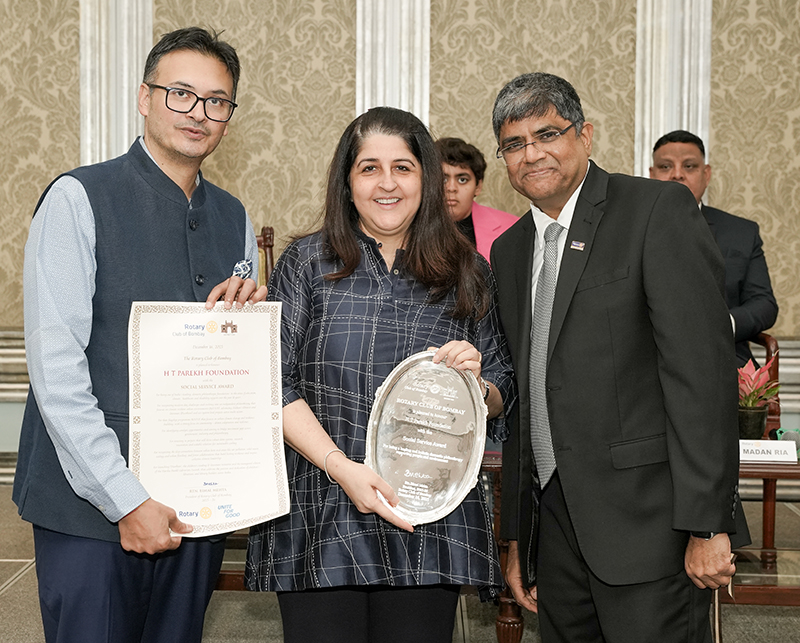
Rotary Club of Bombay Social Service Award to HT Parekh Foundation accepted by Ms. Ziaa Lalkaka.
Good afternoon, ladies and gentlemen. The Chairman of our Foundation, Mr. Deepak Parekh, an honorary Rotarian for several years, sends his profuse apologies for not being here today, as he had committed to be at the Mahim Bombay Scottish School Annual Day Function, a role in which he has been active and which he has held as a trustee for 55 years. He has been instrumental in building the school and bringing it to the level it is at today. It is their Annual Day function, something he never misses – so he sends his apologies for not being here today.
Both of us thank you for recognising our Foundation as a worthy recipient of the Rotary Social Service Award. Over more than a decade now, both HDFC and the H.T. Parekh Foundation have supported various initiatives with your prestigious Club. We started as almost a seed supporter, I can say, to Bhavishya Yaan, then the Ananda Yaan Initiative, which we supported for seniors for many years, some of your rural healthcare initiatives in Dahanu, and ofcourse your flagship programme addressing paediatric heart surgeries for children, which aligned closely with a very critical healthcare programme that we ran at the Foundation.
Coming to the H.T. Parekh Foundation — who are we? Whilst we proudly hold our name and lineage to the pioneer of India’s housing finance industry and the founder of HDFC Mr. H.T. Parekh, as a Foundation, we have come a long way over the past almost 11 years in carving our own philanthropic identity.
We spent the first decade of our existence operating as what one would typically call a corporate philanthropy, implementing the large CSR mandate of our parent, the erstwhile HDFC Limited. Our journey as a corporate foundation started in 2014. In fact, I was the first employee, employee number one — right up to 2023, when the merger happened with HDFC Bank.
This journey laid strong foundation blocks for us on many fronts. Not only did we have a large CSR budget running into a few hundred crores every year, we also often struggled with what we called the problem of “too much”. Responsibly investing such large amounts year on year taught us some very invaluable lessons.
First, thinking strategically whilst doing philanthropy. While most people think strategically in the corporate world, there is also a way of thinking strategically in philanthropy. That approach is now widely used in the development sector and is called strategic philanthropy.
Second, identifying and supporting niche, underfunded areas. While thousands of crores of CSR money go into education, healthcare, and livelihoods — which are very much needed — there are underrepresented sectors such as the arts and heritage preservation. We found our niche in the area of disability, a sector that is significantly underfunded. This became a secondary focus area for us over the last decade, and we have supported organisations such as Jai Vakeel and Ummeed, which have grown into ecosystem-level organisations within the disability sector.
Third, turning our attention to areas of established need. We observed that the eastern and north-eastern regions of India received very little CSR funding, despite needing support across human development parameters. We took a conscious decision to increase our investments there. From about 4% of our budget in the initial years, by 2023, our investments grew to 14%.
Fourth, building trust-based relationships with our partners, who are our hands and feet on the ground, as we are a grant-making foundation.
And fifth, and very importantly, being long-term supporters of development programmes — what is termed patient capital in the for-profit world — because that is when real change is seen on the ground.
All of this helped us build a philanthropic brand and identity, recognised as a mature and forward-thinking donor, a thought leader, and a funder whose approach was respected by peers in the sector. I was guided at every step by the Board of HDFC, led by our Chairman, Mr. Deepak Parekh. From day one, the Board’s mandate was clear: our annual budget should be entirely spent on philanthropy, with no linkage whatsoever to the business profits of HDFC, because institutions have a responsibility to give back to society.
The first decade of learnings was invaluable for all of us and for the team at the Foundation, as we now move into what I call HTPF version 2.0.
In July 2023, India witnessed the largest corporate merger in the financial sector, the merger of HDFC Limited into HDFC Bank. Post this, we now operate as an independent philanthropy. Today, we are neither a corporate foundation nor a family trust. We are uniquely positioned as a domestic philanthropy led by an independent Board and run by a professional team, similar to many leading international foundations such as the IKEA Foundation and the MacArthur Foundation.
Post-merger, we launched our flagship initiative, ReVIVE, an urban climate change programme focused on adaptation and resilience in India’s tier-two and tier-three cities, where urban growth is projected to take place. ReVIVE currently focuses on two climate tracks: extreme heat and specific areas within waste management.
Why heat? Extreme heat is expected to have a significant negative impact on people’s health, livelihoods, and productivity over the next five to ten years. Between 2010 and 2019, India witnessed a 24% rise in heat-wave occurrences compared to the previous decade. Unlike air pollution or visible climate disasters such as cyclones or floods, heat is a silent disaster that will deeply affect how we live and work, and most importantly, our quality of life.
Heat-stress-related deaths, particularly at night, are exacerbated by high humidity and rising night-time temperatures, leading to what is known as the urban heat island effect. As India moves towards its vision of Viksit Bharat by 2050, nearly half of the population will live in urban centres.
Our analysis of urban growth since 2011 shows that even smaller cities, such as Solapur in Maharashtra, have grown from populations of three lakh to nine lakh. With migration and the expansion of towns, by 2050, nearly 47-48% of India’s population will be urban. About 40% of the urban workforce operates outdoors, including formal workers, informal workers, and gig workers — those most vulnerable to heat.
According to the International Labour Organization (ILO), by 2030, extreme heat will reduce global working hours by 2.2%, with the greatest impact on middle- and lower-income countries. While heat affects everyone, including those with access to cooling, the most vulnerable remain children, senior citizens, outdoor workers, and pregnant women.
ReVIVE places people at the centre, focusing on research, data, innovation, affordable and sustainable cooling solutions, and city-level pilot models for both the built environment and the natural environment. Dense urban construction and the shrinking of blue-green infrastructure are major contributors to rising heat. Tier-two and tier-three cities offer an opportunity to address both.
Just as India invested heavily in renewable energy over the past decade, cooling solutions at city, community, and personal levels are emerging as the next major area for innovation, investment, and policy action. I cannot emphasise enough the urgency of climate action required around heat stress.
Over the next six to eight years, we aim to be a leading Indian philanthropy working on extreme heat, an issue of the future for India and its population of 150 billion, contributing through solutions and thought leadership.
Besides ReVIVE, we run smaller programmes, including Doorbeen, a four-year children’s reading and literature initiative, and a portfolio supporting legacy partners and exceptional non-profits working across sectors to build systems-level change.
To conclude, after spending nearly 18 years in the corporate world, 2014 marked my turning point into the social sector. These 11 years have been deeply rewarding. If you strive for excellence every day, life itself becomes a pursuit of excellence — a mantra I live by.
Once again, my deepest gratitude for honouring the H.T. Parekh Foundation with this special award. I wish all the Rotarians present here and beyond the very best for the selfless work you do. Your legacy will live on in every life you touch.
Thank you once again.