
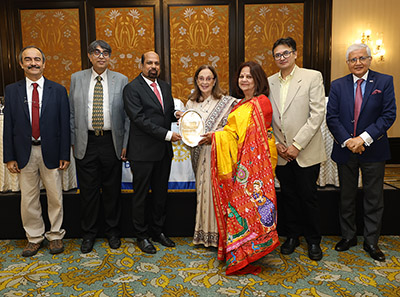
Rotary Club of Bombay to confer the Sohrab P. Godrej Science & Technology Award to Dr. Arun Kumar Nayak
Dr. Arun Kumar Nayak:
It is an honour for me to receive the S. P. Godrej Award on this great occasion. Even though we are one day after the 77th Republic Day, I still wish all of you a happy Republic Day.
As India marches on as a sovereign nation, we are ambitiously positioned to transform India from a developing nation to a developed one in the next 20 years. That is the vision and task given by the Hon. Prime Minister Mr. Modi to each one of us.
While standing here at this desk in the Taj Mahal Palace Hotel, I want to share a small story with each one of you — what this transformation means to each of us, and how, in the end, Godrej will play a major role in this transformation.
The very definition of Viksit Bharat, means our per capita income has to grow at least eight times. This is what the World Bank says. Today, we are at 2,500 US dollars per person per year. It has to go up to around 22,000 US dollars per person per year. That is how today we are a 4-trillion-dollar economy. Multiply that by eight and it becomes a 35-trillion-dollar economy. That is simple mathematics.
But for this economy to stand or grow to 35 trillion, it has to be supported by an energy system. Otherwise, it cannot happen. Today, we consume roughly 10,000 billion units of energy altogether. China consumes 40,000 billion units of energy. China’s GDP is almost 4.5 times ours. The population is comparable, 1.4 billion and 1.4 billion. So, to reach even the Chinese level, simple mathematics says you need at least 40,000 billion units of energy.
Today, 95 per cent of our energy comes from carbon-based, fossil-based sources. We are also standing on the verge, where the two-degree Celsius threshold may be crossed. What do we mean by two degrees Celsius? Why do we all have to worry about it, and how much time is left?
There are a lot of scientific computations on this. Today, Mother Earth is the main victim because of our own development. Believe it or not, the maximum amount of greenhouse gases the Earth can accommodate before crossing two degrees Celsius is hardly 1,150 to 1,350 billion tonnes of CO₂. Please remember this number. Globally, we emit 60 billion tonnes of CO₂ per year. If you divide that by 60, we have just about 20 years left before crossing two degrees Celsius.
Two degrees Celsius is the temperature at which the survivability of habitats on Earth becomes a question. So, 2047 is a magic number. We have to transform ourselves from a developing nation to a developed one. If we continue at the present pace, two degrees Celsius may be crossed, and we may all perish — forget about development.
We also do not have a stable population. We are 1.45 billion today, and another 20 crores are expected to join us in the next 20 years. We will become a population of 1.7 billion.
So what options are left? If you take the full renewable energy capacity for India — including solar, wind, hydro, bio, all together, which God has given us — we cannot create renewables. It is hardly 4,000 billion units, and with all efficient systems assumed to come in the future, it may reach 8,000 billion units.
That means, to develop India, we require 2,500 gigawatts of nuclear energy. Today, we are at 8 gigawatts. That is the rationale behind changing the Atomic Energy Act, and the SHANTI Bill (Sustainable Harnessing and Advancement of Nuclear Energy for Transforming India Bill) came into the picture. It also explains how time and pace matter, and who can help us.
To move from 8 gigawatts to 2,500 gigawatts will require at least 6 to 7 trillion dollars of investment. Today, our GDP is only 4 trillion dollars. That is why the government wants foreign investment in India, to support economic growth.
The second very important parameter is supply chain. We have very few industries like Larsen & Toubro and Godrej, very few. Five years back, I was just mentioning to Mrs. Godrej, when I was in the Atomic Energy Department, the biggest thing that struck me was the need to change every carbon-based source to nuclear. All captive power plants that today run on coal should be changed to small and micro-reactors.
The first plant I visited was the Godrej manufacturing plant. I asked, “How many small reactors can you deliver in a year?” The person said, “One reactor a year.” I said, “I need 100 small reactors a year. Can you give me that?” He said, “I have to talk to Mr. Godrej and come back.”
Today, she (Mrs. Pheroza Godrej) is here. She has given me this award. I am giving the responsibility back to her — that if we have to transform India from a developing nation to a developed one, she has to come forward and do this transformation. Otherwise, we risk losing the country as it continues like this.
The second very important part is our mindset, which has to change. How? When it comes to nuclear, we think radiation. Radiation means cancer. Cancer means death, correct?
But if you get cancer, what treatment does the doctor give you? Is it antibiotics? Is it water? What does the doctor give? Immense amounts of radiation.
Most of you may not know — if there is any doctor here, I will share a small number to educate you. If you build a nuclear power plant, the maximum dose the public is allowed to receive in a year is called 1 millisievert. Just remember this number.
If you go for a heart CT scan, do you know how much dose the doctor gives you? Fourteen millisieverts. If you get breast cancer, how much dose does the doctor give? Eight thousand millisieverts. Eight thousand. For lung cancer and other cancers, the doses are even higher.
So, who created the story that if you get radiation, you will get cancer? Is it science, or has somebody created a phobia?
This phobia was created by America so that, except for five nations, no other nation can do nuclear and become developed. Until now, human beings have never been truly tested against radiation.
Everybody believes that in the Hiroshima and Nagasaki bombings, the 200,000 people who died did so because of radiation. But what does an atom bomb contain? Thirty per cent is heat and light, fifty-five per cent is blast energy. Eighty-five per cent of the energy of an atom bomb is the same as any other explosive. Only 15 per cent is radiation. Out of that, 5 per cent is immediate and 10 per cent is very light.
So the 200,000 people who died in Hiroshima and Nagasaki did not die because of radiation, but the world believed that they did. In those days, there were no radiation-measuring devices.
What America did was retest those two bombs in the Nevada Desert. They measured radiation at different distances from the epicentre and mapped it against the health of atomic bomb survivors. The results were very surprising. People who received 200 millisieverts or less had a longer average lifespan in Japan. They are living 90-plus years and are found to die less from cancer than unexposed Japanese people.
Do you know where people live the longest in the world? A place called Ikaria near Turkey. The average lifespan is 92-plus. Why? Because these islanders bathe in a lake that is highly radioactive.
Before the Second World War, you name any disease — it was treated with radiation. People wore necklaces made of uranium. There are even books that say conference rooms like this should be next to nuclear facilities so that you receive some amount of ionising radiation, your diseases get cured, and lifespan increases. After the Second World War, the story became completely different.
So, to my dear respected members of the Rotary Club, what I say is this: apart from the donations we give, the biggest donation is knowledge. We must give knowledge to each person on this planet. We have very little time, 20-plus years, which is still too short. We have to build hundreds of nuclear reactors. And for that, we all have to forget the idea that radiation is dangerous.
If we can do that, we will transform this nation from a developing one to a developed one. Here, I extend my hand and all the knowledge I have to the Godrej family, not because of this award, but because they have built India, and I have great hopes for them.
Thank you very much.
Rotarians Ask
Thank you, sir, for this gem of wisdom. We never knew about this. In fact, since the Department of Atomic Energy reports directly to the Prime Minister, we should tell him how Viksit Bharat must take this aspect into account; otherwise, carbon levels will continue to rise.
My question, sir, is that this information should be made more widespread, including among schoolchildren, and we should encourage the building of more nuclear plants, because this is the cheapest source of energy apart from hydro.
So, ISRO — and now with your current position — what future do you see unfolding? As Mr. Malkani also mentioned, there have been some changes in the laws as well.
Actually, that is why I wrote a book called The Unregained Fear of Radiation. Whatever you spoke about — when I was pushing hard for India’s nuclear programme, a person, whom I am not naming, told me the same thing: that people are too scared of radiation. He gave me a book called Radiation and Regimes.
I was flying from Bombay to Bhubaneswar — a two-hour flight — and I read the entire book during that flight. I found that the story I spoke about is part of that book. It is completely different from what we believe.
This narrative was created by America with the help of a German scientist called Müller. He was awarded the Nobel Prize for proposing that only zero radiation means a healthy society, and anything above zero carries a risk of cancer and death. Based on this, he was awarded the Nobel Prize.
Using this theory, the Rockefeller Foundation — which is closely linked to oil companies and had close ties with the U.S. government — helped establish laws where zero radiation was considered healthy. One millisievert was fixed as the maximum public dose. That is why regulatory bodies across the world use such a small number, and anything above it is considered dangerous.
After I joined Somaiya, Mr. Sameer Jiwa gave me the responsibility of creating a Centre for Nuclear Science and Technology, which I am working on today. While research will continue, we must support big industries because money is required, manufacturing units are required, supply chains are required, and, of course, sites are required. That is why we have established close tie-ups.
Thank you, sir, for your very kind words of wisdom. My simple question as a layperson is that we are very apprehensive about undergoing X-rays, CT scans, and MRIs. According to you, should we not have these apprehensions?
Precisely. This is what I once bluntly stated in front of the Director of Tata Memorial Centre. I said, “You give such heavy doses of radiation to a patient and never tell them. But when I enter an X-ray room, you put up a red light saying ‘Be careful’. Why?”
Because the rules were made that way. America made the law. It did not allow others to do research. The law has been practised globally, and as a result, we are afraid. That is all.
It is a revelation to know that nuclear radiation can be positive for the human body. I have two questions. First, does India have enough nuclear fuel of its own to support nuclear reactors for its energy needs? Second — this is a little exotic — we have spas that offer hyperbaric oxygen therapy and cryo-freezing. Do you think a nuclear bath could be an option going forward?
Let me answer the first part. Do we have enough nuclear fuel? We have a very small amount of uranium, but we have the largest reserves of thorium in the world. Uranium can be used to drive thorium.
I have personally done the calculations. Using our own resources, without importing even one gram of fuel from outside, India can meet its energy requirements for the next 100 years as a developed nation. There is enough fuel. I believe people tend to politicise this issue without discussing the technology. I am not worried about fuel — uranium or otherwise.
Now, the second part. What we have done is create SMR parts, small modular reactor components, across India. This is not only relevant to India, but globally as well. Look at hotels like the Taj Mahal Palace Hotel; we can install micro-reactors to power them. Airports, railway stations, all can be driven by micro-reactors.
Believe it or not, today there are 7,500 ships moving across the seas, consuming diesel and contributing nearly 20 per cent of global CO₂ emissions. Micro-reactors are being considered to power them.
Look at the North-Eastern region of India, it is underdeveloped. The Human Development Index there is one-third of the national average. To develop that region,we need small and micro-reactors. These SMR and micro-reactor parts will be established across India very soon.
Now, regarding the path forward, what the government has announced under the Shanti Bill is a target of 100 gigawatts. I have spoken about 2,500 gigawatts. So, 100 gigawatts is a stepping stone. After that, many more technologies will come in.
Of course, the roadmap to reach 2,500 gigawatts needs to be clearly defined. Nuclear energy is capital-intensive. It requires a lot of money, resources, and a strong supply chain. That is where big industries must come forward.
Thank you for revealing many unknown facts to some of us. Many years ago, India took delivery of a nuclear submarine from the USSR. A team of senior naval officers went to bring it to India. One of them was a close friend of mine. He died of cancer about five years ago. Later, I came to know that all five officers who went on also died of cancer. Can you attribute the reason for this?
This is very simple. I said radiation is beneficial, but not at every dose. There is nothing in the universe that is without poison. At a certain dose, it becomes medicine; beyond that, it becomes dangerous.
Earlier, I mentioned the figure of 200 millisieverts. Up to 200 millisieverts, and even up to 500 millisieverts, as accepted earlier, the average lifespan of people exposed to radiation, such as in Japan, actually increased. Today, the public limit is fixed at just one millisievert, which is extremely conservative.
Anything beyond certain limits will definitely have a negative impact. Extremely lethal doses will cause death. Every dose has its effect.
For laypersons like us, accidents such as Three Mile Island, Chernobyl, and Fukushima have caused fear. Can you explain what went wrong with regulations in these cases?
I will answer this in two parts. First, what actually happened in these accidents, and second, why they occurred.
Chernobyl was the worst accident to date because the reactor exploded almost like an atomic bomb. The amount of radioactivity released was far higher than that released during the Hiroshima and Nagasaki bombings.
Humans were evacuated due to fear of radiation, but animals continued to live in the Chernobyl forests. Years later, animals — especially wolves and dogs — were studied and found to have developed resistance to cancer. This information is publicly available.
Now, coming to Three Mile Island and Fukushima. When these accidents occurred, governments evacuated nearby populations. This evacuation caused immense stress, particularly among the elderly, who died in relief centres due to existing illnesses. However, not a single person has died of cancer due to radiation exposure from these accidents.
Now, why did these accidents occur? No machine in the world is foolproof. Earlier-generation reactors were built before scientists fully understood all possible failure modes. After these accidents, multiple layers of safety systems were introduced.
Today’s nuclear reactors are walk-away-safe reactors. This means that if an accident occurs, the operators can leave the plant and go home to take care of their families. The reactor will take care of itself. That is the level of safety in modern nuclear technology.