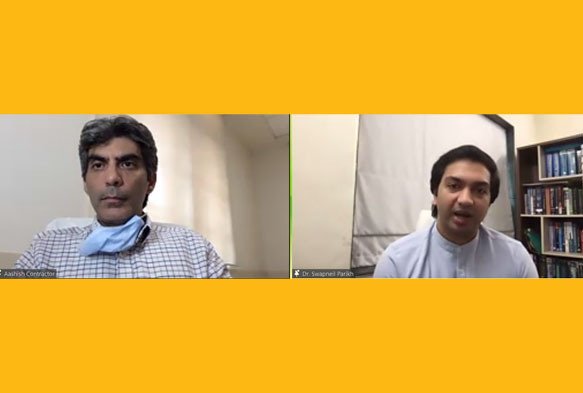
Rtn. Dr. Aashish Contractor In Conversation With Dr. Swapneil Parikh
Rtn. Dr. Aashish Contractor: Globally, we have crossed a 110 million Covid cases with more than 2.4 million deaths. In India, we have crossed roughly 11 million cases with around 1.5 lakh deaths. So, clearly it has left its toll and it is something that we have not experienced in our lifetime and hopefully with the vaccine we will see the
beginning of the end.
In terms of vaccines, now The New York times have an excellent section on their website where they talk about development, so, I have pulled out data from there. We have 37 vaccines currently in phase I, 27 in phase II and 20 in phase III, a total of 6 have been authorised and 4 have been approved. So, what are these phases of the trials?
When you come out with any new medical product, the first thing that they do is conduct a pre-clinical test. So, in phase I, they test on mice for safety after that they start the human safe trials. Here they look more for safety rather than effectiveness.
Then they move to Phase II where they have a few hundred people and then they go on to what is called as Phase III where they have few thousand people, where they are looking at not only safety but also effectiveness of the trials. That is what these Phase I, II and III mean that we keep reading of. In terms of types of vaccines, there are roughly four large categories of vaccines –
mRNA: Pfizer and Moderna
Viral vector: Oxford Vaccine
or Covishield in India
Protein-based: Novavax
Inactivated: Chinese Sinovac
So, Swapneil, Covishield – the one that will be available to us, could you explain how it works?
Dr. Swapneil Parikh: Broadly two vaccines have received some kind of authorization from India: Covishield and Covaxin. These are primarily available to healthcare and frontline workers and hopefully, soon, to the elderly and to people with co-morbidities.
Covishield is a viral vector vaccine, this means it is a harmless virus that doesn’t cause disease or infection in human beings. It is used as a carrier for a part of corona virus. If we step back a little, the corona virus has club like projections on its surface called the spike protein or the S-protein and this S-protein is critical because this is what allows the corona virus to infect human cells. So, if we have an immune response, anti-bodies against the spike protein, then we are protected from infection against the corona virus, but what the Covishield vaccine (the local name for the Oxford-AstraZeneca vaccine developed in the UK ) does, is it takes a fragment of DNA that encodes for a spike protein and it has put that part of DNA into the vector called the Chimpanzee Adenovirus.
When this vector is injected into a person, the human cells read this DNA, the DNA goes in the nucleus of the cell, it is from the DNA then mRNA is made and the spike protein and the fragments of the spike protein are made. These are then taken by the antigen presenting cell which shows the immune system that there are these fragments and you need to develop an immune response against it. Interestingly the Adenovirus is also very immunogenic, so, it sends out an alert to the immune system: look here, produce an immune system against it. And there are two components to the immune response; one is the humoral abilities that is antibodies and the second is cellular immunities, those are T cells.
So, the B cells start making antibodies against the Spike protein and the T cells, one class of T cells helps to make the antibodies and the other class of T cells are called killer T cells and they hunt for cells that are infected by the corona virus and kill those cells so that the virus can’t spread. The third part of this is that there is also something called immune memory. Your body remembers the spike protein that if in the future you are ever exposed to the virus again, very quickly your body can start building response to the virus. So, that is essentially how all the vaccines work. They will have an immune response against the spike protein and that prevents the corona virus from infecting ourselves or limits the severity of the disease.
AC: So, the one question that everyone asks me is that have you taken the vaccine? Yes! I have, I just did my antibody report yesterday and I showed it to Swapneil, it is the IGG but it has to be against the spike protein, the mistake sometimes people do is that they do an antibody test which is not specific to the vaccine they have taken. So, I am happy to share in this closed audience that my antibody level is already high. So, don’t get carried away by people that say that you took the vaccine, there are no antibodies because maybe they are measuring the wrong anti-bodies. When I measured the N antibody, there was actually no response, because it was not meant to respond to the Covishield vaccine.
The common fear that people have is that vaccines take years to develop, these vaccines have actually been a feat of human science where, literally, from sequencing which was probably in January last year to January this year, you already have vaccines that have been ruled out. What are your thoughts?
SP: It is a very valid question but to contextualize, the work didn’t start in January, Corona virus has caused problems since 2003, even before that common-cold corona virus had been around. So, in 2003 with SARS and in 2015 with MERS, a lot of research started on the Corona virus and the spike had already been identified as a target.
So, a lot of fundamental research had been done when the virus was found. When the sequencers were identified, it was easy to hit. We also have to realise that this was an emergency situation. The world’s top manufacturers, organisations like Bill Gates Foundation, all the vaccine organisations, WHO, various governments, they gave a lot of money and facility, a lot of their regulatory hurdles were lifted.
Scientists wanted to work on this, manufacturers wanted to scale these technologies, doctors wanted to run clinical trials, people wanted to join as participants in the clinical trials, so, a lot of usual trial that are in the vaccine development were just taken away. So, when people ask me how did this vaccine get developed so quickly, my response is why are other vaccines taking so long? We should follow this similar process, try and accelerate everything, reassure everyone. It is about the most read and researched vaccine in the world, it is done quickly because, as they say, necessity is the mother of all inventions, we have to do it! We didn’t have a choice. We should be proud that humanity responded as such.
AC: So, a lot of logistics just fell into place quickly which otherwise take a long time, the recruitments and all, the financial risks, so, no one should doubt the process but we should marvel at it.
Swapneil what are the side effects? You know, people have fever after a day or two, what is your experience in that?
SP: I think we will need to contextualize this, what is the objective of the vaccination? What is the other side of it? So, we know that the vaccine stops death and severe outcomes of Covid-19. Of course, the risk is lower in younger people but as you get older the risk is very high. On one hand if you get covid-19, the risks are death, severe illness, strokes, heart attacks, as minor as losing your sense of taste and smell forever, imagine not be able to enjoy the aromas that used to, so, there are serious risks if you get covid-19. In that context, the side-effects of the vaccine are very mild, they are primarily what we call as reactogenicity, when the immune response occurs, there are certain chemicals called cytokines that are released and cause a fluish feeling, the most common response is fatigue, after that body ache, muscle pain, headaches, chills, these side effects are very manageable, temporary, they can be managed with a paracetamol and of course they are nothing compared to what would happen in Covid-19. In that context, we should inform people, yes there is going to be some reactogenicity, but it is manageable and is not life threatening. These vaccines are very safe.
AC: Yes, even in my personal experience, the day when I took it, my mother who is 76, took it, my sister and brother-in-law took it and all of us were fine in the morning, but at night we felt this lethargic malaise kind of feeling which lasted 24 hrs and then went away. What is interesting is that about 5400 healthcare workers took it and one quick study was written up, they found 66% had some symptoms after the vaccination and 34% had none.
From these 5400 people, 2400 or so, had tiredness, about half had body ache, about one-third had fever and some of the other things like headache, injection pain side, nausea, joint pain, diarrhoea, but these were only about 100s. What was interesting was that in this particular group, the older people had less symptoms than the younger, for whatever reason. And I would like to emphasise the point that Swapneil mentioned, when we take a decision in medicine or in life, we always look at the risk and benefits ratio, whether you cross the road, there is always slight risk but we look at in proportion to the risk. So, I think the benefit of taking the vaccine and protecting yourself is far bigger than the potential risk there might be.
Another doubt people have is, suppose you have had Covid in the past, then should you take a vaccine?
SP: The answer is yes, Covid-19 is a spectrum. So, you can have asymptomatic infection, moderate, severe and different people have different immune responses following Covid-19…. But people should follow the recommendations in India and even if you have had covid 19, take both shots.
AC: We read about the mutation in various papers, will this vaccine help against these mutations?
SP: A lot depends on how much the virus changes and how quickly. Currently we think that all the authorised vaccines including Covishield will protect against death and severe disease, and hospitalisation from all existing variants. It is possible that mild moderate infections may occur, it is possible however it will save your life. In the future you may need a booster but that is the case with many other vaccines as well. But, right now, it will protect you.
AC: What about people with heart disease, cancer, G6PD [glucose-6-phosphate dehydrogenase]?
SP: If you have many of these conditions, then there is a very high risk of severe Covid-19, so that is exactly the target group that needs the vaccine to stay safe. But, of course, all clinical decisions should be discussed with the doctor. There has been some concern about specific blood thinners, but we don’t have clear data on them. It is a precautionary measure, it is not to say that if you have condition X then you are going to have worse effects of vaccines.
AC: After the vaccine, can they go back to leading the normal life?
SP: When you take the vaccine and after you are fully immune, your risk assessment completely changes. Right now, if you get back to normal life you can end up being infected and wind up in a hospital afterwards. Once you have taken the vaccine, that is not going to happen or the odds of that happening are very low, so, you get to reassess all of this. Everyone needs to make the decisions for themselves. Let’s look at them in three categories-
1. Risk to yourself
2. Risk to others
3. Do we want to create an immunity base class system?
For now, everyone should follow rules and protocols, wear masks, and risk reduction is additive, so, every step you take gives you additional protection and for the larger population every measure that the community takes as a whole will protect the entire population. So, let’s say the vaccine takes away 20-30% of risk, the mask takes away 20-30% of risk, social distancing, air quality, ventilation, hand hygiene takes away some risk. So, from the individual level I think you will get protected but from the community level, we should all follow Covid-appropriate behaviours to keep our country and community safe.
AC: That is an excellent answer. I know in your tweets and posts you emphasise on ventilation and being outdoors that reduces the risk of infections. So, Swapneil, the early study came from Pfizer and they had these dazzling numbers, sometimes people ask if they have the access to travel out of the country and take any of these vaccines, or should they take those that we offer here. Any thoughts on that?
SP: How would you fly there? You really want to go to the USA right now? They are having the worst outbreak right now. There is so much risk in that process to get the vaccine that if you get infected before you take the first dose or at the time of taking the first dose, what would be the purpose of that? So, I’d say don’t take that kind of risk. Also, taking a Covishield or Covaxin today doesn’t preclude you from taking a better vaccine in the future. We don’t have data on this right now but studies are already underway for what we call as heterotopous prime boost that is using one vaccine initially and then another vaccine later. I think that is very much possible in the future. Right now, take what is available, it will save your life, and in the future if there is more efficacious vaccine and a clinical trial has shown that it is safe to take it, then we can look at that later.
AC: Is it true that you cannot take alcohol before and after the vaccine?
SP: Alcohol can blunt the immune response, weaken the immune response, so it is advisable to reduce or avoid alcohol for a few days before and after as much as possible. This is to give your body the best shot or response to the vaccine and build a strong and robust immunity.
ROTARIANS ASK
It has been 11 months, the vaccine is ready, I am a 60+ citizen, what are we waiting for?
SP: I have been screaming from the roof tops that we need to start vaccinating the elderly. It is the single-most effective intervention to save lives and that gets us back to normal as quickly as possible.
The key message here is that we need to protect the elderly. The private sector absolutely has to be involved. Technology should always facilitate improved logistics, it should never be the barrier of the programme, the goal is to vaccinate as many people as possible. So, if there is technology issue, jump into what we used to, we have done pulse polio and inoculated million of children far before these platforms were available.
Once we take these two doses, is there any study that shows that we need to do another round after a specific time and why is there so much negative publicity about the vaccines?
SP: Pfizer and Moderna have both taken a commercial position on the vaccine, they are looking at it as clear for-profit business so, of course, there is a lot of financial incentive there. AstraZeneca has taken the position that they don’t want to profit off the Oxford vaccine, in fact that is one of the conditions under which they got the vaccine license and they said they want to distribute it to the countries at no-profit. So they don’t have as much of an incentive to put out this kind of PR. A lot of this comes down to misunderstanding what efficacy is, the efficacy in these studies is mild and moderate infections and not against severe or deaths. The data coming from other parts of the world shows that Covishield will save your life, it will keep you out of hospital.
SP: About second doses, not sure, there is uncertainty about this but I believe people who have taken these vaccines will need a booster later. The good news is that India is working on a lot of these vaccines so you won’t have to travel elsewhere for high efficacy booster.
AC: Where Covaxin is concerned, when it was conditionally approved, it may have been a fabulous vaccine but at that time the phase three trials were not conducted. So, I think we need to wait for that data to make the right comment.
 You said, there is a possibility of taking first dose of one vaccine and second dose of another vaccine. Right now, isn’t there a trial going on that says they are testing the first dose of Covishield to be followed by Russia’s Sputnik vaccine, which I believe will give us 95% protection. Is there any truth in this?
SP: Yes, that is right. They are planning to do the study with Covishield, what happens is with vector vaccine, you develop the immune response to both, the vector as well as part of the corona virus. Now the problem with that is with the second vector you already have an immune response against that vector. So, your immune system adapts the vector and the efficacy may not be as good. It is called vector immunity. Because of that they are trying to use two different vectors for the 1st and the 2nd dose with the hope that this will boost the efficacy. That is on, there is also a trial in UK on looking at Covishield, AstraZeneca and Pfizer, so, these trials are going to happen everywhere. There is going to be a new generation of vaccines in India, nasal vaccines, and there is a lot of hope that these vaccines might be the best ones. So, all kinds of vaccines will be possible. The key thing is taking what is available right now.
How safe are airplanes and hotels within India?
SP: In the last six months, the majority of my work has been moving cricket teams and football teams from one part of the world to the other. There is a lot of risk in airports and hotels, it is quite a process to make the air travel safe. It is just not the plane. From the time you leave your house, you possibly bump into the watchman, you have to get to the airport, go through security, check-in, immigration, wait for the boarding, using toilets at all these places, eating during the travel, getting off at the other destination till you reach your final destination, there is risk at every point and the hotel is also risky. It is not always contact with individual. If you are confined in a closed space, there can be numerous aerosols and the virus can be in the room, I might leave the room and you might go in and get infected. Also, some hotels have a re-circulating air system and may not have the right kind of filters so the air supply between rooms and corridors can be shared. Even in quarantine facilities there have been transmissions. The single-most important thing that you can do is use a high quality mask, N95 mask, it is very important to use the mask correctly and don’t take it off. That will keep you safe.
How do they decide whether you have 21 or 28 days before two shots? After you get both the shots do you take some anti-gen or paracetamol or wait for symptoms to develop and then take it?
AC: To answer the second, at our hospital, they are giving everyone a strip of three paracetamol and I think it is a good idea to take it within 24 hours because it is precautionary and there is no downside to taking a low-grade paracetamol. In terms of the time gap between the two doses, the first is your priming dose and second is the actual booster for immunity. The researchers found that after the first dose itself the response very high which led to deciding that we can space out the two doses so more people can get one rather than half getting two doses. This is an evolving area.
How effective are our masks really? What are our chances of getting infection if we are masked around an infected person wearing a mask?
SP: It is not just about wearing a mask, it is about wearing it correctly, risk reduction is additive, so, also try and maintain distance. If, in the situation given by you, both the parties have good quality mask then the transmission rate is zero, I can also tell you that doctors wear N95 masks around Covid patients all the time, some of them are masked, some can’t wear, if you are wearing your mask correctly you will not get infected.
Can we say that we have entered into the stage of herd immunity with everything opening up?
SP: There is a misconception that when you reach the herd immunity threshold, the risk is over. Even once you reach herd immunity, there is something called as overshoot, imagine a car moving wearing quickly and you press the brake. Does it stop instantly? No, there is still inertia, so, herd immunity is like that, there is an overshoot, infections can still occur for some time. Even if you reach herd immunity, that doesn’t mean individuals are in bars or theatres or trains in extreme close contact and infections can’t occur, infections can still occur and I don’t think in India we have reached herd immunity. Mortality might come down but in case of Covid there is great amount of morbidity, about 20-30% have long term symptoms and great sufferings. So, I don’t think we are anywhere close to herd immunity and what we have to think about is herd protection.