
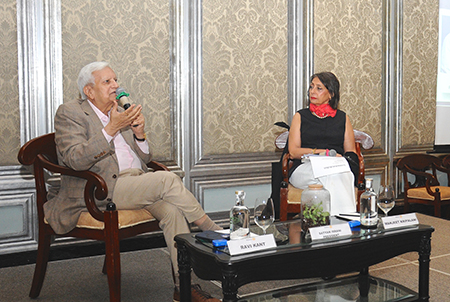
Rtn. Manjeet Kripalani in a fireside chat with Mr. Ravi Kant, author and former CEO, Tata Motors, on his book Leading From the Back
Rtn. Manjeet Kripalani:
Ravi, as you reminded me this week, the corporate initiative is 250 years old. Is it the first time that such an idea of management is being articulated as a concept in a book?
Mr. Ravi Kant:
Yes, ‘corporates’ as we know them today have existed only for about 200 to 250 years. Although we think they’ve been there forever, they were created after the Industrial Revolution of the 17th and 18th centuries in the UK and Europe, when organisations grew and needed a proper structure with leadership models, etc.
The leadership model they had in front of them in the 1700s and 1800s was two-fold: the Catholic Church and the Army. And for obvious reasons, they chose the Army, which meant leading from the front, a hierarchical structure, with somebody at the top. It worked very well, and it’s been working very well till recently. Corporates adopted this model, but in the military itself, the model has changed.
If you go back even two and a half thousand years ago, Alexander the Great led from the front — he’s called “the Great” because he never lost a battle. So that is the model which has been there all along. But things have changed now. In the wars you see across the world today, the guys conducting the war are not at the front; they are sitting in Moscow or Kyiv, or Washington D.C., etc. Therefore, the whole psychology of leadership has changed tremendously. It’s not about going to the front and trying to show people how brave you are or how you do things. It has moved from brawn to brain and that’s why people don’t need to be there at the front. You need to be at the back, looking at things, and doing things.
And corporates have done something similar. But now, in the 21st century, corporates are facing a lot of trouble. Trouble because of three things — three things external, and three things internal. You would have seen in your organisations — it starts off with good intentions and things like that. But over a period of time, it accumulates a lot of negatives. And therefore, in organisations — in corporates — three negatives, in my view, have come to extremes. And we need to look at that very seriously.
1) Corporates have been there for a long time, and they have been focussed only on money, money, money. So, corporates only want shareholder value — they don’t care about anybody else, they want only to enrich themselves, and forget about anybody else. “How can I become a millionaire, billionaire, or multi-trillionaire?” That’s the only focus.
There’s nothing wrong with money; money is the thing that helps corporates grow. But I think we have reached a stage where it has come to the extreme — it has created so much inequality, so much inequality, that it is unsustainable, whether it is the US, India, or anywhere else. I don’t think we can have a society like this, because society is going to get fractured. It is already getting fractured. In fact, it’s my considered view that Mr. Trump is actually a product of inequality in society.
2) In our pursuit of productivity and efficiency — and again, mind you, productivity and efficiency are very important for growth and for, kind of, operational effectiveness — but in doing so, we have dehumanised human beings. Human beings are not treated as human beings anymore. They are treated as a piece of equipment or pieces of items which you can throw out. You can take away 20,000 people, 30,000 people, 40,000 — nobody is bothered, nobody is talking about that. And, what happens to these people?
For example, when the US got de-industrialised, the entire auto industry went into a tailspin. I mean, where the auto industry was — what happened to those people? Therefore, we need to start thinking about these things — increase productivity, yes, but please don’t dehumanise.
If these two things are combined, they cause a tremendous amount of stress to organisations, to corporates, and to society. The time has come for us to look at something else.
3) Over-glorification of leadership. Because of this particular model, somebody who is at the top, somebody being the face, we have over-glorified leadership, as if he is the one who is doing everything. As if he is he, because all the credit is ascribed to that one person, which is not correct. It’s never the reality. But this over-glorification of leadership has again reached an extreme, where I think we need to set the balance right.
So, these are three internal negative things that the corporates have acquired in the last 20-30 years, especially, and it’s getting more and more pronounced.
Now, three external things which have changed dramatically, especially in this 21st century — and that’s why it is even more important.
1) Uncertainty and unpredictability were always there, all along, but the kind of intensity of that uncertainty, unpredictability, and disruptions which have come in the 21st century has been enormous. They are mind-boggling. And they are happening simultaneously. Whether it is man-made disasters like wars, or whether it’s earthquakes and things like that, or whether it’s technological disruptions — whatever you look at, things have become extremely uncertain.
In this kind of uncertainty, a rigid, parametrical, hierarchical organisation cannot work. You can understand that it will get shaken, because it’s a rigid thing, and therefore, you need to have more flexible, adaptive, proactive, and fast-reacting organisations.
2) Information, especially in the last 10 years — it’s been happening in the last 20 years but more so in the last 10 years, even before AI came into reckoning — the information load has become so much. First, information used to go at a slow rate. Now, in the 21st century, information has increased at a rapid speed. And in this kind of situation, it is impossible for one person to be seized of all the things and be taking decisions. Therefore, you need to have distributed leadership. You can’t be saying, “I know all; I know everything.” You need to have distributed leadership. You need to have more people. You need to have more people who will be absorbing from the environment, telling things, and working together. Therefore, you need to create a team.
3) In my view, the most important one: today’s generation — especially millennials and Gen Z, all of you have grandchildren or children — if you ask them whether they would like to work under a command-and-control type of organisation, I can tell you, there is only one answer — and that’s “no.” And I have tested this across the world. This is my 91st interaction on the book, on the philosophy of the book, and I’ve seen this in the UK, in Singapore, in Ireland, in Dubai, in India — and in all parts of the country.
There’s only one answer: “No, we will not work.”
Therefore, you need to think of a very different kind of leadership. And the kind of leadership that I’m proposing, for want of a better word, is leading from the back.
Rtn. Manjeet: Thanks, Ravi. That’s a very good explanation about why this is the right time for this book — uncertainty, unpredictability, and complexity in the current environment.
So, I’m going to ask you to describe leading from the back. You’ve described it in a very simple way: 3 x 3 x 3 — three lines and three ways to react to them. So we’re going to put it up on the screen, but I’m going to ask you to describe it, and then we’ll go into different details about how you talked about this in the book.
Mr. Ravi: So let me go a step further — step back, rather. You know, I did not know how I was working, but I was working in a certain manner until about four years ago. I asked a guy who I respect a lot from the advertising world, “Can you describe the way I work?” That’s all. That’s the question I asked him.
He just stood for a moment — and I have a lot of respect for him — and he said, “Ravi, you lead from the back.” I did not know myself, till four years ago, that that’s what I was doing. But I said, “This guy is from advertising. He’s given me a headline.”
Now I need to, therefore, dig. I didn’t ask him why he said so. So I started deconstructing what it meant. I went back to more than five decades of experience, wondering, what is it that I was doing that was very different? I tried to crystallise my learnings, my thinking, my behaviour, and then I broke it down into three sets of three, as you can see from that: how should I be, how should I deal with the team, and how should I deal with the task. Because leading from the back is all about creating a very powerful team.
In short, a one-line sentence: Leading from the back means you are trying to create very powerful teams which can do impossible tasks. And how do you create those teams? The fundamental thing is trust. If you build trust in the teams, then you can do things that are impossible. We understand trust in a somewhat normal way of looking at it. I’m saying, if you can create real trust in your teams, you can do anything. I will cite my example.
Why am I saying this? I have worked in seven companies, each in a new industry of which I had no knowledge. Understand this — I’ll repeat: I worked with seven companies, each in a new industry, of which I had no knowledge. By whatever you can say — good luck, fate, or whatever — I got into these companies. Now, everybody in the company I’m joining is far more knowledgeable than me, far more technically competent than me, including Tata Motors, Philips, Vespa, Titan Watches, anywhere. So I don’t know the business. What do I tell them?
I have to do something out there, and I can tell you something magical happened in all the places. Titan Watches — you know, it finished off HMT Watches in five years’ time, six years’ time.
Vespa — it was making ₹40 crore loss. It started making ₹40 crore profit. From 9%, it gained 23% market share. It went to 32%. I mean, there is a Bajaj person here, so you will understand — 32% market share, can you understand? From 9 to 32 in a very, very strong, dominant segment.
Philips — ten times increase in ten months.
Tata Motors — from $1.6 billion turnover to $39 billion turnover in 15 years. And, it did many, many fantastic things, like bringing out the Nano, bringing out Ace, a small vehicle which doubled the size of the commercial vehicle market; going to South Korea, taking over Daewoo truck company, and then going to the UK and taking over Jaguar, Land Rover.
All of that, at that point in time, seemed like impossible tasks — everything. But how did it happen? Because, as I said, I am not knowledgeable. I am not technically competent. So, it happened because you were able to create a great team. And how do you create a team? Not by bringing your own people, but the same people — exactly the same people. You may add one or two later on. Same people.
So, what I’m trying to say is — people are not bad. People are not bad anywhere. You’ve got to start with the mindset of trusting. And trust doesn’t come immediately, as you know — especially if you are new to the organisation. It takes a long while to win trust because by talking you will not earn trust. It’s through your behaviour — honesty, integrity, transparency, equitable treatment, fair treatment — all these kinds of things, over a period of time.
In fact, trust must become so important, so important, that it must become predictable. Trust must be predictable. That means people should begin to feel, “I know what the answer is going to be.” Wherever the question comes from, this is going to be the answer. That is trust — consistent integrity.
Therefore, you are able to create what I call psychological safety. If you create psychological safety, then people who normally hold back — because in any group, not everybody comes forward and gives his or her opinion; people are reserved. People don’t know whether someone is going to rap their knuckles, or someone is going to do this. But if you are able to create that psychological safety, then you are encouraging people to come forward, you are encouraging people to share their views and ideas. And I can tell you, ideas are galore. You should not think ideas are the monopoly of two or three people in the organisation. Everybody — down to the ground — whether it’s workers or junior engineers or junior officers or mid-level or mid-management — ideas. You are missing so much by confining yourself to two or three so-called leaders.
If you are able to do this, you are able to build a very strong organisation. You are able to see people, meet people, feel free — you are giving psychological safety — and many, many wonderful things start happening. So that’s all I have to say. As they say, the proof of the pudding is in its eating. And I’ve told you what all happened, and I’ve told you the disadvantage I had when I entered different companies.
Rtn. Manjeet: Ravi, you have used a very beautiful way of writing this book, in the form of a parable, through a protagonist, a young manager called Shiv Kundra. Why?
Mr. Ravi: Because I didn’t want to talk about what I did. People have been telling me for the last 30-35 years, “Write a book on this, write a book on this, write a book on this” — whatever things I mentioned about. But I was never in favour of writing a book of that kind until four years ago, when I met another gentleman, and he said, “But surely you would have learnt something from the world?” I said, yes. And he said, “Then it’s your responsibility to share.” That got me.
Then, I started looking at it, but I was still hesitant — my things should not come — and therefore, we found a beautiful way through Y Media to make it happen.
I didn’t know how to write a parable — and therefore, through somebody, some intermediary, we got in touch with two fantastic writers in the US. They’ve written fantastic books. And they were very impressed. They said, “We want to be co-authors.” And that’s how it happened. In fact, I must credit them. They are the ones who wrote the parables. They are the ones — 70% of the names you will find are Indian names — but they are the ones who gave the names. They live in the US. They are Americans. And that’s how it happened.
It happened during the period of COVID. We have never met each other. It all happened over Zoom calls and emails and things like that. But I think something very nice has come up. That’s all I can say. So it’s a parable. It’s a story. It’s a story of a mid-level manager, Shiv Kundra, as you said. And how he’s been very successful — an aggressive kind of guy and all that. Then he finds that no, it’s not working anymore. And then the story goes on, and through that coaching and all that, we come to all these things.
Rtn. Manjeet: And Shiv was a very quick learner. When we have our conversations, you always say this is a movement. It’s not something that is written down, codified yet — but this should be a movement. And how do you describe it? If it’s your 91st meeting — you’ve been to other places — what do you see?
Mr. Ravi: Initially, I thought maybe it was an exception, I was very hesitant. But as I talked to people, whichever country, whichever group of businessmen, companies, academic institutions, well-known academic institutions, business schools and all that, I found that it is not so unknown.
A lot of people are doing it in the US, Japan, and China, except it doesn’t have this label — just as I did not have a label. I was doing it, I did not have a label; now I have a label. But people are doing it in some form or another. Many people are doing it, and therefore, it’s not that it’s not practised at all. It is practised. That is one thing I learnt.
Second, the leading-from-the-front type of guy — he wants to be up there on the cover of magazines, he wants to be on social media, he wants to be meeting Prime Ministers, Presidents and all that. He wants to be in the news all the time. So everybody knows about that person.
But the leading-from-the-back guy doesn’t want to be there. Given a choice, he doesn’t want to be there; therefore, he is more interested in the organisation, he is more interested in the products, he is more interested in the people — building people. And therefore, we don’t know about that person. So it is the responsibility, I would say, of people in media, people like you, people in business, to create awareness about these people. We can get examples.
I know of many, many examples. A Chinese example — a very great company, which is now the biggest kind of white goods company in the world. Fantastic. You may not know the name — it’s Haier.
In the US, we know Microsoft. We’ve all heard of Microsoft. We’ve heard of a guy called Satya Nadella. Have you heard of his predecessor? Steve Ballmer. He was a typical leading-from-the-front kind of leader. Fifteen years. Aggressive guy. Very rude guy. He nearly destroyed the company, nearly destroyed the company. And then comes Satya Nadella. And now, as you know, it’s one of the top-most valuable companies in the world.
How does Satya Nadella lead? Nobody says he is leading from the back, but whatever he does — it’s all there. That’s what he does. There’s not much known about him. Satya Nadella is known because Microsoft is known. But there are many Satya Nadellas in different companies who are not known. Whatever little information — there’s not much information — but whatever little information you have about Satya, you can understand his style of working, which is similar to that.
So, all I’m trying to say is: it is there, incipient. It is below the surface. It is our responsibility — you are rightly saying — how can we create a movement? How can we make people feel that this is also something I can do? How can we give people more confidence that, OK, this is something that can be done. And I’m sure that people are not going to laugh at me. But I’m going to make it happen.
So, at many places I have been, some people have come forward and said, “No, we are doing it.” In fact, I’m going to Chennai this weekend. They come from a very unique kind of industry. It’s people who have ladders and all, and change lights and things like that. A small industry. This guy is part of that industry and I had a Zoom interaction with him. He said, “Now I am going to do it.” Then he made me speak to his whole industry people in Goa. And three days ago, he said, “Sir, I am having my leadership team. And whatever you talked, we are doing it. And you said, from 500 we should go to 5000. Sir, I talked to all my people. They said no, they don’t want to go to 5000. They want to go to 10,000.” That’s the kind of change. That’s the kind of change he could have never thought of.
Another organisation here, based out of Bombay, but they’re doing a lot of things. I won’t name them. Similar kind of thing. I said, “Look, your turnover is about ₹1200–₹1500. What are you planning it to be?” So he said, “This.” I said, “But why not five times?” You know what will happen? I said, “Talk to your people. All the ideas are there.” I came back — I said this in the morning — I came back, I said, “You change your entire afternoon schedule. You do this. Make four goals.”
They did it. You know, the next day he sent me an SMS — he’s a man of very few words — he said, “You are right. Now it seems very easy — what you said.” That’s what I’m trying to say: the power of ideas. The power within the people. I think we must leverage it. We don’t understand it sufficiently. So please do that. That’s all I’m saying.
Rtn. Manjeet: So Ravi, is this quintessentially an Indian concept then?
Mr. Ravi: I can’t say that because people are applying it everywhere else. You could say we are perhaps more inclined towards it. How should I be… Have an open mind. Seems easy to do, but talk to your colleagues in private and they will know the answer. The more successful you are, the more close-minded you become.
Assume ownership. Whether you own the company financially or not is immaterial. Whatever job you’ve got, assume it as if it’s your own. It brings a very different perspective. I’m talking about LML Vespa — I did not own LML Vespa, but I said we own it because the company was going into liquidation. I told my colleagues, as the one marketing it, that we could not let 20,000 mouths go hungry.
One colleague asked, why 20,000? There are only 5,000 employees. I said, what about their families? That was the mission — not to enrich ourselves, not to get a promotion, not even to turn around the company. We said we cannot let these 20,000 people go hungry. We owned it, and we made it happen. That’s all I can say. Same people, very same people.
Be detached. Some people think there is a contradiction between owning and detachment. I feel there is no contradiction. You are owning it, yet you are at a distance. You are not so emotionally involved, and therefore you’re able to take a more balanced view of things. It is this idea of detachment that some feel is more Indianised. Yes, I would say you are somewhat right in saying so, but this kind of thing exists in societies across the world.
Rtn. Manjeet: It’s universal.
And before we open it up to Q&A, is it a pure coincidence that this concept has emerged from an executive of the Tata Group, which identifies itself with stakeholders as also shareholders?
Mr. Ravi: Well, let me put it this way — this is the way I have been living. This is the way I’ve been working. It so happens that when I joined the Tata Group, it felt as if I had found my own environment. It made me grow in a much bigger way. Had I not joined Tata Motors, I could not have thought of testing the limits. “Test the limits” means looking at the opportunities and doing things — not just saying, “Last year was 105, this year should be 110.” Don’t look at the past. Look at what opportunities you have and decide what you should go for.
I was always doing this in my own way, but had I not joined Tata Motors, had I not worked with Mr. Tata, I could never have done things at that scale. He could think big. He allowed you the freedom to think big. And most importantly, he gave me psychological safety. If anything went wrong, he was there. He wasn’t going to abandon me. Once you have this kind of security, then whether it is Ravikant or ABCD or you, you will behave in the same manner. Go for the big thing — you’ve been given the freedom, and you know that if something unintentionally goes wrong, you’ll be taken care of. This gives you the confidence to take big steps. Once you do this, you gain confidence, and you want to do more. That’s how the whole thing works.
ROTARIANS ASK
This was insightful. This leadership quality that you’re speaking of, leading from the front or leading from the back — is it naturally imbibed, or does one have to acquire it? How does one go about learning this art?
Well, some people have it naturally. Some may not, and therefore they can acquire it. That’s all I’m saying. But it is difficult because usually you reach a crisis point. You’re micromanaging everything, exhausting yourself, and still not achieving your goals. And then something clicks in your mind — you realise that either you can continue this way, or you can do something different.
That is the point when change happens. If you’re faithful and honest with yourself, and you start trying these kinds of things — even in small ways — you will see a very different change in your life. Many people have come back after events or sent me emails saying they used to micromanage everything, but they don’t anymore. They’ve given responsibilities to their teams and those teams are producing fantastic results.
I gave you one example, but I have at least a dozen more. There may be many others who haven’t written to me but are practising this. The question now is — how can we create a movement? How can we take this forward?
If we can share more and more examples, I believe more people will gain confidence. The real question is — when do we reach the tipping point? A moment will come when we reach that tipping point. I don’t know whether it’ll happen in one year, two years, ten years, or twenty. I don’t know. But this is an idea, like Victor Hugo said, “an idea whose time has come.” I feel that leading from the back is an idea whose time has come in the 21st century.
A follow-up question: India has a very large, young, untrained workforce. Most people here have employees who are waiting for instructions. But what you’re saying is that leading from the back also requires initiative. What happens with this young workforce that still needs to be trained?
As I mentioned, if you’re dealing with today’s generation — millennials, Gen Z, and the ones to come — if you become prescriptive, if you tell them exactly what to do, if you rely on command and control, it won’t work. You won’t be able to control them. We should all move away from this model. You’ve got to give them space, give them freedom, let them make decisions, let them take initiative — yes, within certain boundaries. But if you give them that freedom, that is what they want.
If you take the historical route of control and instruction, you will not retain them. Companies, through their brand names, might be able to attract talent, but they will not be able to retain them. Either talented people won’t join, or those who join will quickly leave. If you want to retain talent, you must give them space, give them responsibility, and allow them to make things happen — again, within a framework, of course.
So why did Nano not succeed commercially? And are there any lessons that one should learn from that?
Oh, there are a lot of lessons. I think the first lesson is — it’s a question of, when you say not succeed, you’ve got to define what you mean by not succeed commercially. Yeah. But I’ll come a step before commercially. Nowhere in the world has a car priced at ₹1,00,000 been introduced. Please understand that. That’s the first thing — even Tata Motors could not have done it. When Mr. Tata gave this vision seven years prior to that, at Geneva, by that time, the concept of the car itself, which he had in mind, had changed. It became a full-fledged car meeting all the safety norms, all the pollution norms — everything.
Number two, the prices of parameters had gone through the roof. Still, to create a car at that price was a lesson in innovation. And I’ll tell you what was done.
We took a blank sheet of paper — and a pencil and eraser — and we wrote down: “₹100,000 price of the car.” Therefore, what should be the bill of materials? ₹70,000. So, you put down an imaginary car there. How much should the tyres cost? How much should the seating cost? How much should the sheet metal cost? How much should every component cost? And then you say, “OK, now let me go and do it.”
At that point in time, everybody said it’s not possible. We ourselves did not know whether it was possible or not. But I can tell you, when we got to work — through our engineers and through our huge network of vendors and suppliers — it was amazing. Whoever you spoke to, you talked only about this. And ideas started coming — whether in commercial terms, in logistics, or materials. Somebody suggested tin steel. Somebody else was supplying something. Multinational companies and Indian companies — they all came together.
Of course, many innovations were done. Many out-of-the-box things were done. Many, many things. And the car became a reality. I can tell you that nowhere else has it happened.
The second thing I’ll tell you. As you know, due to unfortunate circumstances, we had to move out of West Bengal. Now, Mr. Tata had already promised: the car will come. We are moving from West Bengal. Everything is done. We are taking trial production.
Understand this: all the machinery is installed — but we’ve taken a decision to move out. So, we’re dismantling all the machines — nut by nut, bolt by bolt — packing them, putting them in containers — 1,300 containers — and we move them 1,300 kilometres away.
And simultaneously, while this is being deconstructed, we are constructing a brand-new factory in Gujarat, in another site. At the same time. But this would have taken 13 months. That would have also taken nearly 13 months. And that’s already a quick timeframe. So, we said, we must still supply to people. We had just opened the plant for Ace, in Uttarakhand. It was a commercial vehicle plant — you know, car plants are very different from commercial vehicle plants — but through our ingenuity — and I must salute the engineers of Tata Motors — they earmarked a certain part of that facility and they started producing cars. I forget the number — 130 or 150 a day, but that’s not the point. We started supplying to the market. A hundred cars, 150 cars per day.
So, three things were happening at once:
– You are knocking down a factory.
– You are setting up a factory.
– And you are starting production from a third factory.
It has not happened in any industry anywhere in the world. I can tell you that. Anywhere in the world. So, we’ve got to understand these things. And I’m saying, there’s huge learning for organisations, there’s huge learning for the Tatas, and, of course, huge learning for everybody else. Yes, after that, we launched the vehicle. Fantastic response. Fantastic interest. There was so much buzz that lakhs and lakhs of people went into showrooms. Thousands upon thousands of people took test rides.
But then something happened. Many of these people didn’t come back. Possibly — there are many, many reasons. As you know, success has many fathers, failure has none. So I’m taking responsibility for that. But I’m just giving you a few examples.
When they went back to their families, the family said, “No, no, I don’t want to go in a — what is this? It’s called a lakhtakia car?” Because it was the ₹1,00,000 car.
“I don’t want to be seen in this car.” Something in their minds. Or some incidents of the car catching fire became big news. Let’s understand — all cars, all brands catch fire. All car brands catch fire. Including Mercedes and BMWs and the like. We’ve got all the statistics. That’s not the point. But I don’t want to go into details — what happened, why it was raised — and social media was full of all these kinds of things. And many other things happened. That I can tell you.
But all in all, it was not commercially successful. I can tell you that. But it was a great piece of innovation. It was a great piece of executing things by our people. That’s all I can say.
Ravi, what did you learn from Mr. Ratan Tata?
Well, I learnt many things. But I think I told you — I could never have thought as big as he could. And you know, he was a man of few words. He would not tell you what to do. You had to understand from his body language, most of the time. You had to read from his body language.
I’ll give one example to illustrate this. When we were taking over Daewoo in South Korea, we had some kind of price band in our minds. But the price was exceeding that. And therefore, I was unsure of myself. I wasn’t confident in myself — should I take this step or not? So, I went to Mr. Tata, and I told him, “Mr. Tata, this deal is going beyond our limit. Should we go ahead or not?” What do you think his answer was?
He didn’t give me an answer. He said: “Ravi, it depends on how badly you want it. Period.” That was his answer. So he left it to you. To decide and take a call — based on your philosophy of things, and all the working that you have done. And he was also telling you indirectly that in case things go wrong, nothing drastic is going to happen.
To tell someone, “It depends on how badly you want it” — that has always stayed with me. Even for personal things. Even for something I have to do — if I have to buy a house, a flat, and I say, “Oh, the price is a bit much,” then I apply that to myself — what Mr. Tata told me. So I told myself, I told my wife: “How badly do you want this? Period.” And the answer came.
So all I’m trying to say is — these may look small, but they are huge, huge lessons in your life when you do this. And I’m saying — if I have benefited from this, I believe we can make many more thousands of people benefit from similar kinds of behaviour. That’s all I’m saying.