
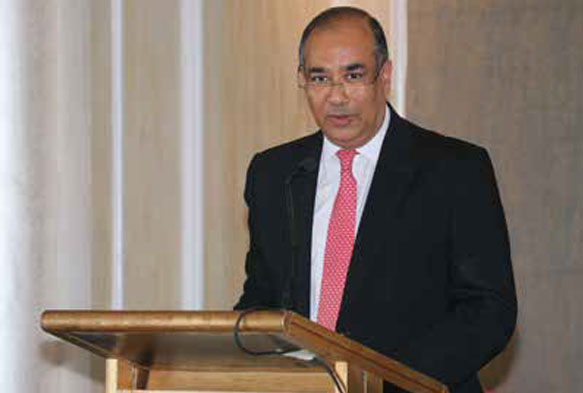
Sunil Mathur, Managing Director & Chief Executive Officer, Siemens LTD., Unveils Transformative Impact Of Technology In A Dynamic World
In a thought-provoking talk delivered to the Rotary Club of Bombay, Sunil Mathur, a renowned expert in technology and global trends, delved into the profound influence of technology in our rapidly changing world.
Addressing a diverse audience, Mr. Mathur highlighted the current state of global volatility, encompassing challenges between economic powerhouses like the United States and China, ongoing trade wars, geopolitical conflicts such as the war in Ukraine and Russia, and conflicting interests in the Middle East.
Whilst Africa remains untapped as of now, Mr. Mathur emphasised its immense potential as a continent of the future, along with the noteworthy emergence of East Asian countries with their lofty ambitions. However, it was India that took centre stage in Mr. Mathur’s discourse. He underscored India’s increasing importance on the global stage, not solely as an alternative to China or a manufacturing hub, but as the largest democracy in the world, surpassing China in population, and maintaining a remarkable growth rate of 7 to 8% even amidst a global recession.
Despite the positive aspects, Mr. Mathur acknowledged the numerous political and geopolitical challenges faced by the world. He shed light on a multitude of global trends that are reshaping societies and economies. The implementation of increased regulations, the critical need for sustainability, and the urgent concerns surrounding climate change were among the key themes discussed.
Amidst these prevailing trends, Mr. Mathur highlighted a silent revolution taking place, often overlooked by many. He identified five mega trends that dominate our lives and have a significant impact on our daily existence: urbanisation, globalisation or glocalisation, demographic changes, climate change, and digitalisation.
Urbanisation, as Mr. Mathur described it, is a remarkable phenomenon that has witnessed significant growth over the years. From a mere 10% in 1910, the global urban population has now reached 55% and is projected to rise to a staggering 75%. This shift presents a host of challenges related to mobility, water supply, electricity, food
distribution, and overall infrastructure, as people from smaller towns and villages migrate to cities in search of
work and better opportunities.
Globalisation, once celebrated for its ability to facilitate easy access to global markets and seamless crossborder
interactions, has undergone a transformation. Mr. Mathur pointed out that countries are becoming more protective, implementing restrictive laws and regulations to safeguard their own interests. This shift necessitates a move towards localised production and distribution, with companies setting up multiple facilities closer to their
customers, thereby leading to farreaching implications.
The significance of demographic changes was not overlooked in Mr. Mathur’s analysis. With the global population currently standing at 8 billion, it is projected to increase to 10 billion by 2050, adding an additional 2 billion people within a span of just 30 years. Such population growth exerts tremendous pressure on cities, job availability, and overall lifestyles. Mr. Mathur emphasised the additional health challenges faced by women, who now outlive men, impacting financial stability and placing strain on healthcare systems worldwide. The future of healthcare financing poses a set of challenges of its own.
Addressing the urgent issue of climate change, Mr. Mathur highlighted the stark reality faced in our daily lives.
Whilst global conferences like COP26 and COP28 address the topic at a macro level, the ground reality is that we experience climate changes regularly. The increasing energy and water requirements, rising by 10% each year, raise concerns about future availability. Mr. Mathur urged immediate action rather than relying solely on future conferences and agreements.
Lastly, Mr. Mathur underscored the revolution brought about by digitalisation in various aspects of our lives. He reminisced about the establishment of the first telegraph line by Siemens 154 years ago, a groundbreaking development that drastically reduced communication time and paved the way for the digital era we currently inhabit. With the rapid advancements in technology, digitalisation has transformed the way we work, conduct business, and manufacture goods. It has even redefined the future of work itself. Mr. Mathur emphasised the crucial role of data usage and management in this new landscape, highlighting its impact on decision-making processes and overall productivity.
Thus, Mr. Mathur provided a comprehensive overview of the impact of technology in our ever-changing world. His insights shed light on the global challenges, emerging trends, and transformative power of technology, urging individuals and societies to adapt and harness its potential for a better future.
